How should you arrange eight gemstones for the eight Vastu directions? Start with the traditional Ashta Dik (eight quarters of space), understand the Ashta Dikpalas (their guardian deities), then choose stones with a clear purpose. The North associated with Kubera does not play the same role as Agneya, the fire-oriented South-East, or Ishanya, the spiritually important North-East. A useful arrangement must make those differences visible.
Eight-direction gemstone sets bring together Vastu Shastra, sacred directional symbolism and contemporary gemstone practice. They can be used in a home, shop, office or professional Vastu consultation as a clearly laid-out arrangement. The key is not collecting eight random coloured stones; it is knowing which direction each position represents, why a particular stone has been selected, and how that choice relates to the space. This guide gives you a complete working layout, an eight-direction reference table, stone-by-stone explanations and practical cases.
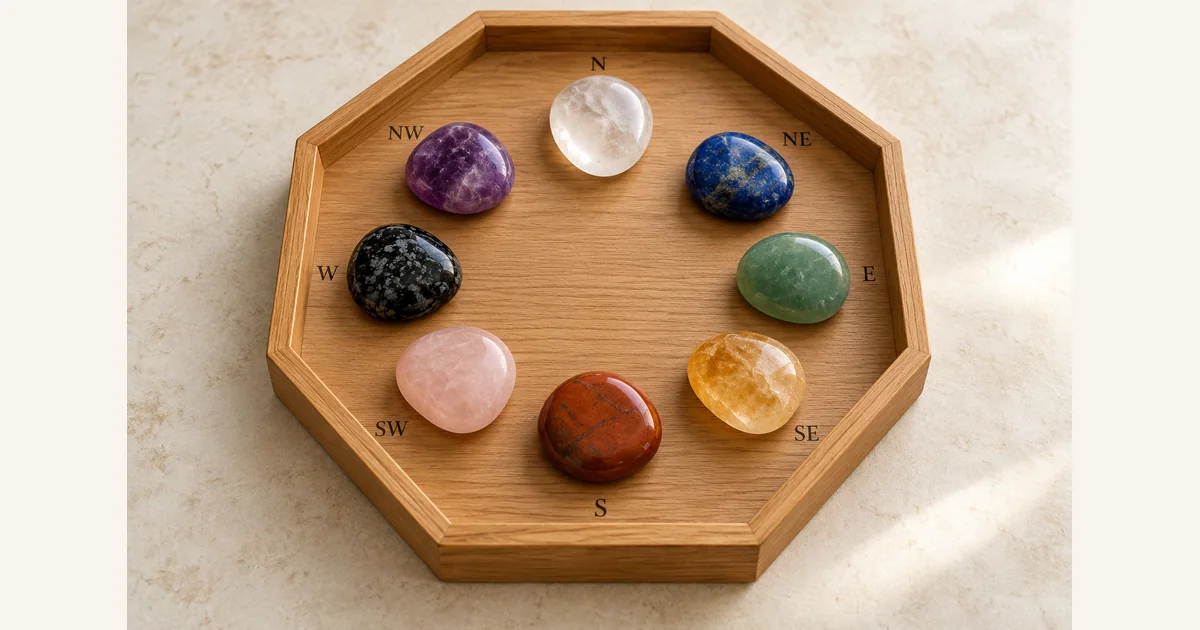
1. The eight Vastu directions: Ashta Dik and Ashta Dikpalas
Traditional Indian directional thought associates each quarter with a guardian deity. The familiar sequence begins with Indra in the East, proceeds clockwise through Agni, Yama, Nirriti, Varuna, Vayu and Kubera, and reaches Ishana in the North-East. These names are not interchangeable colour labels. They express the character of each quarter in Vastu discussion, temple iconography and ritual practice.
| Direction | Sanskrit / Vastu name | Guardian | Traditional theme | Example stone in a modern teaching set |
|---|---|---|---|---|
| North (N) | Uttara | Kubera | Resources, wealth, opportunity and stewardship | Green aventurine |
| North-East (NE) | Ishanya | Ishana / Shiva | Prayer, insight, purity and spiritual focus | Sphatik / clear quartz |
| East (E) | Purva | Indra | Dawn, initiative, visibility and beginnings | Amethyst, or sunstone in a different set |
| South-East (SE) | Agneya | Agni | Fire, activity, transformation and the kitchen | Carnelian |
| South (S) | Dakshina | Yama | Discipline, boundaries and responsibility | Red jasper |
| South-West (SW) | Nairritya | Nirriti | Grounding, stability, weight and continuity | Smoky quartz |
| West (W) | Paschima | Varuna | Water symbolism, reflection and containment | Rose quartz in this illustrative set |
| North-West (NW) | Vayavya | Vayu | Movement, exchange, travel and relationships | Sodalite |
Read the two traditions together, but do not confuse them: the guardian-deity assignments are part of established Indian directional symbolism; the gemstone column is an example of a contemporary Vastu-inspired arrangement. Different teachers may choose a different crystal for the same quarter. A practitioner should explain the choice, rather than treat one commercial set as the only allowable sequence.
2. How to read an eight-direction board correctly
When North is at the top of a map, East is on the right. This simple rule prevents a surprisingly common mistake: turning an octagonal tray around and forgetting that its gemstone positions have shifted. Place a compass rose or printed North arrow beside the stones and keep the label facing the same way while discussing the arrangement.
| North-West (NW) | North (N) | North-East (NE) |
|---|---|---|
| Vayu Sodalite | Kubera Green aventurine | Ishana Clear quartz |
| West (W) Varuna Rose quartz | Centre Brahmasthan Keep the orientation marker visible | East (E) Indra Amethyst |
| South-West (SW) Nirriti Smoky quartz | South (S) Yama Red jasper | South-East (SE) Agni Carnelian |
The centre is not a ninth compass direction. In Vastu design, Brahmasthan refers to the central zone of a plan. In a portable eight-stone board, leave the middle open or put a removable label there rather than silently adding another stone and calling the result an eight-direction set. A Navagraha arrangement and a Pancha Mahabhuta arrangement have different organizing ideas and should be labelled accordingly.
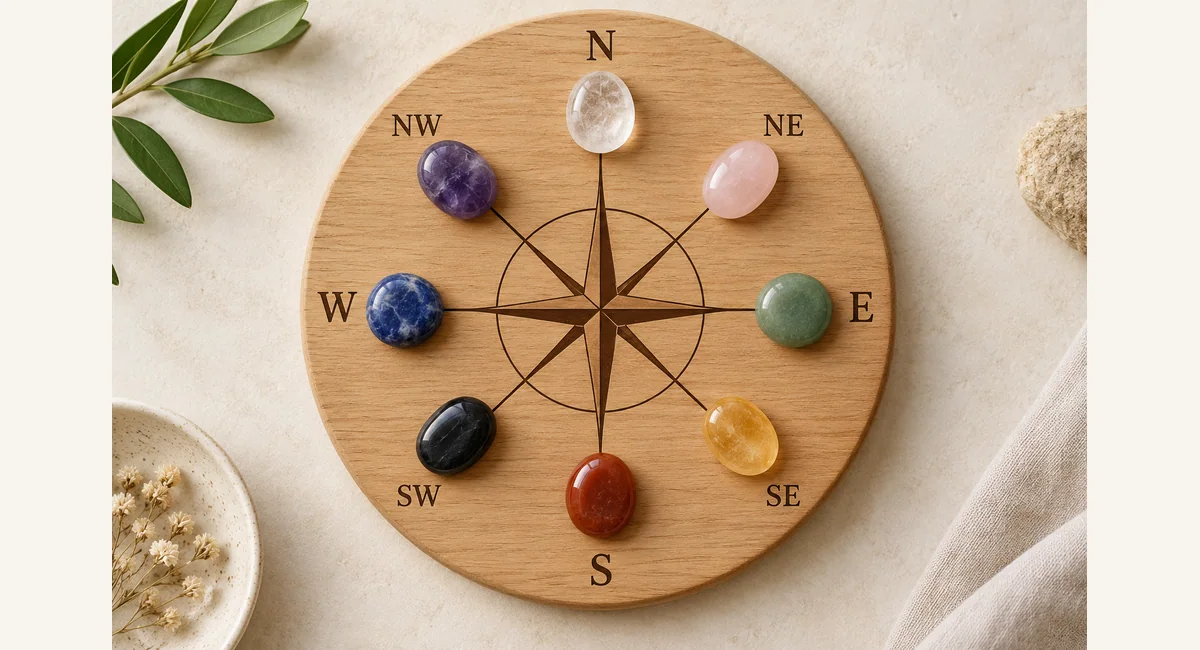
3. Gemstone meanings for each direction: a practical selection guide
North — Kubera, prosperity and financial intention
North, the quarter of Kubera, is commonly considered when a household or business wants to strengthen its prosperity-oriented practice. A green aventurine tumbled stone suits a contemporary abundance-themed set because green is widely associated with growth, renewal and opportunity. Place the stone at the North position of the arrangement and identify it as green aventurine, not emerald. A practitioner using actual emerald for a separate astrological purpose should explain that this is a different selection method.
For a shop owner, the North position can represent responsible handling of resources, sales opportunities and financial planning. It is not automatically the correct place for a cash box in every floor plan: distinguish the map of a property from the directional arrangement placed on a desk.
North-East — Ishanya, Sphatik and spiritual clarity
The North-East is closely connected with Ishana and with puja, reflection and a calm, unobstructed spiritual zone in many Vastu traditions. Sphatik (clear quartz) is frequently chosen in present-day spiritual practice for purity, clarity and meditation. In a gemstone set, position it in the North-East and explain its relationship to a prayerful intention. An amethyst or white stone may be used by another school, but the reason should be recorded.
In an apartment with a North-East prayer shelf, a small Sphatik stone can accompany a puja arrangement without competing with the primary worship items. The eight-direction board itself need not be placed inside the puja room: the board teaches the correspondences, while an individual stone may be placed separately.
East — Indra, beginnings and fresh initiative
East relates to sunrise, Indra and the beginning of activity. One contemporary teaching layout uses amethyst as a focus or clarity stone for the East, particularly for a study, planning desk or fresh project. Another might choose sunstone or a yellow stone to emphasize solar symbolism. Explain the selection instead of pretending every Vastu tradition has one fixed East gemstone.
For a student preparing for examinations, an East-themed placement can serve as part of a regular morning study practice. In an office, the same direction can symbolize clear planning and new initiatives. The educational value lies in tying the selection to a particular intention and spatial orientation.
South-East — Agneya, Agni and active transformation
Agneya is associated with Agni, and South-East is a familiar fire-oriented quarter in Vastu discussions of cooking and activity. Carnelian, with its warm orange-red appearance, is often used in contemporary crystal practice for motivation, vitality and action. It makes an intuitive teaching example for an Agneya-labelled arrangement.
In a home, the South-East example can be discussed alongside the kitchen's existing layout. In an office, it may stand for energy and execution rather than the literal placement of a cooking appliance. Do not put loose stones near a flame, gas burner or electrical hazard simply to achieve a perfect compass location.
South — Dakshina, Yama and discipline
South is traditionally assigned to Yama and is associated with order, duty, limits and the passage of time. Red jasper offers a grounded, earthy visual language for steady effort and discipline in a modern gemstone collection. Unlike a claim that a particular stone automatically corrects a South-facing entrance, this pairing can be explained as a symbolic application of the direction's traditional qualities.
A professional might use the South position to discuss perseverance, routine and the importance of maintaining clear boundaries in a work environment. It is a useful teaching aid when compared with the different emphasis of the South-West.
South-West — Nairritya, stability and grounding
South-West, also called Nairritya, is important for stability, weight, settled relationships and continuity in common Vastu practice. Smoky quartz, or a brown earthy stone chosen with similar symbolic intention, is a fitting modern reference sample. A small stone is not a substitute for the building's basic spatial arrangement, but it can express the theme clearly in a professional display.
For a home, discuss the importance often attached to the master bedroom or heavy storage in the South-West. For a business, discuss an established management area or files intended to be kept secure. Show the relationship between the quarter's meaning and the proposed placement rather than simply repeating that South-West is 'good' or 'bad'.
West — Paschima, Varuna and reflection
West is assigned to Varuna, whose symbolism includes water, cosmic order and containment. In the original eight-stone teaching sequence, rose quartz was selected for the West to represent harmony and personal relationships. This is a contemporary crystal association, not a prescribed Varuna gemstone. An alternative practitioner may select a blue stone such as sodalite or lapis lazuli to emphasize water and depth.
When explaining the set to customers, name the actual stone and the reason for choosing it. That is more useful than describing every pink or blue stone as interchangeable. In a home setting, the West sample can support a conversation about restful, harmonious shared space.
North-West — Vayavya, Vayu and movement
North-West is Vayavya, the quarter of Vayu, and is regularly associated with movement, travel, communication, guests and exchange. Sodalite can represent clear expression in a modern demonstration kit. Other contemporary sets use moonstone or lighter-coloured stones when the emphasis is on flexibility and changing circumstances.
For an office team that communicates with many customers, North-West becomes an intuitive discussion point about movement of information. For a residence, the same symbolic lesson may concern guests, transitions and daily routines. The stone's meaning should be linked to the purpose of the arrangement, not simply to its colour.
4. Which stones belong in an eight-direction Vastu gemstone set?
There is no reason to hide the difference between a purpose-selected Vastu set, a Navaratna or Navagraha set, and a chakra kit. All three may use gemstones, but they answer different questions.
| Type of set | Organising principle | Typical contents | Best use |
|---|---|---|---|
| Eight Directions / Ashta Dik | Eight spatial quarters and their meanings | Eight identified stones and compass layout | Vastu placement explanation, home or office walkthrough |
| Navagraha / Navaratna | Nine astrological grahas and gemstone associations | Traditional nine gemstones or clearly identified educational alternatives | Jyotish and planetary-gemstone learning |
| Five Elements / Panchamahabhuta | Prithvi, Jala, Agni, Vayu, Akasha | Five meaningfully selected stones | Teaching elemental correspondences |
| Seven Chakras | Seven energy-centre associations in modern crystal practice | Seven selected stones arranged along a vertical system | Chakra education and meditation practice |
A professional can own all four kits, but should never mix up their legends. Eight-direction stones are placed by spatial quarter; Navaratna gemstones follow a graha scheme; chakra sets follow a different sequence. For gemstone identity, list the name of each specimen in the actual box. Green aventurine is not emerald, and sodalite is not lapis lazuli, even when their colour roles look similar.
5. Choosing the position in a real home, office or shop
The correct first step is to identify North in the real space. Stand away from strong metal objects and electrical equipment when using a magnetic compass, cross-check the result, and draw a simple floor plan. Mark North, South, East and West, then their four intermediate quarters. If a professional uses a more detailed sixteen-zone method, keep that analysis separate from this eight-direction overview.
- Map the space: outline the home, office or shop and mark doors, major rooms and the approximate centre.
- Identify the eight zones: North, North-East, East, South-East, South, South-West, West and North-West; do not decide them from the direction someone is facing while standing at the entrance.
- Choose the purpose: write down whether the arrangement concerns prosperity, worship, stability, concentration, communication or a balanced overview.
- Select and name each stone: use the eight-stone reference table as one coherent arrangement, or record your teacher's alternative selection.
- Orient the board: align the North mark of the display to the chosen compass reference. When demonstrating on a table, tell participants whether the board is aligned to the building or oriented just for reading.
- Decide between one board and individual stones: a professional portable set keeps all eight together, while an individual zone-focused placement may use only the relevant stone.
- Document the final choice: take a photograph, write the gemstone names, and record any teaching tradition or intention used for the placement.
A true-to-life directional diagram is much more useful than saying 'place in a positive corner'. The space itself still matters: keep passageways open and place objects where they can be looked after.
6. Worked example: eight-direction layout for a family apartment
Imagine a compact Bengaluru apartment with its living room in the North-East/East portion of the plan, a kitchen toward the South-East, and the main bedroom nearer the South-West. The resident wants to make a small Vastu study arrangement, not renovate the apartment. After checking the compass, the resident places an eight-direction stone board on a stable living-room shelf, with the board's North label oriented correctly.
The North green aventurine marks prosperity-oriented intentions; North-East Sphatik recalls prayer and clarity; South-East carnelian explains the Agni zone; and South-West smoky quartz illustrates stability. Instead of moving every object in the house, the board lets the resident understand why those quarters are discussed differently. If a separate Sphatik stone is selected for a puja shelf, it is documented as an individual placement rather than silently removing it from the eight-piece set.
7. Worked example: jewellery showroom and business premises
A jewellery showroom owner wants to organise a consultation counter and explain Vastu gemstone sets to visitors. The consultant draws a simple compass plan of the premises, notes the entrance and sales counter, and uses an eight-section tray as a teaching model. North becomes a discussion of Kubera and financial stewardship; East of visibility and new beginnings; South-East of the active operations area; South-West of business stability; and North-West of customer movement and communication.
Next to the eight-section tray, the store keeps individual specimen cards. The owner can compare the Eight Directions Gemstone Display Set with the Professional Eight Directions Stone Layout Kit. A compact set may suit a home study shelf, whereas a professional kit may include labelled compartments, a compass board and replacement specimen records. This is a concrete difference in use, not just a difference in box size.
8. Worked example: a professional Vastu consultation kit
A practitioner visiting several offices carries eight individually labelled tumbled stones and a foldable directional map. At the first site the North-facing wall is clearly identified; at the second, the layout is irregular and the usable zones need more careful mapping. The practitioner keeps the same stone legend in both demonstrations so the lesson remains consistent, while adapting the discussion to the actual rooms.
For each visit, record: site, compass orientation, eight-zone sketch, selected stones, intended purpose, proposed placement and photograph. The stone board becomes a useful reference object that can be reused for teaching. This is why the arrangement should be understood as a practical kit, not as eight anonymous pebbles put into a bowl.
9. Care, cleansing and maintenance of the gemstone arrangement
Traditional spiritual users may begin a new set with a quiet cleansing, a short prayer, mantra or sankalpa (statement of intention). Some use incense or a simple dry wipe before placement. Practices differ; select one that suits your tradition and the actual gemstone material. Do not soak a mixed collection indiscriminately, because some stones, coatings or adhesives need dry care. Keep each stone labelled if the set is moved or packed away.
For office or retail use, check the tray periodically: are the directions still visible, have two similar stones been swapped, and is the display clear of spills or heat? For a professional visit, a fresh photograph of the assembled board makes the next consultation more consistent.
10. Common questions about eight-direction gemstone Vastu
Can I use the same eight gemstones for every home?
A standard eight-stone arrangement is useful for learning the eight quarters. For an individual home or professional consultation, the purpose, space and tradition may lead to a different choice or a smaller zone-focused selection. Keep the board's legend explicit.
Should the stones be placed at eight separate corners of a room?
Not necessarily. A tabletop eight-direction display is one arrangement. Placing individual stones in corresponding building zones is another. A physical room also may not have eight usable corners; map the actual directions rather than forcing the stones into literal corners.
Which stone is best for the North-East?
Sphatik (clear quartz) is a popular contemporary choice for the spiritual clarity associated with Ishanya. Some traditions select amethyst or other white stones. The right explanation includes the stone's identity and the purpose of the placement.
Can gemstone colour alone determine the Vastu direction?
Colour is one selection tool, not the whole tradition. Guardian deity, element symbolism, intended use and local method all influence a choice. Two blue stones may represent different minerals and be selected for different reasons.
Is an eight-direction set the same as a Navagraha set?
No. An Ashta Dik arrangement is organised by eight directions; Navagraha and Navaratna follow nine planetary correspondences. A separate article on Five Elements and Gemstones discusses another arrangement that should also be kept distinct.
How do I know if my directional board is facing the right way?
Check the North arrow against your compass plan. With North at the top, East must appear on the right, West on the left and South at the bottom. If the board is rotated for a photograph or demonstration, label the new orientation.
Can I choose a professional set instead of buying individual stones?
Yes. A professional eight-direction kit is convenient when teaching or visiting multiple locations because the stones, labels and map can travel together. Individual stones are more flexible for a single chosen placement.
11. Explore related Vastu stone guides
For a broader starting point, read Tumbled Stones for Vastu: Traditional Uses and Practical Display. To see how a portable layout can be built, use Designing an Eight Directions Gemstone Demonstration Kit. For the differences between bowls, trays and a mapped board, see Gemstone Bowls, Shells and Trays: How to Build a Display. Explore the wider Vastu and gemstone collections for complementary materials and purposes.