Should you place tumbled gemstones in a bowl, a natural shell or a wooden tray? The answer changes with your purpose. A low gemstone bowl can become a compact arrangement for peace and harmony; a shell brings oceanic and Jala Tattva symbolism into a contemporary display; a compartmented tray gives a Vastu practitioner a practical way to arrange stones by direction, element or planet. Each form tells a different story. Choosing thoughtfully begins with the meaning of the stones and the place where you intend to use them.
Consider three everyday situations. A family wants a quiet arrangement beside its meditation seat. A retailer wants a small prosperity-oriented collection near a reception desk. A Vastu consultant needs sixteen identifiable gemstones that can be compared in a single session. A bowl, shell and tray may all contain stones, but they should not be designed or selected in the same way. This guide explains the traditional associations, stone combinations, directional considerations and hands-on assembly methods for each.
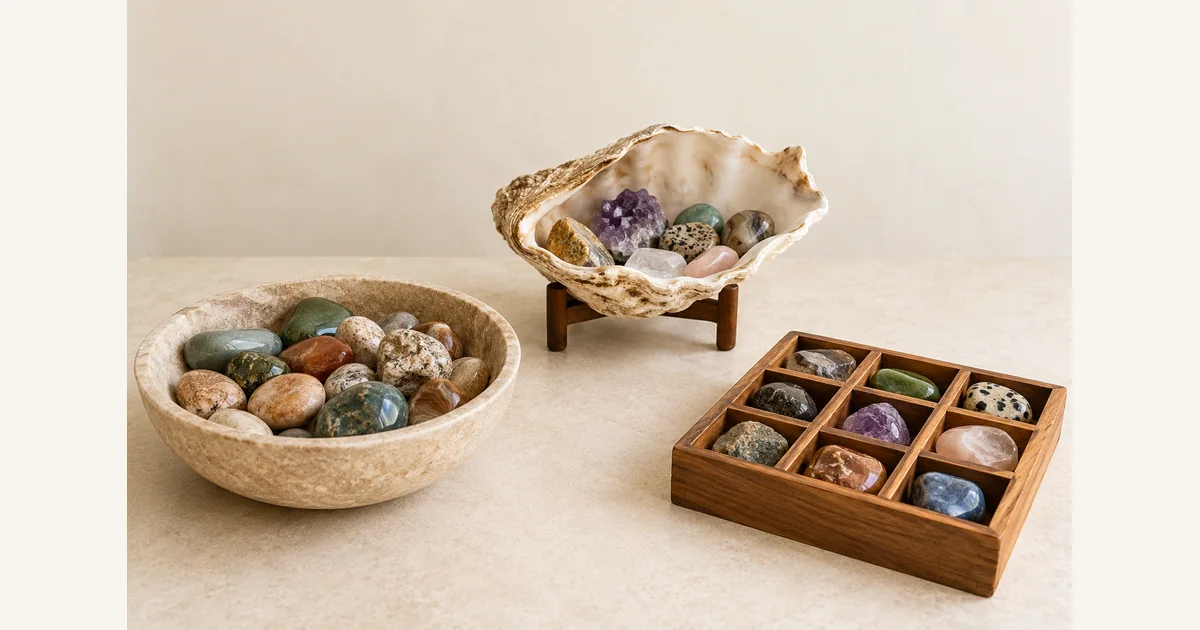
1. Bowl, shell or tray: which is meaningful for which purpose?
In a traditional Indian household, the meaning of an object often depends on its material, location and use: a puja patra holds offerings, a shankha has a specific place in ritual worship, and a dedicated tray can help keep sacred articles arranged with care. Contemporary gemstone collections draw on those ideas but also introduce modern crystal combinations. It is useful to understand the distinction instead of assuming that every gemstone bowl is an ancient prescribed Vastu remedy.
| Container | Principal role | Suitable stones or practices | Best practical use |
|---|---|---|---|
| Open bowl | A gathered centre; abundance, harmony or reflective intention | Citrine, green aventurine, rose quartz, sphatik, amethyst | Home altar shelf, reception area, quiet corner |
| Decorative sea shell | Ocean, movement and Jala (water-element) symbolism | Blue and white-toned stones; moonstone, aquamarine, clear quartz | Coastal-themed setting, selected Vastu-inspired arrangement |
| Wooden tray | Grounding, organisation, directional education | Eight-direction, seven-chakra, five-element or Navagraha study sets | Vastu practitioner, showroom teaching display, office |
| Metal bowl | Warmth and ritual styling, depending on the practice | Small dry gemstone groups or a designated offering arrangement | Stable puja furniture, covered reception cabinet |
| Compartmented tray | Clearly separated specimens and reproducible positions | Identification, comparative Jyotish or directional sets | Consultations, professional reference kit, training |
These descriptions are a selection framework, not fixed rules for every Vastu lineage. The purpose is to make the arrangement intelligible: why a stone is there, what it represents, and how the container supports its use.
2. Gemstone bowls: choose a clear purpose before choosing stones
A gemstone bowl works especially well when the intended emphasis is one coherent intention rather than a catalogue of unrelated crystals. Too many mixed stones can confuse the arrangement. Start with three to seven stones, or with a single mineral group, and use colour, symbolic association and room function to decide the composition.
Prosperity and business intentions
For contemporary crystal-based Vastu practice, citrine is widely selected for abundance-oriented intentions, green aventurine for opportunity and growth, and tiger eye for confidence and purposeful action. A small grouping might consist of three citrine tumbles, two green aventurine pieces and one tiger eye. The emphasis is not the number alone: each colour has a distinct role. Place the arrangement on a stable office shelf or near a reception space without blocking business activity.
Some modern practitioners favour the north for prosperity symbolism because of its association with Kubera; others prefer an existing business altar or a selected zone based on the complete floor plan. Do not treat the corner of a room and the north sector of the entire premises as automatically identical. The actual orientation must be determined first.
Family harmony and a calming domestic setting
Rose quartz has become a familiar symbol of affection and gentle relationships in contemporary crystal practice. Pairing it with amethyst for contemplation and clear quartz (sphatik) for clarity creates a simple, coherent bowl. An example is three rose quartz tumbles, two amethyst tumbles and one clear quartz. This can sit beside a family prayer shelf or in a quiet room where it is not in the way of ordinary household use.
Sphatik has a particular place in Indian devotional life through crystal malas, ritual objects and images of deities. A loose sphatik bowl is a modern presentation of the material, not necessarily the same thing as a traditionally consecrated sphatik object. That difference is useful for customers choosing between a ritual item and a contemporary gemstone arrangement.
Study, concentration and reflective practice
A compact arrangement of clear quartz, amethyst and fluorite may be chosen as a visual anchor for study or meditation. Keep it to one side of the desk, beyond the working papers. In the actual study space, lighting, noise and sufficient working room still matter. The crystal group is a symbolic and contemplative feature of that setting.
How to build the bowl in six steps
- Define the theme: prosperity, prayer, harmony or a seasonal festival.
- Select the vessel: choose a dry, flat-bottomed bowl; ceramic, polished stone, wood and metal have different weights and care needs.
- Choose the composition: use one anchor material and one or two supporting minerals.
- Arrange intentionally: place the anchor at the centre and the supporting stones around it rather than forming an unrecorded pile.
- Write a small legend: record stone names, counts and the traditional association that informed the choice.
- Observe the space: check whether the bowl sits securely, receives harsh sunlight or interferes with household activities.
Worked bowl example: for a small office reception, use one ceramic bowl containing 3 citrine, 2 green aventurine, 1 tiger eye and 1 clear quartz tumble: seven stones in total. Citrine carries the prosperity theme; aventurine represents growth; tiger eye contributes resolve; quartz supplies a visual centre. Photograph the original layout and retain a seven-item stock card so the grouping can be recreated after cleaning.
3. Shell arrangements: Jala Tattva, ocean symbolism and the place of Shankha
Natural shells suggest the sea, tides and movement. In a contemporary Vastu-inspired arrangement, they can be associated with Jala Tattva, the water element, and with qualities such as fluidity, reflection and emotional ease. This makes a shell a different choice from a wooden tray, which visually suggests steadiness and structure. A shell arrangement is particularly suited to customers who deliberately want marine symbolism; it is not simply a bowl in an unusual shape.
Indian religious practice also has a longstanding, specific tradition around the Shankha (conch), linked with Bhagavan Vishnu, auspicious sound and ritual worship. A decorative open shell holding gemstone tumbles is not automatically equivalent to a ritual Shankha. A conch used for puja or Shankhanada should be selected and treated for that purpose. A shallow decorative shell used as a crystal holder is a separate product choice. This keeps the significance of the traditional conch intact.
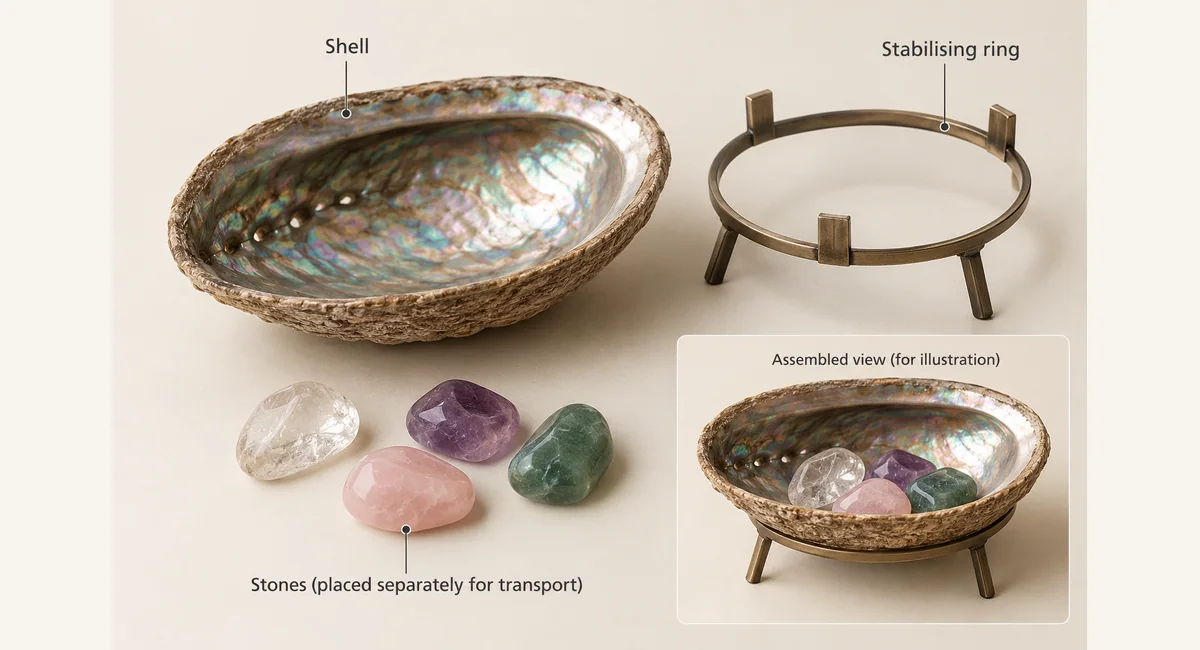
Building an ocean-inspired gemstone shell
A coherent composition might use two aquamarine-coloured stones for the water theme, two moonstones for lunar and reflective symbolism, two sodalite tumbles for blue depth, and two clear quartz tumbles to add brightness. That is eight stones, two of each material. The choice is a modern symbolic arrangement; it should not be presented as a universal classical eight-stone prescription.
Place the shell on a stable ring or cradle if its underside is curved. Use a thin removable fabric pad where the shell surface is fragile. Arrange the stones from the deeper blue shades on one side through pale blues to clear quartz on the other, creating a readable flow rather than a heap. The accompanying card can state: “Jala-inspired gemstone arrangement: aquamarine, moonstone, sodalite and sphatik; two pieces each.”
For a Vastu-oriented home, some practitioners consider water-associated objects in the north or northeast, but the correct placement of a shell should also reflect the room's actual use and the household's tradition. An uncovered shell full of rolling stones is unsuitable on a narrow entrance ledge, even if the direction seems symbolically suitable.
Choosing a shell responsibly
Ask whether it is a natural shell, a carved shell, a resin imitation or a shell-shaped ceramic container. Species, provenance and legal sourcing matter, especially for unusual large marine shells. Avoid assuming that a marine shell is interchangeable with a ritual conch. Check for cracks, sharp edges, unstable rims and any coating that could transfer to the stones. If the shell is included with a product, the product description should say so; otherwise the photographed shell is styling only.
4. Wooden and compartmented trays: a Vastu layout that can be taught and repeated
A wooden tray is a strong choice when the stones must be examined individually or their positions matter. It suits professional kits because each specimen has a fixed place and a clear label. It also lends itself to an Ashta Dik arrangement: the eight directions and their traditional guardians, the Ashta Dikpalas. The direction framework is traditional; the particular gemstone combinations below are a practical, modern teaching arrangement that can be adapted to the practitioner's school.
Example: a 16-stone, eight-direction tray
Use eight paired positions around a small central compass card, with two stones per direction. A square tray is easier for showing cardinal and intercardinal positions than a long rectangular tray. Put north at the top of the orientation card and rotate the complete tray to correspond with the room's measured north when using it as a directional teaching tool.
| Direction | Traditional guardian | Two-stone example | Purpose of comparison |
|---|---|---|---|
| North (Uttara) | Kubera | Green aventurine + citrine | Growth, opportunity, prosperity intentions |
| Northeast (Ishanya) | Ishana | Sphatik + amethyst | Prayer, clarity, contemplation |
| East (Purva) | Indra | Sunstone + carnelian | Beginnings, vitality, confidence |
| Southeast (Agneya) | Agni | Red jasper + garnet | Agni and active, fiery symbolism |
| South (Dakshina) | Yama | Hematite + black tourmaline | Discipline and grounding imagery |
| Southwest (Nairitya) | Nirriti | Tiger eye + smoky quartz | Stability and steadiness |
| West (Pashchima) | Varuna | Blue lace agate + sodalite | Water-related, reflective symbolism |
| Northwest (Vayavya) | Vayu | Howlite + moonstone | Movement, adjustment and balance |
The entire layout contains 16 individual stones and eight labelled pairs. In practice, a client may not possess all sixteen minerals, so use locally available and correctly identified specimens. The chart is a discussion aid, not a demand to place two stones permanently in every corner of a house.
Compass method: first identify the centre of the floor plan; establish a reliable north bearing using a calibrated compass away from large metal objects; then mark N, NE, E, SE, S, SW, W and NW. A professional can explain how the north of the site, the entrance-facing direction and the position of an individual table differ. The stone tray may remain on the consultation table while its position cards are compared with the actual plan. There is no need to scatter every demonstration specimen around a client's rooms.
Using one tray for a Pancha Mahabhuta study
The same kind of tray can be relabelled for the five elements—Prithvi (earth), Jala (water), Agni (fire), Vayu (air) and Akasha (space). One teaching collection might compare red jasper or tiger eye for the earth theme; aquamarine or moonstone for water; carnelian or sunstone for fire; clear quartz or light-toned stones for air; and amethyst or sphatik for contemplation and space. These gemstone selections are contemporary interpretations used for teaching. The elemental framework itself has a deeper history in Indian philosophical and Vastu traditions.
Keep a second label card for a Navagraha lesson rather than relabelling the same coloured tumbled stones as exact traditional planetary gems. A Navaratna arrangement has its own gemstone conventions—ruby, pearl, coral, emerald, yellow sapphire, diamond, blue sapphire, hessonite and cat's eye are the familiar reference group. An educational set using substitutes should plainly say which minerals are included. A chakra set follows another system and likewise needs its own legend.
5. Room-by-room placement: three complete examples
Example A: a family prayer corner
A family has a modest puja shelf in the northeast area of an apartment. Their intention is a simple contemplative space, not a large ornamental installation. Choose a shallow bowl containing three sphatik tumbles and two amethyst tumbles. Place it beside, not on top of, the main deity image or the designated offering vessels. Keep oil lamps and flames sufficiently separate. The white and violet grouping visually supports the theme of prayer and quiet reflection.
If the household uses a ritual conch, keep it on its own appropriate stand rather than using it to hold loose gems. The difference respects the distinct purpose of the Shankha and makes cleaning the puja shelf easier.
Example B: a shop reception and purchase counter
A small Bengaluru showroom wants an arrangement relevant to welcoming customers and discussing prosperity-related gemstones. Choose a low wooden or stone bowl with seven pieces: three citrine, two green aventurine, one tiger eye and one clear quartz. Put it on a side shelf near reception, not in the payment or packing area where bags and bills can knock stones over. The staff can use a short legend to explain the traditional and contemporary associations to customers.
If the shop also sells Tumbled Stones in Decorative Shell or Tumbled Stones in Wooden Display Tray, showing their differences side by side is a practical buying aid: shells express one theme, while a tray makes its contents visibly countable. These are existing product links also repeated in the original product list below.
Example C: a Vastu practitioner's portable demonstration kit
A consultant visits several offices in a day and needs to show different ways of matching gemstones with directions. Use a square, compartmented tray with the 16-stone eight-direction plan above. Print one removable north arrow and a legend containing each stone name, direction and symbolic reason for its selection. The client can see the pairs without being asked to remember a long list of names. After consultation, return each piece to its numbered slot and store the tray flat.
This tray is a useful companion to the Eight Directions Gemstone Display Set and Five Elements Gemstone Set. Unlike a home bowl, the primary requirement is repeatable identification. A practitioner can demonstrate a different traditional method by changing the card rather than silently changing the stones.
6. How to choose the right gemstones for your container
| Gemstone | Common symbolic association | Suitable arrangement | Considerations |
|---|---|---|---|
| Sphatik / clear quartz | Clarity, purity, spiritual focus | Prayer bowl, centre of arrangement, tray | Separate from softer polished materials |
| Amethyst | Reflection, calm, meditation | Contemplative bowl, chakra reference | Avoid prolonged harsh sunlight |
| Rose quartz | Affection, gentle relationships | Family harmony bowl | Keep off crowded worktops |
| Citrine | Abundance, enterprise, prosperity | Business and reception arrangement | Identify natural vs heat-treated material when relevant |
| Green aventurine | Growth, opportunity, renewal | Prosperity bowl, north teaching pair | Colour alone does not establish identity |
| Tiger eye | Resolve, steadiness, confidence | Office bowl, southwest teaching pair | Use correctly identified and polished material |
| Carnelian | Initiative, courage, active energy | Agni-oriented study tray | May be confused with dyed chalcedony |
| Moonstone | Lunar, reflective, gentle symbolism | Shell, water-element comparison | Protect from abrasion by harder quartz |
| Sodalite | Thought, depth, expression | Water-colour shell, professional tray | Different from lapis lazuli |
| Black tourmaline | Protective and grounding symbolism | Dedicated tray or low bowl | Rough specimens can chip against hard stones |
A consumer should choose by correct mineral identification first, then colour, meaning, size, price and placement. Some marketed stones are dyed, coated, reconstructed or sold under trade names. Those distinctions matter even when the collection is intended primarily for spiritual use.
7. Material choice, stability and day-to-day care
A container is part of the experience. Its material, rim height and depth determine whether the arrangement stays readable and can be maintained. A deep bowl is suitable for an informal grouping but hides the smaller stones beneath larger ones. A shallow dish allows the whole grouping to be seen. A natural shell is distinctive but often needs a stand. A wooden tray works well for numbered slots, especially if it has a soft lining.
| Material | Advantage | Selection and care note |
|---|---|---|
| Wood | Warm appearance; easy to divide into slots | Keep dry; use separate liners; avoid humid placements |
| Ceramic | Stable, easily wiped surface | Check for chips; pad contact with softer stones |
| Brass or copper | Ritual-inspired appearance; durable vessel | May tarnish; clean separately from gemstones |
| Natural shell | Distinct oceanic symbolism and texture | Check provenance; use support; avoid rough impacts and acids |
| Stone-carved bowl | Material continuity with gemstones | Confirm mineral, weight and finish; avoid unnecessary immersion |
| Compartment tray | Best for professional inventory and comparative learning | Label every slot; retain a lid or protective wrap for travel |
Never assume that all gemstones tolerate the same treatment. Amethyst may lose some colour under intense, prolonged light; soft or cleavable minerals can scratch or chip in a crowded bowl. Many fragile, porous or treated materials are best wiped with a soft dry cloth. Keep water, perfume, cleaning chemicals, flames and prolonged direct sunshine away unless the exact material's care requirements permit them.
When a bowl is refreshed for a festival or ritual, remove the gemstones before wiping the vessel and dry both completely. If a family performs a traditional cleansing rite, keep the handling appropriate to the actual gemstones and to their devotional practice. There is no reason to soak delicate materials merely to make the grouping feel more ceremonial.
8. A practical selection checklist before buying
- Purpose: Is the display for prayer, prosperity intentions, a gift, a showroom or professional Vastu explanation?
- Container included? Confirm whether the advertised price includes the bowl, shell, tray, support ring or lid.
- Gemstones and counts: Request a material list with the exact number and approximate size of pieces.
- Direction: If this is a Vastu arrangement, identify the actual compass bearing and intended zone of the home or office.
- Traditional meaning: Ask how the chosen gemstones correspond to the purpose; do not choose by colour alone.
- Practical stability: Verify the width, depth, weight, support and available surface.
- Care: Confirm any sensitive stones, dyed materials or fragile shell surfaces.
- Documentation: A label or legend should let the customer reproduce the arrangement and replace a missing piece correctly.
Quick choice: Pick a bowl for a small, unified intention; a decorative shell when ocean and water-element symbolism are central to the design; or a labelled tray when directions, stone identification and repeatable teaching matter most. The best collection is the one whose materials, placement and meaning can be clearly explained.
9. Frequently asked questions
Can gemstone bowls be placed in the northeast of a home?
They can be used in a quiet northeast prayer or meditation zone when the home layout and household tradition support that choice. A small sphatik-and-amethyst bowl is a common contemporary example. The actual direction should be measured rather than guessed from the room's entrance.
Is a conch shell containing gemstones the same as a puja Shankha?
No. A ritual Shankha has established religious meaning and customary handling; a broad decorative shell holding stones is a different object and product format. Identify the shell type and intended purpose before purchasing.
How many stones should a prosperity bowl contain?
There is no single compulsory count for a contemporary gemstone bowl. Seven well-chosen, identified stones may make a more coherent arrangement than an unlabelled large mix. Counts associated with a specific ritual should follow that particular tradition.
Should I put water inside a gemstone bowl?
A dry grouping is generally easier to maintain. Mineral species differ in their response to water and cleaning solutions, and wooden or shell vessels have their own restrictions. Water used in puja should be handled through the relevant ritual vessels, not automatically through a mixed gemstone display.
Can a professional Vastu kit be left permanently on a desk?
Yes, if the tray is stable and the workspace has room, but a demonstration kit benefits from a numbered, covered layout so all pieces can be checked and returned after every session. It is often better to use a separate small bowl for day-to-day decoration.
Continue reading
- Tumbled Stones for Home and Office Display
- How to Pack and Ship Tumbled Stone Sets Safely
- Professional Crystal Kit Packaging, Transport and Replacement
Explore the existing Vastu and gemstone collections for wider context.
Explore the materials and sets
- Professional Home & Office Crystal Display Kit
- Seven Chakra Tumbled Stone Set
- Nine-Planet Gemstone Arrangement Set
- Eight Directions Gemstone Display Set
- Five Elements Gemstone Set
- Home Entrance Gemstone Arrangement Set
- Office Desk Gemstone Display Set
- Tumbled Stones in Decorative Shell
- Tumbled Stones in Wooden Display Tray