Green jade is not one mineral, and a polished green tumbled stone is not necessarily jade. A tray of similar-looking pebbles may contain genuine nephrite, jadeite, serpentine, green aventurine, dyed chalcedony or other materials. All can be attractive; they cannot be described, valued or cared for as though they were identical. For a home Vastu display, the choice may begin with colour and symbolism. For a labelled collection, jewellery counter or professional consultation set, the actual material and any treatments are equally important.
This guide explains what the term jade covers, why popular substitutes are confused with it, how to make a buying decision without damaging the stone, and where green stones fit into contemporary Vastu and gemstone arrangements. It also separates established cultural associations with jade from modern crystal-placement recommendations and from the classical Navaratna system.
1. What qualifies as genuine jade?
Gemologists have long used jade for two different, exceptionally tough gem materials: nephrite and jadeite. Modern laboratory descriptions also recognise certain green omphacite material within the broader jade category under specified circumstances. Those definitions are about mineral composition and structure, not simply colour. A stone that is green, cool, smooth and translucent does not automatically qualify.
Nephrite is a compact rock composed mainly of amphibole minerals in the tremolite–actinolite series. Very fine, interlocking fibres give it remarkable toughness. Jadeite is a pyroxene mineral that generally occurs as a tightly interlocking granular aggregate. Fine jadeite can have brighter colour and greater translucency than much commercial nephrite, but appearance overlaps and fine specimens of both can be beautiful. Omphacite is another pyroxene; its distinction from jadeite may require advanced laboratory examination. In a retail setting, verified nephrite and verified jadeite are much clearer labels than a generic premium-sounding phrase such as “original green jade”.
| Material | What it is | Common appearance | What a careful label should say |
|---|---|---|---|
| Nephrite jade | Fine-grained, interlocking tremolite–actinolite rock | Olive, spinach, grey-green, creamy white to deep dark green; often softly translucent | “Green nephrite jade”; add treatment information if known |
| Jadeite jade | Interlocking jadeite pyroxene aggregate | White, green, lavender and other colours; fine material can be vividly coloured and translucent | “Jadeite jade”; describe colour, treatment and evidence separately |
| Green omphacite | Related pyroxene material recognised as jade in particular gemological circumstances | May overlap jadeite in colour and appearance | Name only when a suitable laboratory identification supports it |
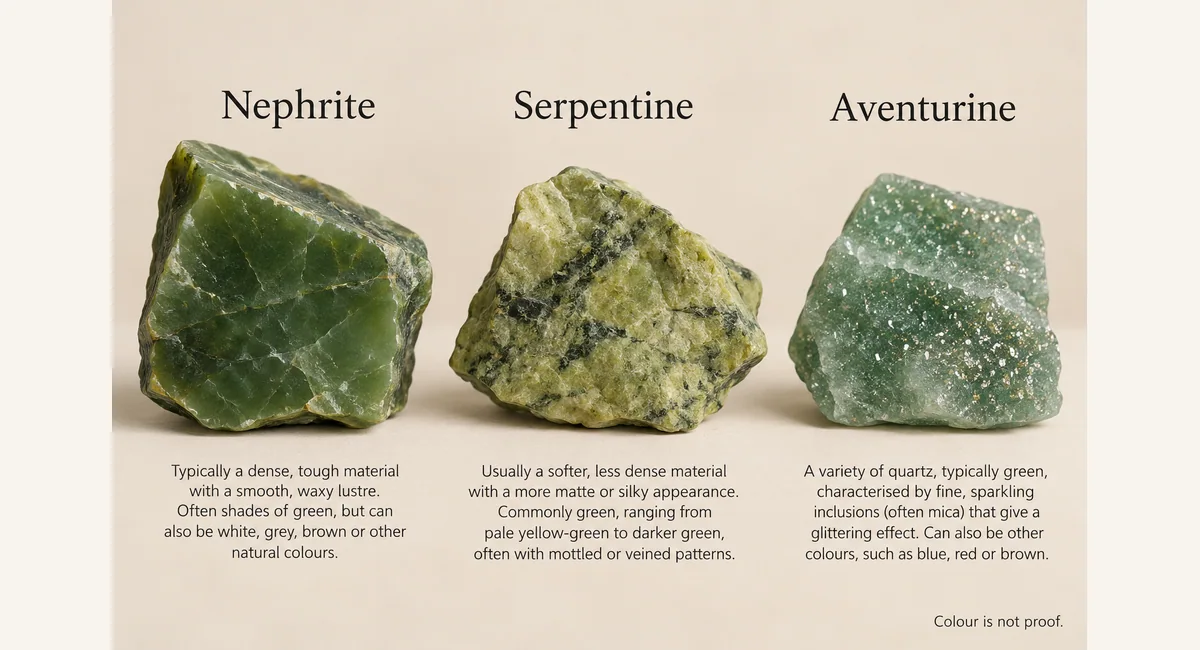
| Serpentine | A family of magnesium silicate minerals and related serpentinite rock | Yellow-green, waxy light green, olive and mottled | “Green serpentine” or “serpentinite,” not simply jade |
| Green aventurine | Quartz containing minute inclusions that may create a subtle sparkle | Pale to deep green, commonly cloudy or glittering in direct light | “Green aventurine quartz” |
Toughness is not the same as hardness. Jade owes its historical appeal for carvings and ornaments partly to its resistance to breakage. Mohs hardness is resistance to scratching, whereas toughness is resistance to fracture. Nephrite is often about 6–6.5 on the Mohs scale and jadeite about 6.5–7; either can still develop scratches from harder materials or chips from sharp impacts. A casual home scratch test tells little about a valuable specimen and may permanently mark its surface.
2. Why so many green stones are sold as “jade”
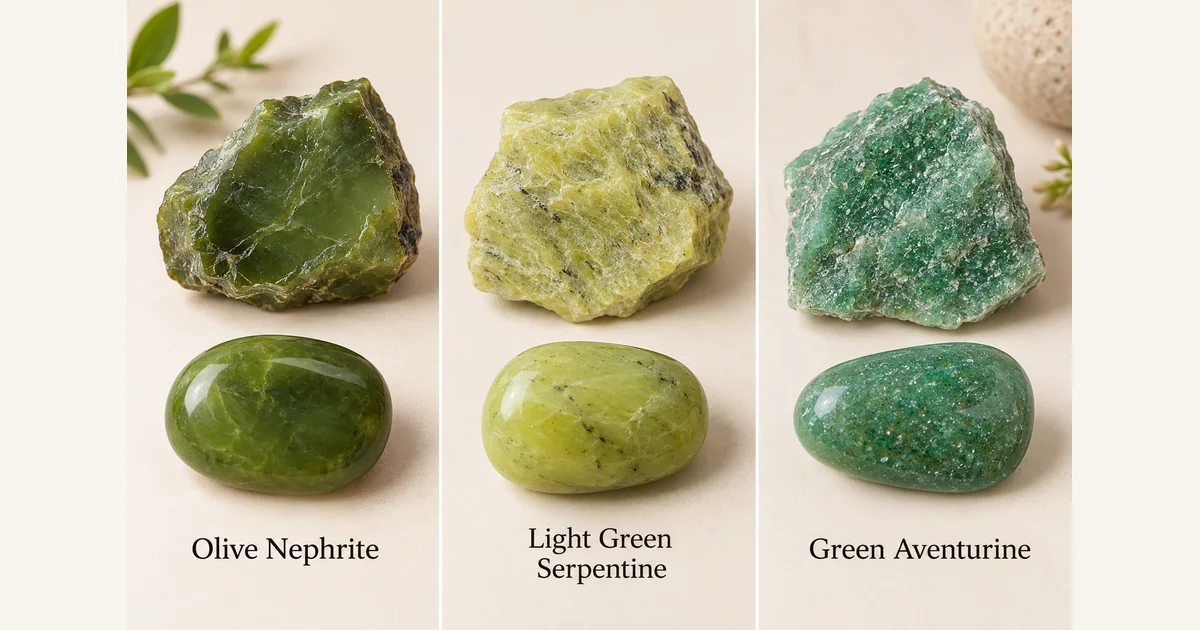
Gemstone trade names often began as comparisons of appearance rather than exact mineral identifications. Terms such as new jade, olive jade, Indian jade, or green jade stone may be used inconsistently across markets. Some sellers use “new jade” for light green serpentine; other labels may refer to green aventurine, dyed quartz or unrelated rocks. An item can be properly made, attractive and affordable while still needing a more precise name.
The distinction is particularly important for tumbled stone sets. Polishing rounds away the natural crystal faces that may otherwise aid recognition. Different minerals can finish with a similar smooth waxy shine; studio lighting can make dull green stones appear vivid. A batch title or a label received from a wholesaler is a starting point for verification, not the same thing as identifying every specimen.
| Lookalike or trade label | Typical reason for confusion | Clue to investigate | How to sell or record it |
|---|---|---|---|
| “New jade” | Frequently used for light green serpentine or related material | Soft-looking polish, pale waxy green and a supplier's mineral description | Use the actual tested material name; treat “new jade” only as an explained trade name |
| Green aventurine | Attractive translucent or cloudy green surface | Possible tiny reflective inclusions; quartz-based composition | Green aventurine, not nephrite or jadeite |
| Serpentine / serpentinite | Waxy finish and green or yellow-green shades resembling some nephrite | Often lower hardness and different microscopic structure; lab testing may be needed | Serpentine or serpentinite as verified |
| Dyed chalcedony / agate | Strong or uniform saturated green from a treatment | Colour concentrations may follow cracks or pores, but not always visibly | Dyed chalcedony or dyed agate when confirmed |
| Green jasper or other decorative rock | Opaque patterned green tumble and similar retail size | Opaque texture and individual mineral constituents | Name the actual rock; do not imply jade pricing |
| Green glass or reconstructed material | Consistent colour, smooth finish or imitation of translucent jade | Possible bubbles or manufacture features, but not always apparent | Disclose glass, composite or manufactured identity accurately |
In practice, the supplier may offer a mixed tray of “green jade” at a price consistent with aventurine or serpentine. The correct response is not automatically to reject the whole tray. Instead, decide which genuine material you want: a verified jade product, an economical green decorative stone, or a comparative teaching set containing each material under its own label.
3. Recognising colour, texture and polish without damaging a stone
For a first inspection, use neutral daylight, a white background and a small magnifier. Look at the surface under more than one angle. Note whether the green colour is even or patchy, whether the polish is glossy or softly waxy, whether inclusions sparkle, and whether cracks, drill holes or pits show concentrated colour. Compare several stones from the same parcel. This helps you record differences but does not by itself establish the mineral.
Nephrite often presents a compact, subtly fibrous-looking or cloudy texture and a distinctive smooth polish. Jadeite can show granular structure and a lustre ranging from vitreous to softly greasy. Aventurine may show fine sparkling inclusions, especially under side lighting. Serpentine can be mottled and waxy. These are suggestions for observation, not guaranteed identification rules: dyed material, fine-grained quartz, glass, unusual natural textures and artificial lighting can imitate one another.
| Question during inspection | Useful observation | What the observation cannot prove |
|---|---|---|
| Does the stone look green in every light? | Compare daylight and neutral artificial light; record actual hue | Green colour does not prove jade or natural colour |
| Is there a bright flash or subtle sparkle? | Check for tiny reflective inclusions characteristic of some aventurine | Lack of sparkle does not prove nephrite |
| Do cracks or pores carry stronger colour? | Look for possible signs that justify a treatment question | Uniform appearance does not rule out dye or impregnation |
| Is it heavy or cool in the hand? | Record dimensions and mass where appropriate | Touch and heft cannot independently separate all green minerals |
| Does a seller supply a material report? | Check matching item description, report number, method and treatment statement | A certificate for another specimen does not identify the entire parcel |
Professional gemological identification may use microscopy, refractive-index observations where applicable, specific-gravity measurement and spectroscopy. Laboratory methods such as Raman spectroscopy can resolve some difficult mineral distinctions. Keep these as specialist methods; do not use a knife, acid, flame, nail file or household solvent on stones intended for a customer. A damaged surface destroys value without reliably answering the more complex questions.
4. Natural jade, treated jade and the A/B/C terminology
Correctly naming a stone and describing its treatment are two separate jobs. A jadeite piece can be genuine jadeite yet dyed or polymer-impregnated. Conversely, an entirely natural piece of serpentine is still not jade. This is why “natural”, “original”, “untreated” and “authentic jadeite” should not be treated as interchangeable sales phrases.
In the jadeite trade, the familiar Type A, Type B and Type C terminology relates principally to treatment rather than beauty or a universal quality grade. Type A normally denotes natural jadeite with no alteration beyond traditional surface waxing; Type B describes acid-bleached, polymer-impregnated material; Type C describes dyed material. Some listings use B+C for material receiving both polymer treatment and dye. Interpret these letters in the specific jadeite context instead of attaching them casually to nephrite, serpentine or aventurine. A valuable claim should be accompanied by appropriate treatment disclosure and, where warranted, testing for that particular item.
| Statement on a jade listing | What it generally communicates | Buyer question |
|---|---|---|
| “Nephrite jade, green” | Identity claim, not necessarily treatment status | How was this lot identified, and are treatments disclosed? |
| “Type A jadeite” | Conventional jadeite treatment designation | Is the specific item supported by an independent report? |
| “Type B jadeite” | Bleached and polymer-impregnated jadeite | Are the enhancements and care implications clearly disclosed? |
| “Type C jadeite” | Dyed jadeite | Is colour treatment reflected in description and price? |
| “New jade, natural” | An imprecise trade label that may refer to serpentine | Which mineral is it, precisely? |
| “Imperial green jade” | A potentially high-value colour/quality claim, not proof of jadeite | Is mineral identity, treatment and quality separately documented? |
When assessing a moderate-price tumble, an accurate invoice and a transparent batch description may be the practical level of documentation. For an expensive jadeite carving, bangle or rare specimen, item-specific laboratory evidence becomes more important. Avoid using one report to make unqualified claims for many visually similar stones if they were not individually examined.
5. Cultural meaning of jade: an established tradition and its limits
Jade has a long and distinguished history in East Asian art, ritual and personal ornaments. In Chinese cultural contexts, jade has been valued for durability, refinement and qualities often discussed through the language of virtue, integrity and harmonious conduct. Carved discs, pendants, ornaments and ceremonial objects therefore belong to a far older history than the modern sale of mixed crystal tumbled-stone kits. The word jade in an English product description should not erase the distinction between nephrite and jadeite or suggest that every green stone carries the same historical status.
Indian gemstone and astrology traditions have their own specific vocabulary. In Navaratna practice, the green gemstone associated with Budha (Mercury) is Marakata or Panna—emerald, a beryl gemstone. It is not automatically nephrite jade, green aventurine or serpentine. Modern green-jade displays may borrow the ideas of learning, growth, harmony or prosperity, but that symbolism does not convert jade into a classical substitute for an astrologically prescribed emerald. Gemstone selection for Jyotisha also depends on the actual birth-chart tradition being followed, rather than choosing exclusively by colour.
These distinctions make the spiritual discussion more useful, not less. A person may choose a green nephrite tumble as an object for calm attention during daily prayer, a green aventurine bowl as a contemporary decorative symbol of renewal, or an emerald for a specific Jyotisha recommendation. Each choice has a different purpose and a different standard of material identification.
6. Green stones in Vastu: direction, intention and proportion
Classical Vastu considers the arrangement of entrances, rooms, light, movement, orientation and the use of space. Small gemstones are a later accessory in many contemporary Vastu practices. They may provide a visible focus, support a personal intention or introduce colour into a room, but a green stone does not replace the underlying function of a well-used space.
Two commonly discussed directional ideas are relevant. The north is associated in many Vastu interpretations with Kubera, the guardian of wealth; green is also associated with Budha in the Navagraha colour system. The east is connected with dawn, sunlight and renewal. Contemporary advisers may place a green stone in a north-side work or accounts area or in an east-side study or plant corner. These are interpretative colour and symbolism choices, not a single unchanging injunction found in every classical Vastu text.
| Space or direction | Possible purpose | Suitable display decision | What matters most |
|---|---|---|---|
| North-side desk or accounts shelf | Modern prosperity or professional-growth symbolism | One verified nephrite or clearly labelled green aventurine tumble on a small tray | Clear workspace and orderly financial records |
| East-facing study or reading shelf | Renewal, attention and an uncluttered learning environment | Small green stone beside a notebook or plant | Lighting, comfortable seating and concentration |
| Prayer or meditation shelf | A personal point of attention or symbolic harmony | A clean single tumble in its own dish, separate from food and flames | Respectful placement and room for the practice itself |
| Jewellery showroom display | Material education and responsible product comparison | Labelled nephrite, serpentine and aventurine specimens side by side | Truthful names, lighting and pricing |
| Vastu consultation kit | Explain colour-based arrangements and material choice | A removable, annotated green-stone reference section | Direction is measured; material identities remain traceable |
Small stones are easy to move as a room changes, which makes them appropriate for demonstration kits. They should not obstruct doors, take over a working desk, sit on unstable shelves or hide clear labels. A few considered objects usually communicate an arrangement better than a crowded bowl of unrelated stones labelled “vastu jade remedy”.
7. Choosing genuine nephrite for an OmmRudraksha-style tumbled collection
For a product intended specifically as green nephrite jade, begin with the supplier's declared mineral identity rather than the green colour on the website. Request the material name on the invoice, the source or batch description where known, treatment information and consistent photographs of the actual stock. Agree whether the supply is a single mineral lot or mixed green stones. A low-priced mixed bundle can serve as a comparison kit but should not be silently relabelled as uniform nephrite.
Examine the sample and the commercial parcel separately. The sample may be more translucent or more evenly green than later batches. Record the parcel's range of size, shape, polish and inclusions. A natural nephrite group can show colour variation; consistent material identity matters more than producing twenty pebbles that appear digitally identical. For a product card, describe observable attributes—olive green, rounded tumble, mottled translucent edges—without inventing a mine origin or guaranteeing a grade.
A useful catalogue line is: “Green Nephrite Jade Tumbled Stone — polished natural rock; colour and pattern vary; material identification and treatment status as stated for this batch.” If treatment status is genuinely unknown, mark it as not established in the internal stock record rather than representing an unknown as a promise of untreated jade. For a higher-value jadeite item, item-specific gemological testing is a different procurement decision and should be priced accordingly.
8. A practical buying checklist for green stones
- Define the purchase: verified nephrite, jadeite, inexpensive green aventurine, serpentine, or a mixed educational set. Do not order only by the word “jade”.
- Request the mineral identity: ask for exact English material names and a sample invoice description; clarify any trade names.
- Ask about enhancements: dyes, impregnation, coatings or other treatments must be handled separately from material identity.
- Compare real stock: inspect photographs in neutral light, sample size distribution, cracks, polish and significant colour variation.
- Record provenance carefully: note supplier, date, lot and any testing or report reference. Do not invent a geographic origin.
- Agree on substitutes in advance: if nephrite is unavailable, the supplier should not send serpentine under the same label.
- Check the finished product: remove sharp chips and residues from the retail presentation; check that the size and number of stones match the listing.
- Prepare the content together: product title, picture captions, packing slip, related blog articles and educational cards should all name the same material.
9. Worked example: an economical green-stone teaching tray
Imagine a Vastu practitioner wants a low-cost set showing how green stones can look alike. Buying ten pieces described simply as “green jade” would defeat the purpose: neither the learner nor the consultant could confidently state what each stone represents. A more effective tray has three separate divisions. The first contains verified green nephrite, the second contains properly labelled green aventurine and the third contains identified serpentine. Each division receives its material name, colour description, treatment statement if known and a note that colour does not prove identity.
The consultant uses the tray to demonstrate two different points: several materials can share a colour suitable for a contemporary green display, while their mineral identities and costs remain different. A north-side accounts placement may use any one of the selected decorative stones as a modern symbol, but a product requested as nephrite must actually be nephrite. After the session, each sample returns to its own compartment so that labels never become mixed.
10. Worked example: choosing a stone for a home prayer and study corner
A family wants one understated green gemstone beside a bookshelf and a small prayer shelf. They are not seeking a chart-specific Navaratna prescription. A small polished nephrite tumble is appropriate if they appreciate jade's wider cultural symbolism and have confirmed what was supplied. If the family wants the same colour at a lower cost, clearly labelled green aventurine is another reasonable decorative option. There is no reason to sell aventurine to them as “nephrite jade” simply to make the ritual feel more impressive.
They place the chosen stone on a shallow, stable ceramic dish in an uncluttered part of the shelf, where it does not compete with the worship objects or interfere with lamps. The family may use the visual reminder to begin a study session with a simple personal intention. Such a use is symbolic and practical; the stone is not described as a substitute for prescribed emerald or as proof of a directional correction.
11. Worked example: a Bengaluru jewellery showroom receiving “new jade”
A showroom receives fifty polished pale-green pebbles from a supplier whose parcel reads “new jade”. The stones are smooth, attractively coloured and suitable for affordable decorative jewellery. Yet the invoice does not state whether they are serpentine, nephrite or another mineral. Before assigning them to the green-nephrite product page, the shop asks for the mineral name and, if needed, tests representative material from the lot.
If the supplier confirms serpentine, the shop creates a separate serpentine product record or a clearly disclosed mixed-green-stone set. The gemstone display can still show a comparison with nephrite and aventurine. This avoids mismatched labels, misleading product images and price confusion. If the supplier cannot provide a reliable identity, a precise mineral label remains unverified and the stock is not sold as genuine nephrite or jadeite until sufficient evidence is obtained.
12. Care and storage for jade and green substitutes
Nephrite and jadeite are notably tough, making them useful for polished ornaments and pocket stones, but they are not indestructible. Keep them away from repeated hard impacts, abrasives and loose contact with harder gems. A soft cloth and mild soapy water are generally suitable for untreated jade, followed by careful drying; treatment status can change the appropriate care method. Avoid placing unknown treated stones in ultrasonic or steam cleaning equipment. Store higher-value or confirmed treated material in separate padded compartments with its identifying card.
For a green-stone mixed set, care should follow the least robust or most heavily treated member, not the word “jade” on the outer box. Serpentine may scratch more readily, dyed chalcedony may have colour-treatment considerations, and a resin-filled or coated stone may respond differently to heat or solvents. If the exact treatment is unknown, a soft dry or slightly damp cloth and prompt drying are a sensible default for day-to-day display. Keep retail samples away from excessive heat, prolonged harsh sunlight and abrasive loose storage.
13. Questions buyers commonly ask
Is every green jade stone genuine jade?
No. Some sellers apply jade-like names to serpentine, aventurine and other green materials. Verify whether the item is nephrite, jadeite or another identified material; green colour alone is not enough.
Is nephrite inferior to jadeite?
They are different jade materials rather than two quality grades of the same mineral. Premium jadeite can reach higher market values, but a well-chosen nephrite specimen has its own beauty, durability and cultural history. Compare within the appropriate material class.
Does “new jade” mean newly mined jade?
Not necessarily. “New jade” is a variable trade name, commonly associated with serpentine material. Ask for its actual mineral identity instead of treating the phrase as a geological description.
Can I tell real jade from aventurine with a flashlight?
Lighting can reveal visible colour patterns and possible sparkling inclusions, but no single flashlight observation proves the mineral or rules out treatment. A useful first inspection should lead to documentation or professional identification when the claim matters.
Does Type A mean the highest-quality green jade?
No. In common jadeite terminology, Type A is a treatment designation, not a statement that the colour, translucency or craftsmanship is superior to every other piece. Jadeite quality is evaluated separately.
Is green jade the gemstone of Mercury?
In the classical Navaratna tradition, emerald (Panna/Marakata) is the gemstone associated with Budha. Nephrite or jadeite may be used in contemporary green-colour symbolism but should not be represented as the classical prescribed emerald without a clear explanation of the different system.
Where should a green stone be placed for Vastu?
Modern practitioners often choose a north-side work area for growth and wealth symbolism or an east-side study for renewal. The more meaningful decision is to use an appropriate, stable and uncluttered location; neither placement is a universal classical rule for every green mineral.
Can serpentine or green aventurine still be useful in a Vastu kit?
Yes, as accurately identified decorative or teaching materials. Their usefulness for colour and arrangement does not depend on calling them jade. A comparison tray with honest labels can be more educational than a collection of impressive but vague trade names.
14. Choosing the right name is part of choosing the right stone
Green nephrite, jadeite, serpentine and aventurine can all make handsome polished stones, yet the names are not interchangeable. For jewellery and professional collections, begin with material identity and treatment; for Vastu displays, also consider proportion, placement and the intended symbolism. For Jyotisha, keep the separate traditional meaning of emerald and the Navaratna system clear. This approach lets each material be appreciated on its own merits and gives a customer a reliable reason to choose it.
Continue reading
- How to Choose Genuine Tumbled Stones
- Natural, Dyed, Heat-Treated and Reconstructed Stones
- Howlite, Dyed Stones and Common Misidentification
Explore the existing Vastu and gemstone collections for wider context.