Clear quartz, rose quartz and amethyst belong to the same mineral family, yet a good tumbled-stone collection shows three very different expressions of quartz: transparent or milky white, delicate pink and violet-purple. All three are varieties of crystalline silica (SiO₂), with a Mohs hardness of approximately 7. Their shared composition does not make them visually identical, interchangeable in every spiritual tradition or equal in commercial value. Colour, translucency, fractures, internal zoning, polish and treatment history can differ greatly from one specimen to another.
For OmmRudraksha customers, the comparison matters in two settings. One is a traditional Sphatik or gemstone-related practice, where the material's identity and intended use are important. The other is a modern Vastu, meditation or decorative tumbled-stone arrangement, where shape, colour harmony, direction, symbolism and care determine the choice. This guide explains both without treating every modern crystal association as an ancient prescription.
1. What does “quartz” actually mean?
Quartz is a mineral made principally of silicon dioxide. In its crystalline form it has a hexagonal crystal system; pieces tumbled into smooth pebbles usually no longer display recognisable crystal faces. The tumbler rounds corners by abrasion and polishing; it does not change the underlying quartz into a new mineral species. Clear quartz (also called rock crystal), rose quartz and amethyst are named by their appearance and colour rather than by a different basic chemical formula.
Quartz should also be distinguished from quartzite, a metamorphic rock made predominantly of interlocking quartz grains; from chalcedony, a microcrystalline quartz-family material widely associated with agate and jasper; and from man-made glass. A mixed online listing may combine these names loosely. A label identifying a stone as “quartz family” is a starting point, not a complete description of an individual piece.
| Material | Usual appearance after tumbling | What to observe | Helpful buying description |
|---|---|---|---|
| Clear quartz / rock crystal / Sphatik | Colourless, transparent to translucent; may be white or clouded | Internal veils, tiny inclusions, surface polish and fractures | Colourless crystalline quartz, with clarity and source recorded if known |
| Rose quartz | Pale blush to stronger pink; commonly translucent or milky | Evenness of pink, internal cloudiness and natural variation | Pink quartz, with any known enhancement disclosed |
| Amethyst | Lilac to rich purple, often with pale or colourless zones | Colour zoning, brightness, fractures and saturation | Purple quartz; note any disclosed heating, dyeing or other treatment |
| Milky quartz | White and strongly clouded | Cloudiness throughout rather than a clear centre | White or milky quartz, not automatically equivalent to transparent Sphatik |
| Dyed or coloured glass | Can imitate any of the above in photographs | Unusually uniform colour, possible rounded gas bubbles, overall feel | Do not label as natural quartz without reasonable material evidence |
Mohs 7 means quartz resists some everyday scratching better than fluorite, calcite or marble; it does not mean a tumbled quartz stone is unbreakable. Hardness measures scratching resistance, not freedom from fracture or chipping when dropped on tile or stone.
2. Clear quartz and Sphatik: meaning, appearance and tradition
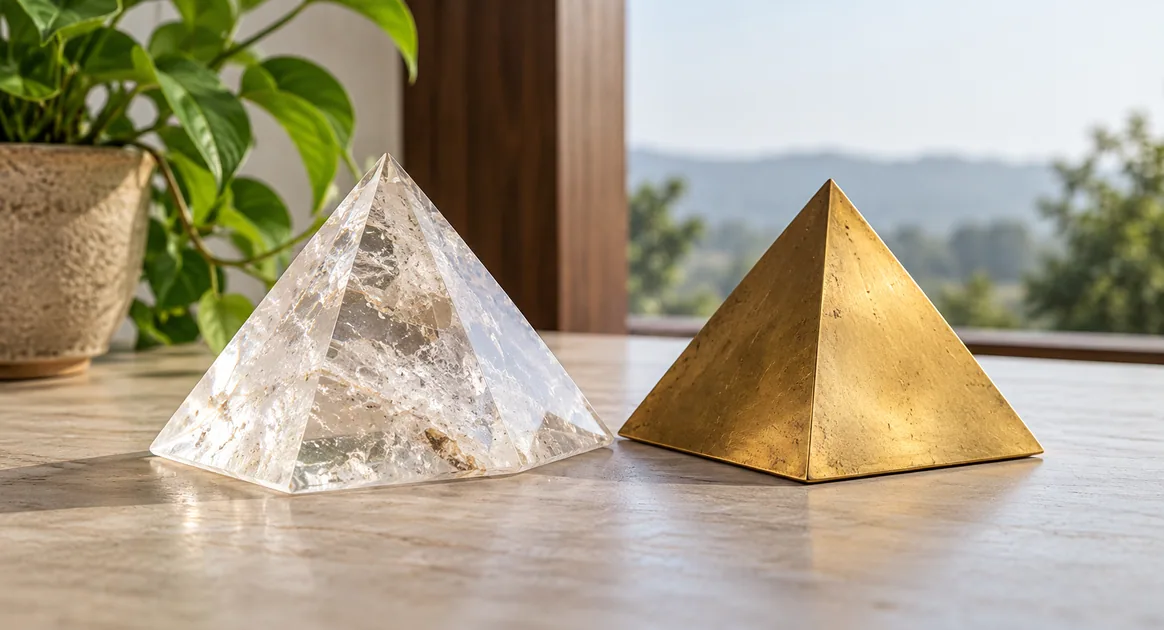
Clear quartz is often referred to in the Indian market as Sphatik or Spatika. The word appears in traditional religious and literary usage for crystal-like, transparent material, and Sphatik malas, beads, Shivlingas and ritual objects have a recognised place in Indian devotional practice. When a customer requests Sphatik specifically, it is important to clarify whether they mean transparent natural rock crystal, a milky quartz product, a decorative quartz tumble or simply a clear-looking material. Those objects can look alike in a small photograph but serve different purposes and price bands.
Many households associate a Sphatik mala with japa, calm devotional focus and worship; Sphatik Shivlingas are used in Shiva-oriented worship. There are also practitioner-specific ritual conventions concerning sanctification, offerings and handling. A small tumbled quartz pebble on a desk is not automatically a replacement for a properly selected mala, established puja object or consecrated item. For japa, the quality of the bead drilling, cord and traditional purpose matters much more than the appearance of a single tumbled stone.
In a Vastu-inspired interior, a clear quartz tumble or small group may be placed in a tidy meditation area or Ishanya, the north-east sector, where a calm and uncluttered puja arrangement is commonly preferred. This is a practical modern use of quartz within a traditional spatial vocabulary, not a claim that a fixed number of clear quartz pebbles is prescribed by every classical Vastu text. In living rooms, clear quartz also suits neutral stone bowls because it reflects ambient light without imposing a strong colour theme.
Selection tip: transparent specimens show veils and inclusions more easily; cloudy pieces can look lovely and are still quartz. Transparent does not mean inclusion-free, and white milky quartz should not be marketed as transparent crystal merely because it comes from the same family.
3. Rose quartz: the pink variety, its symbolism and practical selection
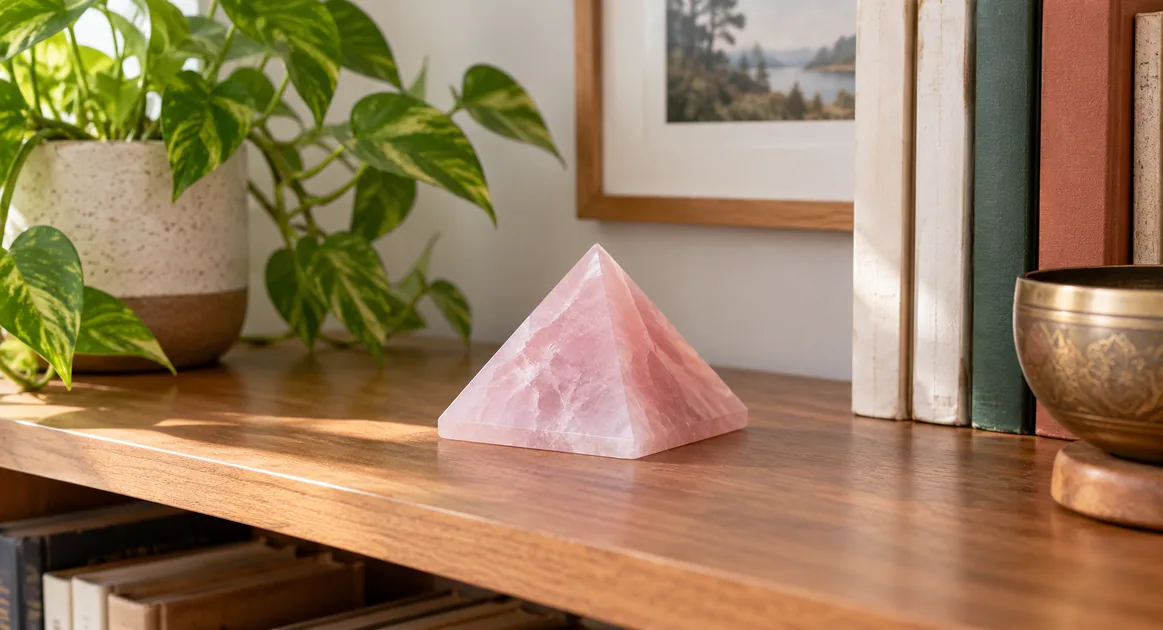
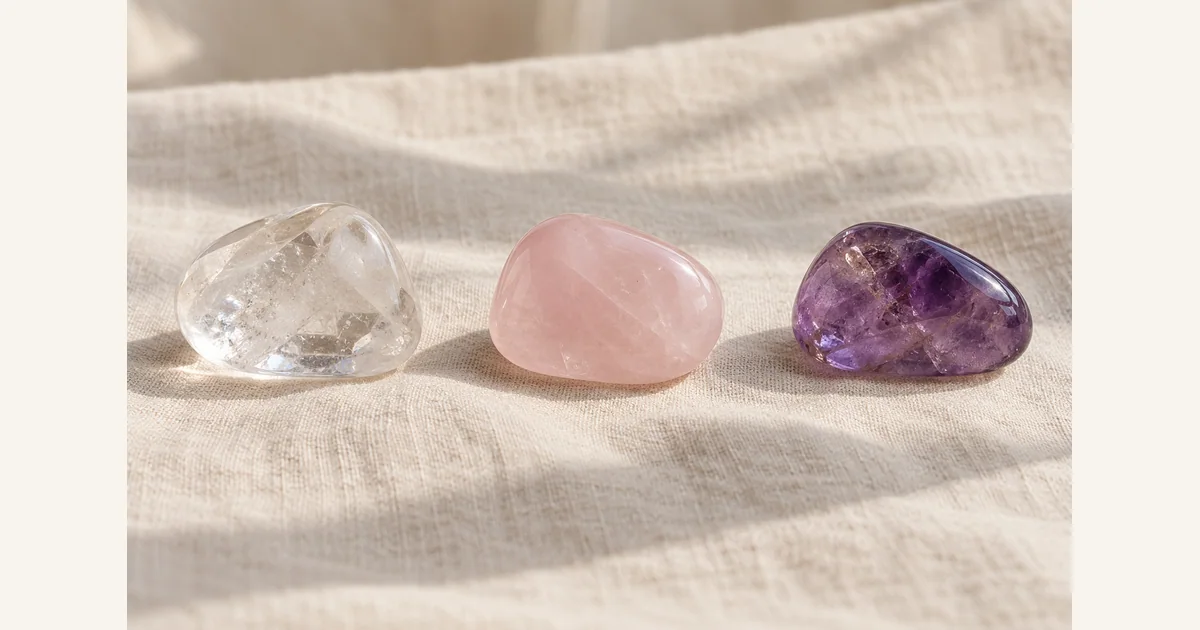
Rose quartz is characteristically soft pink, often with a cloudy internal look rather than the window-like transparency seen in fine rock crystal. The colour can be faint, patchy or deeper in some pieces; thicker stones may appear more saturated than thin slices of the same material. A wholesale lot made up of individually attractive pink stones will not necessarily match perfectly in tone. That variation can be a strength in a natural collection.
Modern crystal practice commonly associates rose quartz with affection, friendship, empathy, emotional harmony and the heart chakra (Anahata). These are widely used contemporary interpretive associations. They should be distinguished from the older Navaratna and graha-ratna frameworks, in which the main planetary gemstones are selected according to established Jyotisha methods. Rose quartz is not one of the nine standard Navaratna stones and is not automatically a substitute for a prescribed pearl, diamond or emerald because the intention is pleasant or loving.
For a family gift, a pair or small group of rose quartz pebbles can express affection through colour and intention. In a bedroom or family sitting area, a simple ceramic bowl of pink stones may fit the decorative scheme better than a large mixed display. A user following a particular Vastu school may prefer the south-west family or relationship area for a stable, uncluttered arrangement; another may keep the stones close to a reading corner or meditation seat. The decisive questions are the user's purpose, the room layout and the approach they follow—not a universal claim that pink crystals must occupy one precise compass point.
In the shop, compare actual rose quartz tumbles against a neutral white or warm-grey background. Harsh pink lighting can make weakly coloured material look stronger. A statement such as “natural rose quartz, treatment not known” is more useful than automatically declaring every pale pink piece untreated. Rose quartz can occasionally be enhanced, so the treatment statement should reflect available supplier information.
4. Amethyst: purple quartz, meditation associations and colour zoning
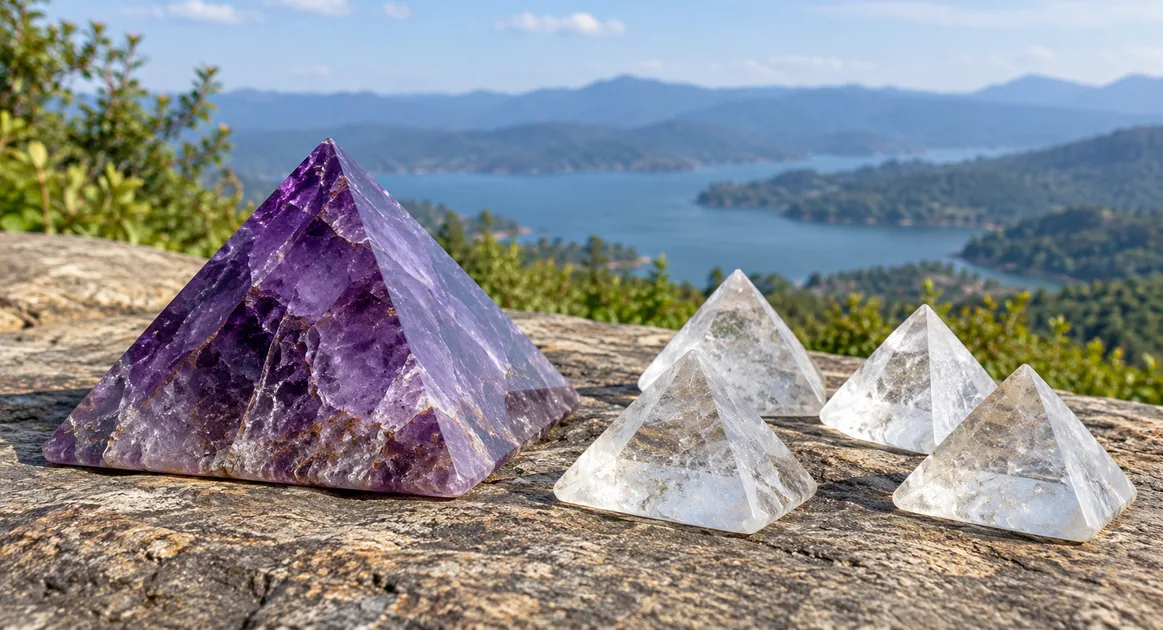
Amethyst ranges from pale lilac to deep violet, sometimes with reddish-purple or bluish-purple undertones. Natural crystals may display strong colour zoning: an area of intense purple can lie next to a nearly colourless band. After tumbling, the original growth orientation may be invisible, but patches, veils or alternating pale and dark segments can remain. Some amethyst pieces contain conspicuous white quartz; these are not automatically defective merely because the stone is not uniformly purple.
Amethyst has a long history as a decorative and ornamental purple quartz. In contemporary meditation and crystal traditions, people often associate it with quiet contemplation, disciplined thought and the Ajna or Sahasrara chakra themes. Those associations can be described openly when a customer is exploring personal spiritual practice, while distinguishing them from the classical Navagraha gemstone system. In particular, amethyst should not be sold as a universal substitute for the blue sapphire recommended for Shani, nor as the standard stone for any individual horoscope without an actual Jyotisha assessment.
For a meditation corner, amethyst works as a visual focal point. One polished tumble or a modest group in a non-slip bowl can be easier to manage than a large heavy cluster. For a puja shelf, keep ample room for the central deity or ritual items; the gemstones are supporting objects and need not dominate a traditional arrangement. Amethyst also works well in a study or reflective reading space when the colour itself helps establish a calm atmosphere.
Buyers should ask about processing when a special claim is made. Heat can alter the colour of some amethyst; other quartz materials can be dyed or treated. A photograph alone cannot establish geographic origin or confirm that the purple colour has never been modified. Avoid displaying amethyst indefinitely in intense sunlight or high heat because colour change is possible. A bright window shelf is not always the best home for a treasured piece.
5. Clear, pink and purple quartz: complete side-by-side comparison
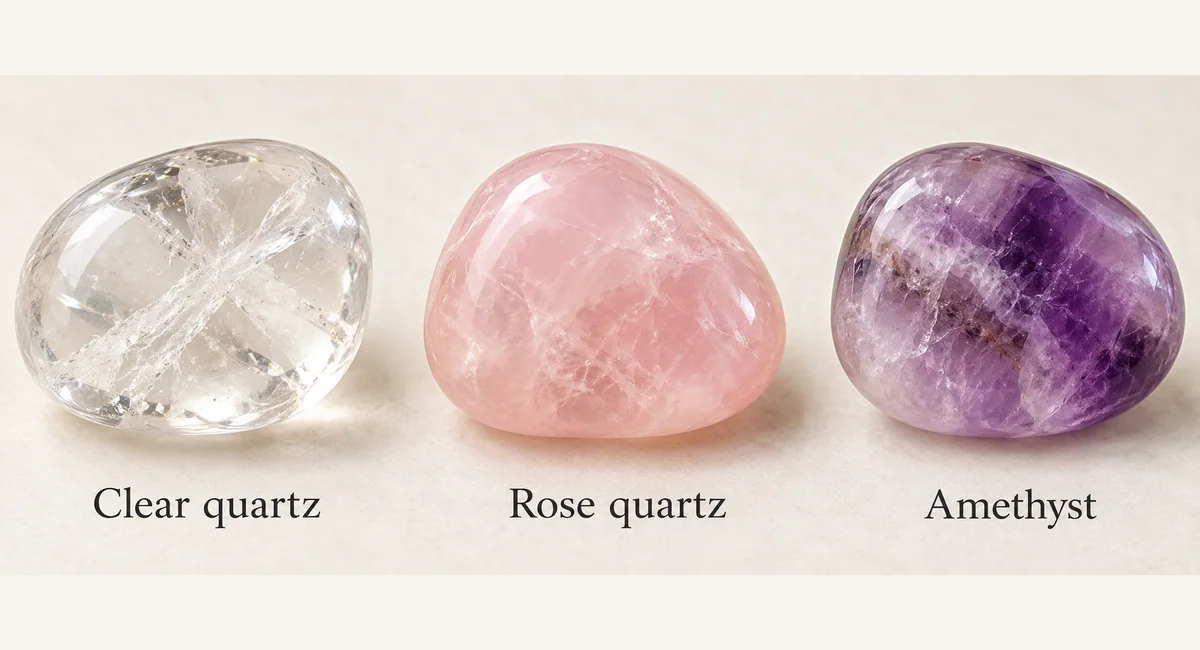
| Question | Clear quartz / Sphatik | Rose quartz | Amethyst |
|---|---|---|---|
| Mineral family | Crystalline quartz, SiO₂ | Crystalline quartz, SiO₂ | Crystalline quartz, SiO₂ |
| Colour | Colourless to cloudy white | Pastel to medium pink | Light lilac to deeper purple |
| Transparency | Can be transparent; veils common | Usually translucent or cloudy in common tumbles | Transparent to translucent; zoning common |
| Mohs hardness | About 7 | About 7 | About 7 |
| Traditional or spiritual reference | Sphatik ritual and devotional objects have a strong Indian context | Love, friendship and Anahata mainly in modern crystal practice | Meditative reflection and upper-chakra themes in modern practice |
| Possible display | Puja shelf or neutral meditation corner | Family shelf, bedside display or gift bowl | Meditation nook or study shelf |
| Typical purchase concern | Glass substitutes; misleading clarity descriptions | Weak pink colour, colour enhancement claims | Colour zoning, heating, dye and sun exposure |
| Practical care | Separate from fragile materials and avoid hard impacts | Protect from hard impacts and prolonged bright light | Protect colour from high heat and prolonged strong sunlight |
All three share a related mineral structure, so a buyer comparing equal-size pieces should not expect dramatic differences in weight simply because the colour changes. Real variation depends on the dimensions, internal features and other materials present. Price differences in retail tumbled stones also reflect the attractiveness of colour, sorting labour, transparency, size, consistency, sourcing and packaging rather than a single universal ranking of spiritual value.
6. Identifying real quartz without damaging the specimen
A good identification routine starts with the seller's documented material description and a careful visual examination under neutral light. Use a loupe if available. Note polish quality, internal cloudiness, colour zoning, obvious coatings, chips and whether each item actually resembles the variety named on its label. A smartphone picture can help compare specimens, but camera exposure and white balance may change the appearance of a pale rose or amethyst stone dramatically.
Clear quartz can resemble glass, synthetic materials or polished transparent substitutes. Rounded gas bubbles in a glass object may be one clue, but a single circular-looking feature in a photograph is not sufficient for identification. Natural quartz also has inclusions, negative crystals and fracture features that can be misread. A scratch test with a steel blade or another stone can permanently damage polished merchandise; it is not an appropriate way to authenticate a retail sample. For a valuable claim—such as certified natural colour, exceptional clarity or mine-specific origin—use appropriate gemological documentation instead of home experiments.
| Observation | What it can tell you | What it cannot prove |
|---|---|---|
| Transparent, glassy appearance | The specimen is visually compatible with clear quartz | That it cannot be glass or another transparent material |
| Milky pink body colour | Typical visual character of many rose quartz tumbles | Untreated origin or guaranteed mineral identity from a photo |
| Purple bands or zones | Often compatible with amethyst growth history | A precise deposit or an untreated designation |
| Even, very saturated colour | A reason to ask more about colour and treatment | That dye must have been used |
| Minor veils and internal lines | Features worth recording for the exact specimen | A guarantee of natural origin or lack of treatment |
| Supplier identity and batch record | A traceable basis for description and later comparison | Independent confirmation of every premium origin claim |
7. Natural colour, dyeing and treatments: ask the right question
Gemstone identity and gemstone treatment are separate facts. A piece can be genuine natural quartz but have had its colour modified or its fractures treated. Conversely, a gemstone's colour can vary naturally even if it looks unusually intense. Amethyst's colour involves iron-related colour centres; colour zoning is common. Rose quartz may show variations linked to the circumstances of its formation and can occasionally be enhanced. Clear quartz may be assembled into altered or coated novelty stones in some markets. The sale label should make the particular product's known history understandable.
When asking a supplier about an order, separate four questions: What mineral is this? Is the colour natural or treated? Is the piece solid stone or assembled/reconstructed? What evidence supports any special origin claim? A supplier may know the mineral identity but lack full treatment documentation. Record that uncertainty in the product data rather than converting it into an unsupported premium claim.
For buyers seeking a mixed quartz set, perfect visual uniformity is not always desirable. A clearly labelled pale rose quartz, a medium-purple zoned amethyst and a veil-rich clear quartz demonstrate the family more effectively than three unnaturally perfect, almost identical-looking tumbles.
8. Vastu directions: how to choose a display without mechanical rules
Traditional Vastu Shastra considers orientation, room function, entrances, light, ventilation, circulation and the relationship of spaces. It uses directional vocabulary such as Ishanya (north-east), Agneya (south-east), Nairritya (south-west) and Vayavya (north-west). The Pancha Mahabhuta are Prithvi (earth), Jala (water), Agni (fire), Vayu (air) and Akasha (space). These ideas give a richer framework for understanding a home than a rigid chart saying that a particular modern tumbled stone must occupy one compulsory spot.
A quartz display can be planned as a secondary symbolic and decorative element. First identify the room's actual purpose. Is it a puja corner, desk, family shelf, reception counter or professional consultation table? Next determine whether the user seeks devotional Sphatik, a contemporary chakra-themed practice, a colour-complementary arrangement or a reference demonstration. Then place the piece somewhere secure, clean and visually appropriate.
| Setting | Possible quartz choice | Reason for choosing it | Practical placement note |
|---|---|---|---|
| Ishanya / north-east puja or meditation corner | Clear quartz / Sphatik | Clarity of appearance and Indian Sphatik association | Keep the main puja items accessible; avoid a crowded shelf |
| Family room or a peaceful bedroom shelf | Rose quartz | Soft colour and contemporary friendship or harmony symbolism | Use a small stable bowl away from falling risks |
| Study or reflective reading corner | Amethyst | Purple focal point used in modern meditation practice | Avoid direct prolonged sunlight and excessive visual clutter |
| Reception or jewellery display | All three in separate labelled groups | Visually demonstrates the quartz family and range of appearances | Use consistent neutral lighting, secure trays and clear labels |
| Vastu consultation demonstration | Three quartz varieties with direction card | Allows material and symbolism to be discussed separately | Label modern symbolic associations as such; avoid automatic Jyotisha substitutions |
Some practitioners associate pale or clear stones with the north-east because that sector is linked with purity, openness and devotional attention. Other modern schools describe rose quartz in relation to emotional harmony or amethyst in meditation zones. These are practice-specific adaptations, not uniform instructions across all Vastu lineages. If a room already has an established family tradition, deity installation or professional Vastu plan, follow that context rather than moving sacred items simply to fit a gemstone chart.
9. Chakras, Jyotisha and Sphatik: three systems that should not be confused
A large share of customer confusion comes from combining three different vocabularies as if they formed one stone-selection rule.
- Traditional worship and Sphatik: A natural rock-crystal mala or devotional item may be selected for japa or puja according to a family's or sampradaya's established practice. Material, craftsmanship and the manner of use matter.
- Chakra-oriented meditation: Contemporary crystal systems often place rose quartz with Anahata, while amethyst may appear with Ajna or Sahasrara. Clear quartz may be used as a neutral focal stone or as part of a multi-chakra arrangement. Chakra colour-stone mappings vary among teaching traditions.
- Jyotisha / Navagraha selection: The classical nine-gem arrangement includes recognised planetary stones such as ruby for Surya, pearl for Chandra and blue sapphire for Shani. A quartz tumble purchased for meditation is not automatically a horoscope-based graha gemstone. Birth-chart consultation, quality and intended purpose form a different selection pathway.
The distinction improves product descriptions and prevents a customer buying a decorative rose quartz pebble under the mistaken belief that it is the same thing as a specifically prescribed Navaratna stone. It also leaves space for the genuinely meaningful personal and religious associations customers bring to these materials.
10. Worked example: build a nine-stone quartz demonstration set
For a compact professional kit, use nine individual quartz tumblestones: three clear quartz, three rose quartz and three amethyst. This arrangement is large enough to show variations within each colour variety but small enough to pack in one labelled tray. It is a teaching and display set rather than a fixed ritual prescription.
| Compartments | Stone selection | What the group demonstrates |
|---|---|---|
| 1–3 | 1 fairly transparent clear quartz; 1 veiled clear quartz; 1 milky clear-to-white quartz | Clarity and inclusions can vary within colourless or white quartz |
| 4–6 | 1 pale pink rose quartz; 1 medium pink; 1 clouded or unevenly pink specimen | Pink strength and translucency vary naturally between stones |
| 7–9 | 1 pale lilac amethyst; 1 medium purple; 1 visible purple-and-pale zoned piece | Amethyst colour saturation and zoning are not identical in every piece |
Place the three rows on a clean neutral tray with each stone secured in an individual shallow cup or padded compartment. Put a reference card beside, not under, the stones: “Clear Quartz / Sphatik,” “Rose Quartz” and “Amethyst.” For a more technical class, add approximate dimensions, weight, supplier lot ID, date acquired and any disclosed treatment. For a devotional or Vastu class, add a second card explaining which associations come from established practice and which are modern crystal interpretations.
Do not rely on a lighting setup that makes the pale amethyst appear artificially rich or transforms rose quartz into saturated pink. Ask pupils or customers to examine the stones in diffuse daylight and indoor neutral light. A useful exercise is to describe each stone without reading its label and then compare the observation against the supplier record.
11. Three real-world layouts using the same stones
Example A: a Bengaluru apartment with a north-east prayer shelf
Consider a small apartment where a family's puja shelf already contains their deity images, diya and prayer books. A single clear quartz or small Sphatik piece can sit safely toward the rear or side, leaving the main worship area unobstructed. Rose quartz need not be mixed into the altar simply to fill the tray; two pink stones can remain on a family sitting-room shelf as a symbolic gesture of harmony. One amethyst may be placed in a shaded reading corner. The household preserves the primary worship arrangement while using gemstone colours intentionally.
Example B: a jewellery showroom educating customers
Put the nine-stone reference kit at a customer-facing counter under neutral lighting. Separate the three colour families and include one note: “All are quartz; appearance and processing can differ.” Next to the stones, explain the difference between translucent rose quartz and nearly transparent rock crystal. When customers ask whether amethyst is a universal remedy for Saturn or whether rose quartz replaces a horoscope gemstone, explain the difference between modern symbolic use and a properly selected Jyotisha gemstone. This educational approach helps customers make informed purchases.
Example C: a Vastu consultant carrying a compact demonstration kit
A practitioner can show clear, pink and purple quartz alongside a simple eight-directions chart without claiming that each tumble is a mandatory correction for a structural Vastu problem. The consultation begins with the property plan and actual use of rooms. The gemstones serve as optional supporting examples of colour, material, symbolism and devotional context. Pack them in nine separate cells and photograph the layout before closing the box so that every piece can be accounted for during return travel.
12. How to choose genuine tumbled quartz: a supplier checklist
When purchasing loose stones or larger mixed sets, ask for the exact lot photograph, quantity, size range and the mineral identity. Tumbled products are commonly sold by piece or by weight; those units are not interchangeable. A pack of ten unusually small stones may weigh less than five large specimens. For consistency across future reorders, record the dimensions and weight of several representative samples rather than treating the phrase “medium size” as a measurable standard.
| Buying question | Why it matters | What to record |
|---|---|---|
| Is each item natural quartz? | Glass or mixed rock may have similar colours | Supplier description and any available material evidence |
| How strong is the colour? | Pink and purple vary under different lighting | Actual lot photograph in neutral lighting |
| Are enhancements known? | Treatment changes the accuracy of product claims | Disclosed natural/treated/unknown statement |
| What is the size range? | Affects packing, display and per-piece value | Length range, actual weight and number of pieces |
| Are edges well finished? | Poor polishing may leave rough spots or chips | Chips, pits, fractures and polish quality |
| Will the next lot match? | Natural colour and translucency can shift | Lot reference and reference-sample photographs |
For ordinary educational pieces, sensible inspection and a truthful description may be enough. For premium untreated or origin-specific claims, request proportionate documentation. The word “genuine” is not a complete treatment statement. A trustworthy product card should identify what is known and what is still unconfirmed.
13. Cleaning, storing and displaying clear quartz, rose quartz and amethyst
Quartz is relatively durable, but the tumbling process may leave small surface-reaching fractures. The safest general routine is to remove loose dust with a clean soft cloth, inspect the surface and protect each stone from being dropped. For a confirmed untreated, stable quartz specimen, gentle washing with mild soap and lukewarm water can be appropriate; dry it thoroughly afterward. If the stone is dyed, coated, filled, assembled or of uncertain treatment, follow the specific care instruction for that item and avoid experimental cleaning.
Keep quartz away from prolonged harsh sunlight or excessive heat where delicate colour could change, particularly for amethyst. Store polished pieces in divided pockets to avoid impacts during transit. Quartz is hard enough to scratch several softer gemstones, so a mixed pouch containing quartz, fluorite, malachite and howlite is a poor long-term storage solution. Use stable stands or shallow bowls with no chance of an enthusiastic child or pet knocking pieces onto a hard floor.
Many households enjoy spiritual cleansing rituals, mantra or setting a Sankalpa (intention) before placing a stone. Keep those devotional or meditative actions separate from the physical cleaning needs of a mineral. A puja practice need not require soaking coloured stones in saltwater, leaving amethyst in strong sunlight or exposing uncertain coatings to smoke and heat. Material-aware care lets the objects remain useful for many years.
14. Common questions about quartz tumbled stones
Is clear quartz the same as Sphatik?
In Indian trade and devotional usage, Sphatik commonly refers to rock crystal or transparent quartz. Check the specific product: a Sphatik mala, a carved devotional figure and a loose quartz tumble are different objects even when the material is related. Some sellers use the name loosely, so transparency and mineral identity should be specified.
Are rose quartz and amethyst as hard as clear quartz?
All three are crystalline quartz and usually have a Mohs hardness around 7. Their actual resistance to damage still depends on fractures, impacts, polishing, inclusions and any processing.
Does white quartz mean that a clear quartz stone is poor quality?
Not automatically. Cloudiness or veiling is normal in many natural specimens. Transparent material may command different prices, but a cloudy piece can be well polished, authentic and visually attractive for a teaching or decorative kit.
Is amethyst a substitute for blue sapphire in a horoscope?
Amethyst is not one of the standard nine Navaratna stones. Some modern or local practices discuss substitute stones, but a blanket recommendation for Shani or another planet cannot be inferred merely from purple colour. Keep the Jyotisha question separate from decorative amethyst selection.
Can I place all three together in the north-east?
You can arrange three small quartz specimens together if that suits your personal space and the Vastu system you follow; a safe and uncluttered display is more useful than mechanically crowding an altar. Classical Vastu principles do not create one uniform requirement to put these three modern tumbled-stone products together in that direction.
How many stones are needed for a home or gift set?
Three stones—one each—make an attractive introductory set. Nine specimens—three of each—give a stronger educational comparison. More pieces are useful for professional demonstrations, but a quantity alone does not establish spiritual effectiveness or superior mineral quality.
15. Summary: choose by material, purpose and tradition
Clear quartz is the transparent-to-milky quartz of many Sphatik references and an excellent mineral-comparison specimen. Rose quartz offers a distinctive soft pink presence and modern harmony-oriented symbolism. Amethyst is purple quartz whose colour zoning and meditation associations make it a useful third comparison. The right purchase depends on whether you need an authentic mineral specimen, an established devotional object, an attractive family gift, a Vastu-inspired accent or a documented professional reference kit.
Start by identifying the actual stone and its known treatment history. Then choose the shape and setting appropriate to your purpose. When discussing Sphatik, chakras, Navagraha, Pancha Mahabhuta and Vastu directions, retain the meaning of each tradition rather than flattening them into one generic crystal chart.
Continue reading
- Citrine and Smoky Quartz: Appearance and Treatment Differences
- Tiger Eye, Carnelian and Aventurine Tumbled Stones
- Moss Agate, Botswana Agate, Unakite and Rhodonite
Explore the existing Vastu and gemstone collections for wider context.