Which stone should you choose for a Vastu gemstone set: Moss Agate, Botswana Agate, Unakite or Rhodonite? Their colours can overlap, yet their traditional crystal associations, mineral identities and practical roles are quite different. Moss Agate is often selected for growth and connection with nature; Botswana Agate for patience and a steady, layered approach; Unakite for integrating contrasting feelings and family intentions; and Rhodonite for compassion, emotional harmony and relationship-centred practice. Knowing these differences makes a collection much more useful than a tray of unnamed stones.
This guide compares all four tumbled stones in depth: what they are, how to recognize them, how practitioners use their symbolism within Vastu-inspired arrangements, which directions and spaces suit different intentions, how to choose a suitable specimen, and how to combine them in a small home, office or professional consultation kit. It also explains where modern gemstone symbolism meets—and differs from—classical Vastu principles.
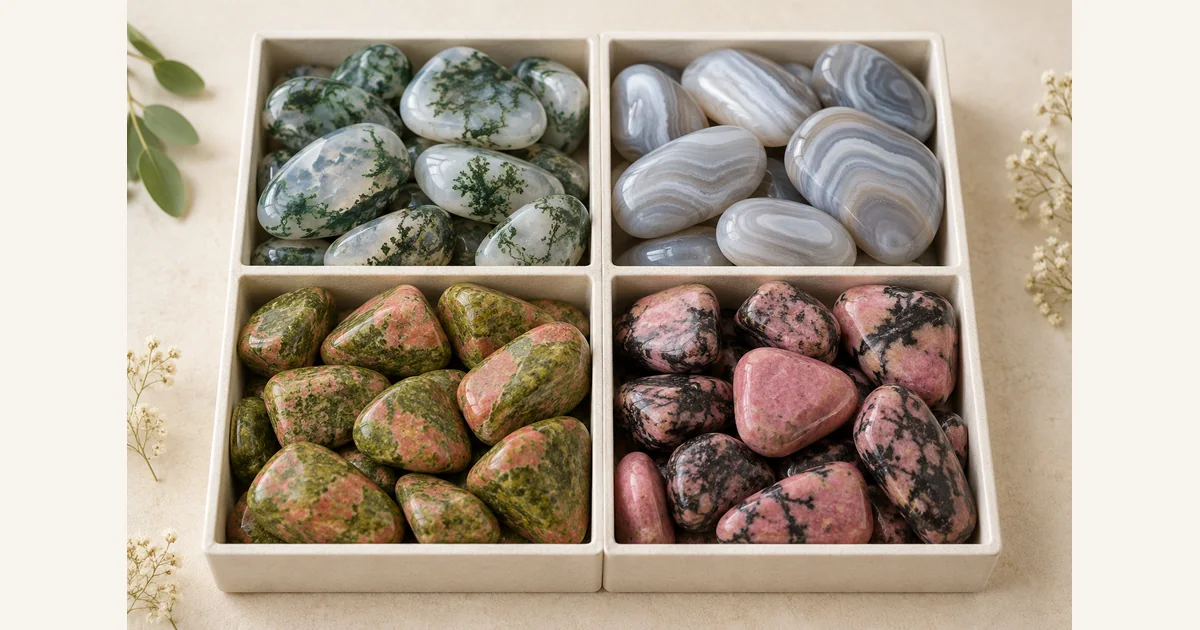
Quick comparison: four stones, four distinct purposes
Use this table as a starting point. The symbolic applications listed here are familiar in contemporary crystal and Vastu-inspired practice; they are not a claim that every classical Vastu text prescribes these four commercial gemstone varieties by name. The underlying traditional framework—direction, colour, Panchamahabhuta and intention—helps explain how practitioners make a purposeful selection.
| Stone | Recognizable appearance | Key symbolic association | Common use in a Vastu-inspired set |
|---|---|---|---|
| Moss Agate | Green, moss-like mineral inclusions in translucent or milky chalcedony | Growth, renewal, nature, patient expansion | Plant corner, new enterprise, growth intention, east or north zone |
| Botswana Agate | Fine curved bands of grey, cream, brown, pink or lavender chalcedony | Steadiness, reflection, continuity, gradual progress | Planning desk, study area, routine-building, calm grounding |
| Unakite | Mottled olive/green epidote with salmon-pink feldspar and pale quartz | Balance, reconciliation, integration, new beginnings | Family space, shared office, thoughtful transitions |
| Rhodonite | Rose-pink manganese silicate with black or dark manganese-oxide areas | Compassion, relationship harmony, forgiveness, supportive communication | Family or consultation area, shared workstation, relationship intention |
1. Moss Agate: symbolism of growth, renewal and the living world
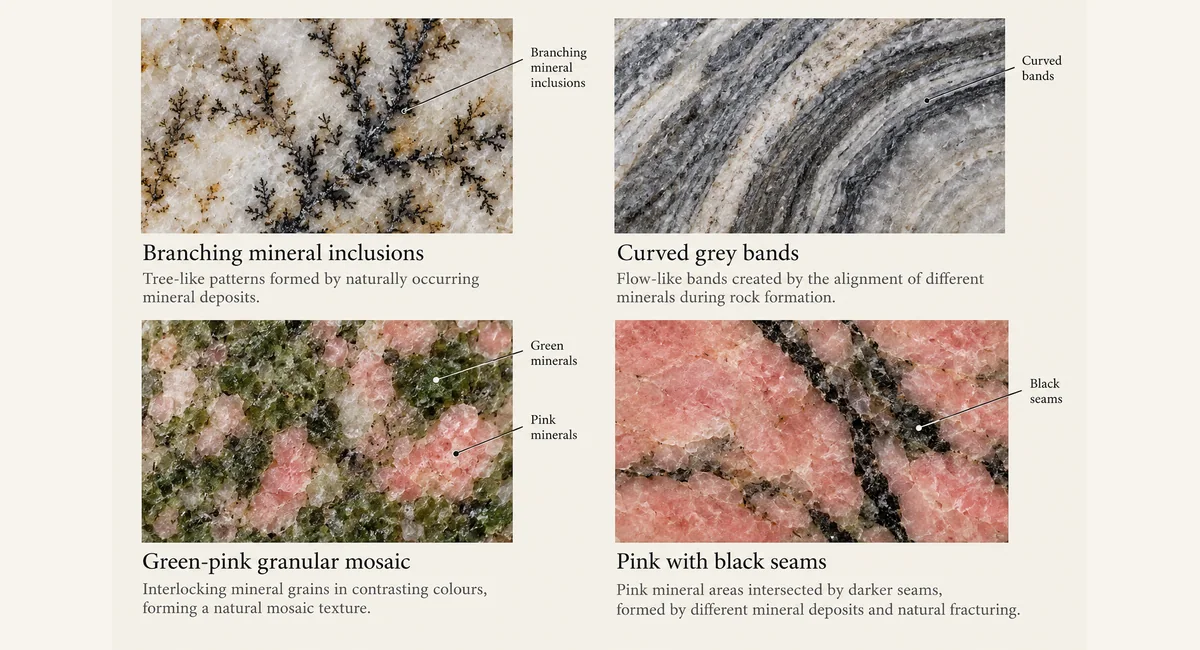
Moss Agate is chalcedony, a fine-grained form of quartz. Its green branching, plume-like or moss-shaped inclusions are mineral formations, commonly involving chlorite or amphibole minerals. They are not actual preserved moss. Some specimens are nearly clear with delicate green branches; others have cloudy white bodies, dense green islands, brown edges or landscape-like patterns. Two natural stones can therefore look very different while belonging to the same commercial material family.
Its importance in crystal practice comes from the visual resemblance to roots, forests, vines and gradual growth. A practitioner may connect that imagery with Prithvi Tattva (the earth element), fertility of ideas, renewal after a difficult phase, or the patient development of a business. The selection is symbolic: a growing branch represents progress made step by step rather than instant change. This interpretation is why Moss Agate is frequently chosen for people beginning a new project, tending a garden, establishing a small shop or studying consistently.
Where to place Moss Agate
For a home, a clean east-side table near healthy indoor plants is a natural choice when the intention is renewal and household growth. A north workspace may be chosen when the focus is professional opportunities or business expansion in a direction-based Vastu scheme. In a shop, one larger polished specimen can sit near a planning ledger or stock-expansion notebook rather than being scattered around cash handling surfaces. For meditation, hold one stone while reciting a personal Sankalpa such as, “May my work develop with patience, clarity and integrity.”
When buying, judge the actual inclusion pattern. Look for visible green branching, pleasing contrast and a well-finished polish. Very opaque or dyed-looking material may not show the dendritic beauty for which Moss Agate is chosen. If the seller describes every branching stone as “Moss Agate,” compare the material with dendritic agate, plume agate and other chalcedony varieties before assigning a final label.
2. Botswana Agate: layers, continuity and thoughtful progress
Botswana Agate belongs to the agate family—banded chalcedony. Its attraction is the succession of layers: narrow pale grey, white, pink, smoky, brown or occasional violet bands, sometimes following the outline of an original mineral-filled cavity. Natural agate forms as silica is deposited in successive layers, often inside spaces in volcanic rocks. Botswana is a well-known source, and commercial names can also be applied loosely to similar-looking material from elsewhere. A seller should distinguish a banded-agate description from an actual geographic-origin claim.
In a crystal symbolism context, those successive bands are read as a picture of patience, steadiness and persistence. A thoughtful Vastu-inspired use is not simply “put grey agate anywhere for good luck”; it is choosing a stone with a layered pattern for a person who wants to maintain daily discipline, organise expenses, complete a long-term course or approach a new business phase carefully. The symbolism follows the material's visible structure: small repeated bands build an entire stone, just as consistent actions build a stable routine.
Where to use Botswana Agate
It suits a study desk, journal corner, planning shelf or office area dedicated to a long-duration goal. In a west-oriented reflective or completion-focused arrangement, practitioners may choose subdued grey-banded stones; in a southwest family or stability context, earth-toned agate may fit the chosen colour palette. There is no need to make it a rigid compass rule: its strong practical role is as a steady visual reminder of continuity. One or three stones arranged beside a written goal may communicate that intention better than a large mixed bowl.
Examine banding carefully. Genuine banded agate can be translucent or opaque; bands may be delicate, concentric or irregular. Intensely saturated artificial colours are common across the wider dyed-agate market, so ask whether the lot is natural-colour, dyed or otherwise treated. A name containing “Botswana” should be supported by responsible sourcing information when locality matters to the customer.
3. Unakite: the meeting of green and pink
Unakite is different from the previous two stones. It is not a single uniform gemstone mineral: it is an altered granitic rock containing green epidote, pink orthoclase feldspar and often quartz. The uneven patches are part of the rock's identity. A predominantly green piece and a predominantly pink piece may both be sold as Unakite, provided their mineral mixture is consistent with the material.
The natural pairing of green and pink gives Unakite its distinctive contemporary spiritual symbolism. Green is frequently associated with renewal and practical growth; pink with warmth, affection and empathy. Together they are used to represent balancing two needs that must coexist: work and home, ambition and family time, independence and cooperation, or progress and patience. In chakra-oriented modern practice, green and pink are often connected with Anahata, the heart centre. This connection is a useful teaching association, rather than evidence that the mineral is explicitly named in ancient chakra texts.
Unakite for home, office and periods of change
Place a Unakite specimen in a family sitting room or a shared desk when the chosen intention is better mutual understanding. A newly married couple furnishing a home may use it alongside a written household Sankalpa. A small business partnership can place it near a meeting table as a reminder to balance different perspectives. A student moving away from home could use a single piece with a journal to reflect on the transition and maintain calm routines.
Unakite is especially effective as a comparison specimen in a teaching kit. It shows that not all tumbled stones are single minerals. Examine the actual colour distribution and polish. Large pale patches or exposed cracks do not automatically make it unsuitable, but avoid presenting a solid-green stone as classic Unakite merely because the sales label says so.
4. Rhodonite: compassion, communication and relationship harmony
Rhodonite is a manganese-bearing silicate mineral. Common tumbled material is rose-pink or reddish pink, crossed by darker manganese-oxide veins, patches or dendrites. Its appearance can be confused with other pink stones such as Rhodochrosite, dyed howlite, pink jasper or pink-and-green Unakite. Mineral names matter here: Rhodonite and Rhodochrosite are not interchangeable, even when both look pink.
Rhodonite's pink colour has encouraged associations with compassion, forgiveness, emotional steadiness and respectful speech in contemporary gemstone traditions. The dark seams within the pink body are often used as a metaphor for working through difficulty while retaining kindness. For a customer interested in a relationship-oriented stone, a detailed discussion of this symbolism is more useful than the generic claim that it “brings positive energy.”
How to use Rhodonite in a meaningful arrangement
In a family home, it can sit on a shelf near a shared conversation area or beside a journal used for gratitude and reflection. In an office, it may accompany a meeting diary or conflict-resolution notebook as a reminder to speak constructively. For a consultant's demonstration, place Rhodonite next to Rose Quartz and Unakite to compare three different pink/green traditions: affectionate openness, reconciliation and balanced growth. The intention is to support a reflective practice; the gemstone does not replace the actual conversation or decision.
Choose Rhodonite for a clear pink body with appealing dark pattern, good polish and minimal open fractures. Since some specimens contain considerable matrix or dark inclusions, do not judge value by pink colour alone. Ask for accurate identification and avoid hard impact: the polished stone can chip, particularly where cleavage or fractures are present.
How the four stones relate to Vastu directions and Panchamahabhuta
Traditional Vastu works with spatial orientation, room functions, the Vastu Purusha Mandala and the five-element vocabulary of Prithvi (earth), Jala (water), Agni (fire), Vayu (air) and Akasha (space). Modern crystal-based arrangements frequently add gemstone colours and symbolic intentions to that framework. Use the two together intelligently. First determine the real space and its intended function; only then decide whether a particular colour or stone supports the practitioner's chosen arrangement.
| Direction or space | Common Vastu-oriented intention | Possible stone choice | Why this choice makes sense |
|---|---|---|---|
| East | Beginnings, light, household growth | Moss Agate | Green branching imagery suits renewal and living plants |
| North | Work, opportunities and business planning | Moss Agate with Botswana Agate | Combines an expansion intention with steady planning |
| Northeast | Quiet study, prayer and reflection | One gentle-patterned agate or Unakite | Supports a restrained, uncluttered contemplation space |
| Southwest | Stability, continuity and family anchoring | Botswana Agate or Unakite | Layered or integrated imagery fits a stability intention |
| Shared family area | Understanding and supportive communication | Unakite and Rhodonite | Green-pink balance and relationship symbolism |
| Office meeting area | Patient planning and respectful discussion | Botswana Agate and Rhodonite | Steadiness paired with communication |
These are practical association examples, not a claim that one exact stone is compulsory in a given compass sector. Different Vastu schools and contemporary gemstone systems can give different colour assignments. A kitchen, puja room or entrance must still be assessed as a functional space; gemstone placement does not override its layout, ventilation, accessibility or safety.
Selection by purpose: which of the four should you buy?
Customers often ask for “a positive gemstone,” but a useful answer begins with the situation. The following comparisons help narrow the choice without simply recommending all four stones for everything.
| Customer's main purpose | First stone to examine | Good second option | Selection reasoning |
|---|---|---|---|
| Starting a new shop, garden or long-term project | Moss Agate | Botswana Agate | Growth symbolism with patient follow-through |
| Study consistency, savings routine or business planning | Botswana Agate | Moss Agate | Gradual layers, structure and steady progress |
| New home, transition or shared family responsibilities | Unakite | Rhodonite | Integrating differing needs and maintaining empathy |
| Constructive conversation and relationship reflection | Rhodonite | Unakite | Compassion, communication and balance |
| Educational mineral and Vastu demonstration kit | All four, labelled | Compare each to related stones | Different mineral structures and symbolic functions |
Worked example 1: a small retail showroom
Imagine a Bengaluru jewellery shop with a north-facing consultation desk, an east-side window and a southwest storage cabinet. The owner wants greater consistency in stock planning and a calm environment for customer conversations. A meaningful arrangement starts with two clearly written intentions, not a demand to purchase ten separate stone products.
- North planning desk: place one Moss Agate near the new-product notebook to represent developing ideas; add a modest Botswana Agate near the weekly reorder checklist for steady follow-through.
- Customer discussion table: keep a single Rhodonite specimen as part of a conversation-centred, welcoming arrangement. Explain its traditional symbolism when customers ask, rather than presenting it as a guaranteed business outcome.
- Shared team space: Unakite can be chosen for a collaborative intention, especially when different staff members handle sales, packing and dispatch.
- Evaluation: after a month, review stock accuracy, meeting routines and actual shop operations. The stones remain reminders within a wider practice of orderly management.
This example shows how one stone, one place, one purpose can be more compelling than scattering identical products throughout the shop. It also helps an OmmRudraksha customer understand why Moss Agate and Botswana Agate are not automatically substitutes merely because they both contain chalcedony.
Worked example 2: a family home with a new study corner
A family has set up a west-side study shelf for two children and a northeast reading corner for quiet work. The parents want to develop consistent study habits and reduce disagreements over shared space. For the study shelf, Botswana Agate suits the notion of gradual learning—lessons built layer by layer. Unakite can be placed in the family sitting area as an image of two different colours working together. If the household also wishes to create an intention-based reflection corner, a single Rhodonite piece beside a gratitude notebook offers a useful relationship symbol.
Notice what is not required: an expensive complete set, a fixed number of identical stones, or the claim that one colour automatically determines a person's destiny. The arrangement is practical because it connects each symbol to a space and a habit. In a small apartment, a clean labelled tray works as well as a dedicated display shelf.
Worked example 3: building a four-stone professional comparison kit
A Vastu practitioner or gemstone seller can prepare a four-compartment board to teach customers how material identity and traditional symbolism are different questions. Number the pieces 01–04, keep a magnified photo of each, and write a concise display card. The kit should be portable, easy to explain and not dependent on decorative packaging.
| Reference no. | Material description | Observation to teach | Associated intention |
|---|---|---|---|
| 01 | Moss Agate; inclusion-bearing chalcedony | Green dendrites do not mean fossilized plants | Growth and renewal |
| 02 | Botswana Agate; finely banded chalcedony | Repeated silica bands; locality needs documentation | Patience and continuity |
| 03 | Unakite; epidote–feldspar–quartz rock | Pink and green represent different mineral components | Integration and family balance |
| 04 | Rhodonite; manganese silicate | Rose-pink body with dark manganese-oxide areas | Compassion and communication |
During a consultation, first ask the customer whether the purchase is intended for a mineral reference set, a personal Sankalpa practice, a Vastu-oriented placement or a gift. The same physical stone may suit different uses, but the explanation should follow the actual purpose. If a customer is requesting a Jyotish gemstone prescribed from a birth chart, do not casually replace the classical nine-graha gemstone framework with these four tumbled stones: that is a separate selection method.
How to choose the actual tumbled specimens
1. Compare colour, pattern and authenticity
For Moss Agate, check the translucent body and mineral-like branching. For Botswana Agate, look for layered chalcedony banding and ask about source. For Unakite, confirm the irregular pink–green mineral mosaic. For Rhodonite, examine its rose-pink and dark areas. A photograph can help with recognition but is not a complete laboratory identification; similar-looking stones can occur in more than one mineral group.
2. Compare size and finish for the intended use
A tiny thumb stone is convenient for an individual meditation practice. A medium-sized piece with visible pattern suits a labelled study kit. A large specimen can be useful in a shop display if the actual mineral features are easy for visitors to see. Avoid buying solely by carat weight. A readable pattern, comfortable handling, accurate name and attractive polish usually matter more for this type of educational and Vastu-oriented use.
3. Ask about treatment and source claims
Agates are sometimes dyed to produce stronger colours; enhanced colour should be described accurately. A geographical label such as “Botswana” conveys more than a colour description and should not be treated as proof of origin without supporting supply information. Mixed commercial sets may substitute visually similar material; a practitioner should label a sample according to its verified identity, not the most expensive product name on the invoice.
4. Care for the four stones separately
Wipe away dust with a soft dry or slightly damp cloth, then dry each piece. Protect polished samples from falls, repeated stone-to-stone impact and harsh cleaning chemicals. Rhodonite can be more vulnerable to chipping or fractures than hard chalcedony, and Unakite's mixed minerals may polish differently across one stone. Label boxes and separate stones with soft dividers when carrying a kit. If a stone is mounted in jewellery or joined with adhesive, follow the component's own cleaning requirements.
A simple Sankalpa and placement practice
Traditional Indian spiritual practices frequently emphasise Sankalpa—a considered intention stated before a meaningful act. For a four-stone set, a short, personal practice can be more coherent than inventing elaborate rituals for every mineral:
- Clean the intended area and decide the precise purpose: growth, disciplined progress, family understanding or considerate communication.
- Choose one principal stone. Add a second only when its symbolism contributes something different.
- Write the intention in one sentence. For example: “May our family discuss differences patiently and act with mutual respect.”
- Place the stone where the associated activity actually happens—study desk, planning corner, meeting table or prayer shelf.
- Review whether the placement still helps focus attention on the chosen purpose. Change the arrangement if the room use or intention changes.
This keeps the practice connected to Vastu's concern with place and function. A well-used single specimen can become personally meaningful; buying every colour is not necessary.
Common questions about Moss Agate, Botswana Agate, Unakite and Rhodonite
Are Moss Agate and Botswana Agate the same stone?
No. Both belong to the broader chalcedony family, but Moss Agate is valued for green, moss-like mineral inclusions, while Botswana Agate is commonly recognized for repeated fine banding and an associated geographic trade name. Their appearance, material story and symbolic uses differ.
Which is better for business growth in a Vastu-inspired collection?
Moss Agate is a natural first choice for a growth intention because its branching inclusions evoke developing roots and leaves. Botswana Agate can be chosen alongside it for steady planning and follow-through. A professional selection should still consider the business space and the exact purpose.
Can Unakite and Rhodonite be used together?
Yes, when the intention involves balance and compassionate communication. Unakite contributes the symbolism of integrating different perspectives; Rhodonite adds a relationship-centred emphasis. For a compact home arrangement, one of each is enough to illustrate the difference.
Is Unakite a crystal or a rock?
It is a rock made of several minerals, chiefly epidote, pink feldspar and quartz. In commercial crystal collections the word “crystal” is used broadly, but a geological label should identify Unakite as a multi-mineral material rather than one uniform crystal species.
Is Rhodonite the same as Rhodochrosite?
No. Both are manganese-related, rose-coloured gem materials, but Rhodonite is a silicate and Rhodochrosite is a carbonate. They differ in mineral chemistry, hardness and characteristic patterns. A dark-veined pink stone might suggest Rhodonite but should still be identified carefully.
Is Botswana Agate always from Botswana?
Material documented as originating in Botswana deserves that name; stones merely resembling its muted, fine banding may be sold under similar commercial descriptions. Ask the seller whether the origin is traceable and consider the neutral label “banded agate” when it is not.
Can I put all four stones in the northeast or beside a home altar?
You can create a small, orderly personal arrangement there when it suits the room and your practice. However, selecting a stone by its symbolic role and keeping the sacred space uncluttered is more useful than assuming every possible gemstone must occupy the same direction. For a study or work purpose, a dedicated desk may be more appropriate.
Are these four stones the same as a Navaratna set?
No. Traditional Navaratna refers to a specific nine-graha gemstone scheme used in Jyotish and jewellery traditions. Moss Agate, Botswana Agate, Unakite and Rhodonite form a different educational or contemporary Vastu-inspired collection; they should not be advertised as direct substitutes for the nine classical gems.
Choosing confidently from the OmmRudraksha collection
Start with the intention and the actual material. If you want branching green stone for a new project, examine Moss Agate. If you are building a steady planning habit, compare the bands of Botswana Agate. If your focus is shared family responsibilities, look at Unakite's green-pink mosaic. If you wish to build a compassion-centred meditation or communication corner, study Rhodonite. Then choose size, quality and presentation accordingly.
Customers comparing specimens can use the related reading and product links below to move from this detailed explanation to existing OmmRudraksha gemstone and Vastu collections. The strongest choice is the one whose traditional symbolism, actual mineral identity and intended use all make sense together.
Continue reading
- Agate, Jasper and Bloodstone Tumbled Stones
- How to Label and Organize a Tumbled Stone Reference Collection
- Gemstone Identification Study Kits: What They Can and Cannot Prove
Explore the existing Vastu and gemstone collections for wider context.