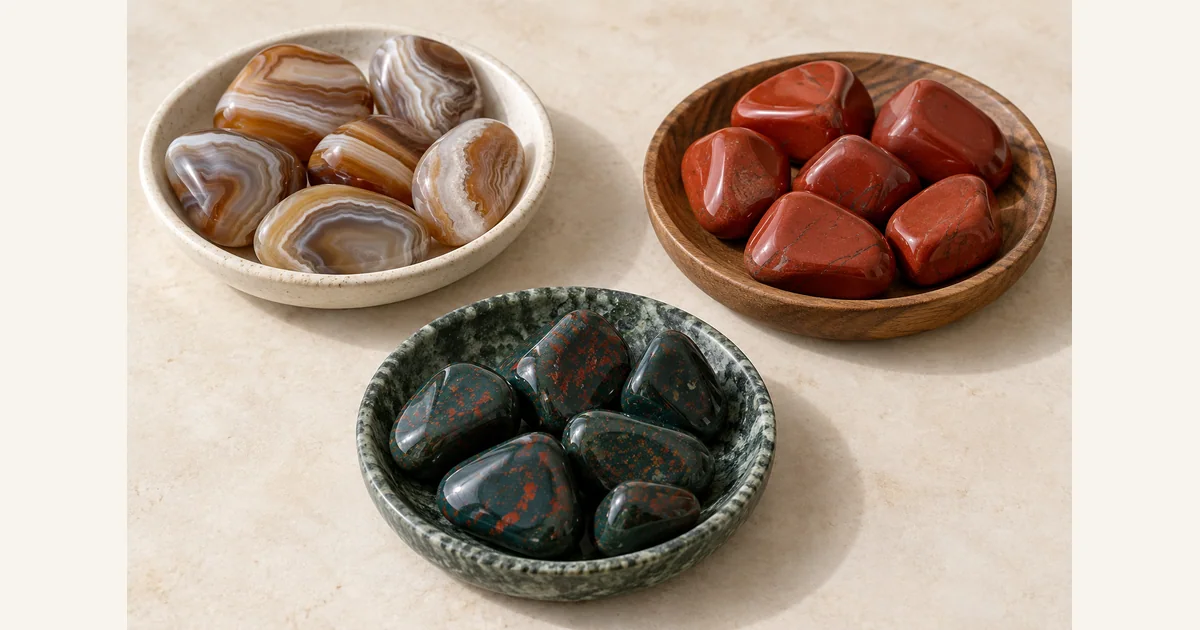
Agate, jasper and bloodstone are related through the quartz–chalcedony family, but they are not interchangeable names. An agate may display curved bands or translucent windows; jasper tends to appear opaque, earthy and patterned; bloodstone (heliotrope) is typically dark green with red spotting. All three can be fashioned into rounded tumbled stones, beads, malas and educational specimens. The useful question is not which one is universally “strongest”, but what the piece actually is, what it looks like in ordinary light, and how its colour and symbolism fit the intended use.
For an OmmRudraksha customer selecting a Vastu gemstone display, the geological and traditional perspectives can be read side by side. Gemology explains the materials and their appearance. Indian devotional and spatial traditions explain ideas such as direction, cleanliness, intention, auspicious colour and the five elements. Contemporary crystal arrangements combine these ideas in new ways; a fixed prescription of one tumbled agate for one direction should not be mistaken for a rule common to every classical Vastu text.
Agate, jasper and bloodstone at a glance
These names sit within a complicated family of microcrystalline silica, where visible pattern, opacity, inclusions and trade terminology are often more decisive than a difference in bulk chemical formula. A quick reference table helps when buying mixed sets or training jewellery staff.
| Material or trade name | Appearance to look for | What makes it distinct | Practical selection |
|---|---|---|---|
| Banded agate | Curved, concentric or parallel pale and coloured bands | Layers within chalcedony; many colour combinations | Choose pieces with bands visible on the polished surface |
| Moss or dendritic agate | Branching, moss-like or landscape inclusions | Named for inclusions; conspicuous banding is not required | Check the pattern on the actual piece rather than a stock photograph |
| Red jasper | Brick-red to deep red, commonly opaque | Fine-grained silica-rich material; iron oxides often influence colour | Look for even polish, natural variation and a declared treatment status |
| Yellow jasper | Mustard, cream, honey or ochre, commonly opaque | Jasper trade variety identified mainly by body colour | Prefer a useful spread of shades over identical-looking units |
| Bloodstone / heliotrope | Dark green background with red spots or patches | Green chalcedony/jasper-type material with characteristic red markings | Inspect the number and distribution of red spots in each specimen |
| Carnelian | Orange to orange-red; sometimes translucent at an edge | A chalcedony colour variety, not simply “red jasper” | Check edge translucency and ask whether colour has been enhanced |
Helpful distinction: agate often names a banded appearance, jasper generally an opaque material and bloodstone a distinctive green-and-red variety. These are commercial and gemological conventions with overlapping boundaries, not three unrelated chemical species. Shape alone—round, oval or pebble-like—does not identify a specimen.
Why closely related silica stones look so different
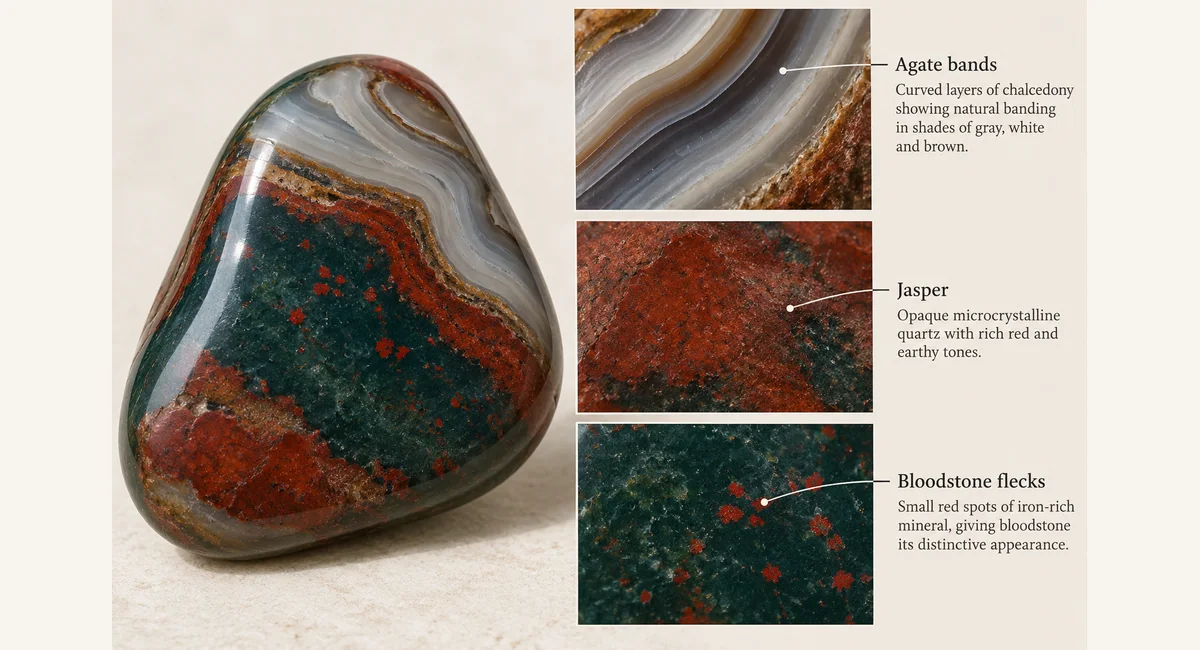
Quartz has the chemical formula SiO2. Large quartz crystals are familiar as clear quartz and amethyst. Chalcedony is composed of extremely fine silica structures, commonly including intergrowths of quartz and moganite. In practice, many agates, jaspers and bloodstones are grouped within the broader cryptocrystalline or microcrystalline silica family. Fine grain size can make a stone look waxy or smoothly opaque rather than glass-clear.
Bands form when silica-rich fluids deposit successive layers. Differences in colour, texture and impurities make some of those layers visible. When the tumble has been cut across the layers, the pattern may appear as circles, arches or parallel stripes; a different orientation can hide the best bands. Jasper's opaque body often reflects dispersed colouring matter or microscopic inclusions. The red specks in bloodstone are associated with iron-rich inclusions. None of these observations establishes a mine or an exact country of origin.
The Mohs hardness of quartz-based materials is commonly near 6.5–7, but two pieces with similar hardness can differ in porosity, fractures, inclusions and resistance to impact. A polished tumble may survive ordinary handling yet chip if dropped on a tiled floor. For retailers, this is more useful than treating “hard stone” as a promise of indestructibility.
How to recognise a good banded agate
The most convincing feature in a banded agate is the relationship between its layers. Follow the lines around the face rather than judging only the colour. The bands may be white and grey, red and cream, honey-coloured or nearly colourless. Some pieces show a window of light passing through a pale edge; others appear cloudy. A well-cut stone brings the bands into view without grinding away so much material that it loses a comfortable shape.
Under a neutral white lamp, rotate the pebble slowly. Note whether the curves remain part of the stone as you change angle, whether the pattern continues across a side and whether there are open fractures. A hand lens can show the edges of layers and pockets of dye, although it cannot by itself authenticate every treatment. A highly saturated blue, purple, green or pink agate is not automatically false—it may be natural or dyed—but it is a reason to request a specific disclosure before describing it as naturally coloured.
Agate has also been used in beads, seals and ornamentation across different historical traditions. In a present-day Vastu arrangement, people often choose bands to represent continuity, order or the bringing together of different parts of a household. That is a symbolic interpretation suitable for a family display; it is not a substitute for measuring the room's orientation, light, use or circulation.
Jasper: red, yellow and patterned varieties
Red jasper is commonly brick-red, russet or reddish brown, sometimes veined with grey, cream or darker patches. Yellow jasper may be muted ochre, mustard, sandy or golden yellow. Picture jasper, brecciated jasper and other patterned materials can include more than one tone. Because commercial “jasper” covers a varied set of silica-rich rocks and aggregates, the seller's trade name should be supported by a description of the actual colour, texture and pattern.
These stones are useful for comparing opacity. Hold a tumbled piece against a neutral background and illuminate an edge with a small torch: an opaque jasper will generally pass little to no light through its body, unlike many carnelian or translucent agate pieces. Do not scratch a stone to prove hardness, and do not infer a precise mineral identity from one phone image. A specimen containing visible fractures, pits or filled sections may need a different grading note even if its colour is attractive.
Red and yellow also have meaningful roles in contemporary devotional aesthetics. Red can evoke vitality, activity and the warmth of Agni; yellow can evoke steadiness, learning, the earth and auspicious offerings. These associations can help someone select a colour for a shelf or teaching tray. They do not make red jasper a universal replacement for a classical ruby or red coral recommendation, nor yellow jasper for yellow sapphire. In Jyotisha, a planetary gemstone recommendation depends on the actual gem, the prescribed tradition and the individual chart.
Bloodstone: dark green with red flecks
Bloodstone is also known as heliotrope. The conventional appearance is a deep green ground carrying small red dots, scattered flecks or irregular reddish patches. Some material shows a few spots; other pieces are heavily marked. The green may be almost black indoors and become noticeably greener in daylight. White or pale sections can occur in commercial pieces; the presence of every possible colour is not a requirement.
Bloodstone has a documented historical identity as an ornamental stone. The name “heliotrope” comes from Greek roots concerning the sun and turning, while the English name refers to its blood-like red marks. Ancient Mediterranean accounts connect it with the sun and reflection; this is a piece of historical lapidary tradition, not evidence of a physical effect from a modern polished pebble. In Indian markets, the term Indian bloodstone is widely used as a commercial description. It should not imply that each particular unit has verified Indian mine provenance without sourcing records.
Do not confuse bloodstone with the mineral hematite, which is an iron oxide. Bloodstone is silica-rich green-and-red lapidary material; hematite is a different mineral, sometimes involved as an iron-rich colouring component. The two can share words such as “blood” in historical or regional naming without being equivalent products.
Compare them in daylight: a repeatable five-minute examination
- Start with accurate labels. Arrange banded agate, red jasper, yellow jasper and bloodstone in separate shallow dishes. Add moss agate as a fifth contrast if available.
- Use neutral lighting. Examine each piece beside a white card in indirect daylight or under a neutral white lamp. Avoid a strongly yellow spotlight that makes red and yellow stones look more alike.
- Observe the main pattern. Record bands, cloudiness, solid opaque colour, branching inclusions or red-on-green markings. Photograph the front, back and an edge rather than selecting one flattering angle.
- Look at light transmission. Without touching a hot bulb to the stone, use a small torch behind an edge. Record “opaque”, “slightly translucent at edge” or “clearly translucent”; do not label a stone as natural solely because of one result.
- Check finish and disclosure. Note chips, filled voids, pits, strong colour pooling and apparent treatment. Ask the supplier about dyes, heating, waxes or stabilisation if relevant.
| Question | Banded agate | Jasper | Bloodstone |
|---|---|---|---|
| Most helpful first clue? | Layered bands | Opaque body colour and mottling | Green ground with red patches |
| Does every specimen look identical? | No; band style and visibility vary | No; colour and inclusions vary | No; spot number and size vary |
| Can natural and treated material both occur? | Yes; ask about dyed agate | Yes; verify unusually uniform colour | Yes; verify identity and any enhancement |
| Best teaching role? | Layering and pattern formation | Opacity and earthy colour range | Inclusions and green/red contrasts |
| What should never be guessed from colour alone? | Country of origin or treatment | Precise mineral composition or grade | Provenance or planetary suitability |
Natural colour, dyeing and misleading names
Colour treatments are particularly relevant to chalcedony because some material can accept colourants. Dyeing has a long commercial history; it is not inherently the same as misidentification. The issue is whether a product is described accurately. Dyed blue agate can be a valid decorative purchase, but calling it a naturally deep-blue banded agate without disclosure is a different claim.
Look for very strong colour along fractures, around pits or in some porous bands. These clues can justify further questioning, but neither an ordinary loupe nor a phone photograph proves that a stone has been dyed. Uniformly polished mixed sets may contain lots from multiple sources and processing methods. For an article, product card or customer invoice, use the name established by the supplier and be clear when a locality, natural-colour claim or treatment status is unverified.
Labels such as “dragon vein agate”, “ocean jasper”, “blood jasper”, “Indian agate” or “healing agate” may function as trade names rather than precise mineral classifications. Some describe an actual visual style; some refer to a locality; others are marketing language. Describe the piece's visible features first, then add the trade name, material family and treatment information. That gives a customer more value than a dramatic name alone.
Traditional symbolism, Pancha Mahabhuta and Vastu
Vastu Shastra discusses the arrangement of a building in relation to directions, functions, site characteristics and larger cosmological ideas. The Pancha Mahabhuta—Prithvi (earth), Jala (water), Agni (fire), Vayu (air) and Akasha (space)—offer a vocabulary for thinking about the character of a space. Stone arrangements can be used today as symbolic, educational or devotional objects within that larger setting.
For example, red jasper's warm earthy body colour may suggest the meeting of Prithvi and Agni in a contemporary display. Yellow jasper may evoke grounding and Prithvi. Banded agate can suggest continuity and rhythm; moss agate may recall plants and growth; bloodstone's green field with red inclusions can be read as a balance of growth and active energy. These are interpretive associations, not fixed prescriptions proven by laboratory testing or drawn uniformly from one Sanskrit source.
Equally important is the distinction between a Vastu decorative stone and a Jyotisha Ratna. Gemstones in classical planetary practice are specified by variety and tradition: the symbolic red of an ordinary jasper does not establish equivalence to a ruby for Surya or red coral for Mangala. A bloodstone name does not itself assign the stone to a planet. Where an individual asks for horoscope-based gemstone selection, the starting point is the chart and that tradition's criteria, not the colour of a household display set.
Direction-wise display ideas for home and work
There is no need to turn every direction into an elaborate crystal grid. Instead, decide what the space is for, choose a small coherent group and make sure the arrangement does not obstruct work, worship or movement. The table below is a modern illustrative arrangement, not a universal classical placement chart.
| Location or purpose | Possible stone selection | Reason for this visual choice | Practical placement |
|---|---|---|---|
| East-facing morning-light shelf | Pale banded agate with one bloodstone | Layered pattern and green-red contrast; an orderly morning display | Place where it can be seen without strong direct heat or accidental falls |
| Northeast study or prayer corner | One quiet-toned agate and one yellow jasper | Calm pattern and warm earth tones without overcrowding | Keep clear space around books, lamps and worship objects |
| Southeast craft or activity zone | Two red jasper pieces | Red evokes warmth and action in contemporary colour symbolism | Use a stable tray away from hot tools and exposed cables |
| Southwest display cabinet | Yellow jasper with neutral agate | Dense, earthy colours give visual weight and symmetry | Use a low bowl or divided tray with no loose pieces at the edge |
| North-facing business counter | Banded agate and a clearly labelled bloodstone | A visually distinctive two-stone conversation starter | Keep product identifiers readable and avoid mixing sale stock with display stock |
| Professional consultation table | One of each main material | Lets a customer compare bands, opacity and inclusions | Use separate slots and a small compass/direction card if teaching Vastu |
A north wall is not automatically the same as a north-oriented desk, and a corner's Vastu interpretation may depend on the building plan rather than a portable compass placed beside a single shelf. When the goal is a full Vastu assessment, first understand the room layout, use, cleanliness, circulation and practical constraints. A bowl of stones is a finishing detail, not a replacement for those decisions.
A reproducible 12-piece agate, jasper and bloodstone set
For a small teaching or showroom kit, a 12-piece arrangement provides enough variation to compare materials without creating an expensive or difficult-to-audit inventory. The selection below is a sample kit design, not a prescription for every house.
| Stone | Quantity | Teaching or display function |
|---|---|---|
| Banded agate, at least two different patterns | 3 | Show layering, curved lines and individual variation |
| Moss agate | 2 | Contrast inclusion patterns with true visible banding |
| Red jasper | 2 | Compare opaque red colour and surface mottling |
| Yellow jasper | 2 | Compare opaque yellow and ochre tones |
| Bloodstone / heliotrope | 2 | Show red flecks within the green material |
| Carnelian | 1 | Compare orange-red translucency with opaque red jasper |
| Total | 12 | Six labelled groups with repeat specimens |
To arrange the tray, put the three banded agates along the back row, two moss agates beside them, the four jaspers in the central row grouped by colour, and the two bloodstones next to the carnelian in the front row. Use a printed legend reading “Banded agate ×3, Moss agate ×2, Red jasper ×2, Yellow jasper ×2, Bloodstone ×2, Carnelian ×1.” This keeps the count visible if the kit travels between a shop and a consultation site.
Every slot should have a product or specimen code, and the accompanying card can record approximate size, appearance, disclosed enhancement, supplier lot and date acquired. If the stones are sold individually, the display must be restocked without substituting a visually different stone under an old photograph. Where a commercial mixed-agate set contains varieties outside this recipe, label the real contents rather than claiming that the tray matches the 12-piece example.
Worked example 1: a compact Bengaluru apartment
A family has a small living room, a prayer shelf and a child who frequently plays near the floor. The family wants a Vastu-inspired arrangement but does not want scattered pebbles. A shallow, stable bowl on a high shelf can contain one gently banded agate, one yellow jasper and one bloodstone. The three pieces offer light pattern, earthy colour and a red-green accent without turning the shelf into a crowded display. The exact direction can be considered in relation to how the shelf is used; no one needs eight separate bowls to create a meaningful setting.
The family keeps the stones separate from lamp oil, incense ash and water offerings, and takes them out for cleaning only when required. If one member prefers a specific devotional arrangement already followed at home, that established practice takes precedence over a newly purchased generic stone chart. A visually simple arrangement is often easier to maintain than a large collection of loosely named “remedies”.
Worked example 2: a jewellery showroom comparison counter
A customer asks whether red jasper is the same as carnelian and whether all dark green pebbles with red spots count as bloodstone. The staff member opens a four-compartment tray showing red jasper, carnelian, banded agate and labelled bloodstone. Under one neutral lamp, the customer can see jasper's opacity, carnelian's light-transmitting edge, the agate's curved bands and the bloodstone's patches. The conversation becomes informative without making an unverifiable claim about the stones' origin.
Each label contains the trade name, approximate size and treatment disclosure where known. A staff note says “photographs are representative: pattern varies per piece”. The same tray may support product photography, in-store education and online catalogue writing. A seller can link the sample back to the exact individual products rather than showing a generic mixed tray that does not match the order delivered.
Worked example 3: a professional Vastu demonstration
A consultant has a room plan on paper and wants to explain how colours and directional symbolism are applied in a modern demonstration. The consultant first marks north, the actual doorway and the function of each room. Only after this does the consultant place red jasper, yellow jasper and agate cards next to selected areas as visual aids—not as evidence that the stones alone change building conditions. Bloodstone is used to show that a material can carry both green and red symbolism, while moss agate demonstrates why an inclusion pattern should not be confused with a banded agate.
After the session, the five types return to their labelled compartments. The client receives a simple record of the stones shown and which choices were merely illustrative. This avoids a common source of confusion: a customer later remembering a demonstration colour as a mandatory astrological gemstone recommendation.
How to evaluate a batch before buying or restocking
Mixed tumbled-stone batches can vary widely in colour, diameter, polish and degree of visible pattern. Instead of ordering only by a product photograph, ask for the number of pieces, size range, natural colour variation and actual selection method. For a dozen educational specimens, two clearly different agates may be more useful than twelve visually identical pebbles.
| Supplier question | Why it matters | What to record |
|---|---|---|
| What material name is used for this lot? | Trade names may overlap across chalcedony, jasper and mixed silica rock | Invoice name and any alternate name |
| Is the colour natural, dyed, heated or otherwise enhanced? | Appearance and care instructions may depend on treatment | Exact supplier disclosure; do not replace “unknown” with “natural” |
| What are the approximate size and weight ranges? | Uniform-looking photos may hide substantial piece-to-piece differences | Stated range and sampled measurements |
| How visible are bands, spots or inclusions? | Pattern visibility is critical for comparison kits | Photographs of a representative actual lot |
| How many pieces show cracks, flat spots or pits? | Visible damage affects display quality even when the stone is genuine | Accepted grade and replacement policy |
| Is a claimed locality supported by batch records? | Country names are sometimes repeated as marketing descriptions | Supporting documents or a neutral “origin not verified” label |
On arrival, sort under a daylight lamp, photograph one example of each appearance and check quantity against the invoice. For an educational set, decide beforehand whether a piece with weak bands is acceptable as a contrast or whether it should be replaced. A tightly controlled display kit is different from a decorative mixed-stone bowl: the former requires identifiable examples; the latter can celebrate visual variety.
Cleaning, storage and presentation
Start with a soft, dry cloth. For uncoated and untreated pieces with a known finish, brief cleaning with mild soapy water followed by thorough drying may be suitable; follow the seller's care instructions for any dyed, stabilised or otherwise treated material. Avoid acids, bleach, ultrasonic equipment, long saltwater soaks and harsh abrasives. Those procedures are unnecessary for an ordinary tumbled-stone display and can compromise finishes or labels.
Store the stones in lined compartments or soft pouches so neighbouring pebbles do not strike each other during transport. Separate them from harder faceted jewellery, dusty grit and metal findings that can scuff a polish. Do not leave a shallow bowl where it can topple, where small children might put stones in their mouths, or where a ritual lamp can overheat its contents.
From a devotional point of view, a clean and orderly shelf, respectful placement and a clear purpose often matter more to the lived experience of a space than the number of stones. For a professional shop, those same habits also improve product quality, photography consistency and customer confidence.
Frequently asked questions
Is agate a type of jasper?
They belong to overlapping microcrystalline silica groupings, but the names commonly describe different appearances. Agate usually signals layered or banded chalcedony; jasper usually signals opaque, coloured or patterned fine-grained silica-rich material. Exact classification may need closer mineralogical examination.
Can moss agate be called agate if it has no visible bands?
Yes. “Moss agate” is an established trade and lapidary name based on branch-like inclusions. Those inclusions are different from the layering that makes banded agate recognisable.
Is bloodstone the same as hematite?
No. Bloodstone, also called heliotrope, is a green silica-rich ornamental stone with red markings. Hematite is a separate iron oxide mineral. Iron oxides may contribute to bloodstone's red colour, but that does not make the whole stone hematite.
Does a bloodstone need a large red patch to be genuine?
No fixed number or size of spots defines every piece. A green body with scattered reddish flecks may be characteristic. What matters is an accurate material identification and a photograph or description consistent with the actual stone supplied.
Are bright blue or pink agates always artificial?
No single colour observation is conclusive. Some vivid commercial colours are produced by dyeing, which must be disclosed when known. Ask for the treatment statement rather than guessing from appearance alone.
Which is better for an office: red jasper or banded agate?
For a subtle, patterned display, banded agate may suit a desk or reception counter; red jasper provides a warmer, opaque colour accent. In a Vastu-oriented display, the room's function, local practice and visual balance should guide the choice. Neither is a universal corrective for office performance.
Can red jasper substitute for red coral in Jyotisha?
They are different materials. Colour similarity does not establish equivalence in traditional planetary gemstone systems. A chart-based recommendation should use its own definitions of gemstone, suitability and quality.
What makes a good agate–jasper–bloodstone gift set?
Prefer clearly identified pieces, visible differences in pattern, a written count, sensible packing, disclosed treatments and an honest note that natural appearance varies. A small labelled set is often more meaningful than an expensive-looking tray of indistinguishable stones.
Continue reading
- Moss Agate, Botswana Agate, Unakite and Rhodonite
- Single Stones, Multipacks and Mixed Sets Compared
- Buying Tumbled Stones in Bulk: Quality and Consistency
Explore the existing Vastu and gemstone collections for wider context.