Tiger eye, carnelian and aventurine tumbled stones are often displayed together, yet each presents a very different feature of the quartz family. Golden-brown tiger eye shows a silky travelling band; orange-red carnelian reveals colour and depth through translucent chalcedony; green or red aventurine may sparkle through minute reflective inclusions. These differences make the trio especially useful for jewellery shoppers, Vastu enthusiasts and gemstone study kits. The stones can share a tray without sharing the same mineral texture, trade history or spiritual symbolism.
The best choice begins with three questions: What material am I receiving? Which feature can I actually see in the piece? How will I use it? A well-chosen Tiger Eye Tumbled Stone may be valued for its directional sheen; a Carnelian Tumbled Stone for its warm depth of colour; and a Green Aventurine Tumbled Stone for its subtle included texture. A Red Aventurine Tumbled Stone adds an interesting fourth comparison. None needs to be marketed as an identical remedy merely because all are supplied as polished pebbles.
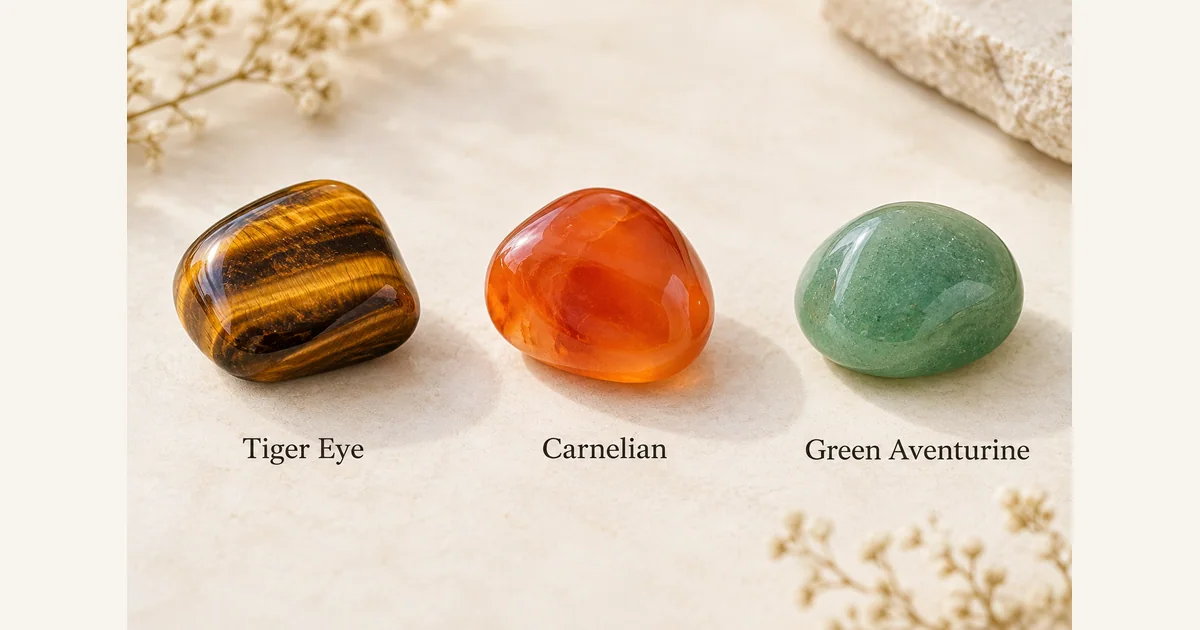
Quick comparison: tiger eye, carnelian and aventurine
Their familiar shop names sometimes conceal important differences. Tiger eye is a chatoyant quartz-rich material with aligned fibrous structures; carnelian is orange-to-red chalcedony; aventurine is usually quartz or quartzite with reflective inclusions. Their similar general hardness does not make their appearance, disclosure or use identical. The table below is a practical starting point, not a substitute for gemological examination where identity is disputed.
| Stone | Common appearance | Main visual clue | What to inspect | Typical symbolic theme |
|---|---|---|---|---|
| Golden tiger eye | Brown and honey-gold, sometimes dark bands | A moving silky line or broad sheen, known as chatoyancy | Turn beneath one light and observe the band from several angles | Steadiness, courage, attention and purposeful action |
| Carnelian | Orange, burnt orange, red-orange or reddish brown | Translucency and glowing edges, sometimes gentle banding | Compare edge and centre under diffuse light; ask about heating | Initiative, creativity, vitality and auspicious warm colour |
| Green aventurine | Pale to deep green; translucent to opaque | Fine mica-related reflections, sometimes subtle | Use oblique light; look for internal specks rather than a moving band | Fresh growth, harmony, renewal and orderly prosperity |
| Red aventurine | Peach, rust red, red-brown or brick orange | Reflective mineral flakes in quartz-rich material | Examine natural-looking grains; distinguish from dyed quartz or glitter glass | Effort, warmth, craftsmanship and energetic activity |
Tiger eye: why the golden band appears to move
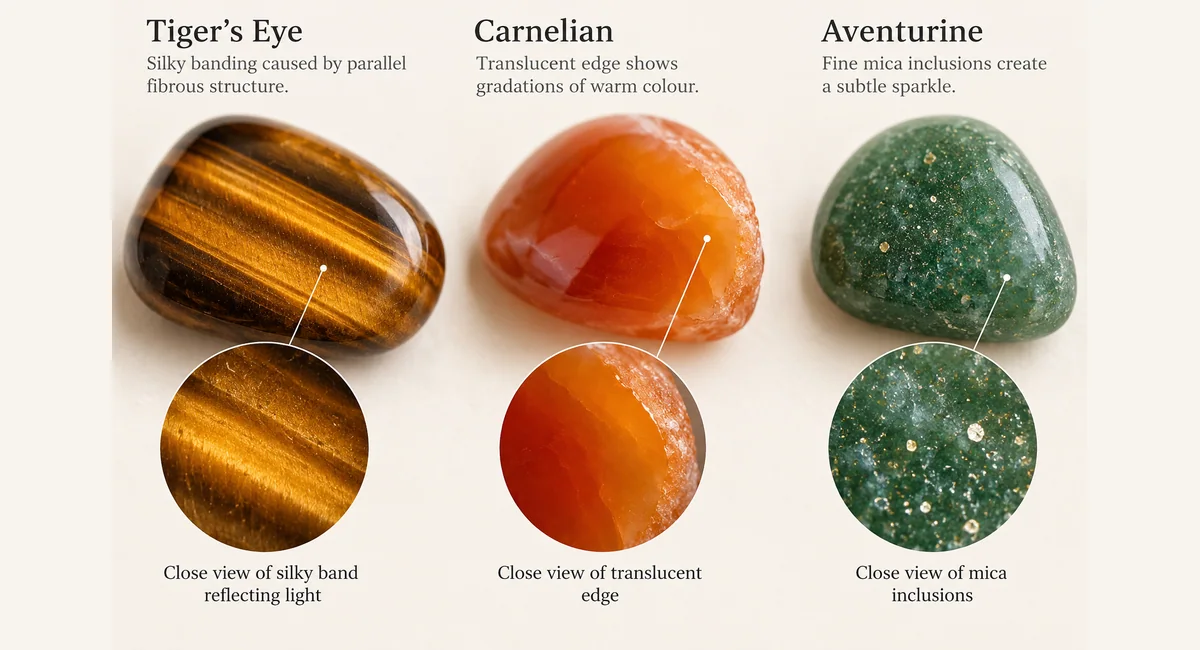
Chatoyancy is the characteristic silky reflection associated with tiger eye. Closely aligned fibrous mineral structures scatter or reflect light so that a band shifts as the viewer rotates the stone. Because a tumble is rounded irregularly rather than cut like a carefully oriented cabochon, the sheen can be broad, interrupted or visible only from a particular direction. That is not automatically a defect. Compare the stone's orientation under a fixed lamp instead of demanding that every surface be equally luminous.
Tiger eye is quartz-rich and associated with original amphibole-fibre structures, often described in trade as crocidolite-related. Iron alteration is significant in the familiar golden-brown colours. Mineralogical explanations of exactly how the quartz and fibres formed have been refined through research; what is important for the buyer is the observable banding, stable polished material and accurate description. The polished stone is not the same as handling loose raw fibrous asbestos material, and it should not be ground or drilled at home without suitable workshop precautions.
Golden tiger eye versus hawk eye: blue-grey hawk eye is another fibrous quartz-related appearance, often less altered in colour; mixed golden and bluish sections can occur. Red tiger eye, meanwhile, can be produced by heating or other enhancement, and deep green or brightly coloured examples may be dyed. Do not describe every red, blue or green commercial piece as a naturally occurring equivalent of standard golden tiger eye. For a four-stone teaching tray, a golden specimen with clear sheen is more educational than a colour-saturated but featureless piece.
The trade expression cat's eye also needs precision. Tiger eye may show a cat-eye-like sheen, but the specific Navagraha gemstone traditionally called Vaidurya or cat's-eye in Jyotisha is commonly associated with chrysoberyl cat's-eye. Selling tiger eye as identical to that material would confuse a decorative stone with a distinct gemstone used in astrological selection.
Carnelian: orange chalcedony, iron colour and translucency
Carnelian is a microcrystalline quartz variety within the chalcedony family. Iron-related colour makes specimens range from pale orange through rich reddish orange to brownish red. A tumble can look almost opaque on a white table yet reveal a warm glow at its thinner edges when held toward a lamp. That depth is a useful visual clue; it differs from tiger eye's travelling band and from aventurine's flake-like reflections.
Purely orange colour does not prove that a pebble is carnelian, because coloured agate, glass, orange jasper and other materials may appear similar. Some carnelian displays soft bands or cloudy patches. In a comparison tray, choose one lighter translucent specimen and one deeper reddish specimen so the viewer can understand variation within the name. A photograph of an intensely red stone is not evidence that the entire delivered lot shares that saturation.
Carnelian has a genuine history as an ornamental and bead-making material, including well-documented ancient South Asian carved and decorated beads. That historical use is more specific than a claim that a particular orange tumbled pebble was prescribed in every classical Vastu text. Today's smooth commercial tumbled forms serve as accessible display, craft and teaching materials, while the older tradition chiefly demonstrates the longstanding esteem of chalcedony as an ornamental gem.
Heat treatment is an important buying question. Heating iron-bearing chalcedony can deepen its orange and red tones; colouring and staining are also encountered in the trade. Neither a rich red hue nor a pale orange hue conclusively establishes whether treatment occurred. If untreated colour is essential for a premium purchase, obtain a lot-specific disclosure rather than attempting heat or chemical experiments on the stone. An appropriately described heated specimen may still be attractive and useful in a decorative set.
Green and red aventurine: the quiet sparkle within quartz
Aventurine is not simply green jade or emerald under another name. Natural green aventurine generally comprises quartz or quartzite with tiny mica inclusions, commonly green fuchsite, that produce a dispersed glimmer called aventurescence. Unlike the single moving streak of tiger eye, numerous little reflective points may brighten separately as the piece moves. Some samples sparkle strongly; others appear more softly mottled and only reveal the effect under angled light.
Red, orange and brown aventurine varieties may derive their colour and reflections from iron-bearing inclusions such as hematite or goethite, or from other mineral mixtures in quartz-rich material. Because commercial labels are not always applied consistently, it is wise to ask for the actual mineral description, especially when purchasing multiple colours from different suppliers. A red pebble with no obvious reflective flakes may still be sold under a trade name, but that claim deserves checking rather than assumption.
The easiest imitation confusion is goldstone—a manufactured glass containing bright metallic-looking sparkling particles. Goldstone can be beautiful as decorative glass, but its composition and manufacturing story differ from natural aventurine quartz. Green or blue glitter glass may be advertised informally as aventurine; ask whether the product is natural quartz, treated stone or manufactured glass. The price tag, glitter intensity or promotional wording alone is not a reliable identifier.
Aventurine also differs from green jade, green agate and green glass. Nephrite and jadeite are separate gem materials; emerald is beryl; dyed agate is microcrystalline silica; and aventurine is a reflective-inclusion-rich quartz material. For a gemstone showroom, a properly labelled green aventurine specimen is a useful educational item precisely because it makes these distinctions visible without pretending to substitute for an astrological emerald.
Three optical effects that must not be confused
Customers may describe all three as “shiny stones,” but the reason for the shine is different. Observing that difference makes it easier to choose authentic-looking specimens, evaluate supplier photographs and explain an item correctly at the counter.
| Effect | What the viewer notices | Stone that illustrates it | Simple observation method | What it does not establish |
|---|---|---|---|---|
| Chatoyancy | A silky band shifts with rotation | Golden tiger eye | Keep a small light still; slowly turn the stone | Country of origin, exact treatment history or relation to chrysoberyl |
| Translucency | Warm colour glows through a thin edge | Carnelian | View the edge against diffuse backlighting | Untreated colour or mineral identity on its own |
| Aventurescence | Many small flakes briefly reflect light | Green or red aventurine | Tilt under side lighting; examine scattered bright points | Natural origin without distinguishing glitter glass |
| Surface polish | Broad smooth highlights from the exterior | All three | Observe the light reflected from the outside surface | The presence of any special internal optical effect |
Traditional symbolism: what belongs to Vastu and what is modern practice?
Indian spatial and devotional traditions refer to Pancha Mahabhuta—Prithvi (earth), Jala (water), Agni (fire), Vayu (air) and Akasha (space)—as a framework for understanding balance, place and activity. In Vastu planning, the southeast is strongly associated with Agni, the southwest with stability and Prithvi, and the centre or Brahmasthan with open space. The symbolic appeal of a warm orange carnelian or earthy gold tiger eye can be understood in this context. The framework is traditional; a standardised prescription naming modern green aventurine tumbles for a particular shelf is not a universal classical rule.
Tiger eye is commonly associated in contemporary gemstone practice with composure, determination and directed effort. Its moving band makes it an evocative reminder to look steadily at a task. Carnelian is often linked with warmth, confidence, craftsmanship and beginning new work. Its colour naturally suggests Agni without implying that it must be kept beside every flame or appliance. Green aventurine is associated with renewal, vegetation and a harmonious working environment; red aventurine with enthusiastic practical activity. These are interpretations commonly used in today's crystal and decorative traditions; they are not identical to a classical astrological gemstone prescription.
For a home altar, symbolism is often most valuable when the arrangement is clean, respectful and connected to the household's actual worship. The deity's image, lamp, offering space and customary practice remain central. A polished tiger eye or carnelian pebble can be placed beside a decorative arrangement as a personal symbol, but it should not compete with the primary ritual objects or obstruct the lamp. In a meditation corner, a single chosen stone may be more meaningful than a crowded heap.
Jewellery and Jyotisha involve another distinction. The Navaratna tradition has named planetary gems, including ruby for Surya, pearl for Chandra, red coral for Mangala, emerald for Budha and chrysoberyl cat's-eye commonly associated with Ketu. Tiger eye is not automatically chrysoberyl cat's-eye; carnelian is not automatically red coral; green aventurine is not emerald. A gemstone being attractive or similarly coloured does not make it a technical astrological substitute. Personal planetary recommendations, when sought, should be understood separately from a decorative Vastu tumbled-stone tray.
How to choose a place: Vastu directions without rigid stone rules
Start with what the space is actually used for. A tidy working desk and good task lighting matter more to daily function than scattering stones in every corner. When a household wishes to use gemstone symbolism, connect the stone with a suitable existing activity and avoid blocking movement, storing items in damp areas or placing unsecured pebbles where children may reach them.
| Setting or purpose | Possible choice | Traditional or symbolic connection | Practical location |
|---|---|---|---|
| Study or focused office work | Golden tiger eye | Steady attention and determined action | A small dish beside books or a desk organiser |
| Craft, design or a new project | Carnelian or red aventurine | Warmth, activity and creative effort; Agni as a symbolic reference | On a stable studio shelf, away from hot tools |
| Plant corner or welcoming display | Green aventurine | Growth and renewal; often read alongside eastern light and fresh beginnings | A dry tray beside—not within—the plant's watering area |
| Small business counter | Tiger eye with green aventurine | Steadiness and harmonious enterprise | A labelled decorative bowl that does not obstruct payment or stock |
| South-east display shelf | Carnelian in an orange-toned arrangement | Agni association in Vastu direction symbolism | A cool, level shelf, not directly beside the stove flame |
These pairings are illustrative choices, not a claim that the same remedy must work in every floor plan. For direction-specific projects, record the actual compass orientation, room use and existing conditions first. A kitchen in the southeast already expresses the Agni principle through its activity; adding an orange pebble does not replace sound ventilation, maintenance or functional planning.
Worked example 1: a study desk in a Bengaluru apartment
Imagine a small apartment with a study desk shared by a student and a working parent. The shelf has a lamp, notebooks and a few family photographs. A neat set of three stones can be arranged as follows: one golden tiger eye at the rear of the dish for a visual reminder of focus, one green aventurine toward the window for the idea of growth, and one carnelian beside the notebook stand for initiative during difficult tasks. The arrangement occupies only a small footprint and can be shifted while cleaning.
In an accompanying card, describe the stones accurately: tiger eye—silky quartz-rich material; aventurine—quartz with reflective inclusions; carnelian—orange chalcedony. The student may prefer the colours without any ritual interpretation. If the family wants a devotional element, they can connect the placement with an established personal study routine or prayer rather than making a guaranteed promise of examination success. That combination of a beautiful object, an accurate label and an actual daily purpose is more useful than placing ten unlabelled stones across the desk.
Worked example 2: a jewellery showroom display
For a showroom selling tumbled stones and malas, build a demonstration tray with three columns: tiger eye, carnelian, and aventurine. Display two pieces of each at slightly different angles so customers can see a broader tiger-eye band, a glowing carnelian edge and a natural-looking aventurine sparkle. Add a small fourth compartment for red aventurine and compare it with orange carnelian. This arrangement creates a useful conversation about what customers are seeing and why two red-orange stones need not be the same material.
Keep the commercial labels concise: species or variety where known, item size, treatment status provided by the supplier, quantity and actual price. “Natural tiger eye with visible chatoyancy” is a description of a verifiable feature when the lot supports it; “guaranteed wealth stone” is not a material description. Where treatment history is unknown, record it as unknown rather than automatically calling the stone untreated. A customer can choose a stone for personal belief, colour, jewellery coordination or collector interest without these reasons being mixed into one unsupported authenticity claim.
Worked example 3: a Vastu consultant's portable colour-and-material kit
A professional demonstrating the five-element concept can use these stones as colour and material illustrations, not as an alternative to surveying the premises. Put gold-brown tiger eye in a clearly labelled tray for stability and disciplined effort; carnelian and red aventurine for warm active themes; green aventurine for a growth theme. Bring a neutral card and a small light so the client can observe real mineral features. Record the property direction independently from the stones; a display sample does not locate northeast or southeast by itself.
The consultant may then explain why the stones were chosen for the presentation and when they are optional. If the client prefers a spare layout, use one specimen rather than prescribing a whole kit. If the location is dusty, damp or used by young children, suggest a secure enclosed display rather than open piles of pebbles. This makes the consultation reproducible and respectful of the client's home instead of treating a gemstone arrangement as a universal building remedy.
Build a twelve-stone comparison and symbolism kit
For teaching or store display, a 12-piece set creates enough variation to show how names apply to different specimens. It also prevents a common problem: one unusually vivid photo becoming the supposed standard for every piece. Start with three examples of each of four varieties, count them in labelled compartments and record representative variations rather than assigning a separate ritual purpose to every pebble.
| Compartment | Contents | Number | Teaching objective |
|---|---|---|---|
| A | Golden tiger eye, preferably different band strengths | 3 | Show direction-dependent chatoyancy and natural colour variation |
| B | Orange-red carnelian, varied translucency | 3 | Compare edge glow, colour depth and chalcedony texture |
| C | Green aventurine, soft to prominent sparkle | 3 | Identify scattered reflective inclusions and green quartz material |
| D | Red aventurine, different shades or grain patterns | 3 | Discuss red quartz-rich material, inclusions and trade descriptions |
| Total | Four labelled groups | 12 | A practical mineral and Vastu demonstration set |
Use a neutral cloth or felt-lined tray with four separated groups. Photograph each compartment from the same distance and keep a record of batch source, average measurements, date received and any known treatments. The set does not need to match perfectly in size; if the lesson includes visual comparison, similar dimensions do make the differences easier to notice. For a gift, select the most attractive three or four specimens and include a short identification card rather than claiming that a particular number is obligatory.
Buying checklist: appearance, quality and disclosure
With polished stones, the label on a bulk bag may be broader than the visible material in each piece. A consistent buying method is more dependable than picking only saturated photographs. Ask for daylight or neutral-light images of the actual lot, not only a heavily edited sample. Inspect the edges and base for chips or fractures. Small natural inclusions can be educational, but significant splits can shorten service life in a handling kit.
| Question | Why it matters | What a useful answer looks like |
|---|---|---|
| Can I see the actual lot? | Representative photographs can hide wide variation | A batch photo plus a few close-up pieces |
| Are the golden tiger eyes visibly chatoyant? | Cut orientation affects the strength of the band | Images or a short rotation view showing the travelling sheen |
| Has carnelian been heated or dyed? | Colour enhancement can alter the buying description | A supplier declaration specific to the offered batch |
| Is this true aventurine quartz or glitter glass? | The material identity changes the product name | A clear mineral/material identification, not a mystical adjective |
| Is size quoted in millimetres or by weight? | Tumbled pieces vary in shape and count per kilogram | Actual ranges for size, approximate weight and quantity |
| What happens with chipped or wrongly labelled pieces? | Teaching and retail sets depend on readable condition | A written replacement and batch-matching policy |
Do not try to verify identity by scratching two polished stones against each other, setting them on fire or exposing them to chemicals. Such tests are destructive, inconclusive for many lookalikes and unnecessary for routine retail selection. Important mineral identity or treatment claims can be investigated using established gemological methods or expert examination. For an ordinary educational tray, clear supplier records, visible distinguishing features and honest labels provide practical value.
Care, cleaning and storage for tumbled quartz-family stones
All three groups are generally suitable for handling as polished decorative material, but a good shine is not protection against a hard fall. Quartz-rich pebbles can chip at weak edges, and friction against rough minerals or metal keys can dull surfaces. Place specimens in a fabric-lined or compartmentalised case for transport. Wash ordinary untreated specimens gently with a soft damp cloth as needed and dry them promptly; where coatings, dyes, fillers or glued attachments are present, follow the supplier's specific care guidance instead.
Avoid repeated exposure to intense heat, aggressive household cleaners, polishing acids, steam or ultrasonic equipment when the material's treatment history is not known. Do not leave a small gemstone display next to a stove, an electrical heater or the edge of a busy counter. If using stones beside plants, keep them separate from wet potting soil and fertiliser. For a puja arrangement, place them well clear of the flame and clean the tray during normal altar maintenance.
Store an information card alongside the stones: name, count, colour description, lot identifier and a dated note of any replacements. A small collection becomes easier to replenish and compare when each group has a stable reference label. Jewellery stores with multiple batches should keep a sample from the accepted lot and note when subsequent deliveries differ visibly in colour or optical effect.
Frequently asked questions
Is tiger eye the same as Vaidurya or cat's-eye gemstone?
No. Tiger eye is a fibrous, chatoyant quartz-rich gem material. In common Indian astrological use, the cat's-eye gem associated with Ketu is typically chrysoberyl cat's-eye. A similar moving band does not make the two minerals or astrological gemstone identities equivalent.
Is carnelian an alternative to red coral in Jyotisha?
Carnelian and red coral are distinct materials. Carnelian is orange-red chalcedony; red coral is an organic gem material. Someone may choose carnelian for colour or symbolism, but it should not be represented as an automatic traditional substitute for a prescribed coral gemstone.
Can green aventurine replace emerald?
Green aventurine is quartz-rich and emerald is beryl. They differ in mineral identity, appearance, rarity and traditional Navaratna association. A green decorative stone may express a similar colour preference, but that does not turn it into an emerald in a gemstone report or planetary recommendation.
Which stone should be kept in the southeast?
The southeast's connection with Agni is an established part of common Vastu direction teaching. Some modern gemstone displays use orange carnelian or red aventurine there to echo warmth and activity. This is a symbolic styling choice, not a universal mandatory stone prescription; room purpose, safe placement and household practice come first.
Why does one tiger-eye pebble shine more than another?
The visual strength of the silky band depends on orientation, internal fibre structure, polishing, shape and lighting. A strongly reflective photo may show the best possible angle. Rotate the actual specimen beneath a fixed light and judge whether its appearance meets the needs of a study kit or decorative purchase.
Does bright glitter mean an aventurine is better?
Not necessarily. Aventurine may display subtle dispersed reflection, and some genuine pieces look almost uniform until tilted. Intensely sparkling material could be natural aventurine, another included stone or manufactured glitter glass. The mineral description and the actual look of the lot are more informative than brightness alone.
Are red aventurine and carnelian the same?
No. Carnelian belongs to the chalcedony family and is valued for orange-red translucent colour. Red aventurine is sold as quartz-rich material with reflective inclusions. Their appearance can overlap in photographs, so compare internal texture, translucency, sparkle and any supplier treatment information before assigning a name.
How many stones are suitable for a small desk or altar?
One carefully chosen piece can be enough. Three specimens make a simple teaching comparison; a twelve-stone arrangement is useful when demonstrating differences between multiple batches or colours. No single number is required for every Vastu display. Choose a count that can be kept clean, safe and visually orderly.
Final selection: material first, meaning second, placement with purpose
Tiger eye, carnelian and aventurine are appealing together because they show three different ways natural-looking polished stones interact with light. Their physical qualities deserve to be understood on their own terms. Their spiritual meanings are best presented as clearly described traditional frameworks and contemporary symbolic associations, rather than invented equivalence to named planetary gems.
For OmmRudraksha shoppers, the practical route is simple: observe the actual stone, check its label, ask about treatments where relevant, and then choose the colour and symbolism that suit the home, workplace, gift or consultation. This allows a small tray to carry real gemstone knowledge alongside a personal sense of beauty and intention.
Continue reading
- Quartz Tumbled Stones: Clear Quartz, Rose Quartz and Amethyst
- Agate, Jasper and Bloodstone Tumbled Stones
- Natural, Dyed, Heat-Treated and Reconstructed Stones
Explore the existing Vastu and gemstone collections for wider context.