Diwali and Dev Deepawali share the language of light, but they are not interchangeable names for the same date. Diwali is a wider festival season with different regional observances. Dev Deepawali is particularly associated with Varanasi and Kartik Purnima. Understanding that distinction helps when choosing a calendar, arranging a visit or preparing a household observance.

The basic difference
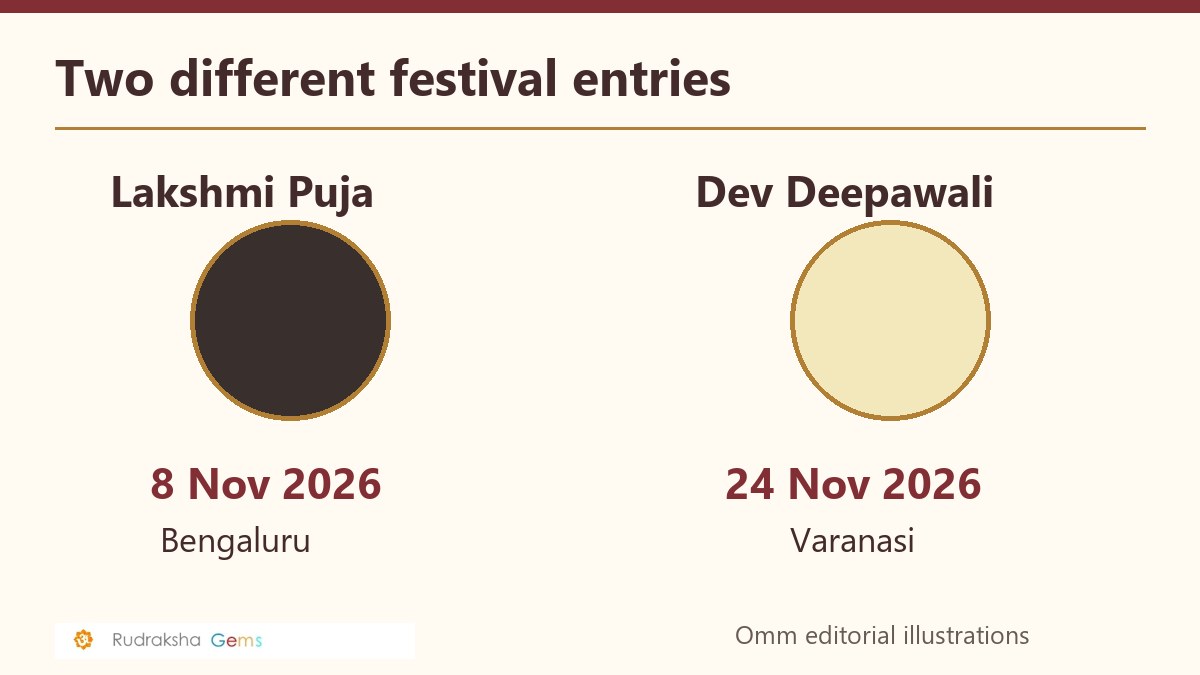
For the 2026 examples below, the Bengaluru calendar places Lakshmi Puja on 8 November. The Varanasi calendar places Dev Deepawali on 24 November. These are location-specific entries for two different observances. They are not competing answers to one question.
| Question | Diwali / Lakshmi Puja example | Dev Deepawali example |
|---|---|---|
| Calendar used here | Bengaluru, 2026 | Varanasi, 2026 |
| Observed date in that calendar | 8 November 2026 | 24 November 2026 |
| Lunar context | Kartik Amavasya for the cited Lakshmi Puja observance | Kartik Purnima |
| What to verify separately | Your regional festival programme and puja practice | Local observance, access arrangements and any current event programme |
The dates come from Drik Panchang's Bengaluru Lakshmi Puja calendar and its Varanasi Dev Deepawali calendar. The table is a date reference, not a universal list of ritual timings.
What the lunar terms tell you
Amavasya and Purnima identify different parts of the lunar month. In this context, they distinguish the new-moon observance from the full-moon observance later in Kartik. A tithi is not simply a midnight-to-midnight civil day, so a calendar may also show its beginning and end across two dates.
That is why a useful calendar check includes the named observance, the city and the year. Copying a date from a festival image without those details can mix a lunar interval, a local celebration and a civil date. Avoid using an exact number of days between festivals as a rule for every year.

Why Varanasi is central to Dev Deepawali
The cited calendar describes Dev Deepawali as a Varanasi celebration associated with the tradition of Shiva's victory over Tripurasura, also called Tripurotsav. Lamps along the riverfront are a well-known part of its observance. These are religious and cultural traditions; the story should be read as a traditional account rather than a historically dated event established by the calendar.
A festival description is also different from a current visitor programme. This guide does not confirm a particular boat service, ghat entry arrangement, procession route or performance time. Obtain those details from the responsible local authority or event operator close to the visit, including the terms of any booking.
Plan a home observance without making a second shopping obligation
If you observe both occasions, begin with the items your household already uses. Decide whether the occasion involves reading, japa, an offering or a gathering. A festival name does not establish that a particular bead, gemstone or jewellery purchase is required.
For prayer beads, the practical questions remain count, handling and construction. Browse the mala collection if you actually need a strand, and compare it with the existing count guide. Keep the buying decision separate from a promise that the purchase will produce prosperity or another specific outcome.
Keep preparation and care separate from ritual claims
A lamp, a strand of beads and a book may share a prayer space, but they need different handling. Keep cords and paper away from a flame, use stable containers and allow the actual materials to dry before storage. Do not apply the same cleaning or offering substance to every object without checking its suitability.
The material-care guide is useful after an observance. It explains physical care without inventing a rule about what a household must do devotionally after a festival.
Are Kartik Purnima and Dev Deepawali exactly the same term?
Kartik Purnima names the lunar observance. Dev Deepawali names a particular festival tradition associated with it, especially in Varanasi. A calendar entry for Kartik Purnima elsewhere does not, by itself, confirm that the local community has the same riverfront celebration or programme.
Can I use these 2026 dates in another year?
No. Keep the year in your notes and look up the next year's location-specific calendar. This article preserves the 2026 example so the dates remain understandable rather than silently changing them to the current year. For a new visit or a timed ritual, verify the new entry instead of reusing an old screenshot.
Diwali, Dev Deepawali and Kartik Purnima: the complete guide to dates, meaning and observance
The names Diwali, Dev Deepawali and Kartik Purnima are sometimes placed together in festival calendars because all three evoke lamps, devotion and the month of Kartik. Yet they are not three interchangeable labels for a single occasion. Diwali or Deepavali is a major festival complex that includes Lakshmi Puja, Naraka Chaturdashi and other observances according to region and community. Kartik Purnima is the full-moon tithi and a day of varied religious traditions. Dev Deepawali is the celebrated festival of lamps associated particularly with the sacred riverfront of Kashi or Varanasi, observed in connection with that Kartik full moon. Knowing the difference prevents mistaken puja dates, confused travel plans and incorrect assumptions about what a household must celebrate.
A calendar is not just a list of fixed Gregorian birthdays. Hindu observance is frequently keyed to the tithi, a lunar angular interval, together with a rule about which portion of a local day or night matters. The same tithi can extend across two civil dates, and sunset is different from city to city. This guide uses two verified 2026 examples—Bengaluru's Lakshmi Puja on Sunday, 8 November 2026, and Varanasi's Dev Deepawali on Tuesday, 24 November 2026—without pretending that those exact civil dates recur every year. A family using a Bengali, Gujarati, Tamil, Kannada, Odia or other regional calendar should follow the named observance in its own tradition.
At a glance: one festival season, three different meanings
| Term | What the name principally identifies | Lunar context | Common focus | Important distinction |
|---|---|---|---|---|
| Diwali / Deepavali | A broader festival of lights comprising regional observances | Especially the new-moon period around Kartik/Ashwin, depending on calendar convention | Lakshmi-Ganesha worship, homes and lamps, community celebrations, family rituals | Not a synonym for Dev Deepawali |
| Lakshmi Puja on Diwali | A specific household or communal observance within the Diwali period | Amavasya and the prescribed evening period in many calendars | Lakshmi, Ganesh, prosperity, gratitude and orderly preparation | Its muhurat is location-specific |
| Dev Deepawali / Dev Diwali | A festival of lamps especially prominent at Kashi's ghats | Kartik Purnima | Deepdan, Shiva devotion, the Tripurasura tradition and the riverfront | Not simply another name for Diwali night |
| Kartik Purnima | A lunar full-moon tithi and observance | Shukla Paksha Purnima of Kartik | Bathing, dana, prayer and many local observances | Its date does not guarantee a Varanasi-style event elsewhere |
| Tripurari Purnima / Tripurotsava | Name linked to Shiva's defeat of Tripura/Tripurasura in traditional narrative | Kartik Purnima | Shiva worship and ceremonial lights | A theological name, not an additional civil holiday |
This table is a vocabulary aid rather than a universal ritual rule. Many communities observe the same festival period with a different emphasis. A visitor should check the actual programme of the city concerned; a household should check the practice it follows rather than making every possible observance compulsory.
1. Verified 2026 dates: Bengaluru versus Varanasi
The Bengaluru, Karnataka Lakshmi Puja calendar gives 8 November 2026, Sunday, as the Diwali Lakshmi Puja observance. The published local Lakshmi Puja muhurat is 6:17 p.m. to 8:20 p.m. (Bengaluru time). The Varanasi, Uttar Pradesh Dev Deepawali calendar gives 24 November 2026, Tuesday, with a published evening Pradoshakal deepdan period of 5:08 p.m. to 7:47 p.m. (Varanasi time). In that Varanasi calculation, Kartik Purnima tithi begins 11:42 p.m. on 23 November and ends 8:23 p.m. on 24 November. These are two distinct city-specific calendar entries, not a single observance with contradictory dates.
2026 calendar comparison and what to write in your diary
| Calendar field | Bengaluru Diwali/Lakshmi Puja | Varanasi Dev Deepawali |
|---|---|---|
| Civil date and day | Sunday, 8 November 2026 | Tuesday, 24 November 2026 |
| Named observance | Lakshmi Puja on Diwali | Dev Deepawali / Tripurotsava |
| Lunar basis | The prescribed Amavasya-evening observance | Kartik Shukla Purnima and prescribed evening period |
| Published local observance window | 6:17–8:20 p.m. | 5:08–7:47 p.m. |
| Location that determines the time | Bengaluru | Varanasi |
| Critical question | Which puja rule and family tradition am I using? | Is this a panchang timing or a public event/boat timetable? |
The above times are almanac timings, not announcements of a particular temple event, crowd-control period, private boat departure or municipal lighting schedule. Recheck any timed visit with the responsible organisers. A calendar updated for one year must not be reused to compute a future year's muhurat. If you are in Mumbai, Delhi, Cuttack, Chennai, Kolkata, Hyderabad, Bhubaneswar or abroad, use your own city when planning a home ritual.
A further subtlety: 8 November 2026 may appear as Krishna Chaturdashi at Bengaluru sunrise, yet that day's evening is used for the Amavasya-associated Lakshmi Puja according to the relevant timing rule. A date table showing the sunrise tithi does not by itself invalidate the evening observance. Compare the designated puja period, not just the name printed at sunrise. On 24 November, by contrast, the Varanasi almanac has Purnima during the daytime and the evening deepdan period. The tithi is a continuous interval, not a promise that every ritual happens precisely at midnight.
2. Understand Amavasya, Shukla Paksha, Purnima and the Kartik month
Amavasya describes the new-moon tithi near the end of the waning half, whereas Purnima is the full-moon tithi at the end of the waxing half. After the new-moon phase, the waxing fortnight is called Shukla Paksha. Kartik Purnima falls after the Diwali new-moon season in this commonly discussed sequence. There are about fifteen lunar tithis between Amavasya and Purnima, but the number of civil calendar dates between named festivals need not be exactly fifteen: an Indian lunar tithi is based on the changing relative angular position of Sun and Moon and does not always match a 24-hour day.
Another source of confusion is the month name. In amanta calendars a lunar month ends at Amavasya; in purnimanta calendars it ends at Purnima. Festival descriptions may therefore put portions of the same period under Ashwin, Kartik or related spellings without changing the underlying Sun–Moon events. A writer who simply extracts one month label from one website and applies it to every regional tradition can create an apparent contradiction that is not real. When sharing a festival date with relatives, give the year, city, festival name and panchang convention rather than only “Kartik eighth day” or a screenshot without its header.
For timed worship, many traditions also apply sunrise, sunset, pradosha, nishita or a different observance-specific rule. One should not assume that every ritual associated with Amavasya is performed at the same hour, nor that all Kartik Purnima customs use the Varanasi evening window. The safest practical workflow is: choose the specific observance first; set the city; select the relevant year; confirm the appropriate tithi and time rule; then check family or temple custom. A festival page offering several unrelated “auspicious times” is not a substitute for this sequence.
Vocabulary that prevents calendar mistakes
| Sanskrit or traditional term | Plain-language meaning | Why it matters here |
|---|---|---|
| Tithi | One of thirty lunar angular divisions in a synodic month | A tithi may span portions of two civil dates |
| Paksha | Waxing or waning lunar fortnight | Places Amavasya and Purnima in the lunar sequence |
| Amavasya | New-moon tithi | Central to many Diwali Lakshmi Puja calculations |
| Shukla Paksha | Waxing lunar half | Leads from new moon toward the full moon |
| Purnima | Full-moon tithi | Lunar basis of Kartik Purnima and Dev Deepawali |
| Pradosha / Pradoshakal | Evening period around sunset, defined in observance-specific rules | Relevant to evening lighting and some puja windows |
| Deepa / Diya | Lamp | Used in Diwali household worship and Dev Deepawali deepdan |
| Deepdan | Offering or dedication of a lamp | A key ritual image associated with Kartik worship in Kashi |
| Snana / Dana | Ritual bathing / charitable giving | Frequently associated with Kartik Purnima traditions |
| Tripurari | Epithet of Shiva as the conqueror of Tripura | Explains the name Tripurari Purnima |
3. What Diwali means across India's different traditions
Diwali does not have one uniform five-day script followed without variation by every Indian family. In many northern and western household calendars, the sequence includes Dhanteras or Dhantrayodashi, Naraka Chaturdashi/Chhoti Diwali, Amavasya Lakshmi Puja, Govardhan Puja/Annakut or related post-Diwali observances, and Bhai Dooj/Bhau Beej. The exact grouping and dates may differ by region, year and tithi overlap. Avoid labelling one local order as mandatory for households elsewhere.
For some families Lakshmi Puja is the centre of the evening. The altar may have an image or murti of Lakshmi and Ganesha, a lamp, fresh flowers, a clean cloth, incense if used safely, simple sweets and family accounting or business ledgers. In Gujarati mercantile practice, Chopda Pujan and the new-year observance have their own importance. In Bengal, Kali Puja during the Diwali new-moon period is especially significant. Some South Indian households place major emphasis on the early-morning Naraka Chaturdashi/Deepavali observance, including an oil bath and family greetings; this should not be flattened into the timing of a northern Lakshmi Puja evening.
Diwali also intersects with distinct histories of other communities. Bandi Chhor Divas, associated with Guru Hargobind in Sikh tradition, is not merely a secondary name for Lakshmi Puja. Jain traditions remember Mahavira's nirvana in connection with Diwali, with their own spiritual significance. Regional legends involving Rama's return to Ayodhya, Krishna and Narakasura, Lakshmi, Kali, and Bali/King Mahabali are not competing laboratory claims; they articulate different devotional inheritances. Respectful writing names the source tradition instead of announcing that one story invalidates another.
Regional Diwali customs: shared light, different priorities
| Region or community | Observance often emphasised | What not to assume |
|---|---|---|
| North Indian household practice | Lakshmi-Ganesha Puja, lights, family gatherings, related festival days | Not every house uses the same puja materials or precise time |
| Gujarat | Business-account worship, Lakshmi, New Year and family visits | The Gujarati New Year is not the same as Dev Deepawali |
| Bengal | Kali Puja and community worship around the new moon | Kali Puja is not automatically a Kartik Purnima festival |
| Tamil Nadu and other South Indian communities | Naraka Chaturdashi/Deepavali traditions, oil bath and family food | Regional morning observances need not copy northern evening timing |
| Maharashtra | Vasubaras, Dhantrayodashi, Lakshmi Puja, Padwa and Bhau Beej in many calendars | The local sequence is not identical everywhere |
| Sikh communities | Bandi Chhor Divas and gurdwara commemorations | Its religious history is distinct from Lakshmi Puja |
| Jain communities | Commemoration of Mahavira's nirvana and spiritual reflection | Do not reduce its observance to shopping or decoration |
Names such as Deepavali, Diwali, Deepotsava, Diwalee and festival-specific local terms may refer to overlapping celebrations. The context matters more than spelling. A family's tradition, and the calendar used by its temple or community, provide better instructions than a generic “one checklist for all India.”
4. Why Varanasi's Dev Deepawali is a distinct festival
The most widely recognised public face of Dev Deepawali is the Kashi or Varanasi Ganga riverfront illuminated by rows of lamps. The spectacle is linked with Kartik Purnima, evening deepdan, prayers, local temple worship and the idea of light offered in devotion. In traditional Shaiva accounts, Shiva is celebrated as Tripurari, the conqueror of the three cities or Tripura and the demon Tripurasura. This is why Dev Deepawali is also called Tripurotsava or Tripurari Purnima in many descriptions. Tell the legend as a sacred narrative of the tradition; do not attach to it a historical calendar date as though it were a dated political battle.
Varanasi's riverfront ghats have complex practical realities. The ritual and public display may involve lamps along the steps, river-facing views, temple visits and crowds. But a panchang page does not certify the city's current traffic restrictions, ghat access, boat licensing, ticket availability, stage performances or security arrangements. Those depend on the municipal and festival authorities and local conditions. A traveler should separate three independent tasks: verify the festival date through a location-specific panchang; verify the public event arrangements through the current official or operator communications; and organise a safe journey and return that does not depend on a single unconfirmed boat ride.
Deepdan can also be a personal act of prayer in an appropriate setting, not solely a mass spectacle. A household may offer a lamp to Shiva, meditate or recite a stotra according to its practice. Participating in or appreciating a cultural event does not require buying a large number of lamps, beads, ornaments or souvenirs. The meaning is the devotion and community, not a compulsory size of purchase. Environmentally attentive practice also matters: avoid leaving nonbiodegradable material, oily containers or plastic in the river or on the ghats, and follow local lamp rules rather than assuming any object can be floated freely.
5. Kartik Purnima has a wider significance than Varanasi alone
Kartik Purnima is the full-moon observance named in several Hindu traditions. It is associated in different communities with sacred bathing, dana (charitable giving), Vishnu worship, Shiva worship, Satyanarayana Puja, deepdan and the culmination of various Kartik-month practices. This diversity does not make the named Varanasi Dev Deepawali programme a universal feature of every Kartik Purnima celebration.
In Odisha, Boita Bandana and Bali Jatra are well-known Kartik Purnima cultural traditions, recalling maritime heritage and including symbolic boats and gatherings. In Sikh tradition, Guru Nanak Gurpurab is linked with the Kartik full-moon period; for 2026 the Varanasi local festival calendar lists Guru Nanak Jayanti on 24 November. In some southern contexts, Karthigai Deepam and related lights traditions occur in their own regional calendar framework; avoid assuming one festival title is simply a translation of another. Pushkar and other pilgrimage places also have Kartik-related fairs or bathing traditions whose exact programmes must be confirmed independently.
A common mistake is to call Kartik Purnima itself “the festival of the gods in Varanasi” without acknowledging that it is first a lunar tithi observed in many places. The better formulation is: Dev Deepawali in Varanasi is observed in connection with Kartik Purnima, while Kartik Purnima supports multiple other local celebrations. A family in Odisha conducting Boita Bandana and visitors watching evening lamps in Kashi can share a lunar date while following very different customs.
Kartik Purnima tradition and location: keep the labels accurate
| Name in a calendar or conversation | Main association | Is it always the same as the Kashi public Dev Deepawali? |
|---|---|---|
| Kartik Purnima Vrat | Full-moon observance, prayer or fasting according to practice | No; describes a religious observance |
| Dev Deepawali (Kashi) | Riverfront lamps and Shiva-linked festival tradition | This is the specifically named local celebration |
| Tripurari Purnima / Tripurotsava | Shiva's Tripura victory narrative | Shares lunar context, not an identical event schedule everywhere |
| Boita Bandana | Odia tradition of symbolic boats and maritime remembrance | No; distinct regional custom |
| Bali Jatra | Fair and cultural celebrations associated with Odia maritime history | No; programme varies with local organisers |
| Guru Nanak Gurpurab | Sikh commemoration of Guru Nanak | Different religious tradition |
| Karthigai Deepam | Tamil lights festival in its own calendar tradition | Do not identify it with Kashi's programme without checking context |
6. Lakshmi, Shiva and the meaning of lamps
A lamp may look outwardly similar across these occasions, but the deity, prayer, household intention and community narrative may differ. A Diwali Lakshmi Puja may invoke Lakshmi and Ganesha in a family or commercial setting and express gratitude for livelihood and order. Dev Deepawali in Kashi is strongly marked by Shiva devotion and the Tripurari story, alongside Ganga reverence and public lamps. Kartik Purnima can include prayers to Vishnu or Satyanarayana, Shaiva worship and many other customary practices. The light itself may symbolise knowledge, auspiciousness, hope, devotion or the overcoming of darkness, depending on the tradition.
That does not mean the same mantra, item list or elaborate ritual sequence should be copied indiscriminately between festivals. A household chanting Om Namah Shivaya during Shiva worship is using a familiar Shaiva invocation; a family beginning with a simple Ganesha prayer or offering flowers to Lakshmi at Diwali is following a different devotional context. A Rudraksha mala can be appropriate for an existing Shiva japa practice, but its presence at an altar does not automatically make every lamp festival a Rudraksha-purchase event. An inherited prayer book, a clean lamp and a sincere family recitation can be entirely sufficient within a household's established custom.
For readers studying Sanskrit, three terms are worth keeping precise: dipa is a lamp, deepdan an offering of a lamp, and arati a form of worship involving the offering of light and other elements. They overlap in materials but are not identical technical descriptions of every regional rite. The role of incense, flowers, grains, sweets, water and lamps depends on the chosen puja procedure. If you are following a priest or a family elder, use the materials they actually specify, rather than a universal ecommerce checklist.
7. Plan an uncomplicated home observance for each occasion
A practical home plan has to serve the occasion rather than turn a festival into a project with endless purchases. Before Diwali, clean and prepare the prayer space, choose safe lamps or lights, check the family's Lakshmi or Kali Puja custom, and keep offerings proportionate. Before Kartik Purnima, decide whether the household intends a short prayer, stotra, charitable act, appropriate deepdan or a temple visit. If observing Dev Deepawali specifically, a Shiva invocation, suitable lamp and family reflection may be meaningful without imitating the scale of the ghats.
Home preparation: items and the reason to use them
| Item | Diwali home use | Kartik Purnima / Dev Deepawali home use | Practical note |
|---|---|---|---|
| Clean altar and cloth | Household puja preparation | Prayer or stotra place | Keep dry and away from the lamp flame |
| Stable diya or enclosed lamp | Common festival of lights item | Deepdan or prayer if customary | Use a fireproof surface and supervise flames |
| Flowers and water | When used in family puja | When used in Shiva, Vishnu or other worship | Fresh, modest quantities usually suffice |
| Puja text or stotra | Lakshmi, Ganesha, Kali or chosen family prayers | Shiva, Vishnu, Satyanarayana or chosen prayers | Choose the correct text and language |
| Rudraksha japa mala | Optional when it serves an established practice | Optional for Shiva japa | Keep away from oil, heat and flames |
| Simple prasada | Shared family offering | Shared family offering where appropriate | Check ingredients and food safety |
| Donation or community service | Optional family practice | Dana is important in many Kartik traditions | Give within means, without pressure |
| Calendar record | Local muhurat, year, city | Local tithi and intended observance | Record the calendar source and year |
A ten-step household workflow: (1) name the intended festival; (2) confirm the local year and date; (3) ask which custom the family follows; (4) clean a safe prayer area; (5) gather the existing supplies; (6) position lamps away from fabric, books and children; (7) keep the prayer or reading text ready; (8) perform the chosen simple worship or reflection; (9) share food or charity according to custom; (10) extinguish flames safely, clean up and store objects dry. This is a planning order, not a mandatory religious liturgy.
For a modest Diwali household celebration, one stable diya may carry the intended symbolism better than an unsafe array of lights. Avoid mixing loose synthetic decoration with flame, placing lit lamps on a wooden shelf without protection, or leaving incense burning near cloth, paper and prayer beads. Where a family uses electricity-powered lamps, the relevant safety checks are sound wiring, suitable indoor/outdoor rating and avoiding overloaded plugs. Devotion and fire safety are compatible; traditional significance does not depend on avoidable risks.
8. Varanasi visitor planning for Dev Deepawali
Visitors often ask whether the date alone is enough to arrange travel. It is not. In 2026 the almanac places Varanasi Dev Deepawali on 24 November, but the specifics of riverfront illuminations, public ceremonies, boat access and viewing areas depend on local operations. Confirm the event details through current official channels before committing to expensive reservations. Avoid sellers who represent an almanac puja window as a guaranteed boat ticket, or promise uninterrupted viewing from a location that might be closed or restricted for crowd control.
Choose accommodation with realistic transport connections; confirm the walking route from the final vehicle drop-off; allow for congestion; carry drinking water and necessary personal supplies; and designate a meeting point if visiting as a group. Ghats have steps, uneven surfaces and potentially crowded approaches. Anyone with mobility limitations should ask about current access arrangements rather than assume a riverside view is reachable without stairs. Night photography can be beautiful, but do not block ritual movement, enter restricted areas, crowd a narrow staircase or put equipment near open flames.
If choosing a boat or river tour, establish the exact embarkation location, duration, cancellation terms, safety equipment and operator authority, and have an alternate plan if the river or authorities restrict movement. Use only authorised services and comply with local directions. When attending a public ritual, ask permission before taking close-up photographs of private worship, keep a respectful distance and avoid leaving packaging or used lamps in the water. A full-moon ritual is not a reason to disregard the river's environmental needs.
Before you pay: visitor planning checklist
| Question to verify | Where the answer should come from | Why it matters |
|---|---|---|
| Which date is Dev Deepawali in this city and year? | Location-specific panchang | Prevents booking the wrong day |
| What public illuminations are announced? | Current event or local-authority programme | A puja tithi is not a programme |
| Are specific ghats accessible? | Current local notices and organisers | Crowd-control rules can change |
| Is the boat operator authorised? | Operator credentials and applicable local rules | Safety and legitimacy |
| What is the ticket's exact service? | Written booking terms | Avoids confusing sightseeing with guaranteed ceremony access |
| How will the group return? | Confirmed route and transport plan | Congestion may be heavy |
| What weather or river restrictions apply? | Current local advisories | Boat and riverfront plans may change |
9. How to compare festival articles, photographs and invitations
Mislabelled festival imagery is a common source of confusion online. A photograph of lamps across the Ganga ghats is likely meant to evoke Dev Deepawali in Kashi; a household Lakshmi-Ganesha altar evokes one form of Diwali worship; a photograph of Boita Bandana may represent Kartik Purnima in Odisha. However, the photograph alone cannot establish the exact date, organiser, city, whether the event was staged, or which year's celebration is depicted. A responsible festival article keeps the caption, location, date and source together.
If you are making a shop newsletter, a family invitation or a school project, use the proper event name and do not silently replace an older date with a newer year. For example, a 2026 Diwali image labelled 8 November, Bengaluru should never be used as proof that Diwali falls on 8 November every year. Likewise, an archival Varanasi ghat image does not prove that a particular ghat, boat or stage will be available on 24 November 2026. If the purpose is educational, identify the narrative tradition without claiming that it is the only pan-Indian story associated with the festival.
A clear caption might read: “Dev Deepawali lamps along the Varanasi ghats; the 2026 local observance is on 24 November.” Another might say: “Family Lakshmi Puja altar during Diwali; Bengaluru's 2026 observance is listed for 8 November.” If the image was photographed in a different year, say so. This simple discipline improves search accuracy, prevents misleading social-media cards and respects regional traditions.
10. Common mistakes when comparing the three occasions
Mistake one: treating Deepavali and Dev Deepawali as synonyms. Their names both contain the idea of light, but they belong to different named observances. Mistake two: assuming Kartik Purnima is only a Varanasi event. It is a broader lunar full-moon observance with other regional meanings. Mistake three: copying a festival date without the city or year. A puja-calendar result that explicitly says Bengaluru is not automatically the correct timed ritual for someone in another time zone. Mistake four: equating the sunrise tithi with an evening rite. The selected muhurat may depend on when the relevant tithi overlaps evening pradosha.
Mistake five: making every household ritual an expensive shopping list. Lamps, prayers, food and existing household devotional materials are often sufficient for the family's practice. Mistake six: assuming a public festival programme is guaranteed by its lunar date. Official access, boat movement and ceremony timing are operational matters. Mistake seven: collapsing all regional Diwali legends into one supposedly universal account. Kali Puja, Naraka Chaturdashi, Lakshmi Puja, Jain observance and Bandi Chhor Divas deserve their respective context. Mistake eight: confusing a religious story with a dated historical report. The Tripurasura story belongs to the sacred narrative context in which it is told.
When an article or video makes an unusually precise claim—such as the total number of ghats illuminated, an exact quantity of lamps, a compulsory mantra count or a guaranteed ritual outcome—ask for its current, relevant evidence. Numbers from a previous celebration can circulate long after arrangements have changed. Precise operational details need primary confirmation; devotional meanings can be stated as traditional significance. This makes the guide useful for readers who are preparing worship, students learning calendar vocabulary and travellers organising a visit.
11. Rudraksha, malas, books and lamps: choosing appropriate materials
OmmRudraksha readers may already use a Rudraksha mala, a short japa strand, a Shiva stotra book or a simple diya as part of daily practice. Those materials do not need to be re-purchased for Diwali or Dev Deepawali. If the intention is Shiva japa, check the mala's actual counting beads and whether there is a separate guru or meru bead. A common full-length counting format is 108 counting beads plus a meru; shorter formats of 54 and 27 can be used for multiple passes where the practitioner's method permits. The important requirement is correct handling and an established practice, not a promise that a particular count will force a result.
Keep devotional objects physically separate from heat and oil. A Rudraksha strand that hangs beside a lit lamp can be damaged by heat, smoke deposits or accidental contact. Gemstone rings and pendants can also include sensitive treatments or glues. Do not automatically wash, oil, immerse or expose mixed-material jewellery to incense smoke because it appeared in a devotional video. After the observance, let clean objects dry appropriately, inspect cords and fittings, and store them away from direct heat or persistent dampness. For an object with a certificate, retain its identification details and care instructions with the item rather than applying a universal treatment.
An informative article can explain the relevance of a mala, stotra, puja tray, diya or kalasha when the ritual actually uses it, without attaching a compulsory gemstone prescription to every festival. Birth-details-based Jyotisha consultations are a separate process; a public festival date alone does not determine a person's individual gemstone recommendation. Similarly, Vastu arrangements should not be inserted into a Diwali-versus-Dev-Deepawali explanation as if they were the necessary basis of the religious occasion.
12. A reusable calendar-checking worksheet for later years
For future years, create a small record rather than copying a promotional poster. Write the full festival name, intended city, calendar year, panchang source, relevant tithi, local muhurat if required, regional custom and programme organiser if there is one. If you are planning a booking, add transport, access and cancellation details in a different section. Distinguish “time for a local religious observance” from “time the public event starts.” Never turn one into the other.
Example worksheet: a verifiable festival record
| Field | Example or instruction |
|---|---|
| Full name | Diwali Lakshmi Puja or Dev Deepawali or Kartik Purnima Vrat |
| Year and city | Bengaluru 2026; Varanasi 2026; or your actual location |
| Civil date | 8 November or 24 November only in the respective 2026 examples |
| Tithi | Record Amavasya or Purnima and the local tithi interval |
| Relevant timing rule | Pradosha, another named muhurat, or none for a general activity |
| Religious tradition | Family or temple custom, not an assumed national uniformity |
| Public programme | Current organiser notice, only if a public event is planned |
| Family supplies | What is already available and what is genuinely needed |
| Follow-up | Reconfirm closer to the date, particularly for travel or timed ceremony |
A family following a Bengali calendar may have more reason to plan Kali Puja than a generic Lakshmi Puja procedure. Someone in Odisha interested in Boita Bandana needs local Kartik Purnima information rather than instructions for a Varanasi boat tour. A Varanasi traveller needs current ghat and transport advisories rather than a general list of festive sweets. A purchaser choosing a mala needs accurate bead and size information, not a calendar claim about spiritual results. Identifying the purpose first makes each next step easier and more accurate.
Frequently asked questions about Diwali, Dev Deepawali and Kartik Purnima
1. Are Diwali and Dev Deepawali the same festival?
No. Diwali or Deepavali is a broader festival season centred on the new-moon period in many regional traditions. Dev Deepawali is associated particularly with Kartik Purnima and Varanasi's riverfront lamps. Their overlapping imagery of light does not make their dates, deity associations or public programmes identical.
2. What is the date of Diwali Lakshmi Puja in Bengaluru in 2026?
The Bengaluru-specific 2026 Lakshmi Puja calendar gives Sunday, 8 November 2026. For that location it publishes an evening puja period of 6:17–8:20 p.m. Use the corresponding city-specific calendar if observing elsewhere; this is not a universal global muhurat.
3. What is the date of Dev Deepawali in Varanasi in 2026?
The Varanasi-specific calendar gives Tuesday, 24 November 2026. It lists the local evening Pradoshakal deepdan window as 5:08–7:47 p.m. A religious time window is not a ticket or confirmation of any stage performance, boating service or ghat opening.
4. Does Dev Deepawali always fall on Kartik Purnima?
The famous Kashi tradition is observed in connection with Kartik Purnima, the full-moon tithi in Kartik. Exact civil-date selection follows the relevant local calendar rules. Check the year and city; do not use one previous year's Gregorian date for the next festival.
5. Why are Diwali and Dev Deepawali on different dates?
They are associated with different points in the lunar cycle. Diwali Lakshmi Puja generally follows a rule connected with Amavasya, while Varanasi Dev Deepawali connects with Kartik Purnima. The new-moon and full-moon phases are separate tithis, so the corresponding civil observances normally occur at different times.
6. Is the number of days between Diwali and Dev Deepawali fixed?
Do not use a fixed number of Gregorian civil days as an annual rule. There are fifteen lunar tithis in the waxing half from the new-moon boundary to full moon, but a tithi need not last exactly twenty-four hours and festival-selection rules can shift the observed civil date. In the cited 2026 examples, the civil dates are 8 and 24 November.
7. Why does the panchang show Chaturdashi on Diwali morning in 2026?
A panchang may show the tithi at sunrise, while the named Lakshmi Puja is selected using the relevant evening overlap. For Bengaluru on 8 November 2026, the local day page shows Chaturdashi at sunrise yet lists Diwali and Lakshmi Puja on that day. Read the actual ritual timing rule instead of comparing only sunrise labels.
8. What does Kartik Purnima mean?
It is the Purnima, or full-moon tithi, associated with the lunar month of Kartik. Across regions it may involve bathing, charity, temple worship, vows, light offerings and community celebrations. It is not restricted to the public Dev Deepawali programme in Varanasi.
9. What is Tripurari Purnima?
This is a traditional name for Kartik Purnima linked to Shiva as Tripurari, the conqueror of the three cities of Tripura. The connection explains the word Tripurotsava in descriptions of Dev Deepawali. It is a sacred narrative association, not a statement that a modern public festival has one compulsory form everywhere.
10. What is the legend of Shiva and Tripurasura?
In Shaiva narrative traditions, Shiva destroys the three cities or fortresses of Tripura, overcoming the power associated with Tripurasura. Dev Deepawali descriptions often connect this victory with lamps and Shiva devotion at Kashi. Details and retellings vary across texts and communities; present it as a traditional account.
11. Why is Varanasi especially famous for Dev Deepawali?
Varanasi combines a longstanding Shaiva sacred geography with the Ganga ghats and a highly visible tradition of evening lamps during Kartik Purnima. The illuminated riverfront is an important visual and devotional expression of the local festival. The exact size and scheduling of any year's public event should be confirmed from current organisers.
12. Is Kartik Purnima celebrated only by Shaiva devotees?
No. Kartik Purnima has associations with Shiva, Vishnu, Satyanarayana worship, charity, pilgrimages and other community practices. In Odisha, for example, Boita Bandana expresses a different regional meaning. These strands share the lunar context but should not be collapsed into one uniform liturgy.
13. Is Dev Deepawali the same as Ganga Aarti?
No. Ganga Aarti describes an offering-of-light worship tradition associated with the Ganga; Dev Deepawali names a festival occasion that can include lamps, prayer and public activity along Varanasi's ghats. A regular aarti schedule, a special festival ceremony and a ticketed river tour are distinct arrangements.
14. Does everyone light lamps on the Ganga during Dev Deepawali?
No. Lamp offerings take different forms. Visitors may attend or observe the riverfront celebration, while households elsewhere may light a diya at home according to their practice. Follow local environmental and safety rules; do not put plastic, metal or unsuitable materials into the river.
15. Are Kali Puja and Diwali held together?
In many Bengali traditions, Kali Puja is associated with the Diwali new-moon period. Its primary deity, worship procedures and cultural practices differ from the Lakshmi-Ganesha Puja followed in some other regions. Use the local Kali Puja calendar and relevant family or temple tradition.
16. Is Naraka Chaturdashi always the same thing as Lakshmi Puja?
No. Naraka Chaturdashi is a distinct observance, important in several regional Deepavali traditions, including many South Indian households. Its emphasis may include early bathing and family rites. Lakshmi Puja has its own date-selection and evening worship context; a year can place them close together without making their ritual requirements identical.
17. What is the significance of Dhanteras within Diwali?
Dhanteras or Dhantrayodashi is a festival-period observance associated in various traditions with Dhanvantari, Lakshmi, household wellbeing and preparation. It precedes the main new-moon Diwali observance in many calendars. Its timing and customs should be checked separately rather than substituted for Dev Deepawali.
18. Is Gujarati New Year another name for Dev Deepawali?
No. Gujarati New Year is linked with the post-Diwali period in Gujarati calendar tradition and has its own business, family and community significance. Dev Deepawali is connected with Kartik Purnima and is particularly prominent in Varanasi. The shared word “Diwali” does not make these celebrations equivalent.
19. How is Odisha's Boita Bandana related to Kartik Purnima?
Boita Bandana is associated with Kartik Purnima and Odisha's maritime heritage. The custom includes symbolic boats and remembrance of voyages and traders; Bali Jatra is a related cultural fair tradition. These are not synonyms for Kashi's Dev Deepawali, even when the dates coincide.
20. Does Guru Nanak Jayanti sometimes coincide with Kartik Purnima?
Yes. In Sikh observance, Guru Nanak Gurpurab is associated with the Kartik full-moon period. The Varanasi 2026 calendar lists Guru Nanak Jayanti alongside Kartik Purnima on 24 November. Its history and worship are specific to the Sikh tradition and should not be described as another form of Shiva Puja.
21. Is Karthigai Deepam the same as Dev Deepawali?
They both use the symbolism of light but belong to distinct regional and ritual traditions. Karthigai Deepam has particular importance in Tamil traditions, including Shiva devotion, and is interpreted through its own calendar observance. Do not label a Tamil festival programme as “Varanasi Dev Deepawali” merely because a date or lamp image overlaps.
22. Which mantra should I chant on Dev Deepawali?
A Shaiva household may use Om Namah Shivaya, a familiar Shiva invocation, or an established stotra if that is part of its practice. Other homes may follow Vishnu, Satyanarayana or family traditions around Kartik Purnima. There is no need to present one commercial mantra package as mandatory for every observer.
23. Is a Rudraksha mala compulsory for Diwali or Kartik Purnima?
No. A Rudraksha mala may serve an established Shiva japa practice, but neither the public date nor the name of the festival alone makes a new mala purchase obligatory. If using a mala, verify the actual bead count, meru construction, cord condition and safe storage near lamps.
24. Can I celebrate both Diwali and Dev Deepawali at home?
Yes, if both occasions are meaningful within your family or chosen practice. Keep the observances distinct: confirm each date, follow the intended worship or reading, and use a modest, safe lamp arrangement. Treat the second occasion as its own devotional context rather than an automatic repetition of every Diwali ritual.
25. Do I need to purchase new diyas for each festival?
No general rule requires it. Reusable clean lamps can be appropriate when suitable for the intended household practice. Inspect them for leaks, unstable bases and residue before lighting, and use fresh wicks or oil where needed. A safe, properly supervised light is preferable to an excessive display.
26. Can I rely on a festival poster for the 2027 date?
Only after verifying the year, location, named observance and calendar source. A shared social-media poster may describe another city or an old year. The examples here are expressly for 2026 and should not be silently carried forward. A current panchang is the proper starting point for a future timed observance.
27. Do Dev Deepawali boat tickets include guaranteed ghat access?
Not automatically. A boat booking, riverfront viewing area, public ceremony and religious timing are separate matters. Obtain the exact boarding point, permitted route, safety arrangements, cancellation terms and any official restrictions from current operators and authorities. A panchang does not certify tourism services.
28. Is Kartik Purnima fasting compulsory for every person?
No universal rule can be inferred from the date alone. Fasting traditions vary with household custom, temple practice, age, circumstances and the form of vrat chosen. An individual can participate through prayer, reading, a suitable donation or a family gathering where their tradition allows; do not assert that all observers must follow one strict regimen.
29. How should I store puja materials after Diwali or Kartik Purnima?
Extinguish and cool all lamps first. Clean reusable vessels according to their material, keep books and prayer beads away from oil and wet flowers, inspect mala strings, and store everything dry. Avoid immersing gemstones, metal-capped Rudraksha or treated jewellery in arbitrary cleaning solutions. The item's actual materials determine its safe care.
30. What is the simplest way to remember all three names correctly?
Remember the sequence new moon, then full moon. Diwali is the broader lights festival around the new-moon period; Kartik Purnima names the later full-moon tithi; Dev Deepawali is a specific festival of lamps—especially prominent in Varanasi—connected with that Kartik full moon. Always attach a year and city when quoting a particular date.
Final quick-reference summary
For 2026, the cited local calendar places Bengaluru Diwali Lakshmi Puja on 8 November and Varanasi Dev Deepawali on 24 November. Their differing dates are expected, not an error. The former belongs to the new-moon festival complex; the latter is associated with Kartik Purnima and the Shaiva Tripurari tradition at Kashi. Elsewhere, Kartik Purnima also carries Odia, Sikh, Vaishnava and other meanings. To plan correctly, choose the specific tradition, year, city, relevant tithi rule and real event arrangements, then keep worship simple, accurate and respectful.