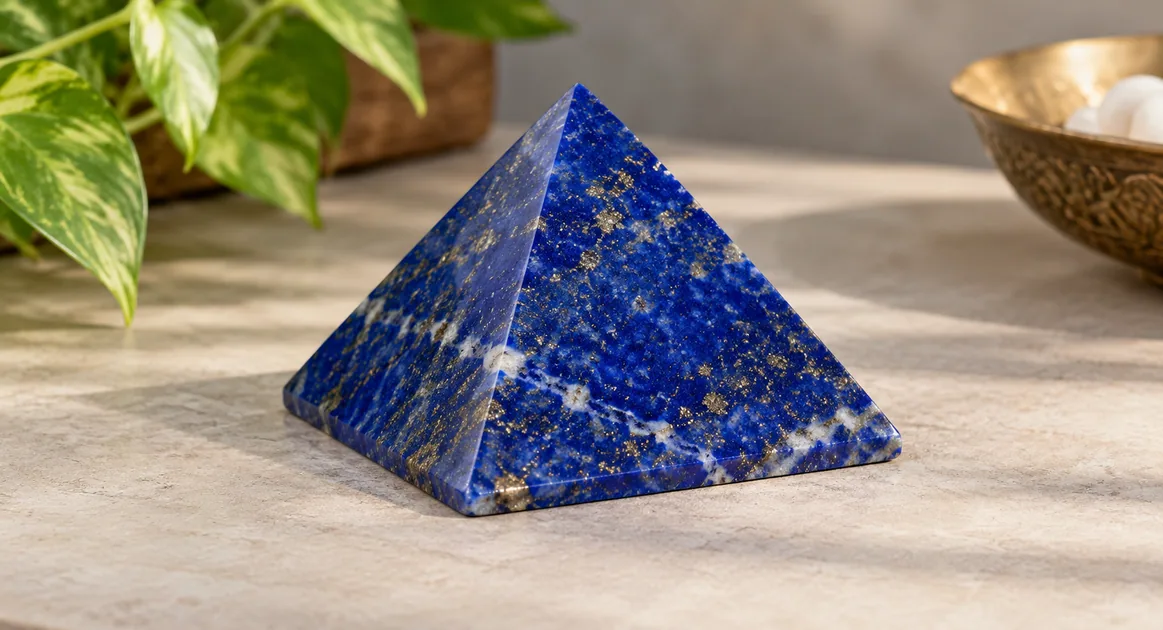
Lapis lazuli pyramids attract attention because their blue is rarely a flat, uniform colour. A face may be saturated ultramarine, another may show pale calcite, and small metallic-yellow specks may catch the light. For a buyer, those variations raise useful questions: Is the carving actually lapis lazuli? What is the blue mineral? Is its surface dyed or waxed? Do the light areas or pyrite flecks change quality? How should a polished pyramid be handled in a puja space, office or shop?
Understanding the real rock makes its Vastu and decorative use more meaningful. Lapis lazuli is a natural mineral aggregate, not a single crystal with a universal composition. Its colour has inspired ornament, art, devotion and personal symbolism for millennia. This guide discusses the geology, quality and trade names of lapis, its distinction from sodalite and blue imitations, practical purchasing checks, the place of blue stones in contemporary Vastu practice, and care that respects mixed minerals and possible surface treatments. A pyramid should be chosen as an actual, accurately described object rather than as a generic royal-blue image.
1. What is lapis lazuli made of?
The essential identity is simple: lapis lazuli is a rock. Its prized intense blue commonly comes from lazurite, a complex sulphur-bearing mineral belonging to the sodalite group. The rock can also include white or grey calcite, brassy-yellow pyrite, and smaller amounts of other minerals such as diopside, mica, amphibole and feldspar. A carved pyramid exposes changing proportions of these constituents on different faces. A uniformly blue piece and a richly mottled blue-and-white piece may both be genuine, provided the material has been correctly identified.
This matters because the chemistry and durability of each inclusion are different. Calcite is softer and more sensitive to acids than many of the other constituents. Pyrite is an iron sulphide mineral, not a piece of gold. Lazurite gives much of the desired colour but it need not occur alone. The full rock, its grain boundaries, filler and any treatment determine what a finished pyramid can tolerate. Gemmological descriptions commonly put lapis at approximately Mohs 5–6, with fair overall toughness, but that shorthand does not imply identical hardness or strength at every point of a mixed-mineral carving.
Lapis is commonly opaque or only faintly translucent in thin areas, with a waxy to vitreous polish. A richly coloured specimen can appear deep blue in diffuse daylight and almost black in underexposed photographs. A pale matrix band can look cream-coloured under warm light. These are reasons to inspect the actual piece in more than one lighting condition; the rock is not defined by a single Pantone-like shade or a perfectly even finish.
| Constituent or property | What it means | Practical consequence |
|---|---|---|
| Lazurite | Important blue-bearing mineral within the aggregate | Blue intensity and evenness vary between carvings |
| Calcite | White or grey carbonate mineral in some lapis rock | Visible pale patches; avoid acids and harsh cleaning |
| Pyrite | Brassy metallic iron sulphide flecks or grains | Decorative sparkle, not gold content or automatic proof of premium grade |
| Other minerals | Possible diopside, mica or amphibole in the mixed rock | Small local differences in strength, tone and texture |
| Mohs hardness | Approximately 5–6 for typical lapis aggregates | Keep separate from harder loose minerals and abrasive objects |
| Surface treatment | Possible dye, oil, wax, resin or protective coating | Changes appearance, disclosure requirements and cleaning choices |
| Carved geometry | Four faces, square base, ridges and a vulnerable apex | Assess corners and join lines separately from mineral colour |
2. Reading the blue colour, white matrix and pyrite flecks
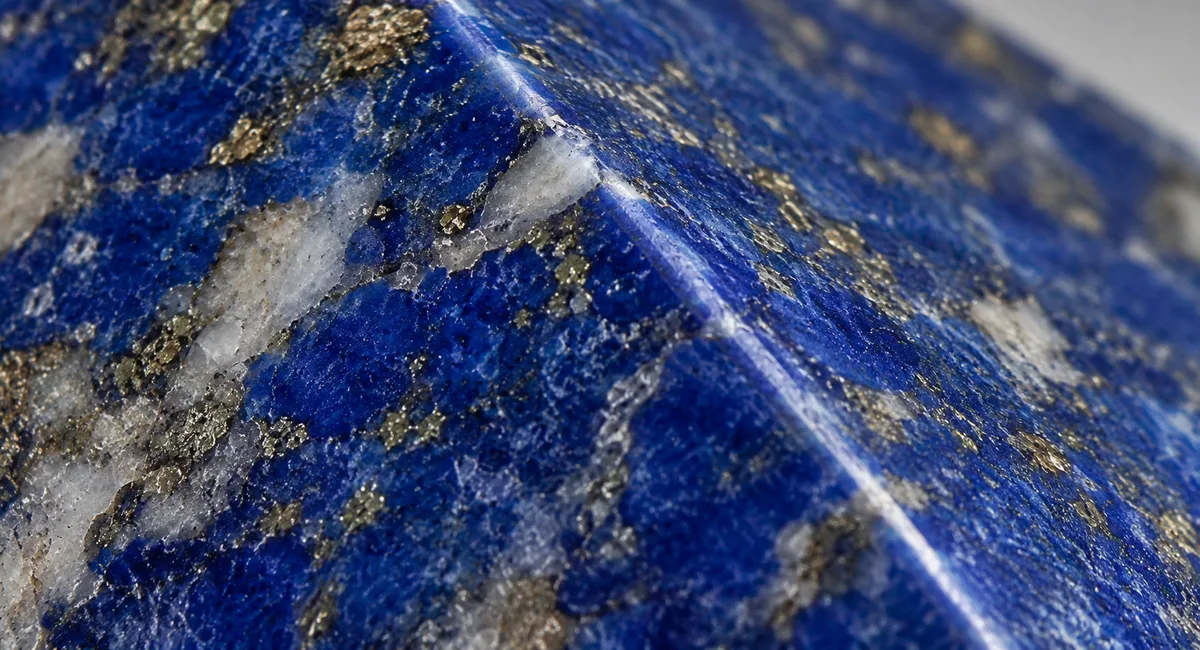
There is no rule that every lapis pyramid must contain a certain percentage of visible pyrite. High-quality material is valued primarily for attractive, richly saturated blue; some desirable pieces show no visible pyrite at all. Fine scattered pyrite can complement the surface, while an overly large or awkward distribution may interrupt the colour. Likewise white calcite can be a natural constituent, although conspicuous white zones often reduce the value of material sold chiefly for a uniform royal-blue finish. These are appearance and valuation criteria, not spiritual measurements.
Watch how the mineral pattern crosses a carved face. Fine pyrite grains may be irregularly dispersed, not painted in a perfectly repeating metallic-dot pattern. A pale vein can continue around one ridge onto the adjacent face or stop where the rough was cut. The point of viewing all sides is not to reject variation but to know which variation you are purchasing. Ask whether the supplied photographs show the exact specimen or a representative product from a batch.
Descriptions such as “starry night lapis,” “royal blue,” “Afghan colour” and “premium blue” communicate an aesthetic preference; they are not definitive laboratory results. A very dark object can photograph as an even blue patch that hides chips, joins or pores. Neutral daylight photographs of the four faces, an underside image, side-lit close-ups of pyrite and calcite, and an accurate dimension/weight listing are more useful than a heavily edited hero photograph.
| Visible feature | Possible explanation | Next check |
|---|---|---|
| Deep rich blue over most faces | Strong lazurite-bearing appearance; may also be treated | Ask specifically about dye, wax and other treatments |
| White irregular bands | Calcite or other pale mineral zones | Check whether bands are stable or contain a crack |
| Small brassy specks | Pyrite may be present | Do not confuse pyrite with gold or infer mine origin |
| No visible metallic specks | Some genuine lapis has little visible pyrite | Judge identity using wider evidence, not absence alone |
| Unnaturally even blue in every crevice | May reflect uniform natural stone, editing or colour treatment | Request unfiltered images and documented disclosure |
| Blue residue at a seam or base | Possible treatment, pigment, polish or unrelated debris | Ask the seller; do not carry out solvent tests at home |
| Open edge, loose grain or flat shiny line | Could be an exposed weakness, repair or assembly | Request close-up and condition declaration |
3. Lapis lazuli versus sodalite, blue sapphire and other blue materials
Sodalite is a mineral species, while lapis lazuli is a mineral-rich rock. Lazurite, the prized blue mineral in lapis, belongs to the sodalite family, but the names are not retail synonyms. Both lapis and sodalite can contain pale calcite and both can be sold in polished blue forms. The common shortcut “sodalite has white veins but lapis has gold flecks” fails because lapis may have white calcite and no visible pyrite, and mineral associations can vary. One visual clue is never a substitute for qualified identification where price or authenticity materially depends on the claim.
Blue sapphire is an entirely different mineral—corundum—and its use in classical Jyotish should not be casually transferred to a lapis pyramid. Dyed howlite or magnesite, coloured glass, resin composites and some ceramics can imitate a blue matrix with metallic-looking additions. A seller might offer a reconstructed product made with chips or powders and a binder: that can be sold as a decorative composite, but should not be described as a single carved natural lapis block.
Appearance and price alone do not decide identity. For ordinary decorative purchases, request complete disclosure, realistic photographs and a reasonable return or inspection policy. For an unusually costly object or an asserted mine origin, consider professional gemmological examination. Physical tests such as scratching, acid application, heating or acetone rubbing are destructive and not sensible customer-side verification methods.
| Material | Identity | Useful distinction |
|---|---|---|
| Lapis lazuli | Blue-bearing aggregate rock with lazurite and other minerals | Variable blue, calcite and possible pyrite; treatment disclosure still needed |
| Sodalite | A separate mineral, sometimes with white matrix | Blue-white appearance overlaps; no single visual test proves a difference |
| Blue sapphire | Corundum gemstone | Not interchangeable with lapis in gemmology or Navaratna Jyotish |
| Dyed howlite or magnesite | Other minerals with added colour | Ask for correct substrate and treatment labeling |
| Blue glass or ceramic | Manufactured decorative material | Can imitate blue colour and added speckles; sold as imitation if appropriate |
| Reconstructed composite | Mixture of particles and binder | Not a one-piece natural lapis carving; cleaning may differ |
| Blue-dyed quartzite | Silica-rich rock with added colour | Hardness, texture, mineral identity and value differ from lapis |
4. Natural, dyed, waxed, oiled and reconstructed lapis
Treatments deserve their own section because lapis can be visually convincing even when altered. Dyeing may deepen the overall blue or make pale calcite zones less conspicuous. Wax, oil or resin impregnation can improve apparent colour saturation, luster or surface continuity. A protective finish is not automatically a defect; it is material information that helps the customer understand appearance, value, maintenance and what was actually purchased. Some formulations age, stain or react to heat and cleaning products, so the object's care instructions should reflect any known treatment.
Fakes may use blue glass, plastic, resin or dyed material to reproduce the look of lazurite and pyrite. Other products are genuinely lapis-bearing but assembled from several sections or stabilized with binders. The most accurate shop label identifies both the underlying material and relevant treatments, for example “natural lapis lazuli, waxed” or “lapis fragments in a resin composite,” when verified. The phrase “natural stone” alone does not answer whether colour is untreated or whether the pyramid is carved from one piece.
A common internet suggestion is to rub a hidden area with acetone or alcohol to see whether blue dye transfers. That is unsuitable for a finished retail object: solvents can remove sealants and damage an authentic but treated carving. Acid tests can also damage carbonate components and are particularly inappropriate. Ask the seller for the treatment history; if it is unavailable, describe the treatment as unverified and avoid unjustified premium claims.
| Claim or process | Reason for concern | Recommended question |
|---|---|---|
| Untreated natural lapis | Appearance alone does not prove untreated status | What evidence supports the no-treatment statement? |
| Dyed lapis | Colour can be enhanced; stability may vary | Is the dye disclosed and how should it be cleaned? |
| Waxed or oiled | Surface can be more sensitive to heat and solvents | Was the finish applied by the supplier or later? |
| Resin-impregnated | May affect apparent polish and maintenance | Is this a stabilised one-piece carving or an assembly? |
| Reconstructed / composite | Actual construction differs from natural carved rock | What particles, binders and coatings are present? |
| “Afghan grade” | Colour-quality term does not prove geographic origin | Is there a traceable source or only an appearance label? |
| “AAA premium” | Seller-defined, not universal grading | What condition, colour and treatment criteria were used? |
5. Pyramid workmanship: apex, edge alignment, base and repairs
A lapis pyramid differs from a cabochon or bead because the cutting geometry exposes long ridges, a pointed apex and a square base. Examine the apex for a clean meeting of faces rather than an excessively blunt, glued or damaged tip; minor asymmetry can be consistent with hand finishing. Check the four ridges for chips, uneven polishing and any unstable pale-mineral zones. Turn it over to check that the base is flat enough to sit securely, free from sharp uneven contact points and labeled if a repaired portion is present.
Natural matrix is not synonymous with a crack. A white calcite vein can be ordinary mineral banding; a deep open fracture with loose edges is a condition issue. Hairline repair resin may be acceptable for a decorative display if disclosed, stable and reflected in price, but it should not be described as an uninterrupted solid specimen. Check large uniformly coloured surfaces for changes in sheen, patchy coating or unnatural seam patterns. A photographic ruler, measured height, square-base width and actual weight are preferable to broad descriptions such as “medium size.”
Because lapis is a multi-mineral rock, the polish may vary from one mineral patch to another. A glossy lazurite-rich area beside a matte calcite patch does not alone show poor workmanship. Evaluate the whole finish: whether the craftsperson worked with the material's natural contrast, whether the edges are safe to handle, and whether the piece stands upright without wobbling. Colour appeal, surface condition and craft quality are different buying factors and deserve separate attention.
| Part | Acceptable variation | What needs disclosure or correction |
|---|---|---|
| Apex | Minor hand-finished asymmetry | Loose particles, breakage, hidden filled tip |
| Faces | Uneven blue, pyrite, calcite and natural grain | Major scuffs, patchy dye, unreported repairs |
| Ridges | Small natural differences in polish | Open cracks or sharp chipped portions |
| Base | Visible mineral pattern and natural underside | Excessive wobble, adhesive joins, unstable support |
| Finish | Waxy-to-glassy appearance according to material | Undisclosed coating or altered colour |
| Specifications | Measured dimensions and realistic weight | Unsubstantiated “perfect” or origin claims |
6. Lapis lazuli in history, art and Indian cultural exchange
The appeal of lapis extends far beyond modern decorative pyramids. Archaeological and historical research traces this deeply blue material through long-distance networks connecting Afghanistan's Badakhshan region with ancient societies in Central and South Asia, Mesopotamia, Egypt and later Europe. The famous Sar-e-Sang mining area is a longstanding source of prized lapis, but a statement that lapis historically came from Afghanistan does not establish that a particular modern pyramid was mined there. Modern lapis-bearing material also comes from other regions, including Chile and Russia.
Its mineral blue played a significant part in artistic culture. Refined lazurite was the source of natural ultramarine pigment, used in historic luxury painting and manuscripts. Research on ancient Buddhist paintings at Bamiyan, within the wider exchange routes of South and Central Asia, shows how precious blue colour circulated across artistic traditions. This history helps explain why intense blue acquired associations with preciousness, knowledge, craftsmanship, nobility and sacred art. Yet the modern four-sided polished pyramid is a contemporary carved decorative form; ancient trade and pigment history should not be stretched into a claim that identical lapis pyramids were prescribed in every classical Vastu treatise.
Within present-day Indian spiritual and decorative practices, people may select a lapis pyramid as a visual focus for Sankalpa (a consciously chosen intention), a thoughtful study area, mantra practice or a calm puja setting. Its blue can be understood through local symbolism, devotional preference and contemporary gemstone traditions. The richer cultural account respects both the rock's documented history and the diversity of actual Indian practice instead of presenting a recent retail convention as a single universal scriptural rule.
7. Vastu symbolism: directions, colour, Pancha Mahabhuta and Sankalpa
In Vastu discussions, a gemstone pyramid is often selected by the function of a space, the practitioner's directional assessment and the material's symbolic associations. A blue lapis pyramid is commonly linked in contemporary crystal and Vastu practice with communication, insight, study, reflection and thoughtful decisions. Different lineages interpret colours and the Pancha Mahabhuta—Prithvi (earth), Ap or Jala (water), Agni (fire), Vayu (air) and Akasha (space)—in different ways. There is no universally authoritative classical instruction requiring every lapis pyramid to occupy a single compass direction in every building.
One family may place it on an orderly study shelf, using its deep blue as a reminder of concentration and precise speech. A consultant may propose a north or northeast location within a broader method, yet the suggestion should be explained in relation to the actual layout, entrance, natural light, existing puja placement and the occupants' practice. A decorative stone does not override ventilation, fire safety, load-bearing shelves or circulation. A meaningful Sankalpa may be written as “I will bring patient attention to my work and communicate clearly,” reinforced through study habits and daily conduct rather than measured by a mineral colour alone.
The pyramid form itself carries a modern visual symbolism of focus and an apex that directs attention upward. It does not make the rock an automatic substitute for architectural Vastu planning or a comprehensive professional assessment. If a professional includes lapis in a multi-stone plan, record the exact intended role and the tradition used; another practitioner may legitimately choose another material. Transparent documentation is more useful to the customer than a one-line claim that a pyramid must always point toward a particular deity or direction.
| Area | Symbolic purpose in contemporary practice | Practical placement rule |
|---|---|---|
| Study desk | Thoughtful speech, attention and learning | Stable shelf away from water glasses, cables and desk edges |
| Meditation corner | Reflection, Sankalpa and a calm visual focal point | Keep beyond reach of candles, oil lamps and incense ash |
| Office meeting area | Clarity of discussion, considered decisions | Put on a secure, nonobstructive display surface |
| Shop display | Inviting blue colour and mineral craftsmanship | Protect from frequent handling and direct strong display heat |
| North/northeast setting | Used by some practitioners according to a wider Vastu method | Check actual plan, directional convention and purpose first |
| Professional consultation kit | Material comparison and client education | Label identity and treatments, with protective compartment |
8. Lapis, Vishuddha, Ajna, Saraswati and Jyotish: keep the systems distinct
Blue lapis is sometimes used in modern chakra work in relation to Vishuddha (throat chakra)—articulation and expression—or Ajna (brow centre)—inner reflection and discernment. An individual may incorporate the colour into a Saraswati-oriented study practice or personal meditation without assuming that the exact mineral is mandated by all classical Saraswati worship manuals. These are meaningful contemporary interpretive connections, but they should be named accurately rather than presented as a unique ancient requirement.
Jyotish and Navagraha gemstone prescriptions are a separate system. The traditional Navaratna framework includes Neelam (blue sapphire) in its planetary context. Lapis lazuli is not automatically identical with sapphire because both are blue, and wearing or displaying lapis should not be described as an equivalent Shani remedy merely on that basis. Some practitioners may use blue stones for symbolic or personal reasons; a chart-based planetary recommendation depends on the client's horoscope, the tradition followed and professional judgment, not just the colour of a retail pyramid.
For a customer who seeks spiritual meaning, discuss their actual goal. If the intention is concentration, talk about an uncluttered desk and a daily study Sankalpa. If the interest is puja, position the carving respectfully within the person's established practice. If the request is a specific planetary correction, route it to a genuine Jyotish consultation rather than assigning an automatic planet. Clear terminology protects the richness of tradition and avoids collapsing Vastu, chakra symbolism, devotion and gemstone astrology into a single vague concept.
9. Case study: a Bengaluru apartment reading corner
Consider a family setting up a compact study nook in an apartment with limited shelving. They find a lapis pyramid with an attractive royal-blue face, one white calcite band and a few scattered metallic specks. Their goal is a visible reminder of patience during exam preparation and focused reading. They first confirm that the item is sold as lapis lazuli rather than “blue sapphire pyramid,” ask whether its polish has been waxed, and request the dimensions so that it fits safely on a bookcase.
The family chooses a low shelf at eye level rather than placing the pointed object beside a laptop charging cable or where young children may knock it down. Their Sankalpa relates to study discipline and clear communication. They do not splash water over the carving during routine cleaning, and it stays away from daily incense deposits. One person may call the setup a devotional reminder; another may view it as an attractive natural stone. The material description and handling plan are valid in either case.
Notice that no part of the decision depends on a universal promise about marks, memory or exam results. It depends on identifying the actual stone, placing it securely and integrating its symbolism with practical daily routines.
10. Case study: a jewellery showroom selecting lapis for display
Now consider a Bengaluru showroom comparing three lapis pyramids. The first has rich even blue and a high asking price. The second is slightly lighter, with natural white areas and evenly spaced brassy pyrite. The third looks unusually dark and glossy in every photograph but comes with no treatment information. The manager requests neutral-light photographs, side and underside views, supplier declarations and accurate size/weight before deciding. The third item is not rejected solely because it is glossy; it is placed in a separate “treatment unverified” category until the supplier can answer.
The display label explains lapis lazuli (natural mixed-mineral rock), possible lazurite, calcite and pyrite, and the known treatment status. A sales assistant avoids the sentence “the pyrite flecks mean real gold.” When comparing the pieces, the assistant explains that evenly saturated blue can be more sought after, natural calcite affects appearance, and small pyrite inclusions are compatible with high-quality lapis. A fair comparison also notes workmanship and the object-specific condition of the tip and base.
For physical merchandising, the showroom uses a clean dry plinth, no acid-based cleaners, and gentle handled demonstrations with a soft base pad. Spiritual associations can be discussed when requested, but do not replace accurate identification and treatment disclosure.
11. Case study: a professional Vastu gemstone reference kit
A professional consultant may carry several blue materials: lapis, sodalite, blue quartz varieties, a piece of dyed howlite labeled as such, and a small manufactured blue-glass imitation. This makes a good teaching collection because it reveals why colour alone is insufficient. The consultant's lapis pyramid is labeled with its source claim if documented, dimensions, visible calcite/pyrite, known treatment and safe handling notes. The blue glass is not mislabeled as a mineral merely to make the collection look premium.
During a consultation, a client asks for a lapis pyramid in a work area. The consultant may discuss the client's intention and the applicable Vastu method, but also checks whether the chosen display position would interfere with the actual office routine. The kit helps compare mineral textures: sodalite may show characteristic blue-white mottling, lapis may include pyrite and calcite, and a synthetic lookalike may have artificial speckles. None of these isolated features is a conclusive test; when mineral identity drives a high-value claim, a qualified gemmological opinion is more appropriate.
At the end, the consultant records why the object was chosen in that specific home or office. The pyramid serves a documented purpose within a wider tradition and remains a durable, well-cared-for sample rather than an unlabeled decorative token.
12. A buyer's sequence: from product photos to informed decision
Step one is to verify the actual product name. Ask the vendor whether “lapis lazuli” describes a single carved natural rock, a treated rock, a resin-stabilised carving or a composite. Step two is to inspect all four faces, the apex, ridges and the underside. Step three is to request the exact dimensions and weight, and an unfiltered photo in diffuse daylight. Step four is to ask for known treatment disclosures, especially dye, wax, oil or resin. Step five is to compare the price to the material's visible quality, disclosed condition and craftsmanship, not an unexplained letter grade.
If the listing claims “Badakhshan Afghanistan,” ask for a verifiable provenance trail. A colour description such as “Afghan blue” or “Chilean style” is not geological proof of origin; even recognized trade nomenclature may refer to appearance. The main risk in buying online is often mismatched expectations about the exact piece delivered. Preserve the product photographs and the supplier's written material statement so that a later discrepancy can be discussed fairly.
| Priority | Buyer action | What to record |
|---|---|---|
| Identity | Confirm lapis lazuli and whether one piece or assembled | Exact material statement |
| Treatments | Ask about dye, oil, wax, resin or coating | Disclosed treatment or status unknown |
| Images | Inspect four faces and underside under realistic lighting | Exact specimen or representative sample |
| Workmanship | Check apex, edges, base and obvious cracks | Damage or stable disclosed repairs |
| Dimensions | Request measured height, base width and weight | Numbers, not vague size categories |
| Provenance | Ask for evidence when a mine/country claim affects price | Documented origin or descriptive trade language |
| Use | Choose a secure place consistent with your practice | Actual shelf, handling and care arrangement |
13. Safe cleaning, storage and display of a mixed-mineral carving
For everyday shelf dust, begin with a soft, clean, dry cloth or a gentle soft brush. If cleaning beyond dusting is necessary and the treatment is known to be stable, a slightly damp, soft cloth with mild soap may be appropriate, followed by immediate gentle drying. Gemmological care guidance recognizes mild soapy water as a safe general cleaning approach for lapis, but recommends care because some dyes and coatings can be unstable. Do not assume that every unknown treated display object should be soaked or scrubbed. When in doubt, keep the cleaning minimal and ask the supplier for the appropriate method.
Avoid ultrasonic and steam cleaning. Keep the stone away from acidic bathroom cleaners, vinegar, lemon juice and harsh surface sprays; calcite-bearing portions can be sensitive to acids. Do not apply acetone, alcohol or paint thinner as home treatment tests. Wax or resin surfaces may react to heat and solvents. In a puja context, protect the pyramid from ghee, oil, kumkum mixtures, incense residue and splashes of abhisheka water, especially if its surface finish is uncertain.
Dry storage matters even for a stone with an attractive polish. Use a padded compartment or soft wrapper, and keep it separated from harder loose stones, metal tools and unprotected jewellery. Store away from direct heat and strong prolonged light that could affect a coating or dye. Keep the pointed apex protected from pressure in shipping cartons; do not pack the rock where a rigid object can strike its tip. Periodically inspect repairs, coatings and mineral boundaries for new changes rather than repeatedly polishing the surface to restore sheen.
| Situation | Preferred practice | Avoid |
|---|---|---|
| Routine shelf dust | Soft dry cloth or brush | Scouring pads and abrasive powder |
| Light surface grime | Only gentle minimal moisture when treatment permits; dry promptly | Long soaking or unknown strong cleaners |
| Uncertain wax/dye | Ask seller or qualified professional | Acetone or alcohol rub tests |
| Puja corner | Place beyond lamps, incense residue and liquid offerings | Repeated water, oil or heat exposure |
| Display lighting | Indirect or moderated light with stable temperature | Strong hot lamps directly against a treated surface |
| Storage | Padded individual wrapping, stable shelf | Loose contact with harder stones and metal objects |
| Transport | Cushion apex and each ridge separately | Pressure directly onto pyramid tip |
14. Eighteen questions buyers and practitioners commonly ask
1. Is a lapis lazuli pyramid a single blue crystal?
No. Lapis lazuli is a rock comprising several minerals, most notably lazurite, with possible calcite, pyrite and others. A pyramid may be carved from one piece of that rock, but its material is still an aggregate.
2. Are golden flecks in lapis actual gold?
Usually they are brassy pyrite. Their colour does not imply precious-metal content or a specific financial value.
3. Must genuine lapis contain pyrite?
No. Visible pyrite is variable and can be absent in attractive natural lapis. It is not an absolute authenticity test.
4. Are white patches necessarily defects?
No. Calcite and other light minerals may be genuine constituents. Large light areas may affect a buyer's preferred appearance and market value; cracks and weakness are separate questions.
5. Is sodalite the same as lapis?
No. Sodalite is a mineral species; lapis is a mixed rock whose blue phase is commonly lazurite. Their appearance can overlap.
6. Can a very evenly blue pyramid still be genuine?
Yes. Some lapis is naturally rich and even. Dye or colour editing can also produce even-looking blue, so request realistic photographs and treatment information.
7. Does “Afghan blue” establish Afghan origin?
No. It may describe a colour or trade quality. A country-of-origin claim needs separate supporting evidence.
8. Can lapis be dyed?
Yes. Dyeing can deepen colour or reduce the visibility of light matrix. Any known treatment should be disclosed.
9. Are waxed or oiled lapis pyramids necessarily poor quality?
Not necessarily. Finishes may improve polish or appearance. The important point is accurate disclosure, realistic pricing and treatment-appropriate care.
10. Can I test the stone by scratching or using acetone?
Do not test a finished carving that way. Scratching and solvents can damage authentic material or coatings. Use qualified examination when identity is critical.
11. What hardness should I assume?
Typical lapis aggregates are commonly described around Mohs 5–6, with differences depending on mineral makeup. Hardness does not prevent edge chipping.
12. Can I wash it during daily puja?
Keep routine cleaning gentle. Avoid repeated soaking, oil, acidic liquids and strong cleaners, particularly when dyes or surface finishes are uncertain.
13. Which Vastu direction is best for lapis?
There is no universally applicable single classical direction for every lapis pyramid. Discuss the actual room, the client's purpose and the specific Vastu tradition used before selecting a spot.
14. Is lapis a Navaratna replacement for blue sapphire?
No. Lapis lazuli is not physically blue sapphire, and similar blue colour alone does not establish an equivalent Shani or Jyotish prescription.
15. What chakra meaning is commonly associated with it?
Some contemporary chakra systems connect its blue colour with Vishuddha and its reflective use with Ajna. These associations belong to particular interpretive practices, not a universal material law.
16. Can lapis be kept near a study area or office computer?
Yes as a safely positioned decorative and symbolic item. Keep it clear of hot vents, edges, wires and drinks.
17. How does a professional kit distinguish lapis from similar stones?
Include labeled samples of lapis, sodalite and known imitations, recording identity, treatment and visible features. Professional testing may be required for an expensive or disputed specimen.
18. What determines the best lapis pyramid to buy?
Accurate identity, appealing blue pattern, declared treatment, craftsmanship, actual dimensions, clean edges, stable base, fair price and suitability for the intended display matter more than a dramatic sales claim.
15. Research basis and final buying recommendation
Mineralogical and gemmological facts in this article were checked against GIA's lapis lazuli description, buyer's guide, quality factors and care guidance, CIBJO gemstone treatment notes, and the International Colored Gemstone Association. Historical context was reviewed against GIA's research on the Badakhshan source, ancient trade and the mineral pigment ultramarine. These names are research attributions, not outbound commercial shopping links.
Choose a lapis lazuli pyramid for Vastu by first confirming the real material, the presence or absence of known dye or wax, and the physical quality of the exact carving. Inspect all four faces, the base and the tip; note the blue colour, natural calcite patches and possible pyrite without reducing the stone to a single visual rule. Then select a secure shelf or puja/study location where its blue symbolism and your personal Sankalpa are relevant. The best description joins material honesty, careful workmanship, culturally meaningful use and responsible long-term care.
Explore existing OmmRudraksha collections
Browse Vastu for the existing collection, or explore gemstone products for other material forms. Each product’s construction and care information should guide your choice.