Sodalite pyramids are often chosen for their deep blue colour, irregular white mineral veins and association with thoughtful speech, study and a calmer workspace. But a good purchase begins with a precise question: is the pyramid genuinely sodalite, or is a similar-looking blue carving being offered under an attractive name? Sodalite and lapis lazuli are different materials. The difference matters for honest descriptions, appropriate care, pricing and the expectations attached to a particular piece.
This guide brings together mineral identification, comparisons with lapis and other blue stones, natural variation, dye and reconstruction questions, pyramid workmanship, Vastu and Sankalpa applications, and practical selection for a Bengaluru home, a jewellery showroom and a professional consultation kit. It keeps the object's observable qualities separate from the cultural meanings a family or practitioner may choose to give it. Each section is intended to help you make a decision rather than rely on a single dramatic photograph or a blanket placement formula.
1. What exactly is sodalite?
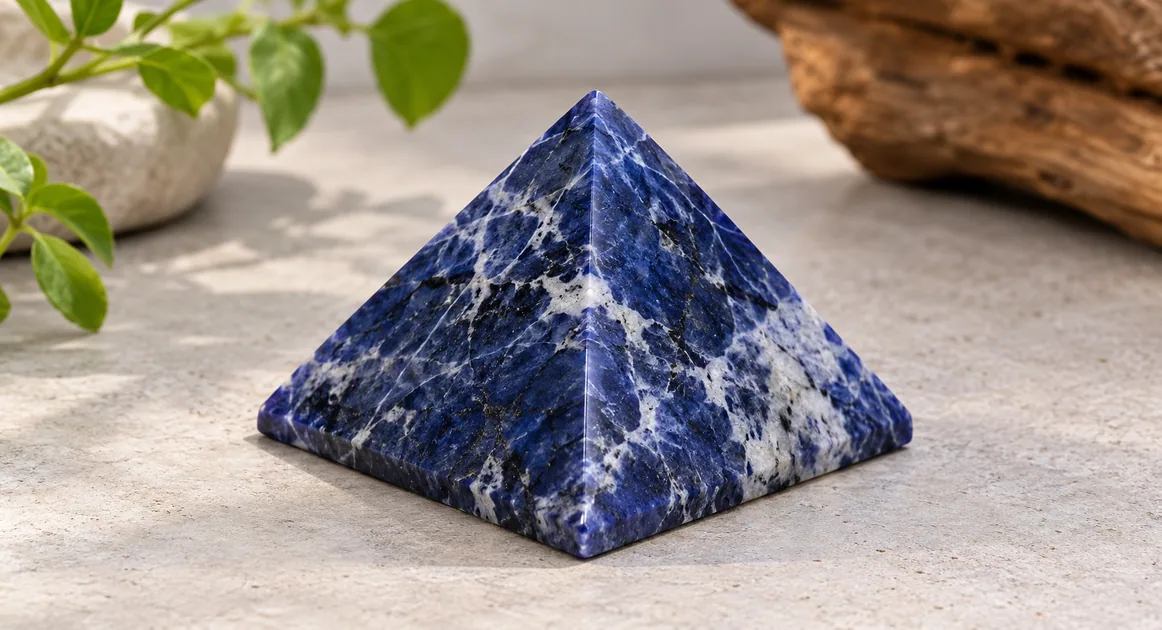
Sodalite is a distinct mineral species: a sodium- and chlorine-bearing aluminosilicate belonging to the feldspathoid group. Its commonly quoted ideal formula is Na4(Al3Si3O12)Cl, also written in doubled form. In nature it can occur as blue, violet, grey, greenish, pale or colourless material. The familiar ornamental blue sodalite is typically fine-grained to massive, and decorative carvings can include other minerals in their host rock or vein network. A polished piece sold as a sodalite pyramid is therefore not necessarily a single chemically pure mineral from apex to base.
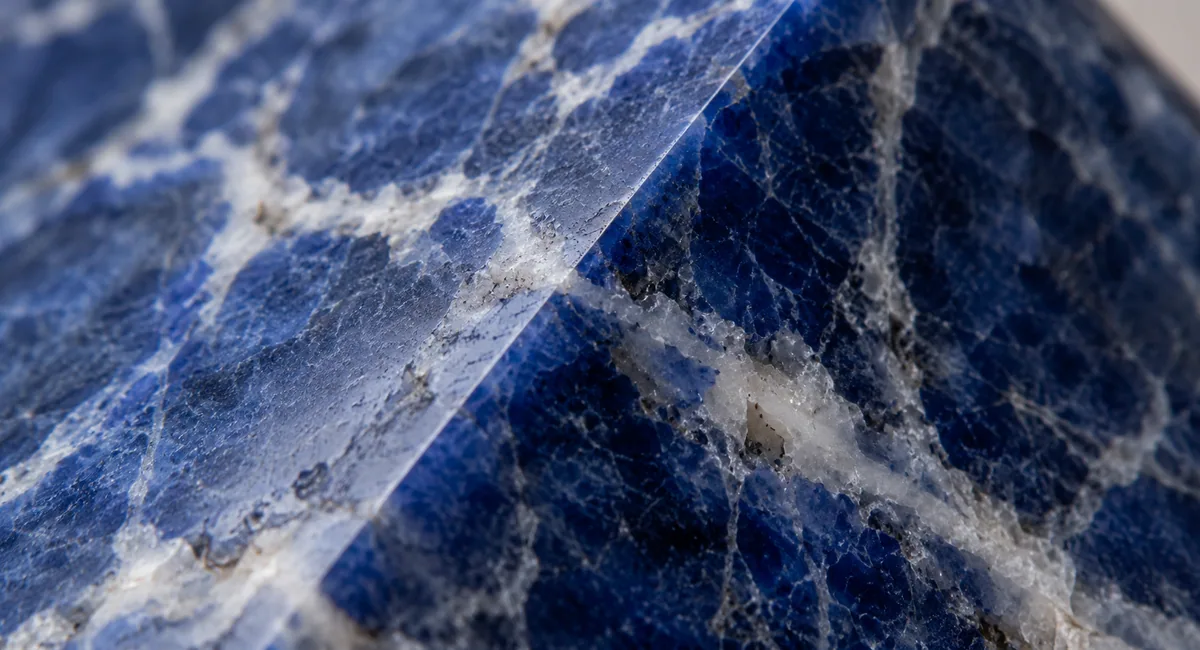
The rich, slightly violet or denim-blue look comes from features of the crystal chemistry; it is not evidence that the object contains cobalt, sapphire or lapis. White or grey patches are common in the decorative material, and calcite may form the pale veins. One side may be almost solid blue while the next has branching white lines, cloud-like patches or small mottled areas. That variation is often part of the appeal: the facets of a pyramid reveal different cross-sections through one piece of stone.
Mineralogical data commonly list sodalite at about 5.5–6 on the Mohs hardness scale, with a white streak, relatively low density for a blue ornamental stone, poor or indistinct cleavage and brittle behaviour. These figures describe the mineral, not every composite of minerals in a marketed carving. A white calcite vein, filled crack, coating or glued join may behave differently from the surrounding blue sodalite. This is why handling advice should be based on the whole object, not on the hardness printed in a catalogue alone.
| Feature | What to understand | Buying implication |
|---|---|---|
| Material | Feldspathoid mineral, often sold as blue decorative stone | Ask whether the piece contains other minerals or repairs |
| Colour | Blue through violet-blue; natural variation is possible | View all faces in neutral daylight and ordinary indoor light |
| Pale veins | Often associated with calcite or other matrix minerals | Veins are not automatic proof of either authenticity or imitation |
| Hardness | About Mohs 5.5–6 for sodalite itself | Keep away from abrasive cleaning and harder stored objects |
| Cleavage/fracture | Poor cleavage, brittle; cracks and corners remain vulnerable | Inspect point, base, edges and any filled fissures |
| Care | Gentle dusting; avoid acids, soaking and harsh cleaners | Ask the seller about coatings and joined sections |
2. Sodalite vs lapis lazuli: similar blue, different identity
The most important distinction is categorical. Sodalite is a mineral; lapis lazuli is a rock composed of several minerals, most notably lazurite, often together with calcite and pyrite. Lazurite belongs to the sodalite mineral group, but that relationship does not make the names interchangeable on a retail label. A sodalite pyramid should not be sold as lapis lazuli merely because the colour appears royal blue in a photograph, and a genuine lapis carving should not be downgraded to sodalite simply because some white areas show on its faces.
Many guides present a simplistic test: sodalite has white veins and lapis has golden pyrite. In practice the world is less tidy. Both may contain white calcite, and lapis can have little or no visible pyrite; mineralogical literature also records pyrite in sodalite-bearing material. A glittering metallic fleck or its absence is therefore a clue to investigate, not a conclusive laboratory identification. Sodalite commonly looks more mottled or veined; good lapis may display a more saturated blue field. Yet their appearances overlap, especially after polishing, lighting adjustments and treatment.
A buyer can use three levels of evaluation. First, inspect ordinary-light photographs of every side and the base. Second, request an honest material and treatment declaration that addresses calcite, pyrite-like flecks, dye and repairs. Third, when a high price or provenance claim materially depends on the mineral identity, obtain qualified gemmological testing. Density, refractive behaviour, microscopy and other professional observations can contribute; neither a home scratch test nor a single shop light is an adequate substitute.
| Question | Sodalite | Lapis lazuli |
|---|---|---|
| What is it? | A mineral species; carvings may include matrix | A rock containing lazurite and other minerals |
| Typical colour | Blue to violet-blue, often mottled | Blue to violet-blue with variable saturation |
| White areas | Common, often calcite-bearing veins | Possible calcite patches or veins |
| Pyrite | Not a dependable exclusion test; rare associations exist | Often present, but not required to be visible |
| Mohs hardness | Usually about 5.5–6 for mineral | Often about 5–6 for mixed rock |
| Price comparison | Typically more accessible ornamental material | Quality and provenance can command higher values |
| Safe conclusion | Name and sell the material as tested or reliably identified | Do not infer authenticity from colour or glitter alone |
3. Reading blue and white patterns across a pyramid
Four broad triangular faces make the stone's internal pattern especially visible. One face may have a clean indigo panel; another may be crossed by a pale diagonal band. Those differences are not automatically flaws, and two pyramids cut from the same rough block need not look alike. What matters is that buyers see a representative view of the actual object, not a carefully selected hero angle that conceals most of its matrix.
Look at the apex first. A thin white vein crossing a point may simply be part of the material, but an open crack, missing fragment or loose filler is a different issue. Rotate the object and examine the four ridges where faces meet, the square base, and any corners that rest against a shelf. Natural irregularities usually follow grain or mineral boundaries; ruler-straight seams, uniform colour drips or glossy lines that interrupt unrelated patterns warrant questions about joining, coating or filling. These observations do not alone establish treatment, and a natural stone can also be repaired properly and disclosed honestly.
Photographing a blue pyramid is deceptively difficult. Warm yellow store lights may suppress blue-violet tones, while strong saturation editing may turn greyish sodalite into an unrealistic electric blue. Ask for one photograph in diffuse daylight, another under ordinary indoor light, and an unfiltered close-up showing pale veins. A scale or ruler helps establish dimensions, although a ruler in the photo is not a substitute for measured specifications. If buying more than one pyramid, ask whether the chosen piece is the exact photographed specimen or one selected from a batch.
| Observation | Reasonable interpretation | Follow-up |
|---|---|---|
| Uneven white veins | Natural matrix may cross blue mineral areas | Request all four faces and underside |
| Very uniform royal blue | Could be naturally uniform, treated or another material | Ask for disclosure; do not conclude by colour alone |
| Blue pooled in cracks | Possible colour concentration; not a diagnostic test | Request treatment history or expert review |
| Gold-coloured specks | May indicate a metallic mineral, but not identity alone | Ask for mineral identification, not a sales label |
| White patch on the apex | May be a normal visible mineral zone | Check structural integrity before dismissing it |
| Glossy straight seam | Possible join, filled break or coating line | Request an underside and side-lit image |
4. Colour treatments, reconstruction and misleading names
The seller's material description should answer four questions: What is the blue material? Has its colour been modified? Is it one carved piece or an assembly? Does a protective surface finish affect appearance or care? Blue decorative materials can be dyed or otherwise treated, and the label should identify relevant known treatments. Common-sounding descriptions such as “AAA blue,” “natural lapis colour” or “premium meditation stone” are not scientific mineral identities.
Lookalikes include dyed howlite, dyed magnesite, blue glass, resin-based composites, and other blue rocks. Some specimens sold under the broad term “blue stone” may be perfectly attractive decorative objects, but they should not carry an unsupported sodalite label. Distinguish a solid naturally coloured mineral from a natural stone that has been dyed, and distinguish both from manufactured glass or an assembled composite. These categories may all be usable as decor when described transparently; their material claims and prices should not be blended together.
Avoid destructive home tests. Scratching with a knife, applying hydrochloric acid, heating a corner, using solvents or rubbing with an unknown chemical can damage a finished specimen and compromise safe handling. Professional observations can include microscopic inspection, density measurement and suitable laboratory analysis. Ask first for straightforward documentation and photographs; send a valuable or disputed specimen for appropriate testing rather than improvising an invasive experiment.
| Retail wording | What you can reasonably ask | Why it matters |
|---|---|---|
| Natural sodalite pyramid | Is this a single carved natural stone? Any treatment or filler? | Sets expectations for composition and care |
| Royal-blue lapis-look | Is the actual material sodalite, glass, dyed howlite or lapis? | Appearance is not identity |
| Reconstructed or composite | What constituents and binders are used? | Different cleaning and durability requirements |
| Hand-polished finish | Any wax, resin, dye or coating? | May change how the surface responds to cleaning |
| Certified genuine | Which independent test? Does its scope match this exact piece? | A general certificate is not specimen-specific proof |
| Premium or AAA | What measurable grading standard is being used? | Trade adjectives are not universal mineral grades |
5. Construction quality: four faces, one stable base
A pyramid has a memorable outline but a demanding finish. Its apex may be a small vulnerable point, its edges can chip, and an uneven base can make the object rock against a shelf. A good carving has the intended proportions, surfaces that are finished consistently for the material, and a stable base. It need not be a perfectly uniform colour. In fact, a real natural-stone carving may show asymmetry or changing bands that have nothing to do with workmanship.
Ask for the base length, overall height and actual weight measured from the specimen or the specific product variant. These figures help establish whether the pyramid suits a work desk, puja shelf, entrance console or consultation sample box. Density varies with composition; do not treat weight as an automatic authenticity test. A comparatively light pyramid might be small or have more low-density material; an unexpectedly heavy one could be larger or contain other minerals. Dimensions, material identity and workmanship should be evaluated together.
The point should be examined under side lighting: a tiny flattened polish at the apex may be a practical finish, whereas a fresh pale impact chip may indicate damage. Check that the base has no sharp burrs and will not scratch furniture. For larger objects, a non-slip felt pad or a stable tray can prevent sliding without hiding cracks or collecting moisture. When a piece is labelled as carved from one stone, visible glue lines or joined slices require explicit disclosure. A repaired piece can remain decorative; the buyer should know what is being supplied.
| Inspection point | Acceptable natural variation | Concern to investigate |
|---|---|---|
| Face colour | Different proportions of blue and white | Unexpected paint-like pooling or concealed repair |
| Point | Neat, mildly rounded finished apex | Fresh chip or unstable filler |
| Edges | Minor variations in polish | Open fracture, sharp loose fragment |
| Base | Natural bands across underside | Strong rocking, crack or unreported join |
| Finish | Vitreous-to-greasy mineral appearance | Peeling coating, tackiness, unexplained dye |
| Specification | Actual dimensions and weight supplied | Stock photos presented as exact specimen without notice |
6. The meaning of blue sodalite in contemporary spiritual practice
The deep blue colour invites comparisons with the sky, night, quiet attention and deliberate speech. In contemporary crystal practice sodalite is frequently associated with reasoning, composure, self-expression and learning. Some practitioners connect blue stones with Vishuddha Chakra, the throat centre associated in yogic symbolism with expression, sound and communication; others discuss Ajna, concentration and discernment. These are interpretive correspondences adopted in modern practice, not a single classical rule that identifies sodalite as a prescribed Vedic gemstone.
There is nevertheless a meaningful traditional context for using a chosen object as a focus of Sankalpa, the deliberate statement of an intention. A student may place a blue sodalite pyramid beside a notebook and quietly resolve to study with patience and honesty. A teacher may use it to remember the importance of measured words. Someone arranging a puja or meditation shelf may value the colour as part of an orderly setting. In each case the actual work—study, speech, reflection or disciplined practice—remains central; the object has significance because the person intentionally incorporates it into a practice.
For devotional symbolism, language and learning are often connected with Saraswati, while auspicious beginnings and obstacle-conscious planning are associated with Ganesha. Those deities should not be claimed as chemically or scripturally exclusive rulers of sodalite. Similarly, naming a mineral blue does not automatically make it a classical substitute for the blue sapphire used in some Jyotish traditions. Sodalite is not one of the classical Navaratna gemstones, and astrological selection depends on a tradition and an individual chart rather than colour alone.
7. Sodalite in Vastu: direction, function and context
Vastu Shastra first concerns the design and use of a space: orientation, openings, movement, light, proportion and appropriate allocation of activities. A decorative gemstone pyramid is a much more recent layer of home practice. It may be incorporated meaningfully, but there is no need to present a universal rule that every sodalite pyramid must face one direction or that every white vein changes its effect. A functional room and a clear purpose are better starting points than moving a decorative object repeatedly to follow conflicting internet lists.
Ashta Dik, the eight-direction framework, is a useful vocabulary for orientation. The north, northeast, east and other directions carry different associations in various Vastu systems, but a carved sodalite pyramid is not a classical direction-specific architectural remedy with one universally settled position. Modern colour-based practices sometimes use blue elements for reflective or communication-focused areas. When using such ideas, record the school of practice and the intention behind the placement; distinguish contemporary suggestions from classical building principles.
For example, a family's northeast study alcove may already be quiet and well lit. A modest blue pyramid can be kept on a secure shelf as a visual cue for learning. A home office may place the object where it is seen during planning rather than on the edge of the working table. A shop may select a blue-and-white specimen for the consultation counter, not because it is guaranteed to change revenue but because its presence reflects the owner's commitment to attentive communication. A professional Vastu practitioner might record why the location was selected and review whether the arrangement improves the usability of the space.
| Setting | Possible location and Sankalpa | Practical priority |
|---|---|---|
| Student's desk | Visible, stable corner; intention of disciplined study | Good task lighting and uncluttered writing space |
| Home library | Shelf near books; symbolism of reflection | Avoid unstable overhead placements |
| Family puja shelf | Side area chosen respectfully within existing tradition | Keep clear of oil lamps, water vessels and heat |
| Professional office | Meeting-space display; thoughtful speech | No obstruction of documents, cables or movement |
| Retail consultation desk | Secure stand visible during discussion | Handle specimens safely; do not block payment area |
| Vastu reference case | Labelled mineral sample with origin and condition notes | Separate samples; preserve accurate identities |
8. What about Budha, Shani, Brihaspati and Navagraha gemstones?
It is tempting to assign every coloured stone to a graha, but traditional Jyotish has its own systems of gemstone correspondence. Budha is commonly linked with emerald in the classical Navaratna system, Shani with blue sapphire and Brihaspati with yellow sapphire. Sodalite does not acquire a classical planetary ruling merely because its blue resembles a Shani-associated gemstone or because some modern writers associate it with communication. Colour analogy, crystal tradition and chart-based prescription are separate kinds of reasoning.
If someone asks whether a sodalite pyramid can substitute for blue sapphire, the useful first response is to clarify the purpose. If the purpose is simple decoration, one may choose the colour and pattern freely. If the purpose is a Navagraha ritual, the traditional material specified by that ritual should not be casually replaced without considering the lineage or instructions. If the request concerns a personal horoscope and gemstone recommendation, the underlying Kundali, Lagna, graha strength, Dasha, Rashi and appropriate practice matter more than retail colour categories. This approach respects both the spiritual tradition and the physical identity of the purchased stone.
The same precision applies to terminology such as energy balancing, protection or prosperity. Such language can accurately describe how a practitioner or family understands a devotional or symbolic practice when presented in that context. It should not be used to obscure defects, treatments, or the actual composition of the object. A thoughtful product page can explain both the material and the cultural association without pretending they are the same type of fact.
9. Choosing a sodalite pyramid for a Bengaluru home
Imagine a family choosing a small pyramid for a study desk in a Bengaluru apartment. There are two available pieces: one is mostly dark navy with a diagonal chalk-white streak, and the other has scattered blue islands among broad white sections. Neither is automatically a better natural stone. The family should decide which design they prefer and then check the actual dimensions, condition and treatment disclosure. A compact specimen may suit a crowded desk better than a large piece that competes with books and electronics.
Because some Bengaluru homes experience humidity during the monsoon, the object should not be left beside a damp window, a constantly wet planter or an air-conditioner drip path. The point should be out of reach of pets and small children, and the base should rest securely. A soft cloth can remove ordinary dust. If the object is placed on a puja shelf, position it away from flame, incense ash, oil, coloured powders and cleaning liquids. Symbolic placement and gentle material care can coexist without complicated rules.
For a family that follows Vastu advice, a simple note records the selected location, why it was chosen, the date, and any planned adjustment to lighting, seating or daily routine. That makes a consultation actionable. The pyramid itself is one element of a thoughtfully arranged environment, not an alternative to solving actual space-planning problems.
10. Retail example: choosing a display piece for a jewellery showroom
A Bengaluru jewellery showroom may want a blue sodalite pyramid at a consultation counter, perhaps as a visual contrast to gold-coloured displays. A high-gloss dark-blue photograph might look attractive online, but the shop should request a current specimen video and clear images of the underside, veins, point and edges. A pyramid that rocks on the counter or contains a concealed glued seam is a poor demonstration piece regardless of colour. Staff should know whether the object is natural sodalite, dyed mineral, composite or another material.
A concise counter card can state the material name, approximate dimensions, characteristic pattern and safe handling instruction. If the retailer discusses modern crystal meanings, it can include “associated with thoughtful speech and reflection in contemporary crystal practice” without describing a specific income outcome. For a gift recipient, a short note explaining the Sankalpa chosen for the gift may be more personal and accurate than a series of absolute promises.
Lighting matters at a counter. Displaying the object under a neutral-white source reveals a more realistic blue-white contrast than saturated LED illumination. The display should not expose the piece to hard impacts from trays, rings or metal samples. When several pyramids are shown together, use individual bases or separators to protect edges and to avoid implying that all have identical natural markings.
11. Professional Vastu reference kit: documentation before symbolism
A practitioner carrying a reference kit may include sodalite alongside lapis lazuli, blue-dyed howlite, quartz, black tourmaline, jasper and other materials. The aim of this arrangement is educational: to show clients how colour, texture, mineral identity and traditional associations differ. Each specimen should have a stable identification label, actual measurements, information on known treatment, a photo reference, and notes about its condition. If identification remains uncertain, record that uncertainty on the label rather than silently upgrading the specimen to a more expensive material.
One useful demonstration places sodalite and lapis samples side by side under diffuse light, then compares the pale veins and overall grain structure. The practitioner can explain why the absence of metallic flecks does not by itself settle the matter. A second demonstration compares natural sodalite with an explicitly labelled imitation or dyed blue stone, focusing on why treatment disclosure is part of ethical purchasing. A third shows how the shape of a pyramid changes where veins are visible on each face. None of these demonstrations requires scratching, heating or wet chemical testing.
| Record field | Recommended entry |
|---|---|
| Specimen ID | Unique, reusable inventory identifier |
| Material | Sodalite; identify known associated minerals if confirmed |
| Appearance | Blue-violet body, irregular pale veins; describe actual piece |
| Dimensions/weight | Measured specimen values, never copied from a similar listing |
| Known treatment | Natural, treated, repaired or unknown as evidence supports |
| Condition | Apex, ridges, base, coating and existing chips |
| Tradition note | Modern communication symbolism; chosen Vastu/Sankalpa context |
| Care note | Soft cloth, protected storage, no acids or abrasive treatment |
12. Cleaning, storage and monsoon-season care
For ordinary dust, begin with a soft dry microfibre cloth or a clean, soft brush. Avoid scrubbing grit across the polished surfaces. If the manufacturer confirms that the finish is compatible with it, a lightly damp cloth can be used for a stubborn fingerprint, followed immediately by thorough drying; do not soak the carving. If the piece contains calcite veins, an acidic household cleaner can react with those areas even if the surrounding sodalite seems unaffected. Vinegar, lemon juice, toilet descaler and acidic polish are therefore poor choices.
Steam and ultrasonic cleaning expose an assembled carving to heat, vibration and fluid penetrating unknown cracks, coatings and joins. They are unnecessary for a decorative pyramid. Avoid aggressive solvents, chlorine bleach, perfume and abrasive polishing compounds. Do not place the pyramid in drinking water or present a mineral-water infusion as a safe care method. Strong direct sunlight can be inappropriate for some treated or colour-sensitive material, while an unshaded windowsill also increases thermal and impact risks. A stable indoor shelf is usually simpler.
Pack the pyramid separately for shipping. Support the base, protect the four ridges and apex without pressing hard on the point, and prevent movement inside a rigid outer box. In a professional sample case, assign each item a separate padded compartment; glass, quartz and metal samples should not be allowed to rub the blue faces. When moving the pyramid, lift it by the body with clean hands rather than grasping the point. After an accidental fall, inspect for tiny chips before placing it where someone may handle it.
| Situation | Preferred approach | Avoid |
|---|---|---|
| Dry household dust | Soft cloth or clean soft brush | Scouring pads or dusty abrasive cloths |
| Fingerprint | Very lightly damp cloth if finish permits; dry immediately | Soaking or hot-water immersion |
| Calcite-bearing veins | Gentle, nonacidic contact only | Vinegar, lemon juice, descaler |
| Unknown coating or glue | Seek supplier-specific advice; start dry | Strong solvent or ultrasonic bath |
| Monsoon storage | Dry padded compartment away from damp surfaces | Wet planter, bathroom or leaking window |
| Transport | Protect point and edges in separate packing | Loose contact with harder stone or metal |
13. Seven buying questions to settle before paying
- Is the material specifically identified as sodalite? A general blue-stone label cannot establish the mineral.
- Are the photographs of the actual specimen? Stock images may hide variation in veins, finish and chips.
- Are any dye, resin, stabilisation, reconstruction or repairs known? Treatment and construction disclosure matter.
- Can I see the apex, all faces and underside? Natural variation is welcome; unreported structural defects are not.
- What are its measured size and weight? Confirm dimensions rather than estimating from props in photographs.
- What care does the particular finish require? A coated or joined stone may need more caution than a solid untreated piece.
- What is the intended use? For a study space, shop display, puja shelf or reference kit, choose the right dimensions and placement before worrying about decorative labels.
14. Frequently asked questions about sodalite pyramids
1. Is sodalite the same as lapis lazuli?
No. Sodalite is a mineral species; lapis lazuli is a rock dominated by blue lazurite with varying associated minerals. Similar blue appearance does not make them identical.
2. Do white veins mean a sodalite pyramid is genuine?
Not on their own. White material can occur in real sodalite-bearing carvings, but lapis lazuli and other decorative materials may show pale veins too. Evaluate more than one feature.
3. Does lapis lazuli always contain gold-looking pyrite?
No. Pyrite is common in lapis but may be absent from the visible surfaces. Gold-coloured flecks alone also do not prove that a blue carving is lapis.
4. Is sodalite a form of quartz?
No. It belongs to the feldspathoid group, not the quartz group. Its chemistry and optical properties differ from quartz and chalcedony.
5. Can sodalite contain calcite?
Yes. White calcite veins are commonly noted in ornamental sodalite material. The finished carving may consequently contain areas with different hardness or cleaning sensitivity.
6. What does a darker blue colour prove?
It proves only that the viewed area appears darker in that lighting. A saturated colour does not establish origin, treatment or grade without supporting evidence.
7. Can a sodalite pyramid be dyed?
Blue ornamental materials can undergo colour enhancement. Ask the seller about known treatments; home observation may raise questions but does not reliably settle them.
8. What is the hardness of sodalite?
Reference data commonly give about 5.5–6 on the Mohs scale. That is not a reason to scratch-test a finished pyramid, especially one with softer veins or repairs.
9. Does a higher weight guarantee a genuine stone?
No. Weight depends on dimensions, density, matrix, fillers and construction. Confirm the declared material independently when identity is important.
10. Is sodalite the same as hackmanite?
Hackmanite is a sodalite variety associated with reversible colour change under particular light conditions. An ordinary blue sodalite pyramid should not be advertised as hackmanite without evidence of that identity and behaviour.
11. Should every sodalite pyramid fluoresce under UV?
No. Responses vary by specimen and excitation conditions. UV fluorescence is a useful specialist observation in some cases but is not a universal home authenticity test.
12. Is sodalite a classical Navaratna gemstone?
No. A sodalite decorative pyramid should not be presented as the classical planetary substitute for blue sapphire or another Navaratna gemstone merely because of its colour.
13. Which direction should a sodalite pyramid face?
There is no single universally established classical Vastu direction specifically for a sodalite carving. Choose a stable, functional place and follow the specific tradition or consultation method used.
14. What spiritual meaning is commonly associated with blue sodalite?
Contemporary crystal traditions often associate it with thoughtful communication, clarity, reflection and learning. Some people use it in Sankalpa or Vishuddha-related symbolism.
15. Can it be placed beside a computer?
Yes as a decorative object if it rests securely, does not obstruct ventilation or work, and is protected against impact. It is not a replacement for electrical safety or good ergonomics.
16. Can I keep it on a puja shelf?
A family may include it as a chosen symbolic item within its own tradition, provided it does not obstruct essential puja objects and stays away from flames, water and oil spills.
17. Can I wash it with vinegar or lemon?
Do not use acidic cleaners. Pale veins may contain calcite or other acid-sensitive minerals, and treatments or joins can also be affected.
18. Is a repaired sodalite pyramid worthless?
No. A disclosed and stable repair may still leave a decorative object fit for its intended use. The description and price should reflect the actual condition and construction.
19. Is an expensive blue sodalite pyramid automatically better?
No. Compare actual identity, attractive natural pattern, craftsmanship, size, documented treatment, finish and condition before judging price.
20. What should a professional Vastu consultant keep on the label?
Specimen identity, size, actual appearance, known treatment, condition, care and the traditional context in which the practitioner uses it. Record uncertainty instead of presenting an uncertain mineral name as verified.
15. Research basis and final decision checklist
For the material facts in this guide, mineralogical references such as Mindat, GIA Gems & Gemology, GIA's lapis lazuli description and the International Gem Society explain the sodalite species, lazurite/lapis distinctions, mineral properties and common lapidary considerations. In particular, gemmological literature documents why pyrite and white veining should not be used as rigid yes-or-no tests. These are research attributions, not recommendations to buy from external commercial pages.
When choosing a sodalite pyramid for Vastu, begin with the physical object. Confirm the stated mineral, inspect all four faces and the base, ask about dye or repair, check the dimensions and choose a secure place. Then, if it is part of your spiritual practice, explain the specific blue-colour symbolism, Sankalpa or reflective habit that makes it meaningful. A good purchase combines proper mineral identification, appealing natural texture, honest disclosure, usable size and respectful traditional context.
Explore existing OmmRudraksha collections
Browse Vastu for the existing collection, or explore gemstone products for other material forms. Each product’s construction and care information should guide your choice.