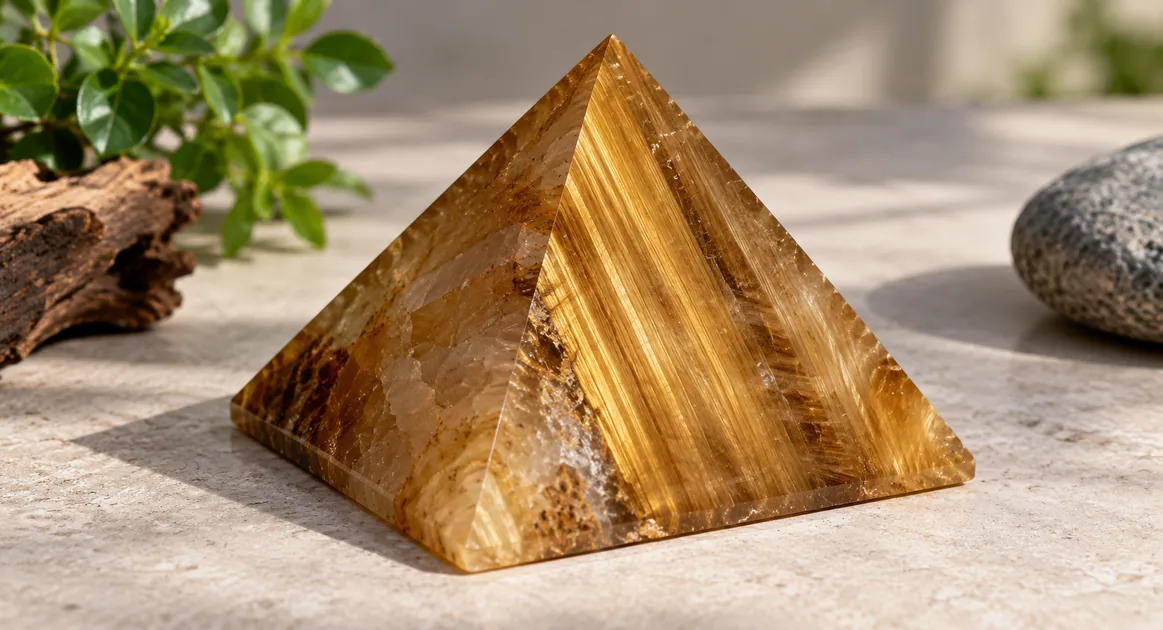
Tiger eye pyramids are golden-brown quartz-based gemstone carvings admired for a bright band of light that seems to travel across the surface when the stone, the light, or the viewer moves. This silky optical effect is called chatoyancy. A beautifully photographed pyramid may show a luminous gold stripe on its front face, yet the adjacent face can look darker because the cut meets the fibres at another angle. That is often a property of the stone and the workmanship, not a defect.
This practical guide explains how tiger's-eye forms, what makes the moving band visible, how to judge all four faces and the point, what red or blue varieties mean, how to distinguish natural stone from dyed or manufactured lookalikes, and how to care for the pyramid. It also explores Tiger Eye Pyramid Vastu placement, the traditional symbolism of Sankalpa, Prithvi and Agni Tattva, courage, Surya, Guru and the Navagraha, and realistic uses in an Indian home, shop and professional Vastu consultation. Material facts and spiritual interpretations are kept clear so buyers can evaluate both thoughtfully.
1. What is tiger eye? Quartz, parallel fibres and golden colour
Tiger's-eye (often written tiger eye or tigers eye) is a chatoyant ornamental quartz material. Its familiar honey-gold, bronze and chocolate-brown zones arise from silica-rich material and altered fibrous amphibole-associated textures containing iron oxides and hydroxides. The appearance is different from clear faceted quartz: the bands look silky because countless tiny, similarly oriented features interact with incident light. The result is particularly striking on a polished dome, sphere, bead or correctly oriented pyramid face.
Reference works often explain tiger eye as quartz replacing crocidolite fibres while keeping the original arrangement. Modern mineralogical research describes a more nuanced crack-seal growth process in which quartz and fibrous amphibole textures developed together and were later altered. It is better to describe the gemstone's fibrous quartz-and-altered-amphibole texture without insisting every piece formed by one simplistic replacement mechanism. GIA's 2025 review of phenomenal gemstones discusses the role of fibrous inclusions in its optical effect.
Natural tiger eye is commonly opaque, with golden-brown bands and a glassy-to-silky surface. As a quartz variety its approximate Mohs hardness is 7, but that number means scratch resistance, not immunity to a knocked apex, a hidden structural fissure, resin filling or damage to a high-polish edge. The exact mineral mix and finishing of a particular carving still matter.
| Property | Typical reference | Why it matters to the buyer |
|---|---|---|
| Material family | Quartz-rich ornamental gem material | Confirm whether the item is carved natural tiger eye or another manufactured material |
| Optical effect | Chatoyancy, a directional moving band of light | Ask for a turning video rather than relying on one bright still image |
| Typical colour | Golden yellow to reddish or chocolate brown | Colour alone is insufficient to establish identity or treatment |
| Mohs hardness | Approximately 7 for quartz | Resists many scratches but the sharp tip can still chip |
| Internal texture | Parallel fibrous mineral features and iron-rich alteration | Light band varies with cut orientation, internal structure and illumination |
| Transparency | Usually opaque | Deep shine does not mean the material is transparent gemstone quality |
| Common disclosures | Colour enhancement, filling, joining or imitation if applicable | Ask what has actually been established for the listed piece |
| Typical uses | Beads, cabochons, polished ornaments and carvings | Pyramid quality depends on both the stone and the cutter's skill |
2. Chatoyancy: why the light band moves when you turn the pyramid
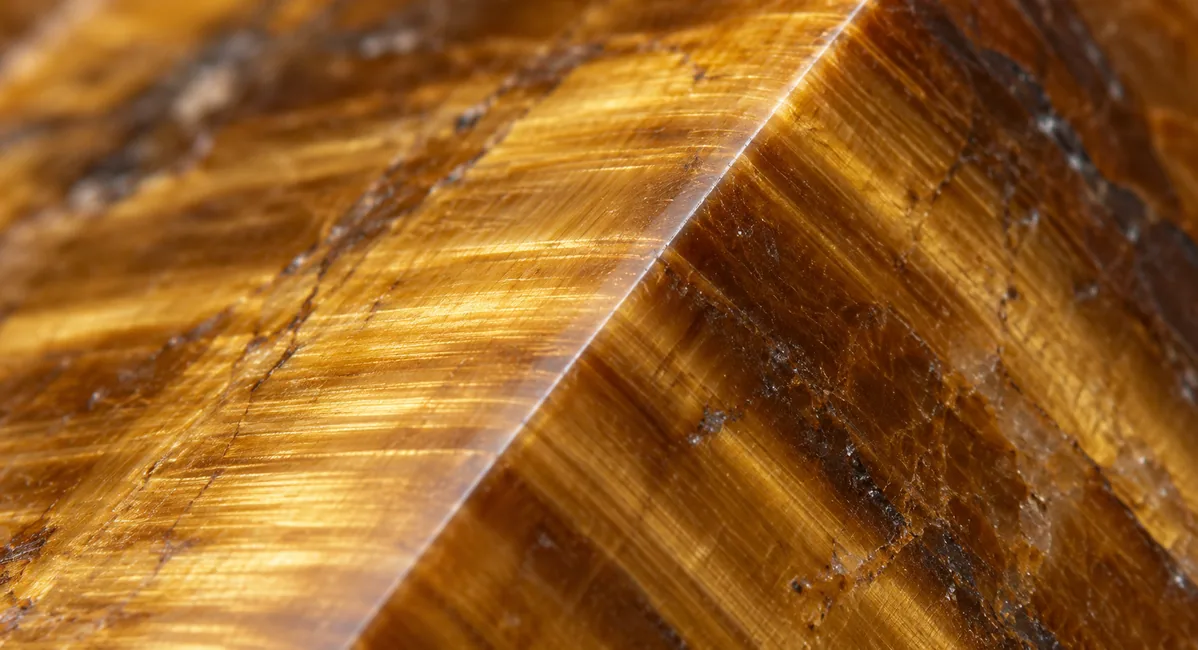
The word chatoyancy comes from the cat's-eye appearance of a shifting light stripe. It is a real optical phenomenon, not a dye, engraving or surface paint. In tiger eye, a densely organized fibrous structure interacts with light. When the relative angle between the fibres, the viewing direction and a light source changes, the brightest band appears to travel. A soft directional lamp or an open window frequently reveals the effect more clearly than diffuse overhead light.
Imagine a flat polished tile with parallel silk threads beneath its surface. From one direction the light falls across many similarly aligned features and a strong, narrow stripe is visible; turn the tile and that reflection changes. A pyramid complicates the experience because its four sloping faces have four orientations. A fibre arrangement chosen for maximum brilliance on the front face cannot always give exactly equal brilliance on the remaining sides.
For a buying video, place the pyramid on a level surface, use neutral side lighting, and rotate the whole object slowly through 360 degrees. Observe whether a clear band travels over at least some faces, whether the pattern is continuous or interrupted, and whether any apparent dull area is simply out of the favourable viewing angle. Do not expect every face to show the same golden highlight in one photograph.
| Observation | Likely explanation | Useful follow-up |
|---|---|---|
| Bright band crosses one face | Favourable orientation of the fibrous structure to light and viewer | Check the same face while turning slowly |
| Neighbouring face looks brown | Different surface angle or fibre alignment | Move the lamp or rotate the object before judging |
| Several bands rather than one | Multiple oriented domains, layers or internal discontinuities | Compare whether the pattern is natural and visually attractive |
| Photograph looks uniformly gold | Strong lighting, editing, or reflective finish may hide differences | Request a neutral-light video of the actual item |
| No band visible in any angle | Weak chatoyancy, unfavourable cut or material needing verification | Ask for other lighting and identity details; do not infer one cause |
| A band terminates suddenly at a line | Natural texture boundary, fracture or possible join | Inspect the line across adjoining faces and the underside |
3. Why a pyramid is different from a tiger eye bead or cabochon
A domed cabochon can be deliberately oriented to gather a strong cat's-eye stripe across its curved front. A pyramid has four flat triangular sides, a pointed apex and a square or rectangular base. Its angular surfaces display changing proportions of sheen, dark bands and colour. That is why the standards for a cabochon should not be copied uncritically to a pyramid. A fine pyramid may emphasize dramatic alternating gold-and-brown faces rather than one perfectly centred eye.
The cutter's decisions include where the fibre direction lies in the rough, which surface becomes the base, how much natural pattern will be lost in trimming, how to keep four faces balanced, and how much polish to apply without rounding the intended geometry. Two pyramids carved from one rough block may look different simply because their optical axes differ. In an honest listing, these differences are strengths to describe, not defects to hide.
For an ornamental object, prioritize the front viewing angle you actually intend to see, sound edges, steady footing and an attractive overall pattern. If the object will stand on a high office shelf, its visible front and side matter more than whether a narrow stripe appears from an awkward low viewing position. A video taken at normal seated and standing eye level is more useful than a dramatic macro view alone.
4. Natural golden, blue hawk's eye, red and coloured tiger eye
Golden tiger eye is the best-known market colour, with yellow-gold to brown bands linked to altered iron-bearing fibres. Hawk's eye (also called falcon's eye) is a naturally blue to grey-blue chatoyant quartz-related variety, often containing less of the brown oxidation colouring. Some pieces show both blue and golden sectors. A seller may accurately describe a mixed blue-gold piece, provided the material itself is identified.
Red tiger eye can be produced by heating golden material, while some naturally reddish-brown pieces can also occur. Do not conclude from red colour alone that a piece is natural, heated or fake. Deep blue, green, purple and highly uniform vivid colours are frequently seen in dyed trade material; exact treatment should be disclosed rather than assumed. Polished tiger eye can be an authentic natural mineral and treated for colour. “Natural stone” and “untreated colour” are different promises.
| Trade appearance | Material description | Disclosure or inspection point |
|---|---|---|
| Golden tiger eye | Yellow-gold to brown chatoyant quartz material | Ask whether colours are natural or enhanced, especially if unusually uniform |
| Blue hawk's eye | Blue-grey fibre-structured chatoyant quartz variety | Separate naturally blue hawk's eye from vividly dyed blue goods |
| Red tiger eye | Reddish-brown chatoyant stone; heating commonly used | Ask explicitly whether heat or dye has altered the colour |
| Green tiger eye | Often dyed original tiger eye material | Request treatment disclosure and use conservative light/cleaning care |
| Rainbow or multi-colour | Sometimes mixed natural zones, sometimes dyed/assembled | Check for unnatural saturated colours and joining, without treating appearance as proof |
| Tiger iron | Decorative rock commonly combining tiger eye, jasper and iron-rich bands | Label as tiger iron rather than a single pure tiger eye stone |
If a supplier advertises a rare “natural electric green tiger eye pyramid,” the correct response is to request evidence and clarify the trade name. Conversely, a properly disclosed dyed piece can still be a decorative object; the concern is an inaccurate description, not the mere existence of a treatment.
5. Tiger eye versus goldstone, pietersite, tiger iron and fibre-optic glass
The market includes several lookalikes, and they are not necessarily inferior decorative objects. They are simply different materials. Goldstone is manufactured glass with sparkling metallic-looking particles, usually more like countless pinpoints than a travelling silky band. Fibre-optic glass can produce a luminous cat's-eye effect that appears convincingly bright, but it remains manufactured glass. A natural tiger eye seller should identify the actual quartz material rather than equating any bright stripe with proof of authenticity.
Pietersite is a striking chatoyant silica-rich ornamental material with disrupted, swirling or brecciated fibrous patterning rather than the comparatively parallel tiger eye look. Tiger iron typically combines tiger eye with iron-rich and jasper-like bands in an attractive layered rock. A listing should say when a pyramid is made from these mixed or related materials instead of silently applying the most familiar name.
| Material | Typical appearance | Key distinction |
|---|---|---|
| Tiger eye | Golden or brown moving silky bands | Natural chatoyant quartz-based fibre texture; band depends on orientation |
| Hawk's eye | Blue-grey chatoyant bands | Related natural blue material, distinct from simply blue-dyed tiger eye |
| Tiger iron | Brown-gold, dark metallic and reddish layered bands | Rock with multiple mineral components rather than solely tiger eye |
| Pietersite | Blue, gold and brown chaotic swirling flashes | Distinct brecciated silica-rich texture and trade identity |
| Goldstone | Uniform glass body with abundant glitter-like points | Manufactured glass rather than natural quartz tiger eye |
| Fibre-optic glass | Strong manufactured luminous stripe | Artificial glass can imitate optical movement |
| Dyed resin/composite | Artificially regular bands, possible mould or bonding signs | Ask for construction and material rather than relying on a colour test |
| Brown agate or jasper | Opaque stripes and scenic patterns | Pattern may be attractive without the same moving optical band |
Photographs are useful for screening but are not a definitive laboratory method. For higher-value claims, material identity and treatment may require qualified gemmological inspection with microscopy, refractive index, spectroscopy or other appropriate tests. Customers should not be instructed to scratch, burn, acid-test or break a saleable pyramid.
6. How to inspect the actual pyramid before buying
Ask for actual-item photographs rather than only a stock representative image. Begin with a straight-on image of each face, a close-up of the apex, and the underside. Then request a gentle turning video in normal light. A tiger eye's pattern is variable; two specimens with the same listed size can have very different chatoyancy. Actual images prevent disappointment when the delivered pyramid does not match the one selected.
Ask for base length and width, total height and actual weight. The phrase “approximately 2 inches” is useful for broad grouping but not a substitute for measured dimensions. Verify that the base sits level, the tip is sound, edges are consistent with the stated finish, and there are no unexplained fillings, joined sections or broken corners. A slight asymmetry does not automatically disqualify a handmade carving, but a rocking base on a high shelf is a practical problem.
| View or disclosure | What to check | Follow-up question |
|---|---|---|
| Front face | Moving band, dominant colour, polish and visual appeal | Will this be the face visible where I display it? |
| Other three faces | Band direction, seam continuity and surface differences | Are quiet faces natural orientation differences? |
| Point or apex | Sharpness, chips, visible filling and stability | Is any damage present before shipping? |
| Underside/base | Flatness, joined construction, adhesive residue and finishing | Can the pyramid stand steady without a hidden support? |
| Rotation video | Movement of chatoyancy in a real lighting condition | Can you show a full turn rather than a staged still? |
| Listing and invoice | Material name, colour treatment, size, weight and return terms | Is the identity supported for this exact object? |
7. Surface lines, fractures, fillers and joined pyramids
Natural-looking streaks are central to tiger eye, but they should not be confused with open fractures that compromise a pyramid. A closed natural grain boundary may appear as a dark line in one face. A structural crack may catch a fingernail, connect to a broken edge or show a gap under strong side light. Never probe an uncertain line with a sharp object; ask the seller for a magnified photograph and accurate description.
Some carvings are made from a single block; others may be stabilized with resin, filled, glued from several segments, or manufactured from powdered material and a binder. These can be priced and cared for differently. A natural mineral matrix is not the same thing as glued assembly. A “solid natural tiger eye pyramid” should mean what the seller says it means, and disclosures should be specific enough for informed comparison.
A good finish does not require polishing away every natural feature. It requires intact geometry, reasonably uniform workmanship and honest presentation. A premium description such as “one-piece tiger eye, golden-brown, minor natural texture, no known dye” is more informative than broad claims about powerful energy or exotic geological rarity without specimen-level evidence.
8. How to judge the moving band in a showroom or on video
Place the pyramid on a stable neutral surface away from harsh spotlights that wash out the darker bands. A small white LED lamp or bright indirect window light can create useful directional illumination. Rotate the object slowly while holding the lamp steady; then keep the object still and move the lamp slightly. These two views reveal whether the visual effect is strongly dependent on lighting and orientation.
Look at the stripe from a normal eye-level distance, not only through a macro lens. A phone camera's exposure processing may make a dark face look brighter or a stripe seem broader than it is. Request at least one unedited video and a clearly stated light source. Natural tiger eye often rewards movement, so a snapshot cannot capture its full appearance; similarly, a weak photograph is not proof of poor material.
For online buying, request a short clip showing the front, left, back and right faces in one uninterrupted rotation. Check whether the footage is of the same physical item as the listing, especially for a natural patterned mineral where no two pieces match precisely. Treat the specimen's character as an individual choice.
9. Vastu meaning of a tiger eye pyramid: resolve, steadiness and intention
In contemporary Vastu and gemstone practice, tiger eye is commonly associated with determination, self-confidence, clear priorities, steadiness and thoughtful action. Its golden glow makes it a popular symbolic choice for a work desk, study table, shop counter or personal Sankalpa practice. The triangular pyramid form can be read as a reminder to direct attention toward a chosen objective. The mineral's moving reflection is a beautiful visual expression of focus, but it is not itself a classical architectural rule.
Sankalpa means a deliberate intention or resolve expressed as part of a devotional, meditative or personal discipline. A person might set a tiger eye pyramid next to a notebook and begin the day by recalling a simple commitment: to keep accounts accurately, make patient decisions, finish a study task or conduct business with steadiness. The stone acts as a physical symbol within that ritual; the real actions remain essential.
The Pancha Mahabhuta offers a traditional vocabulary for symbolic interpretation. The stone's material body can evoke Prithvi Tattva—grounding and structure—while its golden colour can be associated in a modern interpretive way with Agni or the brilliance of sunlight. This symbolic reading is not a scientific classification of mineral energy and should not be presented as an ancient universal rule that every tiger eye pyramid must follow.
For some households, the symbol of courageous steadiness is more meaningful than a fixed compass prescription. Others use a practitioner's room-based Vastu assessment. An article should respect these distinctions, including the family's chosen method, local traditions and the actual function of the room.
10. Tiger eye and Surya, Guru and Navagraha: what is and is not a direct rule
Golden stones are sometimes linked in modern spiritual commerce to Surya, confidence, leadership and radiance; others refer to Guru or Brihaspati because yellow and gold can evoke learning, expansion and auspiciousness. Some discussions describe tiger eye as supportive of disciplined intention, while alternative lists assign different Grahas. These correspondences are not interchangeable with the established Navaratna gemstone tradition. In classical Jyotish practice, for example, ruby is widely associated with Surya and yellow sapphire with Brihaspati.
A tiger eye pyramid for Vastu should therefore not be advertised as automatically equivalent to an astrologically prescribed ruby, yellow sapphire or other planetary gemstone. Chart-based selection can consider Lagna, Rashi, Nakshatra, Graha position, Dasha and the practitioner's interpretive school. A decorative desk pyramid serves a different purpose from a gemstone worn in contact with the body according to a horoscope-based recommendation.
| Framework | How tiger eye may be discussed | Important distinction |
|---|---|---|
| Vastu display | Symbol of steadiness and focused intention in a room | Placement depends on space and tradition; no universal stone-specific classical rule |
| Sankalpa | Personal reminder of resolve and daily discipline | Ritual meaning is personal, not a mineral property measurement |
| Pancha Mahabhuta | Prithvi for solidity and Agni for golden visual symbolism | Interpretive symbolism, not a literal elemental analysis |
| Surya | Golden brightness and leadership symbolism in some modern teachings | Not a substitute for the traditional ruby association |
| Guru/Brihaspati | Yellow-gold colour may prompt learning or growth symbolism | Not equivalent to a prescribed yellow sapphire |
| Manipura chakra | Often associated in modern crystal literature with will and self-direction | Chakra symbolism does not determine mineral authenticity |
| Classical Navaratna | Tiger eye is not one of the conventional nine main gemstones | Do not describe it as a required Navaratna substitute |
11. Which Vastu direction suits a tiger eye pyramid?
There is no single well-established classical Vastu prescription requiring all tiger eye pyramids to face exactly north, east or south-west. Some contemporary practitioners prefer work-related intentions in the north, east or south-east, while others place golden decorative pieces wherever their visibility and room use make sense. A careful recommendation begins with the actual room, entrance, functions, light, compass reading and chosen school of practice rather than a one-size-fits-all slogan.
The Ashta Dik language is nevertheless meaningful in the broader Indian directional tradition. East is related to Indra and beginnings in many Digpala systems, South-east to Agni, North to Kubera, and North-east to Ishana. These traditional directional associations are not themselves evidence that ancient texts prescribed a modern carved tiger eye product to any particular shelf.
| Area | Traditional directional context | Practical way to decide |
|---|---|---|
| East / Purva | Indra, beginnings and orientation in directional traditions | Suitable if it supports a daily intention and avoids intense sun exposure |
| South-east / Agneya | Agni-related functions | Keep away from cooking flames, hot surfaces and cleaning splashes |
| South / Dakshina | Yama in Ashta Dik systems | Prefer a sturdy shelf over an edge near foot traffic |
| South-west / Nairritya | Stability in many contemporary Vastu interpretations | Choose only if it aligns with the family's layout and intention |
| West / Paschima | Varuna in directional tradition | Protect polish and treatments from routine water spray |
| North-west / Vayavya | Vayu and movement | Avoid unstable or frequently disturbed display areas |
| North / Uttara | Kubera and stewardship | A desk or shop counter may be practical if not obstructing work |
| North-east / Ishanya | Ishana and devotional context | Consider household puja customs and keep clear of wet offerings |
The display location should also allow some gentle directional light to reveal the tiger eye's moving band; a completely dark cupboard hides its distinctive visual quality. Direct summer sunlight, repeated handling and insecure high shelves can be undesirable, especially for dyed or filled pieces. A safe, visible and intentional placement is a more defensible practical foundation than a universal promise of prosperity from a compass point.
12. Home example: Bengaluru study desk and family living room
Consider a Bengaluru apartment where one person studies for professional examinations and another works remotely. They want a decorative tiger eye pyramid because the shifting gold band symbolizes alertness and sustained effort. First, they check whether the study desk receives strong afternoon sunlight, whether the stone will interfere with keyboard space, and whether a child or pet can knock the pointed object over. They choose a small stable piece with a flat base, place it on a non-slip tray and view it in indirect morning light.
The family uses the pyramid as a Sankalpa reminder: before starting, they set one measurable study or work objective and review it at the end of the session. If they follow a specific Vastu school, they can separately evaluate room direction and functionality. The stone does not replace sound study habits or financial planning. Its contribution is as an aesthetically meaningful symbol in an intentionally arranged space.
In a living room, the same golden-brown carving may simply complement warm wooden furniture. A family could prefer this location to an altar; another family may include it in a devotional display. Neither choice changes the quartz identity or creates a guaranteed ritual outcome. Care and stability remain relevant in both settings.
13. Shop example: a jewellery counter, billing desk or showroom entrance
Imagine a jewellery showroom in Bengaluru choosing a tiger eye pyramid for a customer-facing desk. The owner associates the golden stripe with clarity of purpose and steady commercial conduct. Rather than placing it at the very edge of the glass counter, the team selects a padded shelf within view but away from merchandise movement. A soft directional light reveals chatoyancy without blinding the customer or producing misleading photographs.
For staff, the pyramid can mark a daily intention to explain treatments accurately, keep invoices clear and treat customers fairly. This is a concrete interpretation of auspicious business practice: an object serves as a visible reminder of conduct. If someone asks whether tiger eye promises sales growth or “absorbs negative energy,” the shop can discuss the contemporary traditional association without presenting a measurable guaranteed outcome.
For catalogue photography, the showroom should show the actual pyramid in several lighting conditions and disclose weight, dimensions and treatments. The same disciplined practice benefits both visitors and online customers. An attractive moving band is part of the product's character, but an accurate description builds longer-term customer trust.
14. Professional Vastu kit: use tiger eye as a reference specimen
A professional Vastu practitioner or gemstone educator may keep tiger eye alongside hematite, carnelian, aventurine, citrine, labradorite, agate and other materials to illustrate how mineral identity, surface appearance and symbolic associations differ. Tiger eye is particularly useful for demonstrating chatoyancy: a neutral lamp, turning tray, labelled specimen and short instructional video show why cutting orientation matters.
Record the stone as “tiger eye (chatoyant quartz-based material), golden-brown,” followed by the actual dimensions, weight, source information if verified, known treatments, photograph references and care notes. If a particular sample contains visible tiger iron layers, state that rather than labelling the whole item pure tiger eye. A small reference card can distinguish mineral fact, modern Vastu usage and the practitioner's interpretive tradition.
| Field | Practical entry | Why it helps |
|---|---|---|
| Material | Tiger eye, golden-brown chatoyant quartz | Supports clear identification |
| Optical note | Band strongest on one or more faces at a stated light angle | Prevents misreading different faces as bad material |
| Treatment | Unknown, reported untreated or documented altered colour | Avoids unsupported claims |
| Measurements | Actual base length, width, height and weight | Allows consistent comparison of samples |
| Construction | One piece, mixed rock, filled or assembled if known | Supports informed value and care discussion |
| Tradition | Sankalpa, steadiness, specific Vastu framework if applicable | Separates symbolic teaching from mineral observation |
| Care | Soft cloth, protected point, avoid unapproved chemicals and heat | Extends practical service life |
15. Clean, handle and store a tiger eye pyramid safely
For routine dust, use a clean, soft and dry microfibre cloth or a soft brush that does not catch on cracks. Lift the stone by its base or stable lower sides rather than pressing the pointed tip. A stable stand prevents small knocks. If its identity and treatment are known and the surface has no filling or vulnerable join, gentle brief wiping with a slightly damp cloth followed by immediate drying may be appropriate; an unknown dyed, coated or assembled piece is best treated conservatively.
Avoid abrasive powders, scouring pads, harsh solvents, acids, prolonged soaking, steam and ultrasonic cleaning when treatments or structural condition are unknown. Do not rub a polishing compound onto the stone hoping to sharpen chatoyancy; the effect depends on internal fibre orientation and cutting quality, not on applying extra shine. Keep dyed material away from long exposure to intense sun or heat if colour stability is uncertain.
Pack the pyramid alone with padding around its apex and four corners. It should not rattle against other gemstone pieces in a box. Use a rigid outer carton for shipping and a separate soft compartment for long-term storage. If a piece has a visible fracture or resin-filled area, do not attempt amateur grinding or drilling; consult a lapidary professional if repair or verification is needed.
Research on tiger eye frequently discusses its relationship to fibrous amphiboles, including the historically asbestiform mineral crocidolite. A finished, intact polished ornamental object should not be equated with loose raw asbestos fibres, but avoid home cutting, dry grinding or sanding because disturbing mineral material may create respirable dust. Professional cutting requires suitable controls, not do-it-yourself experiments in a living room.
16. Buying quality: what actually justifies a higher price?
Price should follow documented size, material identity, natural pattern quality, chatoyancy, workmanship, stability and seller transparency, not an unverifiable claim of exceptional spiritual strength. A cleanly finished medium pyramid with a dramatic moving band and an undamaged apex may be more satisfying than a larger piece with weak optical performance. Conversely, a buyer may deliberately choose subtle brown bands for a restrained decorative appearance.
The source of the rough, treatment history and whether the carving comes from a single piece can affect value when established. Be cautious of unverified provenance labels, alleged ritual charging or claims that a rare Graha combination makes a particular carving uniquely powerful. Sellers can describe genuine traditions without inventing a mineral laboratory result or an exclusive classical prescription.
| Criterion | Strong evidence | Question to resolve |
|---|---|---|
| Actual mineral description | Clear tiger eye name with relevant mixed-rock qualification | What supports the claimed identity? |
| Chatoyancy | Actual-item turning video in neutral light | Where is the best moving band visible? |
| Colour and treatment | Transparent disclosure of known dyes or heat treatment | Is “natural” referring to the base mineral or untouched colour? |
| Geometry | Level base, sound apex, well-finished edges | Any wobble, chips, repairs or open cracks? |
| Construction | Single-piece or assembled status described accurately | Is a joint concealed beneath the polish? |
| Listing quality | Measurements, weight, lighting disclosure and clear return terms | Is the photograph of the exact item? |
| Spiritual descriptions | Clear statement of symbolic and traditional associations | Are dramatic guarantees replacing material facts? |
17. Common buyer mistakes and how to avoid them
Mistake one: expecting four faces to flash equally. Correct it by examining the orientation-dependent optical effect. Mistake two: treating every gold-brown striped object as genuine tiger eye. Ask for the correct mineral name and consider manufactured imitations. Mistake three: using a red, blue or green colour as automatic proof of untreated origin. Request disclosure of colouring methods where applicable.
Mistake four: judging a carved pyramid only by nominal height. Base stability, finish, chatoyancy and true weight also matter. Mistake five: storing sharp points together in a box of stones. Protect them individually. Mistake six: using harsh chemical cleaning on a composite or unknown-treated object. Begin with gentle dry care and follow object-specific advice.
Mistake seven: confusing a contemporary gemstone symbolism with an unambiguous instruction from classical Vastu Shastra. Choose a coherent personal or practitioner-led tradition, but do not promote an exact placement rule without a defensible textual basis. Mistake eight: replacing practical decisions with claims that a pyramid guarantees business outcomes. Sankalpa is most meaningful when paired with consistent action.
18. Frequently asked questions about tiger eye pyramids
1. Why does the golden band appear to move?
Its chatoyancy depends on the directional fibrous structure and the changing angle between the stone, light and viewer. Rotate the pyramid gently under a steady lamp to observe the band.
2. Should all four pyramid faces shine equally?
No. Flat faces meet the internal fibre direction differently. Equal brightness is not a realistic requirement for every natural carving.
3. Is tiger eye a quartz gemstone?
Yes. Tiger eye is a chatoyant quartz-rich ornamental material with altered fibre-associated textures and characteristic gold-to-brown bands.
4. Is every tiger eye pyramid completely natural and untreated?
No. Natural material can be heated, dyed, filled or assembled. Ask for the specific item's treatment and construction details.
5. Is red tiger eye always dyed?
No. Red material is commonly heat treated, and naturally reddish examples also occur. Appearance alone cannot establish treatment history.
6. What is the difference between blue hawk's eye and dyed blue tiger eye?
Hawk's eye is a naturally blue-grey related chatoyant material. Vivid blue dye can be applied to other material; a credible seller should distinguish them.
7. Is green tiger eye naturally green?
Vivid green products are often dyed. Confirm treatment rather than assuming that colour alone proves either authenticity or imitation.
8. Is goldstone the same as tiger eye?
No. Goldstone is manufactured glass with glitter-like inclusions. Tiger eye's moving silky band comes from its natural internal texture.
9. What is tiger iron?
Tiger iron is a decorative mixed rock often containing tiger eye, jasper-like silica and iron-rich bands. It should be labelled as such.
10. Can I test tiger eye by scratching glass?
Do not use destructive scratch tests on a finished product. Hardness alone does not reliably establish identity and can damage the object.
11. Can I wash my tiger eye pyramid?
Use a soft dry cloth first. A brief damp wipe may suit some intact untreated pieces, but avoid soaking unknown dyed, coated, filled or assembled carvings.
12. Will direct sunlight make the stone stronger?
Sunlight can help reveal the appearance in a photograph, but intense long exposure is not required for its symbolism and may be unsuitable for uncertain dyes or coatings.
13. Which direction is best for tiger eye in Vastu?
There is no universal classical rule for a modern tiger eye pyramid. Consider your chosen Vastu tradition, actual room function and safe, visible display location.
14. Is a tiger eye pyramid the same as a prescribed planetary gemstone?
No. Decorative Vastu use and horoscope-based gemstone prescription are different practices. Tiger eye is not a standard main Navaratna gem.
15. Is tiger eye associated with Surya or Guru?
Some modern associations use its golden colour for Surya, Guru or personal confidence, but schools vary. Avoid presenting a single colour association as a fixed traditional substitute for ruby or yellow sapphire.
16. Can I place it near a puja altar?
If compatible with the household's devotional practice, use a stable dry place that does not interfere with lamps, offerings or movement.
17. How should it be packed for delivery?
Pad the apex and edges separately, prevent movement in the inner box and use a rigid outer package so other hard objects cannot strike it.
18. Is a darker face a sign of low grade?
Not automatically. Fibre orientation and light angle affect each face. Review the actual stone in several directions before deciding.
19. Is the stone safe to cut or polish at home?
Do not dry-grind or sand tiger eye at home. Mineral dust from cutting stone can be hazardous; use qualified lapidary professionals with appropriate controls.
20. What matters most when choosing one?
Confirm identity, treatment disclosure, stable geometry, moving-band appearance in ordinary light, good photographs and care suitability for your intended display.
19. Final selection guide: material clarity with meaningful Vastu symbolism
A good tiger eye pyramid should be enjoyable to view, accurately described and safe to display. Select the actual specimen for its golden-brown chatoyancy, inspect a full turn rather than only its best-lit face, check the point and underside, and understand colour treatment and construction. A natural tiger eye's changing light band is its distinguishing visual quality; no two pieces need to present that effect identically.
For traditional use, a tiger eye pyramid can symbolize Sankalpa, steadiness, courage and purposeful action in a home or workplace. If you follow Vastu, choose a placement compatible with the room and your tradition; if you follow Jyotish, distinguish decorative use from an individualized Graha-based gemstone prescription. The guiding principle is simple: know what the stone is, understand why you value it, and care for the actual object.
Research basis: GIA's educational material on tiger's-eye quartz and its 2025 study of phenomenal gemstones; Mindat's tiger's-eye mineral entry; the International Gem Society's tiger eye gem guide; and the Heaney–Fisher mineralogical paper on the crack-seal growth model. These are named research references rather than unnecessary outbound commercial links.
Explore existing OmmRudraksha collections
Browse Vastu for the existing collection, or explore gemstone products for other material forms. Each product’s construction and care information should guide your choice.