A genuine amethyst pyramid combines the purple colour of quartz with the deliberate geometry of a square-based carving. For an Indian home, a puja shelf, a meditation corner or a Vastu consultation, the most useful questions are practical as well as traditional: Is the material really amethyst? Why does the violet colour form angular bands? Are the four faces sound and symmetrical? Where can the piece be displayed without fading? And how should its connection with Shanti, Sankalpa and Jyotish be understood?
This guide gives clear answers for buyers and practitioners. It distinguishes natural colour zoning from surface damage, explains treatments and synthetic quartz, sets out a workable Vastu placement approach, and compares amethyst with fluorite, purple glass, lavender chalcedony and other lookalikes. It also includes realistic examples from an apartment, a jewellery showroom and a professional Vastu reference collection. The mineral discussion and traditional interpretation are separate, so both can be useful on their own terms.
1. What is an amethyst pyramid?
Amethyst is the purple variety of crystalline quartz (SiO₂). A raw amethyst crystal grows with its own natural faces and terminations. By contrast, the flat square base and four triangular faces of a retail Vastu pyramid are shaped and polished by a lapidary. The carved pyramid is therefore a modern decorative or ritual form; it need not be confused with a naturally terminated quartz point.
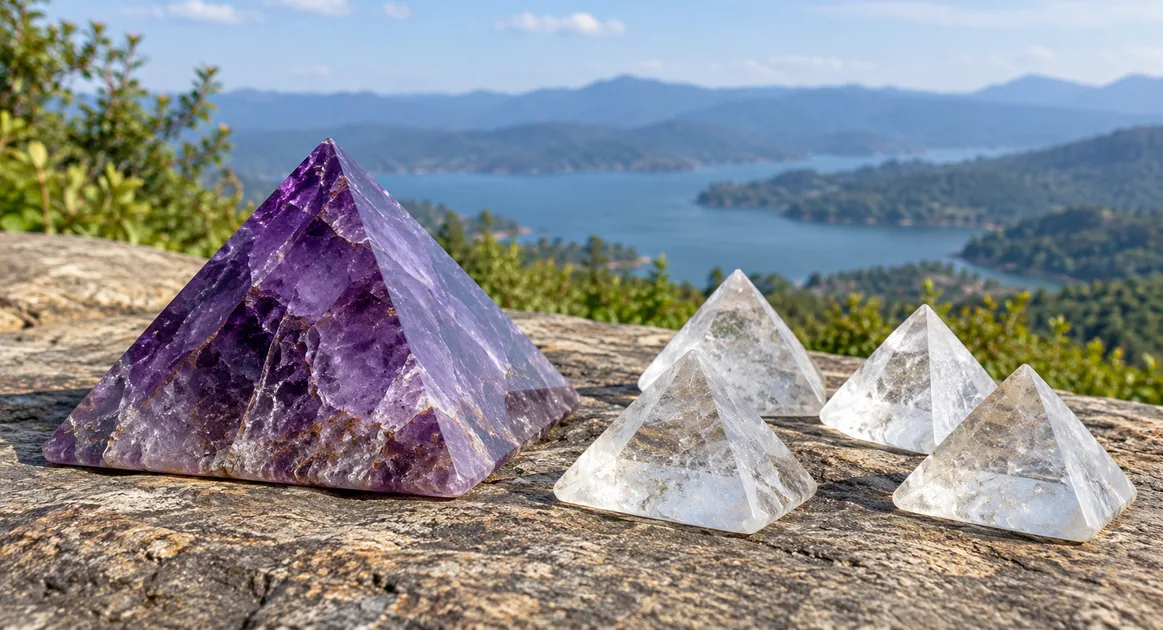
Amethyst shades range from soft lilac through violet to strongly saturated reddish purple, sometimes within the same piece. Because natural rough has internal zones, a pyramid carved from one block may show a luminous face beside a pale one. The centre may appear more saturated than an edge, or a translucent white region may pass diagonally through the base. These variations can be normal features of the starting quartz, not signs that the seller has made a defective product.
The stone's Mohs hardness is approximately 7, and its specific gravity is near 2.65–2.66. These properties belong to the mineral quartz, not to any spiritual grade assigned to the carving. Hardness is resistance to scratching, not resistance to chipping: a pointed apex can still be damaged when struck against a tile or another gemstone.
| Attribute | What to know | Why a pyramid buyer cares |
|---|---|---|
| Mineral | Purple quartz; chemical formula SiO₂ | Identifies the actual stone rather than a colour name |
| Typical colour | Lilac, violet, purple or reddish purple | Colour distribution can differ between faces |
| Hardness | Mohs 7 | Fairly scratch-resistant but corners can chip |
| Transparency | Transparent to translucent; sometimes cloudy | Backlit photographs can exaggerate clarity |
| Colour pattern | Frequently angular or sectoral zoning | A pale corner does not automatically mean imitation |
| Carving | Lapidary-cut faces, point and base | Geometry is workmanship, not a natural crystal habit |
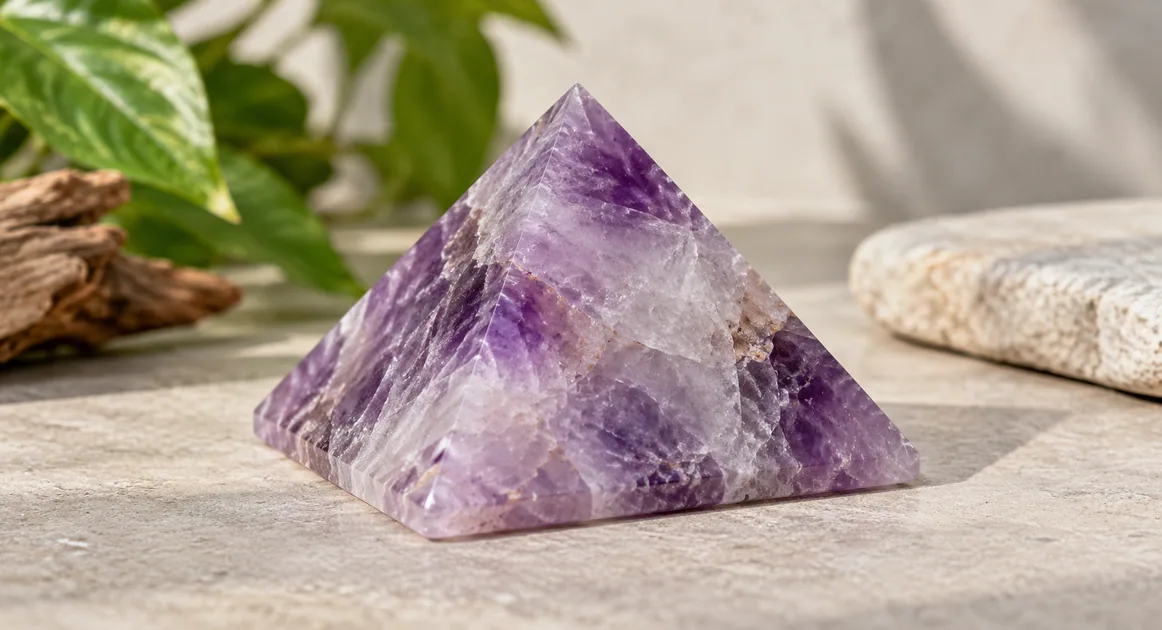
2. Why amethyst develops purple and white zones
The purple colour of amethyst is linked to trace iron and irradiation-related colour centres within the quartz crystal lattice. Geological growth and later conditions do not affect every zone equally. Amethyst therefore often presents straight, angular or wedge-shaped changes from deeper violet to nearly colourless quartz. A natural crystal may also carry growth lines, fluid inclusions, internal veils or healed fractures. Their position relative to the carving determines what the buyer sees.
A pale streak should first be examined under gentle neutral lighting rather than classified immediately as an artificial join. Move the object slowly; look whether the streak is inside the stone or reaches the surface. A cloudy veil may be entirely enclosed, while a crack open at an edge may be more vulnerable to dirt or physical stress. A filled fracture may show a different lustre or an unnatural-looking line, but photography alone rarely establishes treatment with certainty.
A deep-purple front face with an almost clear back is not necessarily misleading if the seller photographs both sides. The problem is omission: displaying only the saturated face and selling the object as uniformly dark. Buyers should request all four faces and the underside, particularly for an expensive or one-of-a-kind specimen.
| What you see | Possible explanation | Better question to ask |
|---|---|---|
| Angular light/dark bands | Natural quartz growth zoning | Does the pattern continue into the body? |
| Soft white cloud | Fine inclusions or internal veils | Is it enclosed or surface-reaching? |
| Dark purple on one face | Different cut orientation or lighting | Can I see a daylight video of all faces? |
| Line crossing an edge | Inclusion, fracture or filled seam | Is the line open, repaired or stable? |
| Purple concentrated on surface | Coating or dye worth checking | Is any colour treatment declared? |
| Very vivid, flawless appearance | May be fine natural, synthetic or imitation | What supports the claimed origin? |
3. Genuine amethyst, laboratory-grown quartz and imitations
Natural amethyst forms geologically. Laboratory-grown amethyst is also quartz, but its crystals were produced under controlled conditions. Purple glass, resin and coated substitutes can resemble amethyst in a photograph without being quartz. These three categories should not be described as interchangeable or sold under one vague label such as “natural crystal”.
Genuine amethyst may be very clear: lack of visible inclusions is not proof of glass. Similarly, bubbles can raise questions about glass, but a casual magnifying-glass inspection cannot authenticate the entire object. Certain patterns of twinning and inclusions can help gemmologists distinguish natural from hydrothermal synthetic quartz. These are specialist observations, not reliable household shortcuts. GIA notes that some clean quartz samples require advanced laboratory work for origin determination.
Avoid destructive “tests” such as scratching the carving, applying acid, heating a corner or dropping it on a hard surface. Such methods can spoil a perfectly genuine piece and still leave its growth origin unanswered. For a substantial purchase, ask for an independent identification report tied to that specific specimen; for an ordinary decorative pyramid, a clearly described material and transparent seller are often the proportionate starting point.
| Material sold as purple pyramid | What it actually is | What should be disclosed |
|---|---|---|
| Natural amethyst | Geological purple quartz | Natural origin; known treatments, if any |
| Synthetic amethyst | Lab-grown purple quartz | Laboratory-grown origin |
| Purple glass | Manufactured silicate glass | Glass, not gemstone quartz |
| Purple resin/composite | Polymer or assembled material | Manufactured/composite construction |
| Dyed or coated light quartz | Quartz with added colour | Dye, coating or other enhancement |
| Purple fluorite | A different mineral (calcium fluoride) | Correct mineral name and more fragile care |
4. Colour intensity, clarity and what determines value
Colour quality is important in fine faceted amethyst, where strong reddish-purple colour with minimal visible zoning is often prized. A decorative pyramid is evaluated differently. Its success depends on the appearance of all faces, a stable resting base, a pleasing distribution of purple, a safely finished apex, and whether the actual item corresponds to the listing. A lively lilac-and-violet carving may be more attractive in a room than a nearly black-looking specimen.
Ask for photographs against a neutral background, plus one image showing the carving at its actual display distance. Strong backlighting can exaggerate transparency; heavily edited saturation can deepen purple beyond ordinary daylight. Scale also matters. A five-centimetre pyramid and a ten-centimetre pyramid may look identical in an isolated product photo, but the weight, price and visual presence differ substantially.
Words such as “AAA”, “super seven”, “royal grade”, “100% natural energy” or “Brazilian premium” are not substitutes for a defined grading method or evidence of origin. No universally standardized AAA scale governs amethyst. Geographic labels should not be invented from colour. A seller may legitimately state “origin not verified” while providing clear photographs and correct mineral identification.
5. Inspect the four faces, apex and base before purchasing
A square-based pyramid should rest securely and present the intended visual geometry without wobbling. Small artistic deviations may be acceptable, but a sloping bottom, a deep chip on the point or a concealed repair changes the offer. Polishing a larger face can sometimes expose internal fractures or cloudy zones; the important issue is whether the stone remains sound and the details are disclosed.
Request a daylight view of the front, back, left, right, apex and underside. Inspect the border where triangular faces meet, since a bright photograph can hide chips along the arrises. If the apex is intentionally flattened for safety, that can be a sensible feature; the product description should say so. Look for adhesive seams or boundaries if the seller calls the piece “solid one-piece amethyst”. Mixed-mineral or assembled constructions can be sold transparently, but they should not be silently presented as a single natural crystal.
| Inspection point | Acceptable variation | Reason to ask for clarification |
|---|---|---|
| Four faces | Different violet density or internal veils | One face entirely omitted from photos |
| Apex | Slightly softened tip, if declared | Fresh sharp chip, split or concealed repair |
| Base | Minor natural colour variation | Unstable base or large untreated crack |
| Edges | Polished or purposefully rounded | Loose fragments or deep corner loss |
| Internal lines | Enclosed inclusion/healed fracture | Open fracture, filling or visible separation |
| Weight/size | Naturally varies with dimensions | Stock image but no actual measurements |
| Construction | Clearly described one-piece or composite | Unclear joining, coating or adhesive |
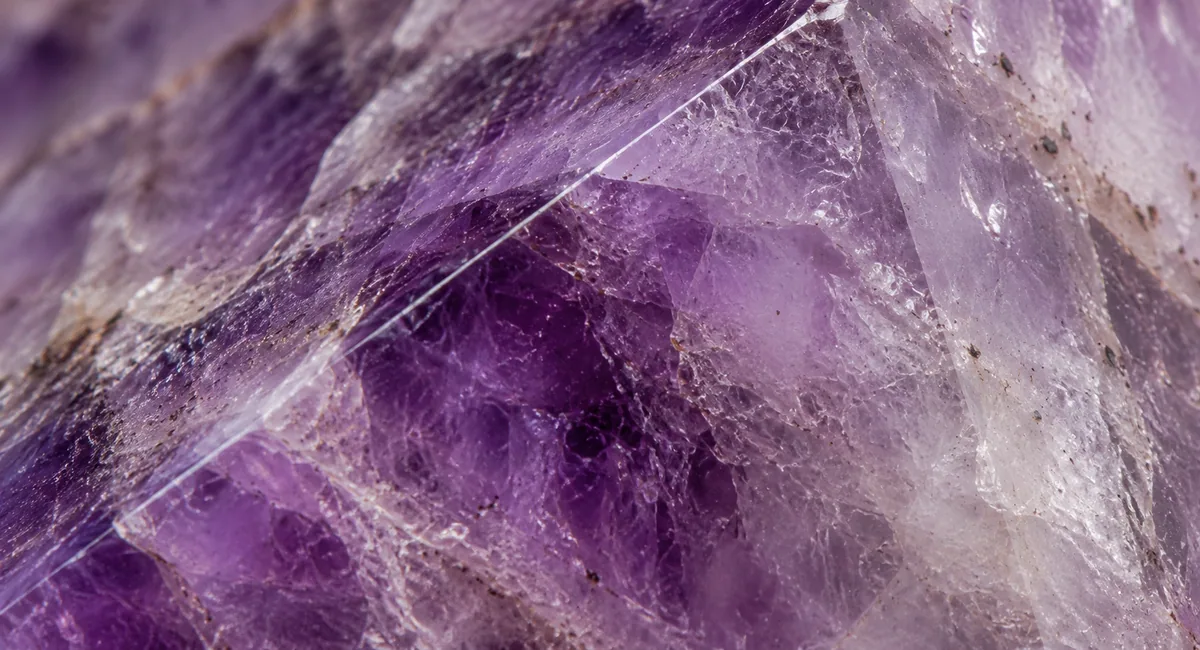
6. Amethyst treatments: heat, dye, irradiation and coatings
Amethyst colour is not a promise that every stone has identical treatment history. Heat can lighten very dark amethyst or remove an unwanted brownish component; heating certain amethyst can produce the yellow-orange material sold as heat-treated citrine. Pale quartz may also be dyed to achieve a purple appearance. Fracture filling is less common but relevant when a carving has visible surface-reaching cracks. The dealer should identify known treatment rather than presume an untreated origin from appearance.
Natural irradiation is part of the geological story of amethyst colour; commercial irradiation is a distinct treatment topic. A seller should not tell buyers that every amethyst pyramid is “radioactive” or that a simple photograph proves irradiation history. The relevant question is whether the supplied piece has a disclosed treatment and is suitable for ordinary use.
A quick comparison: if a listing claims a purple pyramid is heat-treated “to make it more purple”, ask for specifics. Heat treatment commonly lightens amethyst or changes it toward other quartz colours; sweeping statements about heat deepening purple are unreliable. If a coating is suspected, avoid solvent experiments and request better documentation.
7. Purple colour, Indian tradition and Sankalpa
In modern Indian spiritual practice, amethyst is often chosen for Shanti (peace), dhyana (meditation), inward attention, restraint and mental clarity. A carved pyramid may be placed near a meditation seat or a puja accessory tray as a focus for personal Sankalpa—the intention with which a practice is undertaken. Its violet colour and orderly shape can make it a meaningful visual reminder to maintain consistency in sadhana.
Amethyst is a gemstone used in contemporary spiritual and crystal traditions; the particular retail pyramid shape is not equivalent to a prescribed Vedic altar, and it should not be marketed as an ancient compulsory component of all Vastu rituals. A family may connect violet with reflection or a quieter devotional atmosphere, while another family may simply enjoy the beauty of quartz. The value of that practice lies in its cultural and personal context.
To create a coherent puja arrangement, begin with the established needs of the altar: a clean surface, the relevant deity image or murti, diya, flowers, incense used safely, water vessel if appropriate, and enough room for worship. A small amethyst pyramid can be an optional supporting object; it should not displace the main ritual focus. A simple Sankalpa such as “May this space support clarity, steadiness and right action” is more useful than a complicated promise tied to a compass angle.
8. Amethyst in Vastu: directions, placement and purpose
Vastu is fundamentally concerned with how a space is arranged and used. In a contemporary gemstone-based Vastu arrangement, an amethyst pyramid is often selected for a study corner, meditation shelf or quiet consultation area. Some practitioners favour the north-east (Ishanya) for prayer and contemplation, but the suitability of any location depends on the actual room, sunlight, circulation and the intended activity. There is no single universal direction that turns every amethyst pyramid into a guaranteed correction for all Vastu Doshas.
Begin with the purpose: a living-room shelf for a calm decorative effect, a puja alcove for devotional focus, a professional consulting desk for material demonstration, or a protected display case for a fragile collector carving. Then check that the spot is stable, dry, out of harsh direct sunlight and away from falling objects. In a north-east window flooded with afternoon glare, the safer choice is often a nearby shaded shelf rather than the exact sunlit corner.
| Space and purpose | Sensible arrangement | Practical check |
|---|---|---|
| North-east puja/meditation corner | Small pyramid beside, not over, primary worship objects | Avoid diya flame, heat and crowding |
| Study or reading table | Discreet stable shelf or tray | Keep writing area clear |
| Bedroom | Low, secure shelf used as a reflective décor accent | Avoid a ledge above the bed |
| Reception desk | One labelled carving away from payment devices and edges | Prevent falls during customer movement |
| Jewellery showroom | Locked case under gentle display light | Avoid excessive lamp heat and colour editing |
| Vastu consultant's kit | Padded, identified sample slot | Do not confuse symbolic use with gem identification |
9. Pancha Mahabhuta, Ishanya and the distinction from architectural Vastu
The Pancha Mahabhuta—Prithvi (earth), Jala (water), Agni (fire), Vayu (air) and Akasha (space)—provide a traditional conceptual framework for understanding space. An amethyst carving is physically a mineral from the earth, while its colour and intended purpose may be interpreted differently by individual contemporary traditions. It would be inaccurate to present purple quartz as the sole ancient remedy for a particular element without identifying a specific lineage or method.
Ishanya, the north-east, is frequently treated as a spiritually significant direction in Indian Vastu interpretation. That is a reason some users prefer a small amethyst or Sphatik object in a quiet north-east area. But architectural concerns such as ventilation, drainage, excessive heat, movement corridors, room proportions and actual light conditions need direct attention; placing a pyramid is not a substitute for examining those aspects of a building.
For a family house, a good starting sequence is: clear clutter, make the puja or study space functional, check direct light and moisture, select a safe shelf, then decide whether the colour and symbolism of amethyst fit the practice. This order respects both the traditional purpose of the room and the actual requirements of the stone.
10. Jyotish, Graha and Navagraha: where amethyst fits
Vedic Jyotish recommendations are usually based on the janma kundali, Lagna, Rashi, Graha strengths, house rulerships, Dasha and other chart factors, not simply the colour of an ornament. Traditional Navaratna sets have defined principal gemstones; amethyst is not one of the standard nine primary Navaratna gemstones. In some popular or regional gem-remedy discussions, amethyst is presented as an alternative or associated stone for Shani (Saturn), but that association is not the same as a universally accepted one-to-one replacement for Nilam (blue sapphire).
Amethyst is also sometimes compared with Jamunia, a Hindi trade expression for violet-coloured quartz. Trade labels can overlap between markets, so ask whether the dealer specifically means amethyst quartz. A purple pyramid placed on a desk does not automatically have the same role as a Jyotish gemstone chosen for wearing against the skin after horoscope consideration.
Surya, Chandra, Budha, Brihaspati, Shukra, Mangala, Shani, Rahu and Ketu are understood in Jyotish through different rulerships and associations. A consultant should distinguish general colour-based meditation symbolism from prescribed Graha Shanti upayas, mantra japa, puja, vrata and gemstone-wearing guidance. The language of Sankalpa and Shanti may apply to a meditation setting without requiring the seller to assign a planet to every purple object.
| Context | Appropriate treatment of amethyst | What not to assume |
|---|---|---|
| Decorative Vastu pyramid | Meaningful purple quartz used in a chosen area | A fixed cure for every directional defect |
| Puja and dhyana support | Optional object beside established devotional practice | Mandatory classical altar item |
| Popular Shani association | Explain as a tradition-dependent alternative association | Equivalent to prescribed Nilam for every horoscope |
| Kundali-guided gemstone advice | Chart-based assessment and individual recommendation | Colour alone determines suitability |
| Navaratna display | Distinguish principal nine gemstones from other quartz | Amethyst is one of the nine primary stones |
11. Amethyst, Ajna, Sahasrara and contemporary chakra practice
Contemporary crystal and yoga-inspired arrangements often connect amethyst's purple or violet colour with Ajna (the brow centre) and Sahasrara (the crown). The exact associations vary across modern systems, and traditional chakra texts do not universally prescribe modern gemstone pyramids. If a person keeps amethyst near a meditation mat, that can function as a visual aid to attention, breath observation or mantra repetition.
The distinction matters when explaining a product to customers: a colour association is different from a laboratory-detectable energy output. An amethyst pyramid can be described richly in terms of dhyana, inner quiet, devotion, discipline and sacred-space aesthetics without claiming that it diagnoses or treats a condition. If a customer has a health concern, the consultation should stay within the proper scope of spiritual guidance.
12. Choosing amethyst versus other purple stones
Purple appearance is not mineral identity. A buyer looking for “purple pyramid” may encounter fluorite, lepidolite, charoite, lavender-coloured chalcedony, dyed howlite and purple glass. Each can be attractive, but differences in hardness, cleavage, mineral structure and treatment matter for longevity. Fluorite, for example, has pronounced cleavage and is much softer than quartz; its edges deserve special care. Lepidolite is a mica-group material and should not be sold as a solid quartz crystal merely because it looks lavender.
Another common confusion is ametrine, a quartz material showing purple amethyst and yellow/orange citrine colour regions. An ametrine pyramid should be correctly described as ametrine when that mixed zoning is present and identified, rather than labelled uniform amethyst to fit a category. Equally, commercial “chevron amethyst” may show striking pale and purple bands in quartz. The pattern can be attractive, but the specific trade designation should describe the actual material.
| Comparison | Important distinction | Buying implication |
|---|---|---|
| Amethyst vs fluorite | Quartz Mohs 7 vs fluorite Mohs 4 with prominent cleavage | Different risk of edge damage |
| Amethyst vs purple glass | Crystal quartz vs manufactured glass | Ask for truthful material label |
| Amethyst vs lepidolite | Quartz vs mica-rich stone | Different physical structure and surface care |
| Amethyst vs dyed quartz | Natural colour centre vs applied colour | Treatment disclosure matters |
| Amethyst vs ametrine | Mostly purple quartz vs mixed purple/yellow quartz zones | Identify the advertised variety correctly |
| Amethyst vs chevron amethyst | Standard amethyst vs prominent banded quartz-amethyst pattern | Pattern is not automatically evidence of superior grade |
| Amethyst vs synthetic amethyst | Geological vs laboratory-grown quartz | Natural origin may need specialist evidence |
13. Cleaning: water, soap, sunlight and safe handling
For a correctly identified, untreated amethyst pyramid with no vulnerable fracture filling, brief cleaning using lukewarm water and mild soap can be appropriate. GIA also notes that most amethyst is reasonably durable. For a collectible carving with an uncertain treatment history, a soft dry or barely damp lint-free cloth is the more cautious first step. Dry the pyramid fully, paying attention to the base and small recesses. Avoid soaking on a routine basis simply because quartz is relatively hard.
Do not use abrasive powder, metal brushes, strong alkaline cleaners, acids, bleach or unverified chemical dips. Steam cleaning is not recommended. Ultrasonic cleaning may be possible for some untreated jewellery stones, but a carved pyramid with concealed fractures, a repaired tip or unknown filling is better cleaned gently by hand. Keep it away from rapid temperature changes, hot spotlights, candles and long-term intense sunlight.
Because some amethyst can fade under prolonged strong light, a permanently sunny windowsill is an unnecessary risk. An amethyst altar near a diya should have enough separation to avoid heat exposure and accidental knocks. A soft fabric or padded compartment protects the apex during storage, but do not wrap a damp pyramid and seal it away.
| Situation | Recommended approach | Avoid |
|---|---|---|
| Routine dust | Clean soft microfibre cloth | Hard bristles and abrasive polish |
| Fingerprints | Brief mild soapy wipe, if untreated and sound | Strong solvents or long soaking |
| Unknown filling/coating | Dry or minimally damp clean and ask seller | Ultrasound or steam |
| Sunlit display | Move to diffuse natural or moderate indoor light | Permanent direct sun exposure |
| Ritual water or milk | Keep liquid rites separate from the carving | Prolonged immersion or sticky residues |
| Moving/storage | Padded slot, protected apex and dry packaging | Loose contact with harder stones |
| Visible crack or chip | Stop handling and inspect professionally | Grinding, glue repairs without disclosure |
14. Practical example: a Bengaluru apartment's puja shelf
Consider a household in Bengaluru with a north-east prayer alcove beside a large window. The family wants a small purple pyramid for dhyana and a visually ordered puja setting. They select a modest, stable carving with attractive zones instead of a larger piece that crowds the altar. The dealer supplies images of all faces and confirms that the point has no open damage.
During an afternoon check, direct sunlight falls on the shelf for several hours. Rather than insist on the exact sunlit corner, the family places the pyramid on a neighbouring shaded tray, away from the diya, incense ash and water vessel. The room remains usable for actual worship. The object becomes a quiet reminder of Sankalpa, while occasional gentle cleaning and light control protect its colour.
15. Practical example: jewellery showroom and sales demonstration
A showroom manager wants customers to understand why two amethyst pyramids with similar dimensions look different. One has deep violet zones toward the apex; another is paler but more evenly translucent. The display uses neutral, low-heat lighting and keeps each item labelled with measured dimensions, weight, price, material and known treatments. A short handheld video shows the four faces under the same light rather than presenting a saturated studio photo as the full truth.
The salesperson can explain the difference between natural crystal veils and open damage, between the lapidary-cut pyramid and a raw crystal termination, and between amethyst and purple fluorite. If a buyer wants Vastu placement information, the staff can discuss a suitable study, puja or reception area without making unverified promises about income, health or the building's structural conditions.
16. Practical example: a professional Vastu or gemstone reference kit
A practitioner assembling a gemstone reference kit includes one amethyst pyramid alongside clear quartz, smoky quartz, rose quartz, purple fluorite and dyed purple glass samples. Each is separated in a protective compartment and labelled with the verified mineral name, colour, any known treatment and a note on safe care. The amethyst sample demonstrates zoning and the difference between intrinsic mineral colour and a surface coating.
During a client consultation, the practitioner first discusses the room's actual use, available space, daylight and traditional intention. The sample then helps illustrate a possible object for meditation or devotional décor. It should not be confused with a personalized Navagraha gemstone-wearing recommendation, which is a separate Jyotish assessment. This distinction makes the kit educational and professionally useful.
17. Buying checklist before ordering online
When buying online, ask for the actual specimen's height, base width and approximate weight. Confirm whether the photos represent the exact object or a sample of variable stock. A pyramid measured only by diagonal length can look larger than expected; request height and square base measurements in the same units. Ask for the four faces, the apex and underside, preferably in daylight or neutral lighting, and make sure the price and return terms are clear.
Ask explicitly: Is this natural amethyst quartz, laboratory-grown quartz, or another material? Are any dyes, coatings, fillings, repairs or heat treatments known? Has the apex been repaired or intentionally softened? Does the purple zoning seen in the product picture belong to the piece being shipped? Is there any report and, if so, does it refer to this very carving? The seller should be able to answer the material and condition questions without supplying an implausible origin story.
| Seller statement | What to request |
|---|---|
| “100% original amethyst” | Specific mineral description and treatment/origin information |
| “AAA premium” | Seller's own defined criteria and actual photographs |
| “Perfect pyramid energy angle” | Measured geometry, stable base and ordinary product details |
| “Deep royal purple” | Neutral-light video with all faces visible |
| “Imported Brazilian amethyst” | Reliable origin information or acknowledgment if unknown |
| “One-piece carved stone” | Underside and edge photographs showing no joins |
| “Guaranteed Vastu correction” | Clear explanation of practice without impossible outcomes |
18. FAQ: common questions about amethyst pyramids
1. Are amethyst pyramids made from genuine natural crystal points? A commercial pyramid is usually lapidary-cut from rough quartz. It is not necessarily an unmodified natural crystal point.
2. Is every purple quartz pyramid amethyst? Only if its mineral identity and colour justify that description. Purple glass, dyed quartz and synthetic amethyst must be distinguished in the offer.
3. Does deeper purple always mean better quality? Not for decorative carvings. Workmanship, all-face appearance, stable geometry and material disclosure are equally important.
4. Why is one face pale and another dark? Natural colour zoning and cutting orientation can distribute violet differently across the four faces.
5. Are white streaks evidence of a fake? No. Quartz can contain pale bands, internal veils and inclusions. A surface-reaching fracture is a separate issue.
6. Can amethyst be synthetic? Yes. Laboratory-grown amethyst is quartz and requires accurate origin disclosure.
7. Can I distinguish glass from amethyst by scratching it? Do not use destructive home tests. A qualified gemmologist or relevant laboratory can assess uncertain material.
8. Does amethyst naturally contain iron? Trace iron is associated with the formation of the purple colour centres; it does not make the carving an iron-ore specimen.
9. Does amethyst turn yellow if heated? Some amethyst can change toward citrine-like yellow or orange with heat; the result depends on the material and conditions. Do not heat your pyramid to experiment.
10. Can sunlight fade an amethyst pyramid? Prolonged strong light can fade some specimens. Display it away from intense direct sunlight.
11. Can I wash my amethyst pyramid? Brief gentle soap-and-water cleaning can suit a sound, untreated piece; use a minimally damp cloth when repairs or treatments are uncertain.
12. Is steam cleaning recommended? No. Avoid steam and sudden high-temperature exposure.
13. Can a crack at the apex be ignored? An enclosed veil may be harmless, but an open crack or chip should be disclosed and handled carefully.
14. Where should I keep amethyst in Vastu? Many modern practitioners choose a shaded study, meditation or north-east puja area; actual sunlight and safety conditions remain important.
15. Is amethyst a standard Navaratna stone? No. It may appear in wider gem traditions, but it is not one of the nine standard principal Navaratna gemstones.
16. Is it always a substitute for blue sapphire in Shani remedies? No. Popular alternate-gem associations vary and should not replace an individualized Jyotish assessment.
17. Can I keep it beside a Shiva image or Sphatika Lingam? It can be used as an optional decorative or devotional object without confusing it with the main deity or prescribed worship items.
18. Is a large pyramid stronger than a small one? Physical size changes visibility and handling, but does not establish a proportional spiritual outcome.
19. Must the pyramid have four identical purple faces? No. Each cut face may reveal different natural colour zones. Good disclosure is more useful than artificial uniformity.
20. What should I check before placing a showroom order? Request exact-item photographs, dimensions, natural/synthetic status, treatment disclosure, condition, packing and return policy.
19. Final selection guidance
A worthwhile amethyst pyramid is clearly identified quartz, attractively cut, securely based and appropriately described. Purple zoning may be part of its natural character. The most important buying evidence is not a dramatic violet photograph or an unexplained grade: it is the accuracy of the material description, the quality of the finish and the correspondence between the listing and the actual carving.
Traditional uses in dhyana, Sankalpa, Shanti, Vastu-inspired placement and devotional aesthetics can give the object a meaningful place in a home or professional collection. Preserve that significance while keeping mineral identification, Jyotish recommendations and safe physical care distinct. Place the stone where you will actually use and appreciate it, shield it from excessive light and heat, and let a well-chosen carving remain attractive for years.
Explore existing OmmRudraksha collections
Browse Vastu for the existing collection, or explore gemstone products for other material forms. Each product’s construction and care information should guide your choice.