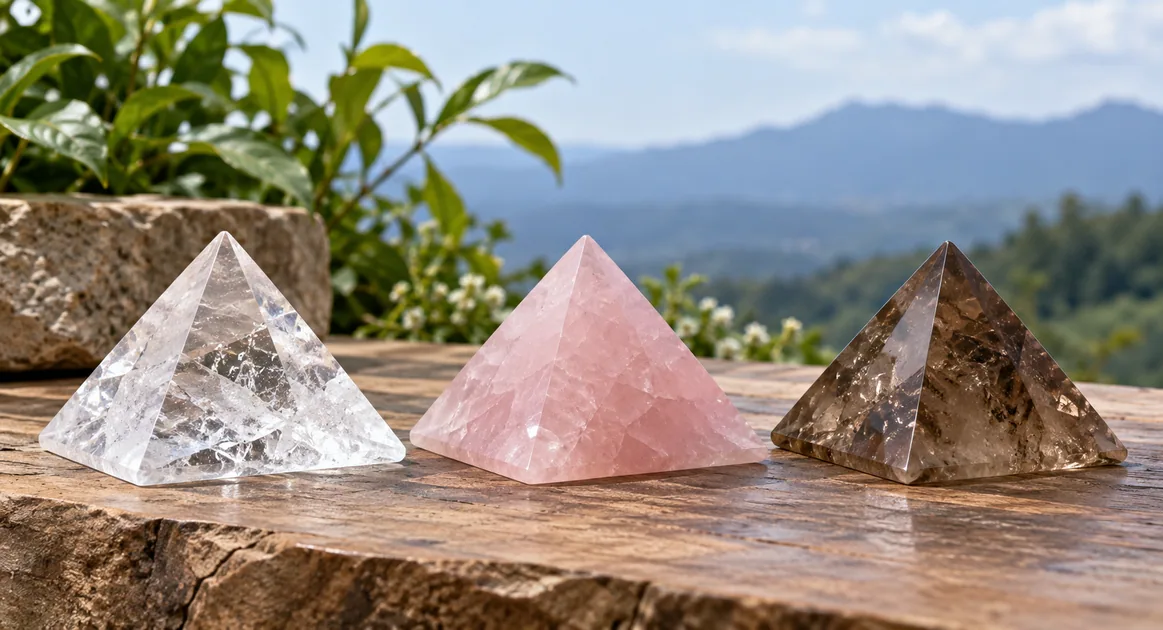
Clear quartz, rose quartz and smoky quartz pyramids are three visually different carvings of the quartz mineral, provided the pieces are correctly identified. Clear quartz is usually colourless and transparent or partly cloudy, rose quartz displays delicate pink with frequent soft translucence, and smoky quartz shows grey-brown to deep brown colouring. Their shared mineral identity is useful when comparing durability, but it does not make their colour origins, treatment histories, visual appearance or traditional associations identical.
A pyramid is especially good for comparing them because its four sloping faces, point and base show the stone from different thicknesses and viewing angles. A piece that looks dark from its middle may appear lighter at the edges; a pink quartz pyramid may have a pale point and a stronger pink base; clear quartz may reveal internal veils that become visible when the stone is rotated. Those are observations to examine, not automatic defects. This guide explains how to separate material identity from presentation, how to build a meaningful display for Vastu or meditation, and what a buyer should ask before paying for any of the three.
At a glance: which quartz pyramid suits which purpose?
| Comparison | Clear quartz / Sphatik | Rose quartz | Smoky quartz |
|---|---|---|---|
| Typical visual character | Colourless, transparent to milky; internal veils may be visible | Pastel pink, often cloudy or translucent | Grey, brown or deep smoky-brown; often transparent to translucent |
| Mineral family | Quartz, SiO₂ | Quartz, SiO₂ | Quartz, SiO₂ |
| What to inspect first | Actual quartz identity, edges, fractures, optical clarity | Evenness of pink, hidden pale areas, inclusions and polish | Colour variation through the body and disclosed treatment history |
| Traditional or contemporary association | Sphatik has a distinct place in Hindu worship and devotional objects | Gentleness, affection and harmony in contemporary crystal practice | Grounding and steadiness in contemporary crystal practice |
| Good illustrative display | Prayer shelf, study display or material comparison | Living-room or family-space display | Desk, entry-shelf or darker-tone material comparison |
| Important buying reminder | Transparency alone cannot prove natural origin | Uniform bright pink is not the only quality indicator | Darkness cannot establish untreated colour |
All three may have a useful place in a Vastu-oriented collection. The correct choice depends on material, intended room, workmanship, price and personal tradition. A single material should not be proclaimed universally superior for every direction or every household.
What all three have in common: quartz mineralogy and carved geometry
Quartz is crystalline silicon dioxide (SiO₂). In standard mineral identification it has Mohs hardness 7 and a specific gravity of about 2.65. These features help explain why it can be polished to a glossy finish and made into small ornamental pyramids. They do not mean every carving is equally tough: fractures, internal fissures, thin points and cutting faults can make a particular piece more vulnerable than a sound piece of the same mineral.
Most small retail pyramids are carved from mineral material; the pyramid is a manufactured shape rather than the natural growth habit of the quartz. It is therefore reasonable to ask both “Is this real quartz?” and “How well is this object carved?” A natural mineral pyramid is not the same thing as a naturally formed pyramidal quartz crystal. Conversely, a carved object made of genuine quartz can be fully natural as material even though a craftsperson shaped and polished it.
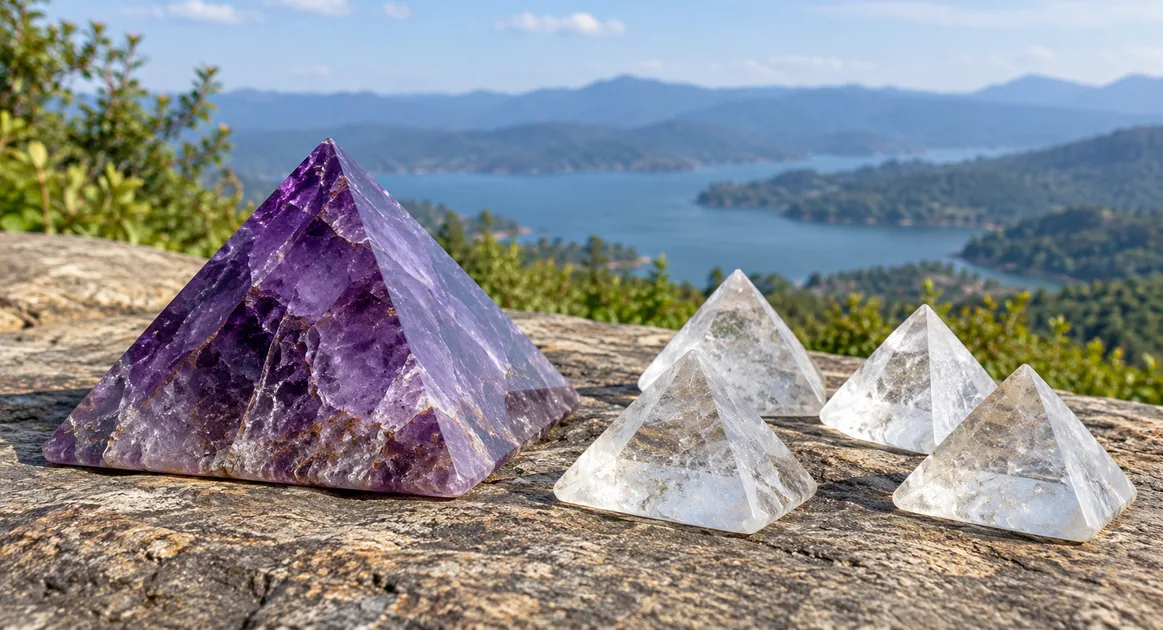
A good comparison uses a similar size and finish for all three. If the clear specimen weighs 40 g and the smoky specimen 150 g, differences in colour depth, apparent clarity and display presence may be caused partly by size. Record the base length, perpendicular height, approximate mass, condition of the apex and treatment information before making a fair judgement.
Clear quartz: recognising Sphatik without confusing clarity with authenticity
Colourless transparent quartz is widely known as rock crystal and is commonly called Sphatik or Spatika in Indian spiritual and commercial contexts. Sphatik has a meaningful association with devotional items, including beads, malas and certain representations used in worship. The spiritual use of Sphatik should be distinguished from the newer retail practice of prescribing a pyramid to remedy a particular room or property. The latter is a choice of contemporary Vastu-related display, not an automatic rule arising from the mineral's name.
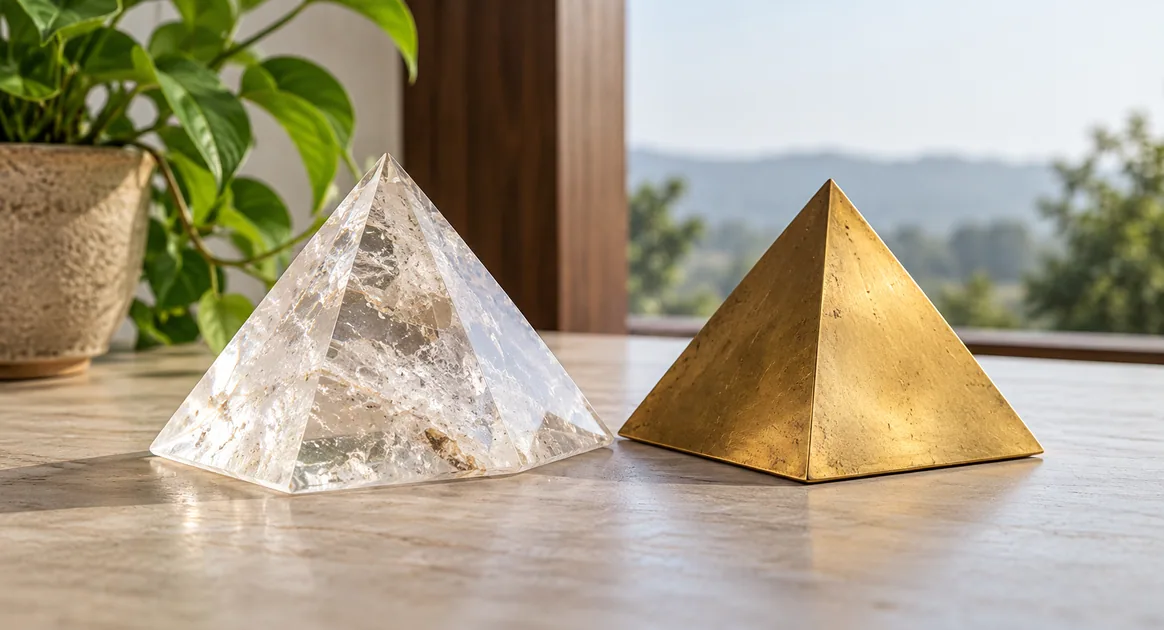
A clear pyramid can display planes of internal reflection, tiny liquid or mineral inclusions, wispy veils and fractures. Some specimens are almost water-clear; others are cloudy near the centre. Good clarity is desirable for many buyers, but a perfectly clear photograph is not a laboratory certificate. Glass, some synthetic materials and laboratory-grown quartz can also be transparent. Bubbles are suggestive in some imitations but are not an exhaustive identification test, and a lack of bubbles proves little.
Practical check: put the clear pyramid on a matte grey surface, turn it under diffuse daylight and photograph each of the four faces plus its base. Record inclusions, fractures, glue, coatings or scratches, if present. If the piece is being bought at a premium on the basis of natural origin, obtain an appropriate material-identification report rather than relying on a home scratch test. Scratching or striking a finished pyramid can permanently damage it.
The clearest quartz can suit a minimal prayer or meditation shelf because the carving does not visually crowd adjacent objects. For a jewellery showroom it can also serve as a useful reference: customers can compare what the words “transparent,” “included” and “milky” mean when applied to actual quartz.
Rose quartz: soft pink, cloudiness and the difference between colour and quality
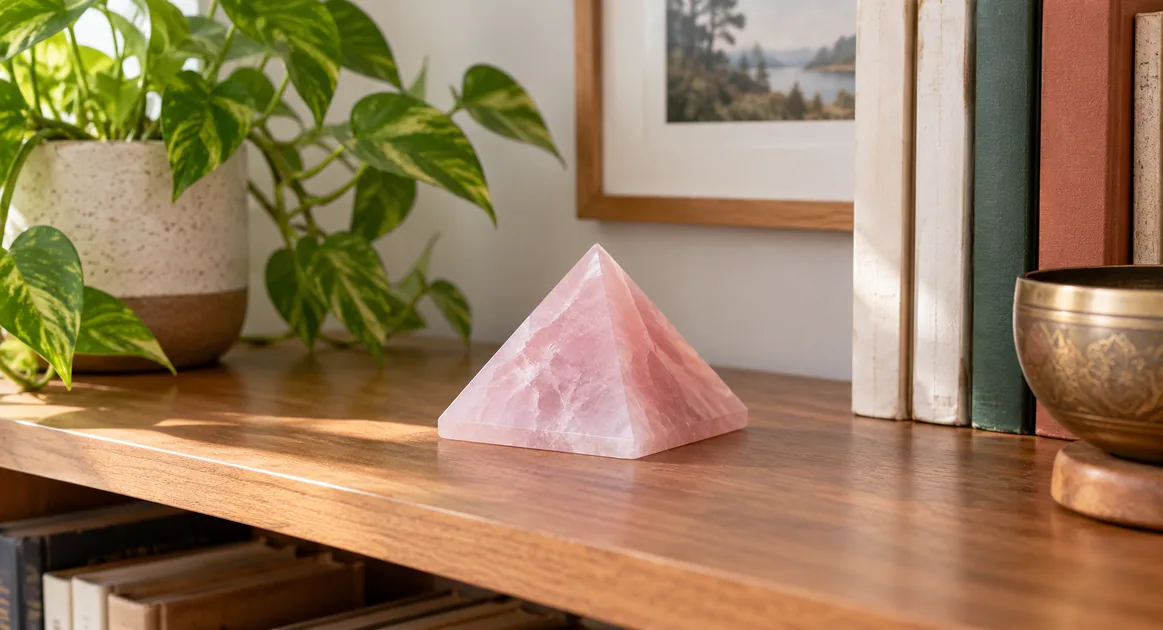
Rose quartz is the pink variety of quartz. Its colour can range from nearly white pink to deeper rose tones. Most familiar rose quartz occurs in massive material, often containing very fine inclusions that produce a misty, translucent appearance. This makes rose quartz well suited to carving, even when it lacks the see-through appearance of a clear quartz point. Rare transparent pink crystalline quartz is a different-looking form, so a seller should not describe every ordinary cloudy carving as that unusual material.
On a pyramid the colour may look stronger towards the thick base and weaker near the point. This can be natural colour-depth behaviour rather than evidence of dye. Buyers should inspect all faces and the underside, since one attractive photograph may hide grey patches, pale areas or fractures. Look for a smooth finish without waxy residue, poorly polished grooves or a chipped apex. Some rose quartz can be colour-enhanced; treatment claims should be disclosed rather than guessed from appearance.
In contemporary gemstone practice rose quartz is often chosen to symbolise affection, reassurance or harmonious relationships. This association can guide an intentional family-space display. It should not be confused with a universally prescribed classical Vastu remedy, a guarantee of relationship outcomes or a substitute for the household's devotional practice. In a mixed display, the soft pink tone is also useful for showing how two specimens with the same Mohs hardness and chemical composition can present radically different translucency.
For a small home shelf, a single well-finished rose quartz pyramid is often more attractive than many differently coloured objects. Use a stable, low-traffic surface away from the edge of a table. Position it where the pink can be seen in gentle indirect light rather than relying on a spotlight that exaggerates the colour and obscures the actual material.
Smoky quartz: brown colour, irradiation and material disclosure
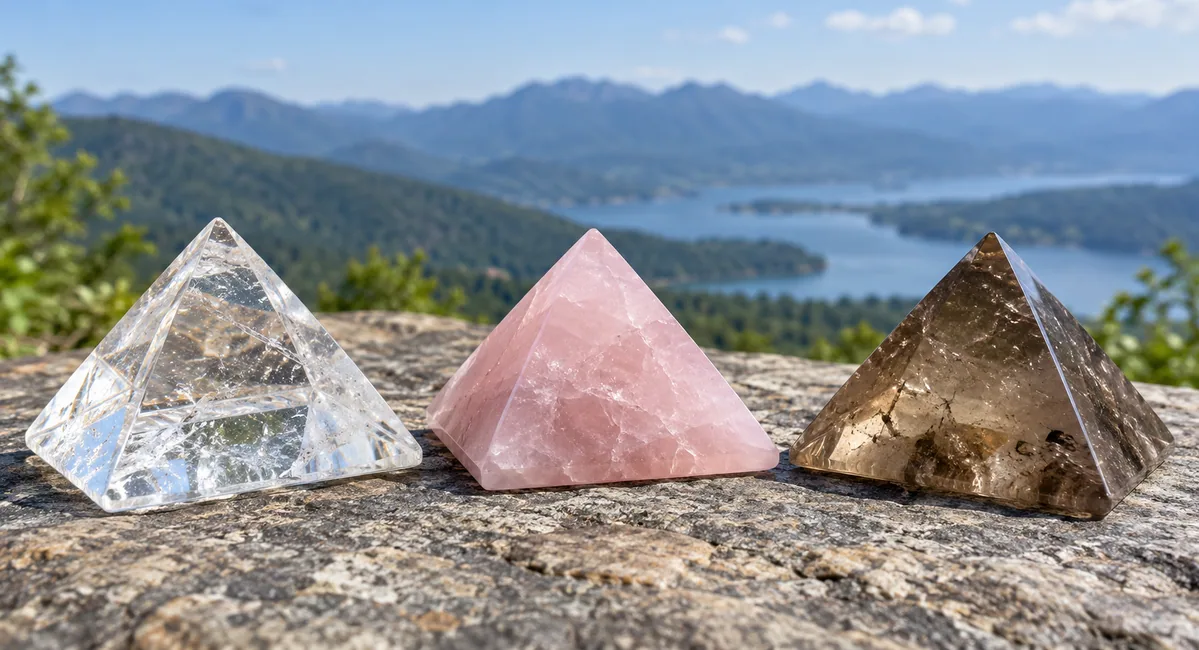
Smoky quartz obtains its grey-to-brown appearance from colour centres associated with the crystal structure; natural irradiation over geological time can contribute to this colouring. Commercial irradiation can also produce or deepen smoky colour. Therefore “natural quartz” and “naturally smoky colour” are two separate claims. A carving may be genuine quartz while its colour has been modified. An image, a dark appearance or a seller's statement that a stone is “powerful” does not establish its treatment history.
Examine the pyramid from the thin edges toward the centre. Many smoky pieces appear much lighter at thin edges and darker through thicker material. That observation is useful for understanding colour depth, but it cannot distinguish naturally irradiated from commercially irradiated quartz. Material sold as “morion,” “black smoky quartz” or “very dark smoky quartz” also deserves a clear description, particularly when the specimen appears nearly opaque.
Contemporary crystal collections often associate smoky quartz with grounding, composure and steadiness. It may be selected as a visual reminder of concentration for a desk or quiet corner. When explaining this to customers, identify the association as symbolic or customary rather than asserting that the pyramid controls electromagnetic fields, removes radiation or produces measurable cures. Its practical qualities are those of a stable carved stone: it can be displayed, inspected, cleaned appropriately and retained as part of a labelled teaching kit.
For buying, record the approximate colour range, transparency at the edges, whether natural-colour origin is claimed, and any disclosed irradiation or other alteration. A vendor who cannot supply a history should say “treatment not determined,” not invent certainty. The treatment status matters particularly when comparing several apparently similar products at very different prices.
How to compare all three pyramids in the same light
Many online comparisons are distorted by photography. The clear specimen may be shown against black velvet, the rose specimen against a warm background and the smoky specimen under bright backlighting. Those conditions make comparison unreliable. A simple repeatable method produces more useful photographs for a product page, showroom, workshop or quality-control record.
| Step | Method | What it reveals |
|---|---|---|
| 1. Match the objects | Choose similar base widths and heights; record actual measurements | Separates colour effects from thickness differences |
| 2. Prepare one background | Use matte neutral grey and a white reference card | Shows the colour without a coloured cast |
| 3. Use diffused light | Photograph all three in one frame, with unchanged camera exposure | Gives a fairer comparison of pink, clear and brown |
| 4. Rotate each pyramid | Inspect four faces, apex and base | Reveals chips, internal features and uneven polish |
| 5. Add a transmitted-light view | Use moderate light through the side, without heating the stone | Shows transparency, colour depth and internal veils |
| 6. Record claims | Note origin and treatment statements exactly as supplied | Prevents guessed information becoming a product specification |
Do not infer the composition of a stone solely from this visual exercise. It is a comparison and documentation method, not a conclusive gemological test. For a showroom, keep one master image of the three pieces together and then show individual views. For an online listing, disclose when the product photograph is representative and natural colour or inclusion patterns will vary between items.
Why pyramid workmanship matters as much as the colour
Two pyramids carved from the same quartz variety can be priced differently because of size, cutting precision, polish, damage and raw-material selection. The square base should sit evenly without rocking. The four faces should meet in a reasonably consistent apex, the edges should be finished to suit the product type, and the underside should not have concealed sharp fragments or large repair patches. Handmade variance is normal; undisclosed breaks, patched points and severe asymmetry are different matters.
| Quality feature | Good observation | Question to ask |
|---|---|---|
| Base | Stable and adequately finished | Does it sit flat on a smooth table? |
| Apex | Point or deliberately softened point is consistent with listing | Is the tip damaged or intentionally rounded? |
| Faces | Even polish without major ripples or residue | Are all four faces shown? |
| Natural features | Inclusions and colour variation described accurately | Which features are natural and which are repairs? |
| Measurement | Actual base, height and mass stated | Does '2 inch pyramid' refer to base width or height? |
| Material disclosure | Natural versus laboratory-grown versus imitation distinguished | What does the seller know about treatment and provenance? |
| Packaging | Tip and faces individually cushioned | Will the stone touch another hard object in the box? |
It is useful to place three specimens on the same flat surface and inspect their profiles from eye level. If a larger clear quartz pyramid is being compared with a tiny rose quartz version, compare a similar-size pair before concluding that one material is better polished. A stone that is smaller is not necessarily less genuine or less suitable for a particular shelf.
Sphatik, sacred symbolism and the distinction between tradition and modern crystal placement
In Indian devotional language, Sphatik identifies clear crystal or rock crystal and appears in the names of ritual and worship items. Sphatik malas and other crystal objects are familiar to many worshippers. This traditional context is stronger and more specific than a general claim that every modern geometric crystal ornament is an ancient ritual prescription. A carved pyramid can be kept in a meditation area with reverence, but it should be described for what it is: a contemporary carved form made from a mineral with its own traditional associations.
Pancha Mahabhuta refers to the five great elements: Prithvi (earth), Jala (water), Agni (fire), Vayu (air) and Akasha (space). In contemporary display planning, some people relate quartz clarity to openness or Akasha, rose quartz to gentler relationships, and smoky quartz to grounded Prithvi qualities. These are interpretive associations used for symbolic arrangements; they are not a fixed classical table that makes clear quartz mandatory in one compass sector and smoky quartz mandatory in another.
Navagraha gemstone selection operates through a different framework: it concerns planetary associations and, in some practices, the person's horoscope and gemstone suitability. Clear quartz is not automatically a substitute for every traditional planetary stone merely because it is transparent; neither rose nor smoky quartz should be advertised as a universal remedy for any particular planet. A Vastu display pyramid, a temple-use Sphatik object and an astrologically recommended gemstone are different purchasing decisions.
Using quartz pyramids with the eight Vastu directions
A room's practical layout comes before a decorative prescription. Identify the entrance, main use of the room, movement paths, shelving, ventilation and light exposure. If directional symbolism is relevant, use the house plan and an appropriate orientation reference rather than estimating north from the position of a door or a phone photograph. Classical Vastu and regional practices can differ in their detailed prescriptions; there is no single historically authoritative quartz-pyramid assignment for all eight sectors.
| Direction / sector | Common directional association | Illustrative modern display idea | Practical priority |
|---|---|---|---|
| North — Uttara | Kubera in many directional traditions | A clear specimen on an orderly work or sales shelf | Labels and customer movement remain unobstructed |
| North-east — Ishanya | Ishana; often considered significant for prayer | Clear Sphatik beside, not replacing, existing devotional objects | Keep altar arrangements respectful and uncluttered |
| East — Purva | Indra in Ashta Dikpala symbolism | Clear quartz in an illuminated but non-glare display | Avoid prolonged strong sun on sensitive displays |
| South-east — Agneya | Agni | Compare the three materials on a labelled teaching shelf | Keep all stones away from heat and cooking splash |
| South — Dakshina | Yama | One understated smoky quartz pyramid as a modern accent | Use a stable, low-traffic shelf |
| South-west — Nairritya | Nirrti in directional deity lists | Rose quartz for a deliberately gentle family-space theme | Do not clutter or obstruct important furniture |
| West — Paschima | Varuna | Rose quartz in soft, indirect light | Avoid damp or precarious window ledges |
| North-west — Vayavya | Vayu | A small comparative set in a consultation space | Prevent falls in a frequently used area |
The deity and directional associations provide cultural context; the suggested quartz placements are modern illustrative choices, not claims that a direction requires a specific gemstone. For a client who follows a family or temple tradition, that existing practice should inform the devotional arrangement. For most homes, one or two meaningful pieces on a secure surface are more useful than eight arbitrary purchases.
Three practical layouts with exact counts
Layout 1: A three-pyramid material comparison
Use one clear quartz, one rose quartz and one smoky quartz pyramid of broadly similar base width. Place them in a straight line on a low neutral tray: clear on the left, rose in the centre and smoky on the right. Leave enough space that light reaches each sloping face. Add a short label with mineral identity, approximate height, mass and disclosed treatment details. This is effective for a jewellery showroom or a beginner's study table because customers see the colour progression immediately without confusing it with a direction-based remedy.
Layout 2: A nine-pyramid symbolic study tray
For a nine-position square display, use one clear quartz, four rose quartz and four smoky quartz pyramids, nine objects in total. Place the clear specimen in the central position; place rose quartz at the four diagonal corners and smoky quartz at the four side midpoints. Keep all apexes upward and the bases on the same level. The central clear piece represents a visual reference point, the pink corners create gentle colour contrast and the darker side pieces emphasise the square geometry. This is an arrangement for teaching and contemplation, not a traditional nine-gem Navaratna set, which uses a different stone list and planetary framework.
| Grid row | Left | Centre | Right |
|---|---|---|---|
| Back | Rose quartz | Smoky quartz | Rose quartz |
| Middle | Smoky quartz | Clear quartz | Smoky quartz |
| Front | Rose quartz | Smoky quartz | Rose quartz |
Count check: four rose + four smoky + one clear = nine pyramids. The table shows a top-down nine-position schematic with the front and back rows labelled.
Layout 3: A real home or consultation shelf
For a small Bengaluru apartment, a single clear Sphatik pyramid can sit on an established prayer or reading shelf, while one rose quartz piece may be kept on a family-room console and one smoky quartz specimen on a study desk. The pieces need not be bought as a compulsory three-part remedy; they are selected for appearance, intention and available space. A consultation kit can carry the same three as material samples with washable, removable labels rather than attempting to demonstrate every variation in a client's home.
Home, showroom and consultation: what changes with the setting?
| Setting | Best first decision | Useful quartz presentation | Common error |
|---|---|---|---|
| Home prayer or meditation shelf | Respect existing devotional objects and uncluttered use | One clear Sphatik or personally meaningful specimen | Replacing traditional worship requirements with a generic crystal claim |
| Family living space | Choose safe location, balanced display and visual tone | One rose quartz pyramid or a modest three-piece set | Using too many bright stones in a small space |
| Office or study desk | Keep documents, cables and movement clear | One smoky or clear pyramid on a protective coaster | Positioning a sharp tip close to the working edge |
| Jewellery showroom | Identify materials and treatments accurately | Side-by-side clear/rose/smoky examples with labels | Calling cloudy rose quartz poor quality or dark smoky untreated |
| Vastu practitioner kit | Make material samples repeatable across visits | Three labelled objects, consistent size and a condition record | Mixing the sample tray with client-specific remedies |
For a retailer, it is worth showing the same combination in two contexts: a plain neutral photograph for honest colour comparison, and a room-scale photograph showing how much space three pyramids actually occupy. This reduces the risk that customers imagine a tiny carving is large enough to dominate a console or prayer shelf.
How to recognise substitutes, treatment uncertainties and misleading descriptions
Quartz is widely available, but inexpensive pyramids can still be misdescribed. Colourless glass may be called “Sphatik,” pink glass or dyed material may be labelled “rose quartz,” and very dark pieces may be sold simply as “smoky crystal.” In each case the key question is the actual material, followed by treatment and workmanship. Do not perform destructive scratch, impact, heat or acid testing on a finished product. An expert gemological examination is more appropriate when the material claim materially affects price.
| Seller claim | What the statement establishes | What still needs verification |
|---|---|---|
| “Natural clear quartz” | Claims a natural quartz origin | Actual mineral identity, repairs and treatments |
| “100% transparent Sphatik” | Describes appearance with a traditional trade name | Whether it is quartz rather than glass or another imitation |
| “Deep pink rose quartz” | Describes colour | Whether colour is natural, enhanced, or photographically exaggerated |
| “Untreated smoky quartz” | Makes a treatment-history claim | Seller's basis for that claim; appearance alone is insufficient |
| “Natural pyramid formation” | Ambiguous wording | Whether a crystal grew naturally or was carved into a pyramid |
| “2 inch quartz pyramid” | Indicates nominal size | Which dimension was measured and its tolerance |
For online buying, seek one real photograph of the actual item when possible, plus approximate base width, perpendicular height and weight. Read the returns policy and ask whether a received piece may vary significantly from sample imagery. A sales claim about chakra, planetary or protective effect is not material-identification evidence. Keep the language of symbolism separate from specifications a customer can verify.
Cleaning and preserving quartz carvings
The quartz mineral is reasonably scratch-resistant, yet a pyramid has vulnerable points and possible internal fractures. For routine display, use a clean soft cloth or soft brush to remove dust. When the stone is known to be uncoated and untreated, gentle washing with mild soap and lukewarm water can be appropriate, followed by a thorough dry. Where fillers, colour treatments, glued repairs or decorative coatings are uncertain, begin with dry cleaning and confirm product-specific instructions before introducing moisture.
Avoid abrupt temperature changes, direct heat, hot-water rituals, prolonged strong sunlight and ultrasonic or steam cleaning when the stone's condition and treatment history are not established. Rose quartz is often displayed for its delicate pink; protecting it from sustained harsh sun helps maintain its appearance. Pack each pyramid separately, cushion the tip and keep it from rubbing against another mineral, metal plate or glass object. Do not place loose pyramids in a bag where their sharp edges can strike each other.
For a prayer shelf, the devotional act of keeping the space clean can be maintained without applying saltwater, acid, strong cleaners or repeated heat to the quartz object. If a customary ritual involves substances that might affect the material or its setting, use a separate ritual vessel and keep the carved stone on a stable surface.
Buying checklist: ten specifications worth recording
Before comparing three prices, note the following ten fields: (1) mineral name, (2) colour variety, (3) natural versus laboratory-grown or imitation status, (4) known treatments or “not determined,” (5) base width, (6) perpendicular height, (7) approximate weight, (8) photographs of all sides and base, (9) known chips, open fractures or repairs, and (10) care and packaging details. When these are supplied consistently, two listings can be compared on real differences rather than spiritual marketing vocabulary.
For a three-piece set, ask whether each pyramid is separately labelled and whether the advertised size applies to all three. For hand-cut work, a small measurement tolerance is realistic; a large unannounced variation that changes the display should be disclosed. For a practitioner teaching gemstone identification, buy samples with representative visual differences rather than choosing only the most homogeneous pieces. Learning to recognise veils, translucency and colour variation is part of the purpose.
Frequently asked questions about clear, rose and smoky quartz pyramids
Are all three the same gemstone?
They are varieties of quartz when genuinely identified as such, with the same basic chemical formula. Their colour mechanisms, visible inclusions and treatment histories may differ. Shared mineral identity should not be mistaken for identical appearance or price.
Is clear quartz always genuine Sphatik?
No. Clear appearance and a traditional shop name cannot alone establish mineral identity. Rock crystal is genuine colourless quartz, while glass or other transparent materials can imitate it. Material identification is important when the distinction affects value or religious purchasing preferences.
Does rose quartz have to be transparent?
No. Much familiar rose quartz is translucent or cloudy because of tiny inclusions. A well-polished softly translucent carving may be entirely appropriate. Evaluate honest description, pleasing colour and workmanship rather than demanding water-clear transparency from every piece.
Is a very dark smoky quartz more effective for Vastu?
Depth of brown colour is an appearance characteristic, not a measured ranking of Vastu efficacy. Darker does not prove untreated origin, nor does it demonstrate stronger spiritual performance. Choose the stone for its described material, visual character and intended use.
Can one use all three pyramids together?
Yes, as a display or teaching collection. A three-piece line and a nine-position geometric arrangement are described above. Those are contemporary arrangements rather than compulsory ancient Vastu prescriptions. You can also use only one specimen in a modest home space.
Does the pyramid need to face a particular direction?
For an ordinary decorative square-base pyramid, the first requirement is stable, safe placement. Some practitioners align a base with room axes as part of their chosen method, but a universal rule is not established for all quartz pyramids. Keep family practice and the actual use of the room in view.
What is the difference between Sphatik and a Navaratna gem?
Sphatik refers to clear quartz in the relevant Indian trade and devotional contexts. Navaratna is a distinct nine-gem planetary scheme; a clear quartz pyramid does not automatically replace the nine gemstones or an individual astrological recommendation.
Should I buy the largest pyramid?
Not necessarily. Check usable shelf dimensions and clearances, then compare workmanship, natural material features, weight, price and care. Small pieces are often easier to position securely and transport as a kit; larger pieces reveal colour depth but require more protection.
Final comparison: choose the material, then choose the carving
Clear quartz is most immediately associated with Sphatik and makes a strong transparent reference specimen; rose quartz offers a softer pink, often cloudy carving suited to gentle contemporary display symbolism; smoky quartz gives transparent-to-deep-brown contrast and makes colour-history disclosure especially relevant. None of these appearances alone identifies a stone beyond doubt or guarantees a spiritual result. A considered choice brings together honest mineral identification, respect for the intended tradition, a well-cut stable pyramid and a suitable place for it.
Explore existing OmmRudraksha collections
Browse Vastu for the existing collection, or explore gemstone products for other material forms. Each product’s construction and care information should guide your choice.