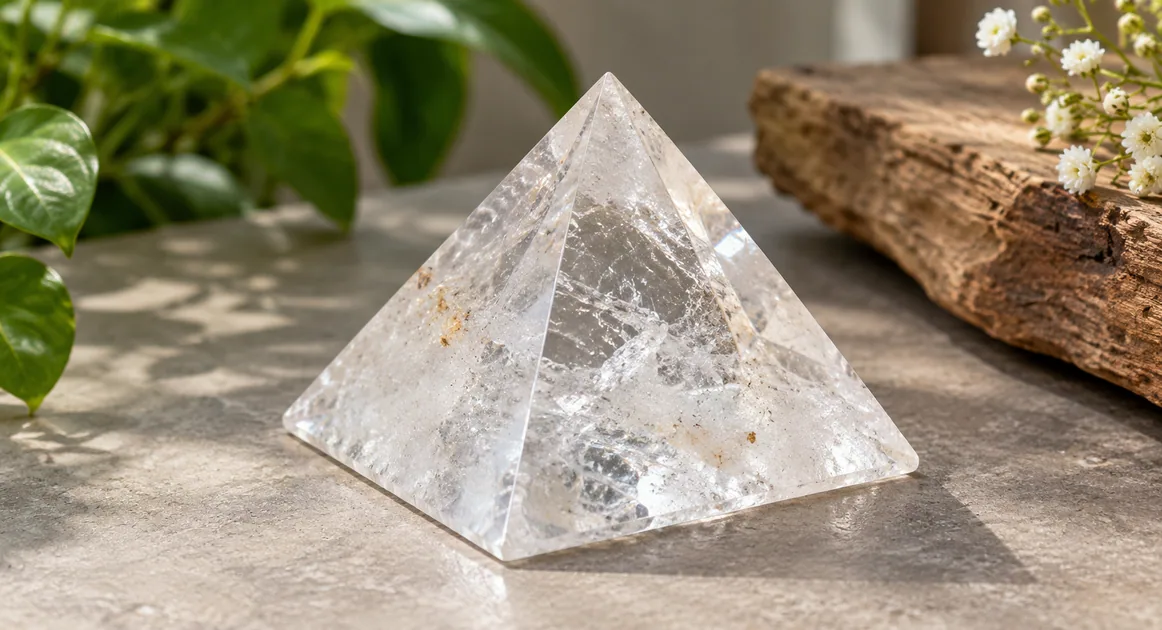
A clear quartz pyramid, often called a Sphatik pyramid in India, brings together two stories: the natural mineral known as rock crystal and the devotional, aesthetic and Vastu meaning that a household may give to a transparent carved form. On a puja shelf, reception counter or Vastu practitioner's demonstration table, a good piece can be beautifully simple. But photographs of clear pyramids create unusually easy confusion. Glass, acrylic, natural quartz and laboratory-grown quartz can look similar; a bright internal reflection can be mistaken for a crack or a hidden second pyramid; and the familiar word Sphatik does not itself certify the material.
This guide explains real Sphatik, rock-crystal identity, clarity grading, inclusions, carving geometry, natural versus synthetic quartz, Vastu placement, Sankalpa, puja use and gentle care. It also offers actual buying checks, comparison tables and examples for Indian homes, showrooms and professional Vastu reference collections. The goal is to select an object that is correctly described, well finished and appropriate to its intended setting, rather than assuming transparency or a special pyramid angle answers every question.
1. What is Sphatik? The Sanskrit name and the mineral identity
Sphaṭika (स्फटिक), also written Sphatik, Spatika or Sphatika in English, is a Sanskrit term associated with crystal or transparent stone. In contemporary Indian jewellery, puja and gemstone retail, it commonly designates transparent or nearly colourless rock crystal quartz. The cultural name is worth retaining: it connects the object with familiar Sphatik malas, Sphatika Shiva Lingams and other devotional articles. Yet the commercial name must be accompanied by a factual description of the carving material. 'Sphatik' on a packet is not by itself evidence that every item inside is naturally mined quartz.
Rock crystal is the colourless transparent variety of the mineral quartz, silicon dioxide (SiO2). It belongs to the same mineral species as amethyst, smoky quartz and citrine, though these other varieties have different colour origins. Quartz normally has a vitreous lustre, Mohs hardness about 7 and density near 2.65 g/cm3. It has no prominent easy cleavage but can fracture and chip. A white or milky piece can still be quartz; the level of transparency changes how a carving looks, not its underlying mineral identity.
The natural crystal habit of quartz commonly shows six-sided prismatic growth with crystal terminations that do not resemble a standard four-faced square-based shop pyramid. A retail pyramid is produced by cutting and polishing a piece of rough material. The maker decides its base, height, faces and edge finish. This manufacturing fact does not reduce the object's traditional or decorative appeal; it tells buyers which features are mineral properties and which are lapidary craftsmanship.
| Feature | Accurate description | Practical implication |
|---|---|---|
| Scientific name | Quartz, SiO2 | Ask for the underlying material, not only the trade name Sphatik. |
| Variety | Rock crystal: colourless to near-colourless crystalline quartz | Milky veils or small inclusions can be natural. |
| Hardness | Approximately 7 on the Mohs scale | Durable for display but a sharp tip still chips on impact. |
| Specific gravity | About 2.65 for quartz | Weight can support professional identification when accurately measured. |
| Cleavage | Usually indistinct; fracture commonly conchoidal | Do not mistake the absence of cleavage for immunity to breakage. |
| Appearance | Transparent, translucent or locally clouded; vitreous polish | Judge the actual carving under neutral light, not a retouched photo. |
| Shape | Square-based pyramid cut by a lapidary | Pyramid geometry is workmanship, not proof of geological origin. |
2. Natural rock crystal, synthetic quartz, glass and acrylic are different products
The word crystal is used very broadly in retail. Natural mined rock crystal is crystalline quartz formed geologically. Laboratory-grown quartz is also chemically and structurally quartz, but is made by people, often using hydrothermal growth methods. Decorative glass is an amorphous material with no long-range quartz crystal lattice; acrylic is a polymer. These materials may all form clear pyramids with polished faces, yet they should not be advertised as the same substance or sold under an unqualified natural-stone promise.
Natural versus laboratory-grown quartz can be a challenging identification even for professionals. GIA has documented synthetic clear quartz with convincing fluid-like inclusions and noted that polished items lose some of the external growth features that might otherwise help. Therefore visible inclusions do not guarantee natural origin; the absence of bubbles or a nearly perfect appearance proves neither natural nor synthetic quartz. Where natural origin materially affects price, request documentation or a gemmological assessment tied to the actual object.
A common sales shortcut is to place a pyramid beside an ice cube and claim that fast cooling proves 'original Sphatik'. The effect depends on temperature, thermal properties, size and test conditions; it is not a reliable method of distinguishing every quartz carving from glass or plastic. Likewise a cold-touch test, sound when tapped or a quick visual sparkle test is only an observation, not a laboratory conclusion. Avoid scratch tests, acids and heat: they risk harming the very item being purchased.
| Material | What it is | Proper selling description |
|---|---|---|
| Natural rock crystal | Mined colourless quartz | Natural clear quartz / Sphatik, when supported by identification. |
| Hydrothermal synthetic quartz | Laboratory-grown crystalline SiO2 | Laboratory-grown or synthetic clear quartz; not naturally mined. |
| Glass | Manufactured amorphous silicate material | Glass crystal-style pyramid, not natural Sphatik quartz. |
| Acrylic / resin | Organic manufactured polymer | Acrylic or resin pyramid, even if exceptionally transparent. |
| Quartz composite | Quartz fragments or powder held with binder | Reconstructed/composite quartz; disclose binding material. |
| Clear coated or fracture-filled stone | Mineral with treatment or surface enhancement | State quartz identity and known coating, filling or treatment. |
3. How to examine clarity, veils, inclusions and internal rainbows
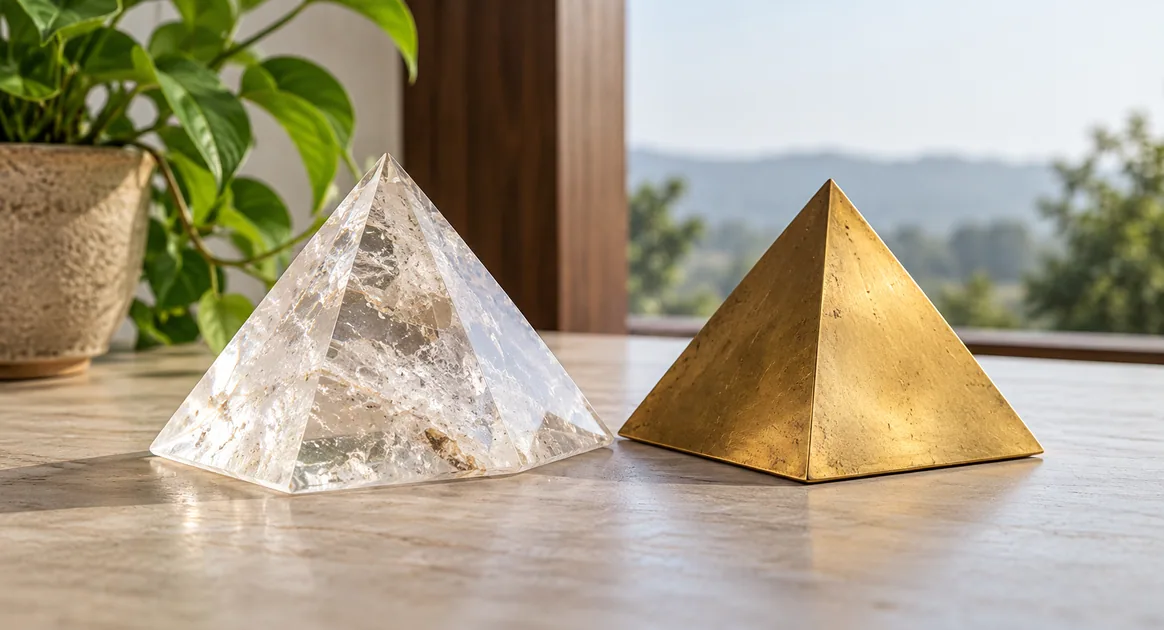
On a clear pyramid, every polished face acts as a window and a reflecting surface. Light enters one side, crosses the material, reflects from another face or an internal fracture and exits at a different angle. What looks like a second apex or duplicate triangular outline may be a reflection or refraction effect produced by the cut geometry. Rotate the pyramid slowly against a plain background and inspect the image from the base and an oblique angle before calling that feature a flaw or a separate crystal.
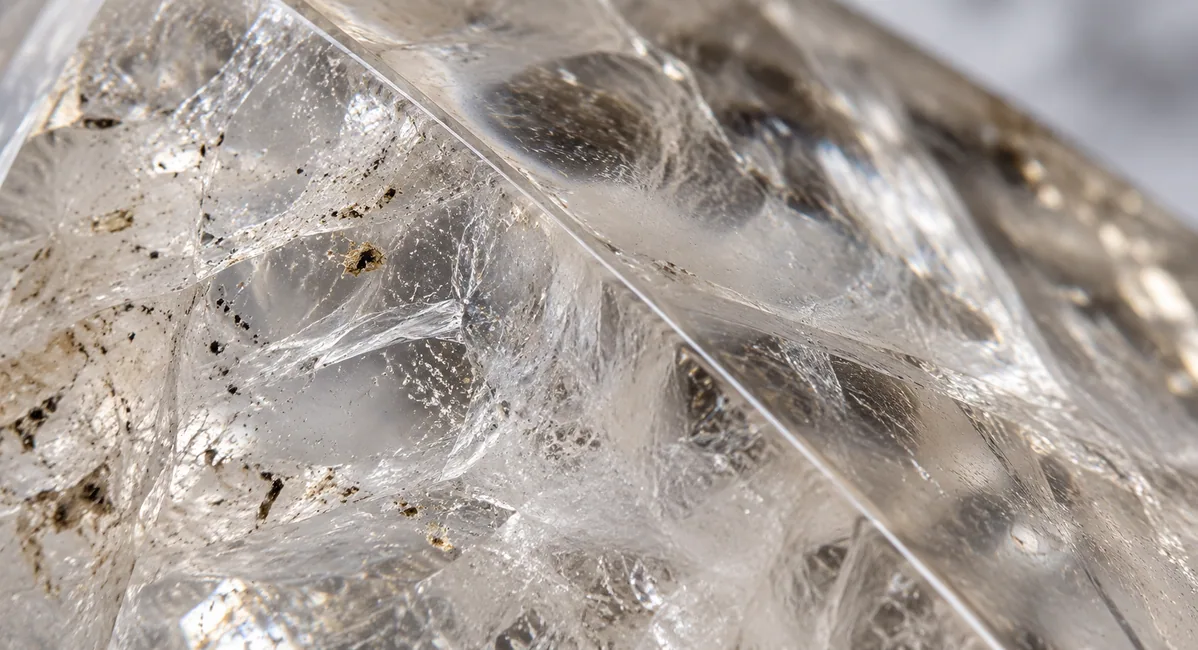
Common natural quartz observations include fine veils, wispy fluid-inclusion planes, faint milkiness and small mineral inclusions. Some fissures create a rainbow-like flash when light reflects from them. A 'rainbow crystal' description should say whether the colour comes from internal fractures, surface films or an applied coating when known. An attractive rainbow is not automatically a defect, but a fracture that reaches the apex or outer corner may weaken the carving or trap dirt.
Photographs can distort clarity. A dark backdrop enhances bright edges; strong backlighting may hide tiny scratches; overexposure can make a cloudy object look transparent; digitally increased contrast can deepen shadows at fractures. Ask for a short turning video, one daylight view against white, one view against a neutral darker surface and an underside photograph. The purpose is not to demand flawless perfection. It is to know exactly which veils, cloudy zones and polishing marks are present in the object being supplied.
| Observation | Possible explanation | Useful check |
|---|---|---|
| Duplicate or 'floating' point | Reflections and refraction through sloping faces | Rotate the object and compare from the flat base. |
| Fine internal rainbow | Light at an internal fissure, or possibly a coating | Inspect whether colour moves with viewing angle and ask about treatment. |
| White cloudy patch | Microscopic fluid inclusions, tiny fractures or different material | Review side-lit and transmitted-light photographs. |
| Small round bubbles | May suggest glass; exceptions and imitations exist | Request gem testing rather than treating one bubble as a verdict. |
| Straight plane reaching an edge | Open or healed fracture, or a polishing line | Look for a catch point, chip, filling or actual open fissure. |
| Flawless uniform interior | High-clarity natural quartz, synthetic quartz or glass | Do not infer natural origin from clarity alone. |
4. How gemmologists distinguish real quartz without harming the carving
When a specimen is valuable or there is serious doubt about identity, a trained gemmologist can combine refractive-index measurements, optical examination, specific gravity where practical and magnification. Quartz has characteristic refractive indices around 1.544 and 1.553 and is doubly refractive; common glass is normally singly refractive, though optical strain can complicate observations. A proper instrument reading and trained interpretation matter more than using a phone torch alone.
Distinguishing natural from synthetic quartz can require microscopy of growth features or infrared spectroscopy. GIA laboratory reports document cases where synthetic clear quartz displayed inclusions that appeared natural at first glance. A certificate is only useful if the testing laboratory, specimen dimensions and photograph match the actual piece, and the document actually establishes the claim being made. A paper saying 'quartz' does not automatically establish natural origin, untreated status or geographic provenance.
For routine small pyramids, transparent seller disclosure and consistent photographs may be a proportionate first step. For expensive large Sphatik carvings, professional verification is more appropriate. Keep one practical distinction in mind: clarity grade, material identity, natural growth origin, carved geometry and devotional suitability are five separate questions. An answer to one does not resolve the others.
5. What makes a well-cut clear quartz pyramid?
The ideal purchase is not necessarily the tallest or the most transparent. First inspect the apex: it should be deliberately finished, not freshly chipped or hidden under an inconsistent blob of clear filler. Then inspect the four triangular faces for stable polish, scratches, tool marks and open seams. Check whether the edges meet cleanly and whether the flat base rests without rocking. Small asymmetry may be normal hand-finishing; serious wobble or a fracture crossing a corner should be disclosed.
A typical square pyramid has four triangular side faces meeting at one point and a square base. Height, base width and slope angle affect appearance and stability. These dimensions are legitimate product specifications. Claims that an exactly stated angle proves the presence of natural quartz, improves gemstone grade or guarantees a Vastu outcome confuse geometry with material facts. Natural quartz crystals do not generally grow as the square pyramids made for household display.
For display photographs, the base width is often more relevant than the height alone: a 45 mm base occupies a much different desk footprint from a 90 mm base. Ask for the size in millimetres, approximate weight, individual-piece photographs when the material varies and packaging that protects the point. If a pyramid is glued to a metal or wooden pedestal, ask which components are quartz and which are mounting materials. The label 'solid Sphatik' should not silently include a large resin-filled or glass interior.
| Part | Check | Why it matters |
|---|---|---|
| Apex | Intentional point or correctly described rounded apex | Prevents damage being mistaken for a special shape. |
| Edges | No fresh chips, sharp splinters or concealed gaps | Reduces handling risk and unwanted breakage. |
| Faces | Consistent polish and accurate photos of each face | Shows carving quality, scratches and internal clarity honestly. |
| Base | Flat, steady rest with no visible rocking | Important for shelving and home puja arrangements. |
| Interior | Inclusions, veils, fills or coatings described where known | Separates natural features from treatments or damage. |
| Dimensions | Base x height plus weight for the actual design | Allows comparison across sellers and placement planning. |
| Mounting | Adhesives and non-quartz components identified | Changes cleaning methods and material claims. |
6. Comparing retail photographs without confusing reflection and material defects
Before placing an online order, request a clear rotating view of all four faces and the underside. Observe whether a bright line shifts position as the object turns; moving lines can be reflections, while a fixed rough line crossing an outer edge deserves close inspection. Natural inclusions may be attractive, but open structural breaks, loose base adhesives and poorly polished tips belong in a condition disclosure. A seller's photograph may describe a design, but the supplier should confirm whether the exact mineral specimen will be the same one shipped.
After delivery, compare the carving with the promised dimensions, material description and photographs under ordinary daylight. Keep the packing slip and relevant certificates with its storage box. If a mismatch is discovered, photograph it before cleaning or altering the item. Clear quartz responds well to gentle care, but an object represented as unmounted natural Sphatik should not turn out to have an undisclosed glass section or adhesive-filled point. These simple steps protect both devotional confidence and practical buyer interests.
7. Sphatik in Indian devotional tradition: purity, Shiva and japa
The traditional appeal of Sphatika is deeper than its appearance on a modern Vastu catalogue page. In Sanskrit literature the word refers to crystal, and clear crystal appears as an image of transparency, purity and luminosity. Sphatika Lingam, a lingam made from crystal, is recognised in Shaiva religious literature and devotional practice. References to crystal lingams in the Shiva Purana show that using clear stone for sacred forms is not a recent invention. Sphatik malas and devotional articles also have an established place in many households and lineages.
At the same time, a Sphatika Lingam, a Sphatik japa mala, a Shri Yantra carving and a square-based quartz pyramid are not the same ritual object. The first three may have dedicated iconographic or ritual use determined by a tradition or teacher. The modern pyramid combines a geometric display form with mineral and Vastu associations. A shop should not suggest that every pyramid automatically inherits every scriptural prescription for a Shiva Lingam or every mantra rule associated with a mala.
Devotional use also depends on context. Some families keep a small clear quartz object near a Shiva image, Ganesha image or other puja articles; others prefer using a Sphatik mala for japa while keeping the pyramid separate as a decorative focus. The practice may include ordinary cleaning of the shelf, a respectful Sankalpa or intention, and a decision to avoid crowding the altar. These choices are meaningful within the household's own tradition without requiring the carving to have a specified laboratory-measured spiritual power.
8. Clear quartz and Pancha Mahabhuta: a thoughtful Vastu framework
Vastu discussion commonly refers to the Pancha Mahabhuta or five great elements: Prithvi (earth), Jala (water), Agni (fire), Vayu (air) and Akasha (space). A physical quartz carving belongs materially to the mineral world and can symbolically evoke Prithvi, while its transparency and passage of light are sometimes used by contemporary practitioners to discuss clarity or Akasha. These are different layers of interpretation. Glass-like appearance does not make quartz literally an Akasha element, and a universal ancient instruction to place a four-sided quartz pyramid at one compass point has not been established.
The clarity of Sphatik often becomes a metaphor for shuddhi (purity), stillness, discernment and unclouded intention. In contemporary crystal and chakra practice, colourless quartz is sometimes linked with the Sahasrara or crown-chakra ideal of spiritual awareness; other practitioners use it during general meditation or mantra recitation. Such associations should be described as practice-based interpretations, not as a replacement for the detailed traditions of chakra sadhana or Jyotish gemstone selection.
In Vastu consultations, the right approach begins with the actual room. Consider function, natural light, traffic flow, moisture, heat, furniture and the household's worship preference before choosing the final shelf. A stable, uncluttered shelf that the family values is more useful than an inaccessible corner selected only because a one-line social-media chart calls it auspicious. If a practitioner uses a particular school of Vastu, record that method and its direction convention rather than mixing multiple incompatible diagrams.
9. Which direction is suitable for a Sphatik pyramid?
Traditional Ashta Dik descriptions recognise the eight directions: Purva (east), Agneya (south-east), Dakshina (south), Nairritya (south-west), Pashchima (west), Vayavya (north-west), Uttara (north) and Ishanya (north-east). In many households, Ishanya is associated with contemplation and worship; some modern Vastu discussions associate Uttara with Kubera and prosperity. These are not proof that all Sphatik pyramids belong only in one corner. A puja object, a reception decoration and a professional demonstration specimen serve different purposes.
| Direction | Traditional discussion | Practical guidance for a clear pyramid |
|---|---|---|
| East / Purva | Morning activity and illumination in many Vastu interpretations | Use a secure shelf; manage direct heat and glare near windows. |
| South-East / Agneya | Agni-associated zone | Keep away from burners, electrical heat and incense flames. |
| South / Dakshina | Part of the directional analysis of a room | Choose furniture that prevents accidental knocks. |
| South-West / Nairritya | Stability discussions in contemporary Vastu | Suitable only where the chosen practitioner and room function support it. |
| West / Pashchima | Directional and time-of-day light context | Watch for bright afternoon glare and concentrated reflected light. |
| North-West / Vayavya | Movement and air in common schemes | Avoid wind-exposed or heavily used transit shelves. |
| North / Uttara | Kubera association in many modern explanations | A neat reception or study display may express a chosen intention. |
| North-East / Ishanya | Frequently favoured for puja and contemplation | Consider a clean stable altar shelf, away from water spills. |
10. Sphatik, Chandra and Navagraha: avoid mixing distinct systems
In Indian ritual and astrological literature, crystalline or white materials can have lunar associations. Some traditional descriptions of Graha Shanti and planetary images refer to Sphatika in connection with Chandra (the Moon). But a general reference to crystal in a ritual inventory does not establish that any commercially sold Sphatik pyramid is the standard remedial gemstone for a specific birth chart.
Classical and contemporary Jyotish gemstone traditions often discuss Mukta or pearl for Chandra, and the familiar Navagraha Ratna system has its own distinct list of stones. Quartz, pearl and moonstone have different physical identities and different roles in particular lineages. The correct approach for an individual recommendation is to examine the applicable practice and, where birth-chart selection is being requested, relevant Graha, Rashi, Nakshatra, Lagna and Dasha context. A crystal ornament should not be assigned a universal planet solely because it is colourless.
A buyer may choose a Sphatik pyramid for devotional calm, a family tradition or a design preference without calling it a prescribed Navagraha gemstone. In a consultation report, naming the actual tradition is better than claiming that the pyramid 'automatically fixes' all planetary positions. This distinction respects both mineral facts and serious Jyotish practice.
11. How to use a clear quartz pyramid in puja, study and meditation
For a puja shelf, place the pyramid on a stable plate or tray where it will not obscure the central deity image, diya or offering vessels. If water or other liquids are used for abhisheka of a separate sacred object, keep those liquids away from a mounted or fracture-filled display pyramid. Unmounted quartz itself tolerates ordinary gentle cleaning, but adhesives, coatings and mixed decorative fittings can behave differently. Avoid placing any stone where a diya, camphor flame or hot incense tip can heat the face suddenly.
In a meditation corner, a small clear carving can act as a quiet visual focal point. The point is to create an orderly environment for japa, pranayama or reflection rather than to claim that its apex redirects a scientifically measured aura. A simple fabric mat, a clean low shelf and a comfortable seating position often matter more to daily practice than a complicated multi-pyramid arrangement. If a family follows a guru's specific instructions, the chosen tradition can guide which devotional articles belong on the altar.
On a study table or reception counter, transparency suits rooms with already colourful objects. Give the pyramid enough surrounding space to see the cut faces and enough clearance to prevent a notebook, bag, calculator or customer's elbow from catching its point. Decorative intention, devotional significance and a professional Vastu kit should be documented separately; a single object may be used in more than one way, but each use should be described accurately.
12. Comparing clear, rose and smoky quartz pyramids
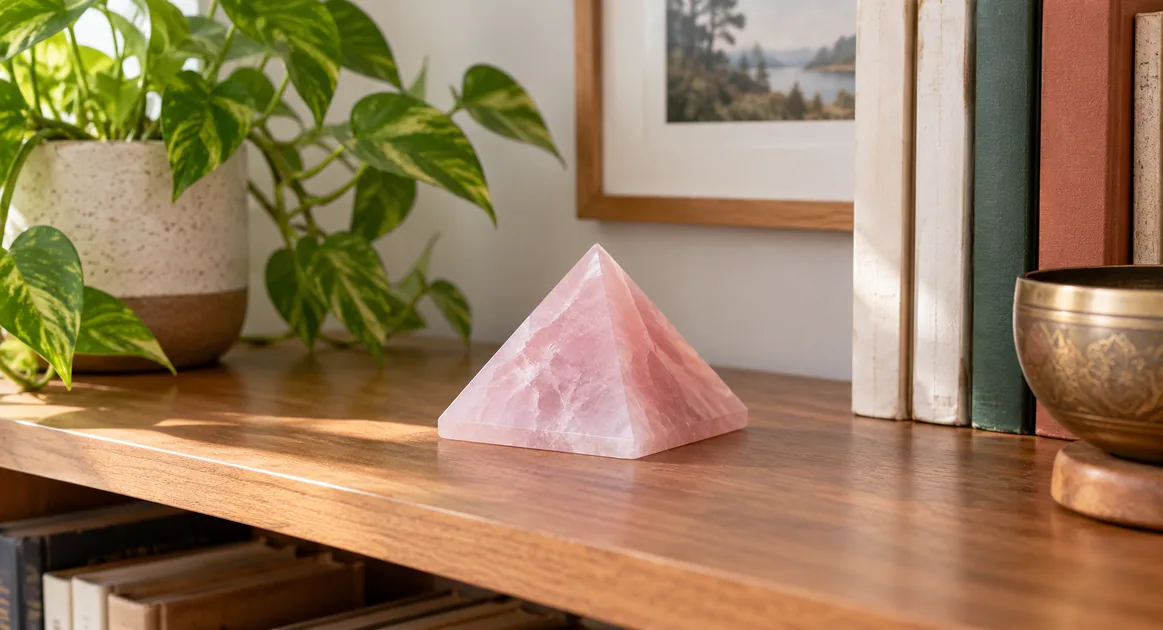
The three common quartz varieties can share much of their physical structure, yet differ strongly in appearance and market language. Clear quartz or rock crystal is colourless, rose quartz is pink and often translucent to milky, and smoky quartz ranges from grey to brown because of radiation-related colour centres. Rose quartz is usually not expected to look as transparent as the clearest Sphatik specimen. A smoky piece may darken through a thick part of the carving and appear pale at an edge. These distinctions help buyers avoid interpreting every visual difference as a defect.
| Feature | Clear Sphatik | Rose quartz | Smoky quartz |
|---|---|---|---|
| Main appearance | Colourless, transparent to translucent | Soft pink, often cloudy | Grey, tea-brown to deep brown |
| Mineral species | Quartz | Quartz | Quartz |
| Visual characteristic | Reflections, veils and clear windows | Diffuse colour and milkiness | Colour zoning and depth-dependent darkness |
| Common buying issue | Natural vs synthetic quartz vs glass | Pinkness, dye or imitation claims | Natural vs commercially irradiated colour |
| Modern symbolic use | Purity, clarity, contemplation | Harmony, affection, relationships | Grounding, steadiness, focus |
| Care priority | Protect tips, avoid sudden heat or harsh cleaners | Protect colour and polish, avoid harsh exposure | Protect point, check treatment disclosure |
All three can be appreciated as mineral carvings and as part of a household's chosen Vastu language. The choice should reflect the purpose and the real object, not a claim that one shade is intrinsically 'higher power' than another. When purchasing several pieces for one collection, use consistent labels with stone identity, treatment status where known, dimensions and care notes.
13. A realistic buying checklist for genuine Sphatik
Begin with the product description. It should state natural clear quartz, laboratory-grown quartz, glass, or another material as accurately as the seller can verify. Ask for the actual size, weight, number of pieces, finish and whether the price is for the photographed specimen or a representative design. If 'high grade' is used, ask what it means: transparency, low visible inclusions, craftsmanship and provenance are different qualities.
For an expensive carving, request daylight photographs of the four faces and base, an image with a scale ruler, and available supplier or lab information. Beware claims that small bubbles prove natural origin, that every quartz pyramid has a unique sacred fixed angle, or that a blue fluorescence proves the material is natural. For many smaller articles, honest disclosure and careful inspection are preferable to meaningless certificates. When a certificate exists, match it to the individual object rather than a generic batch photo.
| Question | Good answer includes | Watch out for |
|---|---|---|
| What is the underlying material? | Natural quartz / synthetic quartz / glass, correctly named | 'Original crystal' with no material identity |
| Is natural origin supported? | Supplier chain or testing tied to the actual item | Claims based solely on transparency |
| Are there treatments? | Known filling, coating, repair or composite details | Blank 'untreated' guarantee without basis |
| Which item will be shipped? | Actual photos or clear representative-image statement | Unrelated flawless studio sample |
| How large and heavy is it? | Base size, height and approximate weight | No dimensions or contradictory size claims |
| What is the apex condition? | Clear photos, sound polish, disclosed rounding | Chips hidden by angle or lighting |
| Does the base sit flat? | Underside image or confirmed stable base | A tall object that visibly rocks |
| How should it be cleaned? | Advice matched to bare stone or mounted components | Harsh soaking or chemical instructions for all products |
14. Three practical examples: Bengaluru home, showroom and professional kit
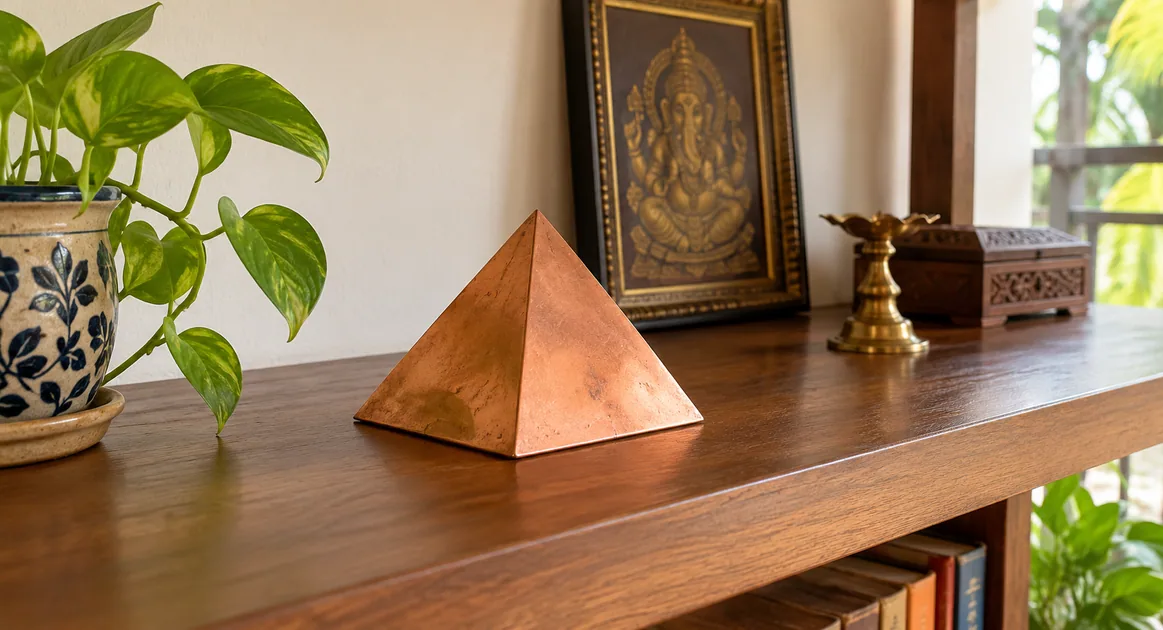
A Bengaluru apartment puja corner
A family wants one clear Sphatik pyramid for a compact wooden altar beside existing Shiva and Ganesha pictures. The shelf is near a window and a small diya is lit each evening. A modest, flat-bottomed carving is easier to place than an oversized specimen, and a simple stone or metal tray protects the shelf surface. They choose a spot that does not crowd the devotional images, check the apex is well away from the diya and wipe off dust with a soft cloth. The spiritual value comes from the family's chosen Sankalpa and practice; the purchase decision still depends on truthful quartz identification and a stable carving.
A jewellery showroom reception
A showroom uses a clear pyramid as a quiet Vastu-themed accent near a consultation counter. Strong lighting makes the edges sparkle, but a glossy black glass top creates misleading reflections that can resemble internal defects. The owner photographs the pyramid against neutral grey, supplies a size card, labels it 'clear quartz (Sphatik)' only after confirming identity, and keeps it far enough from customer handling and jewellery trays. Staff can explain the cultural name without promising sales growth from an object placed near the payment terminal.
A professional Vastu reference collection
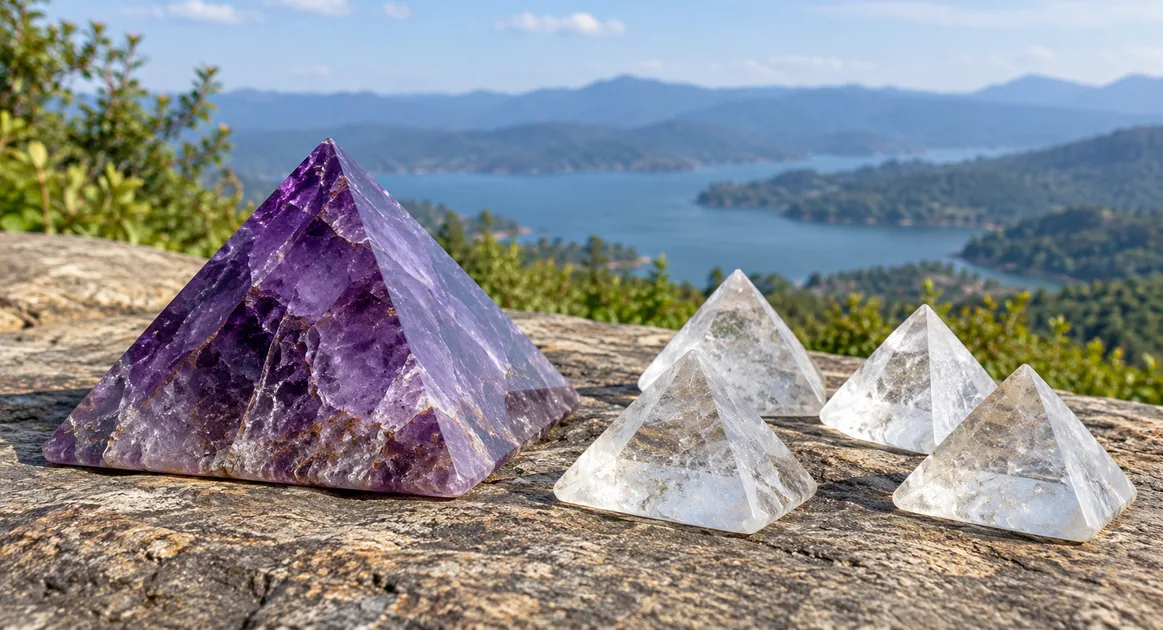
A practitioner compares clear quartz, rose quartz, smoky quartz, glass imitation and synthetic quartz samples. Each specimen receives a durable label identifying the material, dimensions, source, known treatment, test status and date of review. The samples are shown in identical daylight conditions, not merely under a dramatic backlight. Students observe how transparent quartz produces internal reflections and how polished glass can mimic some surface qualities. The practitioner then discusses Prithvi, Akasha, Ishanya and Sankalpa as traditional interpretive concepts, clearly separate from the mineral identification exercise.
15. Cleaning, storage and safe handling
Pure unmounted quartz is relatively stable under normal household conditions. For routine dust use a soft clean microfibre cloth or a soft brush, and avoid abrasive powders that scratch polished faces. For an uncoated, unmounted and structurally sound quartz carving, a little lukewarm water with mild soap can be used when needed; rinse gently and dry completely with a soft lint-free cloth. A simple lightly damp cloth is often sufficient. If treatment, adhesive mounting, surface filling or an open fracture is present, use the gentler approach specified by the seller or restorer rather than immersing the whole piece.
Do not use strong acids, bleach, abrasive cleaners, steam, ultrasonic equipment or extreme hot-to-cold temperature changes on an uncertain retail carving. Although quartz is durable, those methods may affect adhesives, inclusions, filled fractures or the sharp apex. Never test authenticity by heating, burning, dropping, scratching or exposing a stone to acid. A safe home assessment is visual and documentary; the laboratory has appropriate nondestructive methods for higher-stakes identity questions.
Store a pyramid separately in a padded box or compartment so that its point and edges do not strike other quartz pieces or jewellery. For display, place it on a level surface that people are unlikely to brush past. Do not suspend a heavy pyramid over a bed or leave a sharp pointed specimen within small children's reach. Place its cleaning cloth and certificate, if any, in the same labelled storage envelope to make future condition checks easier.
| Construction | Routine cleaning | Extra caution |
|---|---|---|
| Sound, bare quartz | Microfibre; occasional mild soapy-water cleaning and thorough drying | Protect the point and avoid sudden temperature changes. |
| Quartz with open fractures | Gentle dry dusting or slightly damp surface wipe | Do not pressure-clean or force liquid into cracks. |
| Coated / filled quartz | Follow the treatment-specific supplier instructions | Solvents and soaking may damage fills or coatings. |
| Quartz glued to a base | Dust exposed faces, avoid wetting glue joints | Do not assume the mount tolerates water or heat. |
| Glass or acrylic lookalike | Use manufacturer-specific cleaning method | Plastic can scratch easily; glass may chip at an edge. |
| Stored pyramid | Soft wrap with separate point protection | Prevent impacts against other stones and metal jewellery. |
16. Display and product-photography mistakes to avoid
A clear pyramid is unusually sensitive to its surroundings because every facet reflects whatever sits nearby. Coloured shelf liners can tint an otherwise colourless crystal; a warm spotlight may make it look yellow; backlighting can turn minor veils into dramatic lines. For an honest product listing, include one natural light view, a neutral background, all sides where practical and a base close-up. Lifestyle images may be helpful but should not replace material evidence.
Do not rely on a mockup of a large flawless crystal when selling a batch with variable clarity, internal veils or different edge finish. If the shop uses representative photographs, say so. Avoid inventing a laboratory grade based on a photograph and do not label a carved shape as a naturally formed quartz termination. Explain that the faceted pyramid is a handmade or machine-assisted lapidary object, and describe the actual finish rather than overstating a supposed Vastu-angle tolerance.
For online shopping, two photographs may be enough to introduce a simple design, but an expensive or individually variable Sphatik specimen deserves the item-specific views described earlier. The buyer should be able to compare clarity, weight, dimensions, base finish and any known repairs without having to rely on phrases such as 'super premium cosmic crystal'. Clear naming is stronger than an unsupported claim.
17. Frequently asked questions about clear quartz and Sphatik pyramids
1. Is Sphatik the same as clear quartz?
In contemporary Indian gem and puja retail, Sphatik commonly refers to colourless or nearly colourless rock crystal quartz. The term also appears in devotional Sanskrit usage. Confirm the physical material separately because the retail word alone cannot distinguish natural quartz from glass or synthetic material.
2. Is a crystal-clear pyramid always natural?
No. Excellent transparency can occur in natural quartz, laboratory-grown quartz and glass. GIA has published examples of synthetic clear quartz with inclusions resembling those in natural material. Origin requires appropriate evidence rather than an appearance-based guarantee.
3. Do clouds or veils mean a Sphatik pyramid is fake?
No. Natural rock crystal can contain microscopic fluid inclusions, healed fissures and milky regions. Those features do not automatically prove natural origin either. Examine the actual fracture condition and seek testing where the claim matters to price.
4. Does a rainbow inside quartz mean it has been treated?
Not necessarily. Reflections at an internal fracture can create rainbow colours. Thin-film coatings also produce optical effects, and photos can be misleading. Ask for an angled view and known treatment disclosure if the effect influences your purchase.
5. Why can I see a second pyramid or apex inside the carving?
The sloping polished faces refract and reflect light, creating doubled-looking edges or an apparent internal point. Rotate the piece, change the background and examine the base. If the feature remains a suspicious filled cavity, a gemmologist can inspect it.
6. How is a carved pyramid different from a natural quartz point?
Many naturally grown quartz crystals have a six-sided prismatic habit and their own terminations. A commercial square-based pyramid is deliberately cut and polished from raw material. Its symmetrical faces describe workmanship, not natural crystal growth.
7. Does the pyramid angle prove authenticity?
No. A glass or resin pyramid can be cut to the same dimensions as a quartz pyramid. Accurate geometry may be a mark of workmanship, but chemical composition, crystal structure and origin require different evidence.
8. What is the Mohs hardness of clear quartz?
Quartz is approximately 7 on the Mohs scale. That means reasonable resistance to everyday scratching, not immunity to chips. Sharp tips and thin corners can break in a fall. Do not damage an owned object by performing home scratch tests.
9. Can glass be sold as Sphatik?
Glass may be sold as a clear decorative crystal-style object, but it should be labelled glass rather than natural Sphatik quartz. Ask for explicit mineral identity, accurate material description and a return policy if the distinction matters.
10. What is synthetic or hydrothermal quartz?
It is crystalline quartz grown under controlled laboratory conditions, often using hydrothermal methods. It is genuine quartz by chemistry but not mined natural quartz. A reputable listing should distinguish its origin rather than calling it a glass imitation.
11. Can an ordinary photo distinguish natural from synthetic Sphatik?
Usually not reliably. Lighting, cropping and internal reflections obscure meaningful details. Professional microscopy and sometimes instrumental spectroscopy are used for harder cases. An item-matched report is more persuasive than a generic supplier certificate.
12. Is Sphatik associated with Lord Shiva?
Sphatika is a recognized traditional crystal material, and Sphatika Lingam has a devotional place in Shaiva practice and texts. A contemporary clear pyramid is a different form, so its puja use should follow household or lineage preferences rather than a claim that all lingam rituals apply to pyramids.
13. Which Vastu direction is best for a clear quartz pyramid?
Some households favour Ishanya or the north-east for worship and contemplation; other arrangements follow a practitioner's room-specific method. Evaluate intended use, shelf safety, light and the actual layout. There is no single universal placement rule appropriate to every family and every pyramid.
14. Is Sphatik always a Chandra or Moon gemstone?
Crystal appears in some traditional lunar ritual descriptions, while standard Jyotish gemstone discussions frequently identify pearl with Chandra. A clear quartz pyramid is not automatically a birth-chart-prescribed substitute. Match recommendations to the tradition and the chart being considered.
15. Can a Sphatik pyramid be kept beside a Shivling or mala?
Many people choose to keep separate clean devotional articles together on an orderly shelf. Leave suitable space for worship and avoid water spills, hot lamps and crowded arrangements. Specific temple or lineage practices should guide ritual placement when applicable.
16. Must the pyramid be flawless for meditation?
No. Perfect transparency is an aesthetic preference. A sound quartz carving with visible veils can still be appreciated, and its suitability as a visual meditation focus depends on the person's practice, comfort and intention rather than a commercial flawless grade.
17. Can I wash a Sphatik pyramid in water?
A sound bare piece of quartz normally tolerates a gentle lukewarm rinse, but unknown coatings, fills, adhesives or mounted components may not. Soft dusting or a lightly damp cloth is the safer default for a retail object with an uncertain construction history.
18. Should a quartz pyramid face direct sunlight?
Normal room light is fine, but avoid exposed locations with strong glare, large heat swings or where the stone could act as an awkward bright reflection near an altar. A clear carving does not need intense sunlight to serve as an attractive devotional or decorative object.
19. How do I choose the right size?
Measure shelf depth and clearance before comparing marketing sizes. A compact piece works well for a home puja shelf or desk, while a larger one needs a stable secure base. Compare base width, height, approximate weight and apex condition for the exact item.
20. What should I ask the seller before paying?
Ask for precise material identity, natural or synthetic origin when known, treatment or filling disclosure, actual photographs, dimensions and weight, apex and base condition, care advice and an appropriate return policy. Those answers are more useful than an unsupported crystal-power ranking.
18. Final checklist: clarity with cultural depth and accurate material naming
The best Sphatik pyramid is one whose material is correctly named, whose polished faces and base are sound, whose inclusions and treatments are accurately described, and whose appearance suits its intended place. A clear quartz carving does not become less meaningful because it has a faint veil, nor does a flawless-looking pyramid become naturally mined simply because a seller calls it 'original'. Distinguish rock crystal identity, natural growth origin, internal clarity, workmanship and spiritual use before comparing prices.
For OmmRudraksha readers, Sphatika carries a genuine cultural vocabulary involving crystal, puja, japa, purity and Shaiva devotion; contemporary Vastu practice adds its own interpretation of directions, space and Sankalpa. Treat those traditions with specificity rather than flattening them into generic statements. Then use mineralogical evidence to understand the material, a practical checklist to choose the carving, and sensible care to preserve it for years.
Research basis: Mindat's Quartz mineral record for SiO2, Mohs hardness, crystal structure and fracture; GIA's gem identification teaching and its Gems & Gemology laboratory studies on hydrothermal synthetic rock crystal; Geological Survey of India's gem material classification and inclusion guidance; Indian cultural references to Sphatika as crystal, including Sphatika Lingam in Shaiva tradition. Sources are acknowledged by name without introducing unnecessary outbound commercial links.
Explore existing OmmRudraksha collections
Browse Vastu for the existing collection, or explore gemstone products for other material forms. Each product’s construction and care information should guide your choice.