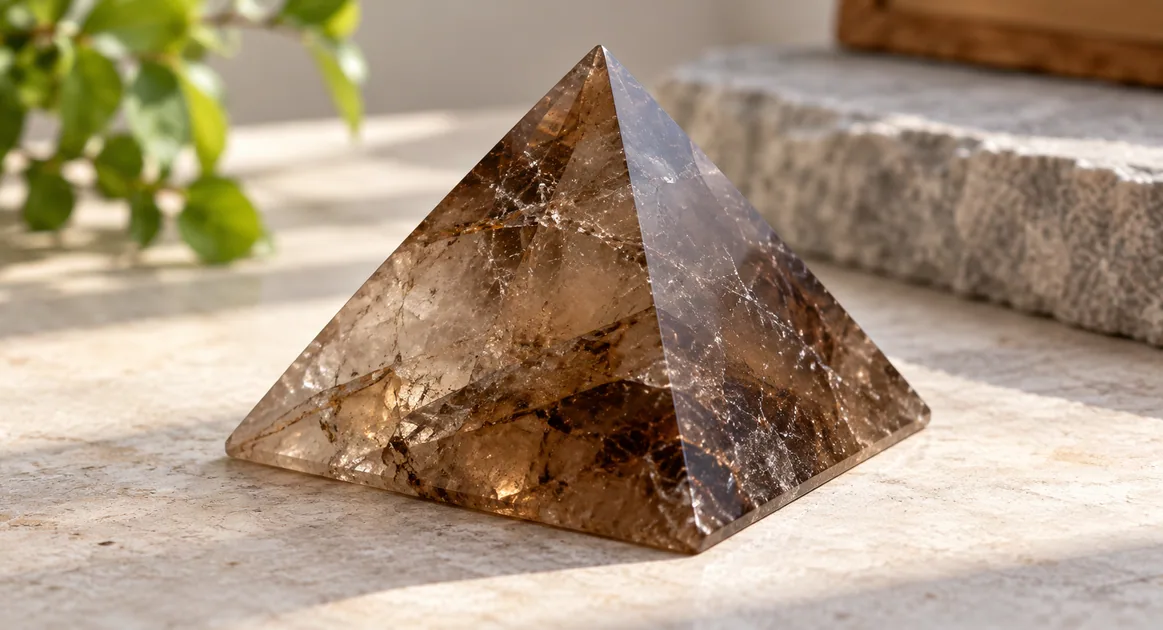
A smoky quartz pyramid is a square-based carving of quartz coloured in shades of smoke-grey, warm tea-brown, chocolate or nearly black. It may be chosen for the calm, earthy appearance of its polished faces, for a thoughtful Vastu display, or simply because the light passing through a naturally patterned quartz body is beautiful. Yet the first buying decision is not where to place it: it is what the carving actually contains, how its colour arose, and whether its edges, apex and base are sound. Those questions matter equally for a compact Bengaluru apartment shelf and a professional Vastu reference collection.
This guide combines smoky quartz identification, treatment disclosure, pyramid carving quality, Vastu symbolism and practical care. It explains why brown intensity changes with thickness, which trade descriptions deserve questions, how smoky quartz differs from other brown stones, and how to make a sensible purchase without treating the stone's appearance as proof of origin or spiritual potency.
1. What is smoky quartz? Mineral identity before symbolism
Smoky quartz is a grey-to-brown or blackish colour variety of crystalline quartz, with the chemical formula SiO2. It belongs to the same mineral family as clear rock crystal, amethyst and citrine. It is not a separate mineral species and it is not naturally a metal, resin or glass. A crystal can have a light smoky tint, a pronounced tea-brown body, distinct colour zoning, or a deep shade sometimes called morion. Different pieces can all be real quartz.
Quartz typically has a hardness of 7 on the Mohs scale, a vitreous or glasslike polish and no prominent cleavage; it can nonetheless fracture and chip. A pyramid's pointed apex and narrow edges are more vulnerable to impact than a rounded quartz pebble. The polished carving is also not necessarily a natural crystal termination: its pyramid shape has been cut and finished by a lapidary worker. A seller should describe it as a carved smoky quartz pyramid, not imply that four perfectly straight triangular faces formed in the ground.
Smoky quartz forms in several geological settings, including pockets and fissures associated with igneous rocks and pegmatites. The exact locality of a retail carving should not be inferred from its brown tone. Brazil, Madagascar, the Alps and other regions supply quartz, but a generic origin story is not a substitute for traceable supplier information about the particular object.
| Feature | Typical characteristic | What the buyer should understand |
|---|---|---|
| Mineral identity | Crystalline quartz, SiO2 | The brown colour is a quartz variety, not a different mineral species. |
| Colour range | Smoky grey, tan, brown and very dark brown-black | Neither darkness nor paleness alone proves quality or untreated status. |
| Hardness | Mohs 7 | Fairly scratch resistant for ordinary display, but not impact-proof. |
| Cleavage / fracture | No characteristic easy cleavage; may fracture unevenly to conchoidally | An apex, tip or edge can still chip when knocked. |
| Polish | Often vitreous, reflecting light clearly | A thick coating or resin gloss should not be confused with natural mineral quality. |
| Colour origin | Radiation-related colour centres in suitable quartz | Both natural and commercial irradiation can produce smoky colour. |
2. Why is smoky quartz brown? Irradiation and aluminium explained
The widely accepted explanation involves trace aluminium substituting for silicon in the quartz lattice and colour centres created by exposure to ionising radiation. In nature, that exposure can occur over geological time from the surrounding environment. A colour centre affects how the crystal absorbs light and therefore gives a translucent stone its smoky appearance. Mineralogical descriptions sometimes explain these as electron or hole-trapping defects; buyers do not need to memorize the chemistry to understand the trade consequence.
The same class of colour effect can also be induced commercially. Colourless or lightly coloured quartz containing suitable impurities can be irradiated to develop a smoky tint. Some treated stones may then be heated to adjust the resulting shade. That means a carved object can be genuinely crystalline quartz while its dark brown appearance was created or intensified after mining. These are two separate questions: Is the material quartz? and Is its colour naturally produced?
There is no dependable home photograph test that distinguishes naturally irradiated smoky quartz from commercially irradiated smoky quartz. A beautiful, uneven brown zone does not prove geological origin; even treatment can yield nonuniform results. Conversely, a uniformly dark piece is not automatically treated. When a supplier does not have documented treatment history, the responsible wording is "treatment status not verified" rather than "guaranteed unheated, untreated and completely natural colour."
| Claim | What it does establish | What it does not establish |
|---|---|---|
| Natural quartz | The underlying substance is mined quartz, if correctly identified. | Does not establish that brown colour is untreated. |
| Natural smoky colour | Claims brown coloration was generated geologically. | Should not be inferred from a product photograph alone. |
| Irradiated smoky quartz | Colour was developed or modified by a commercial process. | Does not make the object glass or plastic. |
| Unheated | Claims no commercial heat step was used. | Does not exclude irradiation or a surface coating. |
| Untreated | Claims no relevant enhancements were applied. | Needs a credible basis, not simply an absent disclosure. |
| Smoky quartz look | Describes appearance only. | May refer to glass, resin or a different stone altogether. |
3. Reading pale tips, dark centres and colour zoning in a pyramid
One smoky quartz pyramid may seem almost black when viewed straight through its thick centre but visibly amber-brown at the thin edges. This is not inherently a defect: light travels through different lengths of coloured material, and more strongly coloured areas can absorb more light. A backlit photo can make transparent zones look dramatic, while a dark background makes the same carving appear nearly opaque. Neither image by itself gives a complete picture.
Ask the seller for at least three neutral views: the pyramid upright in ordinary daylight, a side view against a light background, and an underside or base photograph. A short turning video is helpful where available. Natural-looking zoning, faint internal veils or transparent windows may be desirable aesthetic characteristics. But apparent haze also can be fractures, rough polish, resin, bubbles or residual grinding marks. Insist on a clear description rather than letting poetic colour terms replace facts.
Very dark morion is a recognised trade/mineral variety name for almost black smoky quartz. The term does not constitute an authenticity certificate. Historical cairngorm can refer to smoky quartz associated with the Cairngorm region and traditional Scottish jewellery; retailers should not use that label to claim Scottish provenance for unrelated stock without evidence. Likewise, "black smoky quartz" may describe an intensely coloured stone but not identify the mechanism responsible for the colour.
4. How to identify genuine smoky quartz without damaging the object
Start with a visual and seller-documentation assessment, not a destructive scratch test. Quartz has a familiar vitreous lustre and, where the carving is translucent enough, internal optical features consistent with natural crystalline material. These signs are useful but not conclusive. A polished imitation can be photographed to look convincing. Tiny air bubbles may suggest glass, but their absence does not prove quartz, while natural inclusions should not automatically be called manufacturing defects.
If the purchase is valuable, a qualified gemmologist may use refractive index, specific gravity, polarised-light observations and magnification as part of an identification. Conventional quartz measurements generally fall around refractive index 1.544–1.553 and specific gravity near 2.65. Identification of the mineral and determination of how its colour arose are different laboratory tasks; a basic quartz identification report does not necessarily certify natural colour.
| Observation | Helpful question | Limitation |
|---|---|---|
| Polished surface | Does the lustre look consistent across faces and edges? | Glass and coatings can also appear glossy. |
| Light transmission | Can a brighter background reveal translucent brown zones? | Deep genuine smoky quartz can look very dark. |
| Internal features | Are there natural veils, zoning or visible inclusions? | No one inclusion pattern proves authenticity. |
| Base and point | Are fractures, chips or repair lines disclosed? | Good photography helps assess condition, not treatment origin. |
| Gem examination | Will a trained examiner identify crystalline quartz? | Material confirmation may not distinguish natural from commercial irradiation. |
| Supplier paperwork | Is any treatment, composite construction or origin claim supported? | An unverified marketing certificate is not independent evidence. |
5. Smoky quartz versus lookalikes and other quartz colours
Warm brown colours occur across many materials. Smoky quartz is not the same as brown glass, dyed agate, bronzite, tiger eye or brown topaz. Both quartz and glass can be transparent, but their crystal structures and physical properties differ. Tiger eye owes its moving silky band to an oriented fibrous texture; smoky quartz generally does not show that classic chatoyant stripe. Bronzite has an entirely different mineral structure and often shows metallic-bronzy reflections rather than a clear smoky body.
The quartz-family distinctions also matter. Citrine is yellow-to-orange quartz; amethyst is violet quartz; rock crystal is colourless quartz; rose quartz is pink. A smoky specimen may contain yellowish or amethyst-like zones, but calling every brownish-yellow quartz "natural citrine" is not a responsible shortcut. When buying a pyramid, choose the actual colour and optical behaviour you want rather than assuming the name of one quartz variety makes another interchangeable.
| Material | Typical appearance | Useful distinction | Buying caution |
|---|---|---|---|
| Smoky quartz | Transparent to dark translucent smoky grey-brown quartz | Crystalline quartz, colour may be natural or irradiated commercially | Ask separate questions about mineral identity and treatment. |
| Citrine | Yellow to orange quartz, sometimes brownish | Different marketed colour variety of quartz | Heat history and borderline shades should be described. |
| Brown glass | Often evenly tinted, sometimes highly transparent | Amorphous manufactured material | Do not accept "quartz" based on a glossy photograph alone. |
| Tiger eye | Brown-gold, typically moving light band | Fibrous quartz appearance and chatoyancy | Check the band by changing viewing angle. |
| Smoky topaz / brown topaz | Brownish transparent gemstone material | Topaz is a different mineral species | "Smoky topaz" may be an imprecise historic trade label for quartz. |
| Dyed chalcedony or agate | Brown or dark translucent zones, sometimes banded | Microcrystalline silica instead of a clear macrocrystalline quartz body | Ask whether colour was dyed or otherwise enhanced. |
| Resin / composite | Uniform or swirled dark brown surface | Manufactured or assembled material | Check joints, underside, coating and invoice description. |
6. Pyramid geometry: what good cutting and polishing look like
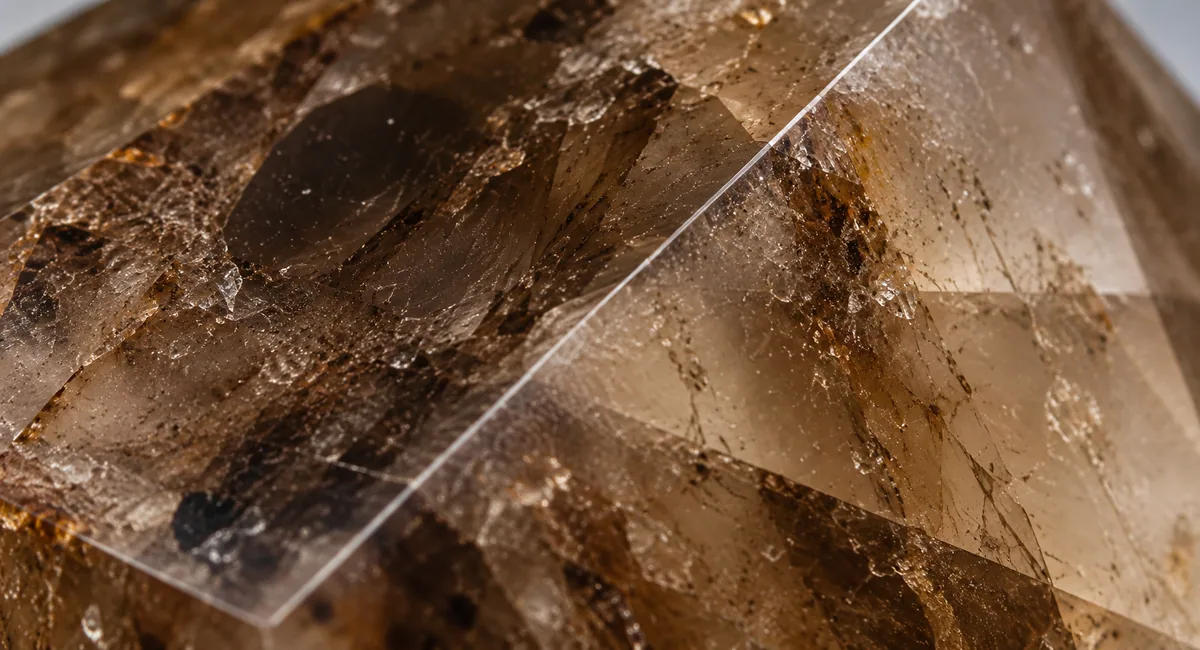
The pyramid's simple geometry reveals workmanship. A balanced square base has four sides meeting cleanly, and the apex sits visually above the centre. Real stone weight, cutting limitations and the maker's design may introduce small tolerances; handmade work does not demand laboratory-perfect symmetry. Nevertheless, a distinctly rocking base, sharp uncontrolled chips or a roughly glued repair should be disclosed before sale.
Look carefully at the tip. A slightly softened apex may be a practical safety choice, particularly for households with children or crowded showroom displays. An accidental broken point is different: it may expose a white fracture and catch on fabric. Under a strong sidelight, polished faces should not reveal extensive unmentioned coarse grinding lines. Naturally occurring internal veils are distinct from surface scratches; knowing where each feature lies changes how a buyer judges the carving.
Opaque-looking dark quartz can conceal internal structure. Request underside photographs against a light background and a close view of each edge. If the object is made of several joined pieces, coated with coloured resin, stabilized or repaired, the seller should state it. A single continuous carved piece and an assembled display item may both be decorative, but they are different constructions and should not share an ambiguous product description.
| Part | Check | When to ask for clarification |
|---|---|---|
| Apex | Deliberate finish, no unreported broken chip | Visible fresh-looking fracture, sharp splinter or repair line |
| Four faces | Coherent finish and clear views under normal light | Large cloudy filler patches or uneven polish not described |
| Edges | Stable, adequately finished, not heavily abraded | Cracks reaching adjacent faces or rough chipped segments |
| Base | Sits level and shows correct dimensions | Rocks, glued seams, hidden cavities or missing corner |
| Interior | Natural-looking zoning and disclosed inclusions | Suspicious bubble clusters or concealed structural repairs |
| Listing | Actual size, weight, photographs and treatment statement | Stock photos substituted for the item without disclosure |
7. Choosing size and proportion for a shelf, puja space or desk
A 35 mm decorative pyramid and a large 100 mm showpiece solve different display problems. A low, broad base can be more stable than a tall and narrow profile of similar height, though actual centre of mass and shelf condition also matter. Check the measurements from the seller; the weight of quartz varies with size and carving shape, and neither a generic weight chart nor a photograph can establish the actual product specification.
For a small home altar, begin with where hands move during daily worship and where lamps, incense and water vessels are kept. A pyramid should not stand where a passing sleeve or prayer plate can knock the point. In a jewellery showroom, place it behind the counter or on a stable display riser, separate from frequently handled stock. For a professional Vastu kit, choose a compact, clearly labelled sample that can be transported without contact with harder mineral specimens.
There is no sound basis for charging more merely because a carving is described as "perfectly energetic" or because one face is darker. A fair assessment considers actual material quality, treatment disclosure, dimensions, finish, originality of manufacture, return policy and the seller's ability to identify the displayed object.
8. Smoky quartz in traditional Vastu and contemporary crystal practice
In contemporary crystal practice, smoky quartz is commonly associated with grounding, steadiness, composure, protection symbolism and thoughtful release of distractions. In a household using Vastu-based symbolic arrangements, its smoke-brown colour may be related to the grounding language of Prithvi Tattva, the earth element within the Pancha Mahabhuta. These are interpretive associations, not mineralogical measurements. The actual quartz is not a mechanical substitute for improving sunlight, ventilation, structural defects or an unsafe room layout.
Traditional Vastu Shastra studies spaces, directions, proportions, site relationships and activities. A modern carved smoky quartz pyramid is a contemporary accessory used by some practitioners alongside those ideas. It should not be represented as a universally mandated object from every classical Vastu treatise. Different schools may assign different materials or colours to directions; a serious practitioner starts from the actual floor plan, room function and intended Sankalpa—the personal intention behind a placement—rather than a single universal placement rule.
For example, a family may place a smoky quartz carving on a quiet study shelf as a reminder of stable habits and attentive work. A shop owner may use a carefully arranged display near the billing desk to symbolize patience and orderly trade. These practices can be culturally meaningful without claiming that a stone automatically changes sales figures or neutralizes a quantified "negative energy" field.
9. Pancha Mahabhuta, Sankalpa and the eight directions
Prithvi represents stability, form and support in traditional five-element frameworks. Jala evokes fluidity, Agni transformation, Vayu movement and Akasha space. A brown-toned stone is frequently interpreted in present-day crystal arrangements as an earthy visual anchor. But it is important to separate a colour analogy from the full Vastu role of an element: a dry quartz carving cannot replace correct drainage, suitable fire placement or healthy movement through a room.
The directional framework of Ashta Dik names East (Purva), South-East (Agneya), South (Dakshina), South-West (Nairritya), West (Pashchima), North-West (Vayavya), North (Uttara) and North-East (Ishanya), with associations that vary by school and context. It is inaccurate to tell every buyer that every smoky quartz pyramid must stand in the same corner. Placement depends on whether the object is devotional, decorative or part of a particular practitioner's plan.
| Direction | Context used in Vastu discussions | Approach to the pyramid |
|---|---|---|
| East / Purva | Often considered in relation to morning light and activity | Display only if light and shelf position are suitable; avoid prolonged harsh heat. |
| South-East / Agneya | Agni-related zone in many traditions | Keep quartz well away from stove flame, hot surfaces and incense heat. |
| South / Dakshina | Examined within broader Vastu directional mapping | Use a stable shelf, not a narrow ledge or doorway pinch point. |
| South-West / Nairritya | Often associated with stability in modern Vastu discussion | Some practitioners prefer grounding-toned displays here; assess the real room. |
| West / Pashchima | Part of the eight-direction room analysis | Watch for strong late-day sun heating a window-adjacent stone. |
| North-West / Vayavya | Traditionally discussed with movement and air | Keep the object away from places frequently brushed while moving. |
| North / Uttara | Sometimes associated in modern practice with Kubera | A prosperity-themed display may be meaningful, but not a guaranteed outcome. |
| North-East / Ishanya | Commonly considered auspicious for worship and contemplation | Keep arrangements respectful, uncluttered and away from ritual water spills. |
10. Devotional associations: Shiva, Kubera, Shani and colour symbolism
Practitioners sometimes relate a smoky pyramid's dark, earthy tone to Shani (Saturn) themes such as discipline, patience and responsibility; others connect a home or commercial prosperity arrangement with Kubera or the blessings of Goddess Lakshmi. Such connections are not universal correspondences assigned to smoky quartz in all branches of classical Jyotish. In particular, a decorative quartz pyramid should not automatically be treated as a substitute for Neelam (blue sapphire), which has its own traditional gemstone-discussion context.
A household may incorporate a simple invocation of Ganesha before arranging an auspicious new workspace, or remember Shiva in a quiet meditation area. The choice of mantra, puja method and deity belongs to the family's sampradaya, teacher and tradition. No special mantra has to be invented specifically for smoky quartz; where an established daily practice exists, the carving can remain a secondary object rather than becoming a competing focus.
For people interested in Jyotish, chart-based recommendations should consider the whole horoscope: Lagna, Rashi, Graha condition, dignity, Bhava, aspects and Dasha where relevant. It is misleading to sell a carved pyramid as automatically suitable for everybody with a particular Sun sign or as a corrective for a named Graha Dosha without considering the actual consultation method. A professional may use the pyramid as one visually evocative sample in a discussion, while maintaining the distinction between decoration, symbolism and personalised astrological advice.
11. Chakra symbolism and meditation arrangements
The earthy smoky appearance is often linked by contemporary practitioners with Muladhara (Root Chakra), a symbolism of stability and connection with the ground. Some also describe smoky quartz as useful in a meditative setting for Sankalpa, concentration and reflective habits. The traditional yogic concept of chakras is richer and more varied than a fixed retail colour chart: not all systems agree on the same stone-to-chakra mapping, and a mineral does not provide a measured clinical intervention.
A practical arrangement can be very simple: a stable mat, comfortable seat, good ventilation, a secure side shelf and a modest quartz carving visible without interfering with movement. A few minutes spent reciting a familiar mantra, performing breath awareness according to one's usual practice or reflecting on a clear intention may be the meaningful centre of the ritual. Clean surroundings and consistency are more useful than crowding the space with many objects whose roles have not been considered.
12. Three practical examples from Indian homes and commercial settings
Example A: a Bengaluru apartment study shelf
A person working from home has a narrow study table, a north-facing window and frequent movement around the desk. Instead of putting a tall pyramid beside a laptop charging cable, they select a small square-based piece for a shelf at the side. They ask for a normal-light photo so the brown is not misleadingly black, verify that the base is level and keep it away from the window's hottest direct sun. The symbolic intention is steadiness in work; the real functional improvements come from arranging the desk, reducing clutter and setting a routine.
Example B: a jewellery showroom counter
In a Bengaluru jewellery showroom, a smoky quartz pyramid is placed beside a simple description card explaining the stone's mineral identity and cultural associations. The owner requests the exact height, base measurement, actual weight and treatment declaration before purchasing. The object sits behind a transparent showcase barrier, not where customers reach across a glass counter. A neutral photograph shows its colour, while a separately labelled backlit view helps customers see transparency. The shop does not call dark colour a proof of extra power or unspecified authenticity.
Example C: a professional Vastu consultation reference kit
A consultant brings several labelled examples—clear quartz, rose quartz, smoky quartz and perhaps a carefully described metal pyramid—to illustrate materials rather than to prescribe one stone mechanically. Each specimen carries a separate label for mineral, colour, construction, treatment status and care requirements. During a discussion of a home floor plan, the consultant distinguishes room-direction analysis from the client's preference for a symbolic desk display. The smoky quartz is wrapped individually after the visit to prevent its point striking another specimen.
13. How to select a piece for a gift, business or collector's set
For gifting, begin with the recipient's likely display space and taste. A smaller smoky quartz pyramid with a carefully finished base may be appreciated more than a giant dark piece that cannot stand safely on a shelf. If the gift is intended for a new business, include a concise note about its associations with steadiness and responsible growth, without promising financial results. If it is for a puja room, ask whether the family welcomes modern gemstone ornaments alongside its established devotional objects.
For a collector or professional set, standardised documentation is more valuable than repeating vague grades such as "AAA+ energy". Keep a photo of the actual object, dimensions, a construction note, the source of treatment information and a simple care card. If origin is unverified, label it so. If colour treatment is unknown, record "not established". Such honest documentation lets a later buyer compare this sample with another carving on material and workmanship rather than marketing adjectives.
14. A buyer's disclosure checklist: ten questions before paying
| Question | Good response from seller |
|---|---|
| 1. Is it natural crystalline quartz? | Specific material identity and basis for that description. |
| 2. Is the smoky colour known to be natural? | Documented basis, declared irradiation, or honest unknown status. |
| 3. Was the stone heated or coated? | Any known enhancement or repair details clearly disclosed. |
| 4. Is it carved from one piece? | Confirmation or transparent description of assembled parts. |
| 5. What are actual dimensions? | Height and base measurements of the offered piece. |
| 6. What is the actual weight? | Measured weight rather than an assumed figure from photographs. |
| 7. Are there chips, filled fractures or inclusions? | Normal-light side, point and base photographs. |
| 8. Can I see the actual item? | Actual-product photographs or a clear representative-photo notice. |
| 9. What is the cleaning guidance? | Care matched to the piece's coatings, joints and condition. |
| 10. What if the description is inaccurate? | A stated resolution, return or replacement process. |
15. Cleaning, handling and storing smoky quartz pyramids
Quartz is relatively durable, but a polished geometric carving still deserves gentle treatment. First use a soft dry brush or clean microfibre cloth to lift grit so particles are not dragged across the surface. If the stone is confirmed to be solid, uncoated quartz without vulnerable repairs, a slightly damp cloth and careful drying are usually reasonable for light household grime. Do not presume that a glued, resin-filled or surface-coated object can be cleaned in the same way.
Avoid abrupt temperature changes, direct flame, strong acids, abrasive powders, steam cleaners and unnecessary ultrasonic cleaning. Brown quartz colour may be altered by substantial heating, and some coloured quartz can be sensitive to prolonged strong ultraviolet exposure. Keep the pyramid away from a hot windowsill, stove, oven, heater or a concentrated flame used in puja. For an ordinary shelf, periodic gentle dusting is generally enough.
For storage or shipping, wrap each pyramid individually so the apex cannot press into the base of another object. A soft sleeve inside a well-padded rigid box helps protect polished corners. Label the stored item with its material and treatment information. Do not leave the pyramid loose among raw rough stones, metal jewellery or hard mineral pieces that could scratch its polished faces or chip the point.
| Situation | Recommended approach | Avoid |
|---|---|---|
| Routine dust | Soft clean brush, then microfibre cloth | Rubbing grit forcefully across polish |
| Fingerprints | Slightly damp cloth if solid and uncoated; dry fully | Soaking uncertain composites or repaired areas |
| Sunlight | Moderate indoor display away from prolonged harsh heat | Hot window ledges or sunlight heating rituals |
| Puja space | Stable shelf apart from diya flame and splashes | Placing the point directly beside heat or water vessels |
| Transport | Separate soft wrap and a padded rigid box | Loose contact with metal or other stones |
| Damaged carving | Photograph, stop rough handling, ask specialist if valuable | Home grinding, acids or aggressive repolishing |
16. Common listing errors and how to correct them
A listing that says "natural smoky quartz" may identify the substance but omit whether its colour was induced by irradiation. A listing that says "unheated" may omit irradiation entirely. A description using "morion" may not explain that the term refers to very dark smoky quartz rather than a distinct gemstone with automatically higher value. "Smoky topaz" is especially confusing: topaz is a separate mineral, and the older trade use of that phrase for quartz can mislead modern buyers.
Descriptions should also distinguish photographs of the exact piece from illustrative images, and state whether pale veins are natural internal features or filled fractures. "No two stones identical" is a reasonable observation, not permission to ignore visible damage. If a supplier advertises precise geographical origin, a rare untreated status or certificate-backed purity, ask for the underlying evidence; absence of evidence should be presented as uncertainty rather than certainty.
17. Frequent questions about smoky quartz pyramids
1. What makes a quartz pyramid smoky?
Smoky colour is associated with colour centres produced by irradiation in suitably constituted quartz, often involving trace aluminium. It can develop naturally or through commercial treatment.
2. Is smoky quartz a separate mineral?
No. Smoky quartz is a grey-to-brown colour variety of the mineral quartz, silicon dioxide.
3. Does a nearly black stone mean it is fake?
No. Very dark smoky quartz, sometimes described as morion, can be genuine. Blackness alone does not establish material identity or treatment history.
4. Does "natural quartz" always mean untreated brown colour?
No. A natural mined quartz specimen can receive commercial irradiation or heating; the mineral's origin and its colour history require separate statements.
5. Can a photograph prove natural irradiation?
No. Colour, zoning and translucency are not reliable stand-alone tests of geological versus commercial irradiation.
6. Is irradiated smoky quartz necessarily unsafe to display?
Commercial gemstone irradiation is a recognised treatment process. Specific safety or regulatory questions should be addressed through the seller's compliance documentation rather than assuming that the word "irradiated" means a decorative stone is hazardous.
7. Why is the pyramid darker through its centre?
Greater thickness means light passes through more coloured material; lighting and background can intensify that appearance.
8. Is a pale or transparent tip defective?
Not necessarily. The apex is thinner and may transmit more light. Evaluate condition separately from the optical effect.
9. Is smoky quartz the same as smoky topaz?
No. Topaz is a different mineral. "Smoky topaz" is an imprecise trade phrase and should not replace the correct mineral name.
10. Is smoky quartz harder than calcite?
Yes. Quartz is Mohs 7, while calcite is Mohs 3; both can be damaged by impact, and hardness alone is not a complete care guide.
11. Can smoky quartz be confused with glass?
Yes. A polished dark-brown object may resemble glass in photographs. For important purchases, ask a qualified examiner to verify crystalline quartz.
12. Which Vastu direction is best for smoky quartz?
There is no universally binding direction for this contemporary decorative carving. Work from your specific room, desired symbolism and the Vastu approach being followed.
13. Is it connected with Prithvi Tattva?
Its earthy colour is often used as a modern symbolic connection with the earth element; that is different from an established mineral property.
14. Is smoky quartz a gemstone remedy for Shani?
Some modern interpretations relate dark stones to Saturn symbolism, but a carved smoky quartz pyramid is not a universal replacement for an individually chosen traditional Jyotish remedy.
15. Can it be placed near a Lakshmi or Kubera display?
It may be used decoratively if consistent with the family's devotional practice. Leave space for worship, keep it stable and avoid describing the placement as a guarantee of wealth.
16. What does Sankalpa mean here?
Sankalpa is a deliberate intention. In this context the pyramid can be a visual reminder of steadiness and disciplined action, rather than a substitute for action.
17. Should I cleanse it with salt water?
Salt-water soaking is unnecessary for ordinary cleaning and can be unsuitable if the piece has coatings, fissure fillings or repairs. Gentle surface care is preferable.
18. Can I leave smoky quartz in direct sunlight all day?
It is better to avoid prolonged harsh sunlight and heating, particularly on a hot window ledge; some quartz colour can change with prolonged exposure or heat.
19. How do I pack a pyramid for travel?
Protect the tip and edges with soft wrap, keep the object from moving inside a padded rigid box and do not stack it directly against another hard sample.
20. What should a buyer prioritise first?
Correct material identity, honest colour-treatment description, the actual item's dimensions, stable carving, clear photographs, suitable care and a meaningful purpose for the display.
18. Final buying and placement summary
A good smoky quartz pyramid combines a correctly named mineral, an understandable colour and treatment history, sound carving and a realistic place to display it. Examine the point, edges, base, colour zoning and treatment statement before comparing names, grades or spiritual descriptions. Darker is not automatically better; a pale tea-brown specimen can be just as attractive as a nearly black one, depending on light and taste.
For OmmRudraksha readers, the stone can be appreciated through two complementary lenses. Mineralogical knowledge clarifies what the object is and how to care for it. Traditional Vastu, Pancha Mahabhuta, Sankalpa and devotional symbolism can help explain why someone chooses it for a particular room or activity. Keep those roles distinct and the result is both more meaningful and more dependable.
Research basis: Mindat's smoky quartz mineral entry for aluminium-related colour centres and thermal sensitivity; GIA's introduction to gemstone treatments and its Gems & Gemology study of radiation-related colour; International Gem Society's smoky quartz and general quartz reference materials; and the Oak Ridge Associated Universities radiation museum's educational note on natural and laboratory irradiation. Research references are provided as text rather than adding unnecessary external commercial hyperlinks.
Explore existing OmmRudraksha collections
Browse Vastu for the existing collection, or explore gemstone products for other material forms. Each product’s construction and care information should guide your choice.