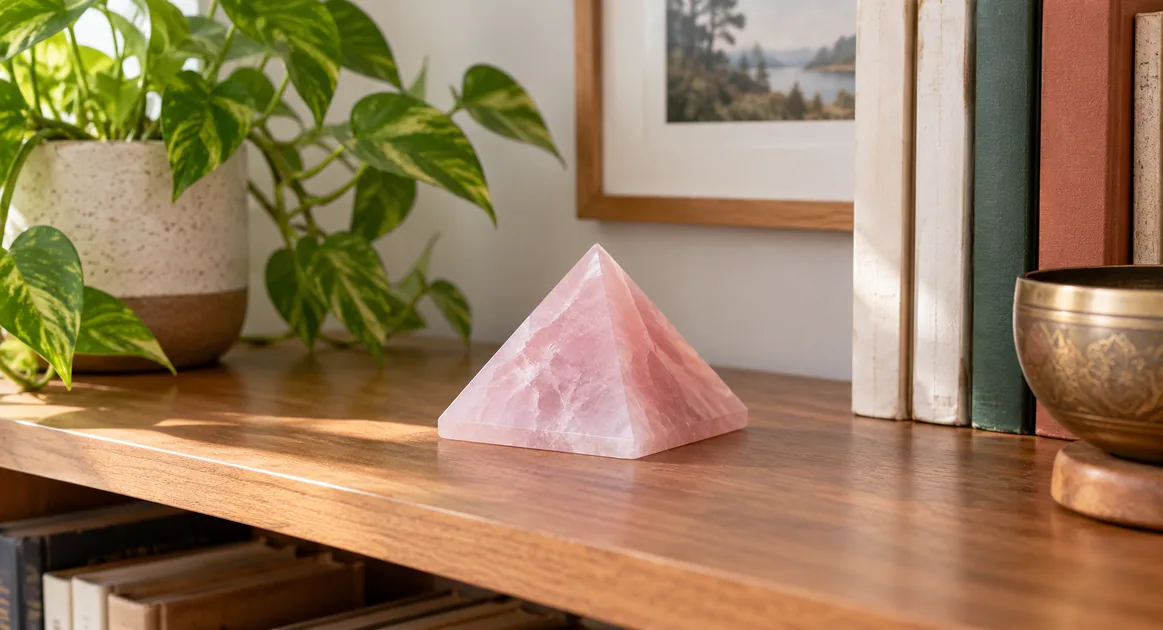
A rose quartz pyramid combines the gentle pink of a natural quartz variety with the balanced proportions of a four-sided carved form. It may be selected for a puja shelf, a family's living room, an office desk, an anniversary gift, or a Vastu arrangement associated with harmony and affectionate relationships. Yet two pyramids sold under the same name can differ in material, colour, cloudiness, finish, price and durability. The most satisfying purchase begins with knowing what rose quartz actually looks like and what a photograph cannot prove.
The familiar material is typically translucent rather than transparent: soft pink may appear beside milky patches, wispy internal veils and occasional fractures. Those are not automatically defects. Likewise, a bright, unnaturally uniform pink surface is not automatically proof of an imitation. The correct approach combines mineral knowledge, close inspection of the supplied piece, honest treatment disclosure and an understanding of why that particular form suits the intended space.
This guide explains rose quartz identification, how the pink colour forms, the distinction between cloudy and fractured areas, the role of pyramid geometry, placement ideas in Vastu and contemporary crystal practice, caring for a polished carving, and selecting a genuine piece for the home, shop or professional reference kit. It also clarifies how rose quartz differs from clear quartz, pink glass and rare crystalline pink quartz.
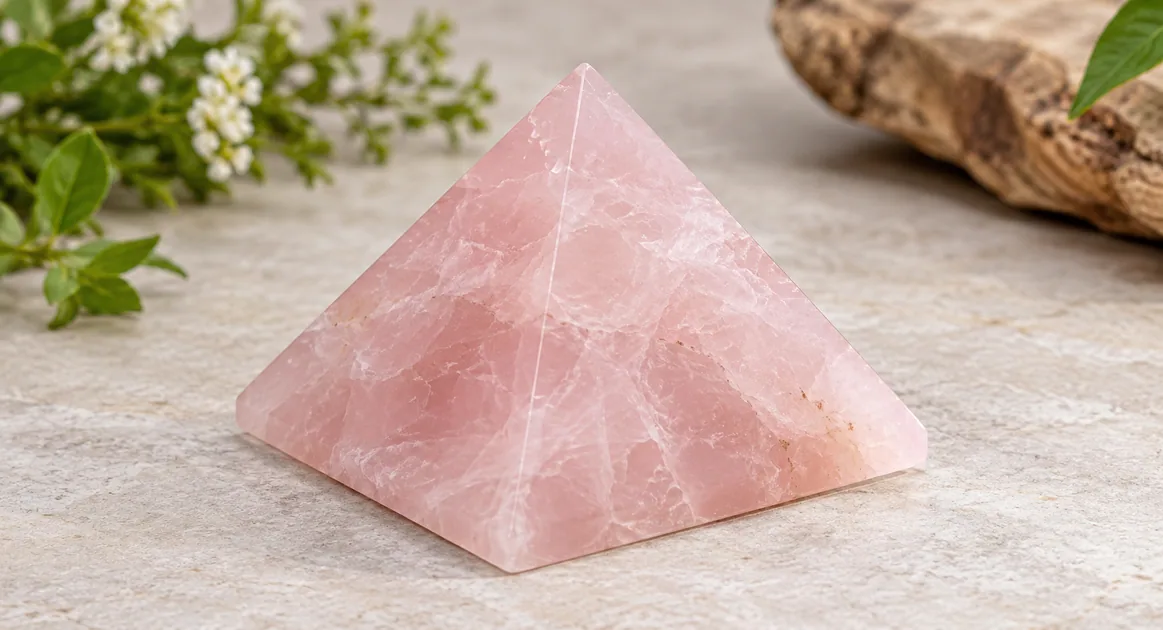
1. What is rose quartz? The mineral behind the pink pyramid
Rose quartz is a pink variety of the mineral quartz, whose chemical formula is SiO₂, silicon dioxide. Quartz is abundant, but attractive pink rough of the right size and texture must still be selected and cut with care. It has a Mohs hardness of approximately 7, has no true mineral cleavage, and may fracture with curved or uneven surfaces. Hardness refers to resistance to scratching; it does not mean a pointed carving is unbreakable if dropped on tile.
The common carving material usually occurs as massive rose quartz: intergrown mineral material rather than an individual six-sided crystal with naturally grown pointed faces. A retail pyramid has been deliberately cut and polished. Its square base and four triangular faces are made by a lapidary worker; that shape is not evidence that the mineral naturally grew as a pyramid. This matters when a listing calls the product a “natural rose quartz pyramid”: natural may describe the starting material, not the manufactured geometry.
In common rose quartz, microscopic fibrous mineral inclusions—closely related to, but not necessarily identical to, dumortierite—are important to the pink appearance. They also scatter light and contribute to the familiar soft, cloudy translucence. Advanced mineralogical studies describe a different, uncommon kind of transparent, well-formed pink quartz crystal whose colour is associated with irradiation-related lattice centres. The trade names sometimes overlap, but the two categories should not be treated as identical.
| Property | Typical rose quartz carving | Why a pyramid buyer should care |
|---|---|---|
| Mineral | Quartz, SiO₂ | Distinguishes genuine quartz from coloured glass or resin |
| Typical colour | Very pale to medium pink | Colour should be viewed under neutral light |
| Appearance | Usually translucent, cloudy or milky | Milkiness alone is not evidence of poor quality |
| Hardness | Mohs 7 | Resistant to ordinary light dusting, not to chips caused by impact |
| Cleavage | None | Fractures and chips can still occur at the apex and corners |
| Manufactured shape | Carved square-base pyramid | Geometric precision is separate from mineral authenticity |
| Possible treatment | Irradiation or other undisclosed alteration may occur | Request item-specific disclosure rather than inferring origin from colour |
2. Why rose quartz often looks cloudy or milky
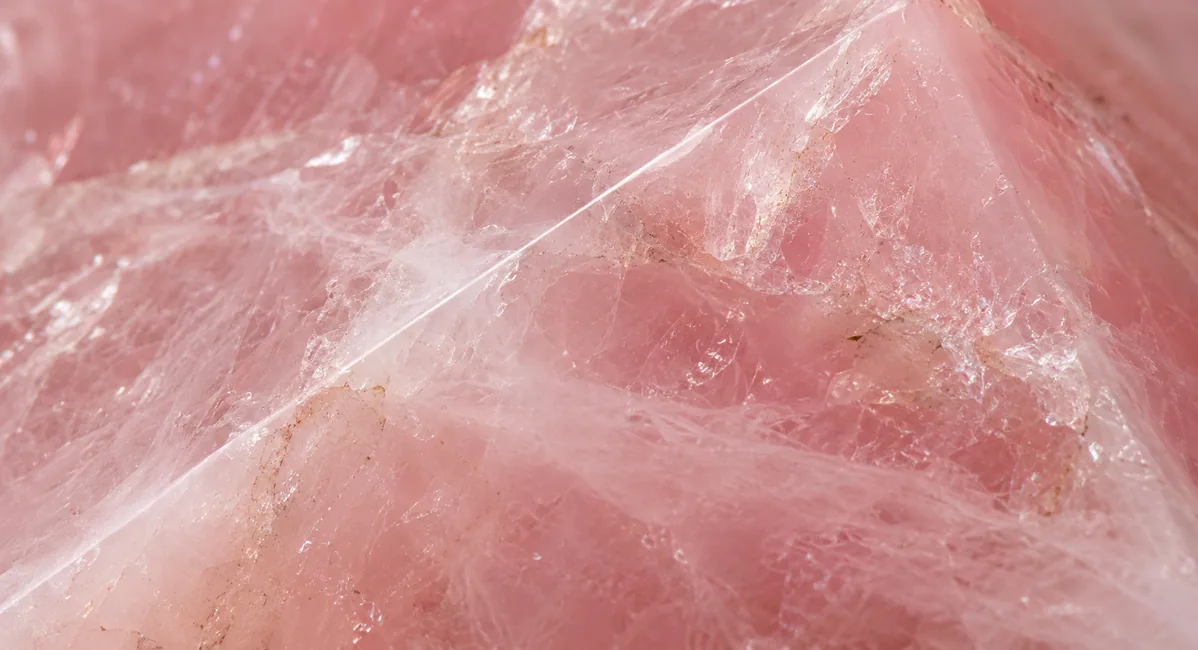
Many buyers expect quartz to resemble a completely transparent Sphatik crystal. Rose quartz frequently looks different because tiny inclusions within the material diffuse incoming light. The result may be a soft glow with cloudy bands that become stronger when the piece is viewed through its thickest portion. In a carved pyramid, a broad base can appear darker than a thin upper edge because light travels through more pink material. That change is not necessarily dye or a flaw.
There are several visually distinct features to look for. Diffuse milkiness creates an even haze without obvious separation. Internal veils may resemble feather-like planes that remain below the polished surface. Colour zoning can appear as pale or stronger pink regions. Open fractures are different: a crack that reaches the surface may trap dirt or weaken a sharp corner. Tiny pits or shallow scratches on the exterior reflect the quality of cutting and finishing, not necessarily the material's species.
Look at all four faces, the underside, each corner and the apex. A faint internal line seen from two directions is not the same as a fracture that catches a fingernail; do not force a fingernail across a fragile point to test it. Ask the seller for close-up photography. A stone can have beautiful internal veils and still be well polished; a perfectly smooth-looking photograph may hide an uneven base or a poorly repaired chip.
The key purchasing distinction is inclusions versus damage. Natural-looking internal texture is part of this stone's character, whereas loose pieces, heavily filled gaps or a cracked point deserve specific disclosure. A cloudy pyramid is not automatically inferior to an unusually clear example; the intended use, integrity and aesthetic preference decide which is the better fit.
3. Why the pink can look stronger in photographs
Rose quartz is often photographed against black velvet, a dark wooden surface or bright white acrylic. Those backgrounds affect perceived saturation. Some sellers increase warmth or saturation during editing; others use lighting that produces an orange cast. A small rose quartz item can look almost white under cool LED lighting and distinctly pink in soft daylight. Two images of the same pyramid can therefore appear to show different material.
Request at least one ordinary daylight photograph beside a neutral white or grey card, plus an image of the base and an oblique view of the faces. If purchasing several pyramids for a matching arrangement, ask for one photograph with all actual pieces together. This is especially important when a product description uses the words “deep pink,” “premium,” or “super clear” without defining a grade.
Colour is not a reliable proof of geographical origin. Neither vivid pink nor a particular cloud pattern establishes that the material came from Brazil, Madagascar, India or any other location. Commercial source claims should be supported by supplier provenance, not guesses based on appearance. Likewise, a photograph of an unrelated attractive specimen should not be used as the quality standard for a different batch.
| Visible feature | Possible explanation | Sensible follow-up |
|---|---|---|
| Soft milky centre | Light scattering from tiny inclusions | View the actual pyramid from two sides |
| Stronger pink at the thick base | Longer light path through the material | Compare under the same illumination |
| Bright neon-pink colour | Lighting, treatment, coating or another material | Ask for untreated photos and treatment disclosure |
| Clear, colourless windows | Natural variation in the rough | Check that other areas remain structurally sound |
| Surface-coloured cracks | Possible dye or staining concentration | Ask the supplier for details; do not self-test with chemicals |
| Small surface pits | Natural inclusions exposed during cutting or imperfect polish | Inspect whether the surface is stable and well finished |
| Brilliant photograph on a black backdrop | Contrast and editing can exaggerate saturation | Request a neutral-background photo with a size reference |
4. Natural rose quartz, treated quartz and pink imitations
A description such as “original rose quartz” should mean that the seller identifies the material as quartz, not merely that the object is pink. Quartz, synthetic quartz, glass, resin and coloured stone can be cut to nearly the same geometry. Even when a carving is real quartz, the seller should not automatically claim its colour is untreated if the supply history has not been established.
Gemological references note that rose quartz is occasionally irradiated to intensify colour. Treatment is not the same as imitation: a treated quartz piece is still quartz, but the process should be disclosed where known. The rarer transparent pink quartz crystal material has a different colouring mechanism, so care advice should not casually mix properties of all pink-looking quartz varieties. A laboratory identification report can address material identity and certain detectable treatments, but an ordinary photograph cannot replace laboratory tests when origin or treatment is commercially important.
Common misleading comparisons include pink glass, which may have gas bubbles but can also look quite convincing; pink resin, which varies widely in weight and finish; dyed pale quartz or chalcedony; and other pink gemstones sold under casual names. The absence of bubbles does not prove something is quartz. Likewise, “cold to the touch,” a smartphone flashlight or an improvised scratch test is not sufficient for definitive identification.
A purchaser can obtain meaningful information without damaging the piece. Ask whether the specimen is one natural-mineral carving, what treatment is known, whether any cracks were filled, and whether the photos show the actual item. For a costly specimen, insist on a proper independent laboratory report that can be matched to that specimen. It is fair to select an untreated item for personal preference, but that preference should not encourage an unsupported claim of certification.
| Material offered | What it actually means | Buyer’s caution |
|---|---|---|
| Natural massive rose quartz | Naturally formed pink quartz rough subsequently carved | Natural rough does not imply perfect clarity or zero inclusions |
| Treated rose quartz | Quartz with disclosed enhancement | Ask what treatment was performed and whether it affects care |
| Rare crystalline pink quartz | Different quartz habit and colour mechanism | Do not confuse a carved pyramid with a naturally terminated crystal |
| Pink glass | Manufactured glass coloured pink | May imitate quartz; visual impressions are not conclusive |
| Pink resin or composite | Manufactured or assembled material | Ask about composition and durability |
| Dyed pale mineral | Another mineral or pale quartz altered for colour | Dye may concentrate along fractures and can change care needs |
| Coated or filled carving | A surface layer or repair may affect appearance | Request clear disclosure of coatings and structural repairs |
5. Four faces, the apex and the difference between shape and quality
The square-base pyramid is a familiar contemporary display form. When placed on a level shelf it presents four sloping faces rising to one point. A seller may advertise exact angles, a special “energy code” or absolute geometrical perfection, but a practical inspection starts with the actual craftsmanship: does the base sit flat, are the faces even, and is the point protected?
Examine the apex for white bruising, tiny missing material, visible glue or an unusually broad flattened tip. Look along each arris—the line where two faces meet. Uneven edges can be harmless hand-finishing variations; sharp chipped edges can catch fabric or make a piece less pleasant to handle. Check the underside for rocking on a flat surface. A good carving can have a slightly rounded point for safety, and such a finish should be represented accurately rather than described as a faultless razor-sharp apex.
A polished pyramid may have one side with more concentrated pink colour and another with stronger cloudiness. Orienting the more attractive face toward the room is a normal display choice. It is not necessary to claim a scientifically measurable field from the pyramid's exact angle. People may value symmetrical geometry and intention in Vastu-inspired practice while still judging the object on its physical craftsmanship.
When comparing photographs, control for scale. A tiny ten-millimetre ornament, a medium desk piece and a large altar carving are not interchangeable. Ask for dimensions in millimetres, approximate weight in grams, and a straightforward image beside a ruler. A thick base can provide stability, while a very tall narrow pyramid can be easier to tip. For a family home with children, pets or a busy counter, stability can matter more than a perfectly acute point.
| Inspection area | Acceptable natural or craft variation | Reason to ask a specific question |
|---|---|---|
| Base | Natural colour difference and ordinary polish marks | Rocks, tilts, has an open crack or does not sit level |
| Apex | Slightly softened point for handling | Chipped point, glue, filler or fragile splinter |
| Four faces | Different cloudiness or veils | Deep scratches or uneven re-polished patches |
| Edges | Minor hand-finishing differences | Sharp damage that could worsen with handling |
| Interior | Diffuse inclusions and colour zoning | Fracture that reaches two exposed faces |
| Surface | Good polished finish | Sticky coating, dye transfer or unidentified residue |
| Sale listing | Honest size and variable-natural-stone disclosure | Stock photo substituted for a significantly different item |
6. Rose quartz in Vastu: harmony, space and Sankalpa
In contemporary Vastu-inspired gemstone arrangements, rose quartz is frequently selected for harmony, affection, gentle communication and emotional warmth. Its pink colour has become a widely recognised symbol of care and relationships. A rose quartz pyramid can therefore be an intentional feature of a family space, a prayer corner or a room used for reflection. This significance can be meaningful without claiming that a particular pyramid automatically fixes a house plan or changes the behaviour of another person.
A thoughtful placement starts with the Sankalpa, the intention for keeping the object. A family might choose to cultivate more patient conversation, a couple might commemorate an anniversary, or a shop owner might use the piece as an auspicious gift display. The intention then informs where the pyramid belongs: somewhere clean, visible and free from clutter, where it can actually be appreciated. In Vastu practice the condition of the space—entry, circulation, light, proportion and purpose—matters alongside any symbolic object.
Descriptions that assign a compulsory direction to every rose quartz item should be handled with care. Some modern crystal guides associate relationship themes with the southwest or harmonious shared spaces; other practitioners prefer a living area or a personal altar. There is no single universal rule that every pink quartz pyramid must face one direction. When a specific Vastu consultation recommends a placement, consider the actual floor plan, occupants, room function and system of interpretation rather than applying an internet chart mechanically.
The Pancha Mahabhuta framework—Prithvi (earth), Jala (water), Agni (fire), Vayu (air) and Akasha (space)—offers an Indian conceptual language for discussing surroundings. A polished stone can be contemplated through Prithvi because it is mineral material; its pastel appearance may also visually soften a setting. That interpretation is different from claiming that quartz itself has an officially fixed elemental classification across every classical Vastu school.
Vastu direction and location choices
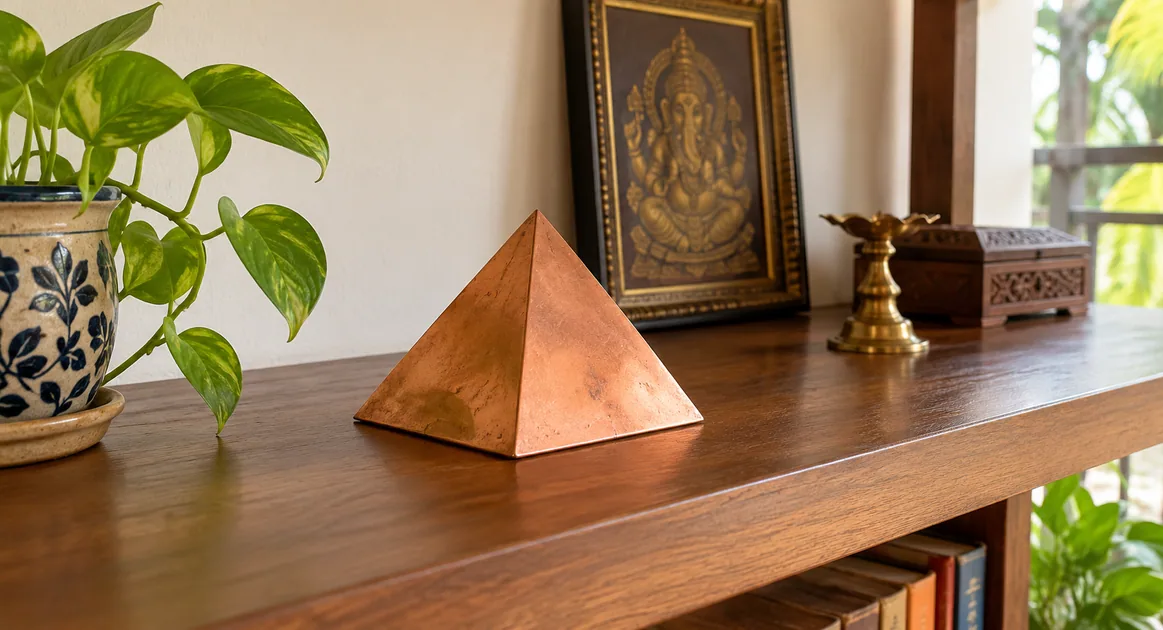
The direction of a room is only one piece of information. In a Bengaluru apartment, the best display shelf may be an uncluttered part of a common room rather than a precise compass corner blocked by cupboards. On a desk, keep the pyramid outside the path of moving papers or a laptop edge. On a puja shelf, choose a stable surface, avoid proximity to open flames or oil splashes, and keep it separate from articles that might chip the point.
| Space or intention | Considered placement | Practical reason |
|---|---|---|
| Shared family room | Stable shelf where people can see it | Symbol of harmonious conversation in daily life |
| Bedroom | Secure side shelf away from bed edge | Gentle personal display without risk of falling |
| Prayer space | Clean, level position away from lamps | Supports chosen Sankalpa and respectful arrangement |
| Office reception | Small stand away from customer movement | Pleasant decorative welcome and easy dusting |
| Jewellery showroom | Well-lit protected display with correct label | Lets customers inspect true colour without handling damage |
| Vastu consultation | Part of a comparative mineral reference tray | Shows rose quartz alongside other materials without confusing meanings |
| Gift arrangement | Protective box with explanatory note | Keeps a meaningful gift from acquiring false claims |
7. Lakshmi, Kamadeva, affection and the limits of historical attribution
The Indian traditions surrounding auspiciousness, prosperity, marriage and affectionate relationships are deep and varied. Lakshmi is revered in relation to Shri, abundance and wellbeing; Kamadeva and Rati are associated with desire and love in Hindu literary and iconographic traditions; Parvati and Shiva express different dimensions of partnership and devotion. These are useful cultural contexts for discussing gifts, domestic harmony and the intention behind a chosen devotional space.
However, a modern rose quartz pyramid is not automatically an ancient scripturally prescribed object of Lakshmi, Kamadeva or a particular Graha. Its present-day relationship symbolism largely belongs to contemporary crystal and Vastu-inspired retail practice. Traditional devotional context and current gemstone associations may be explained together when they are accurately labelled. An article gains credibility by making that distinction clearly, not by stripping the cultural meaning out of the discussion.
Similarly, rose quartz is often linked to the Anahata (heart) chakra in contemporary crystal-meditation teaching. Anahata is a meaningful term within Indian yogic chakra frameworks, but the assertion that a rose quartz pyramid is compulsory for it would go beyond the classical foundation. A person who chooses pink quartz as a visual reminder of compassion can integrate the object into japa, quiet reading or reflective practice while keeping the focus on the actual practice.
For Jyotish selection, a pink rose quartz carving should not be presented as interchangeable with the classical Ratna or Uparatna prescriptions used for specific Grahas. Birth-chart assessment considers the Lagna, Graha dignity, houses, Dasha and broader chart context. A decorative rose quartz pyramid may be meaningful in a space, but it is not a substitute for a chart-based gemstone recommendation simply because it has an attractive colour.
8. Home example: a Bengaluru apartment and a family Sankalpa
Consider a family who wants to place a medium rose quartz pyramid near a shared reading corner. The apartment has limited shelving and receives strong afternoon sunlight. The family is attracted to the symbol of affectionate communication and asks whether the pyramid must be placed in the southwest. Instead of moving furniture solely to match a broad chart, begin by identifying a safe, clean shelf in a room where the family naturally gathers.
The actual piece may have one pinker side and one milkier side. Place the pinker face outward, use a neutral tray, and leave a few centimetres of clearance around the point. If the shelf receives a hot, sustained beam through glass, move the object to a more shaded position—not because ordinary massive rose quartz instantly fades, but to reduce unnecessary temperature change and avoid the special sensitivity of any unusual pink-quartz material of uncertain identification.
A short Sankalpa might be to speak patiently and make time for shared reflection. That gives the piece a role within a daily habit. There is no need for multiple identical pyramids, an obligatory quantity or an exact compass orientation. The effective practical choices are protecting the carving, maintaining a pleasant environment and being intentional about the practice.
9. Jewellery showroom example: displaying three different pink pyramids
Imagine a Bengaluru showroom presenting three items: a very pale rose quartz pyramid, a medium-pink translucent piece with internal veils, and an unusually vivid pink carving whose supplier disclosure is incomplete. They should not all be labelled “AAA certified natural rose quartz” merely because they are polished. Colour, size, price and clarity must be described accurately; the supplier's incomplete disclosure should be noted for the third item rather than guessed away.
Use matching neutral illumination, show approximate dimensions and weight, and place a small information card with material, treatment status if known and care notes. Where a certificate is offered, ensure that its description and identifying characteristics match the actual item. If the vivid pink object is composite, dyed or manufactured, it can still be sold under an accurate label; problems arise when material identity is misrepresented.
A staff member should be able to explain what cloudiness means, why a heavier or larger rose quartz carving may appear more saturated, and whether a customer may choose it for a Vastu-inspired setting. The answer about tradition can be warm and culturally informed while the answer about mineral identification remains testable. Keep fingers away from points during demonstration and lift the item from its base.
10. Professional Vastu kit: how rose quartz should be documented
A professional reference set benefits from material consistency and traceable information. Label the rose quartz pyramid with its trade description, measured dimensions, mass, purchase date, supplier, known treatment status and two ordinary-light photographs. Record whether the specimen is massive rose quartz, a suspected imitation or a deliberately labelled manufactured comparison piece. Do not assign a fixed mine or geological origin without supporting documentation.
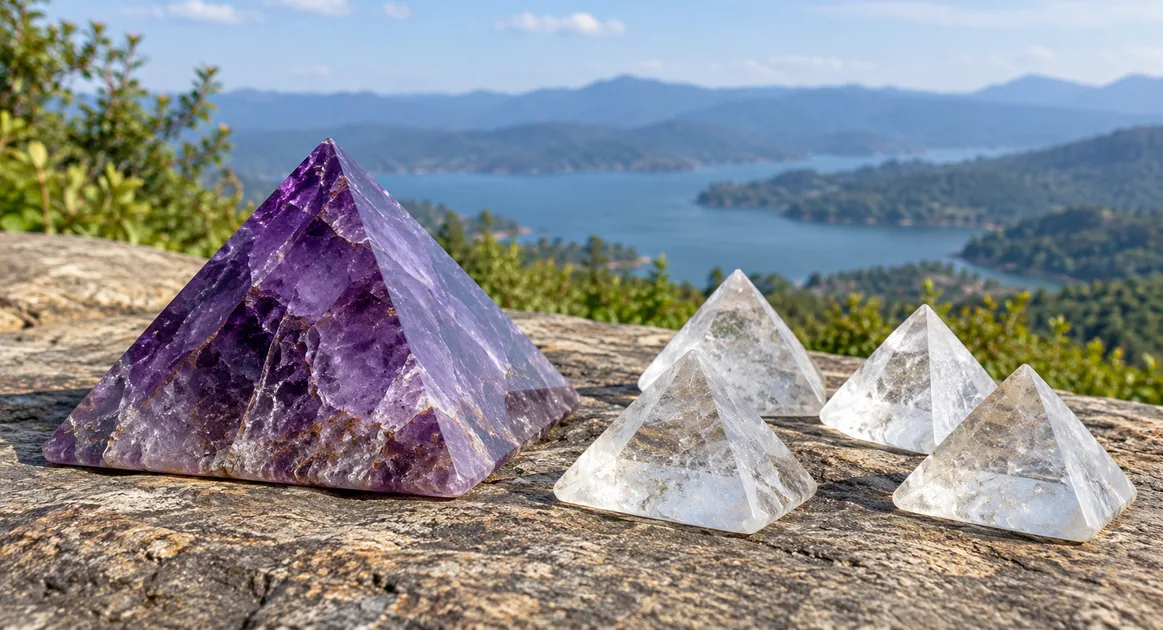
Include a comparison sample of clear quartz and, where available, a confidently identified pink glass imitation. The point of a professional kit is education: clients should see that a pale and cloudy natural specimen may be authentic, and that vivid pink colour is not the sole definition of value. The practitioner can discuss Pancha Mahabhuta, Sankalpa and relationship-themed symbolism without claiming that optical clarity determines spiritual suitability.
Use cushioned, labelled compartments so that pyramid corners do not strike one another in transit. A reference kit that is carried from a showroom to a house should include a condition check before and after each session. If an apex is damaged, photograph it and avoid handing the sharp piece directly to a client until it is safely repaired or replaced.
| Professional kit record | Suggested entry | Why it matters |
|---|---|---|
| Material designation | Rose quartz, quartz variety | Accurate material identification |
| Dimensions and mass | Actual measured values | Reduces confusion between similarly named items |
| Photo record | Front, base and colour-neutral views | Documents the individual specimen |
| Transparency | Milky translucent / clearer zones | Helps explain optical variation |
| Treatments | Known, none reported or unknown | Avoids suggesting a treatment history without evidence |
| Finish | Smooth faces; rounded or pointed apex | Records handling condition |
| Symbolic use | Harmony, affection or chosen Sankalpa | Keeps modern associations distinct from provenance |
| Storage and care | Padded, dry, separate compartment | Reduces chips during repeated handling |
11. Rose quartz versus clear quartz, smoky quartz and other pink material
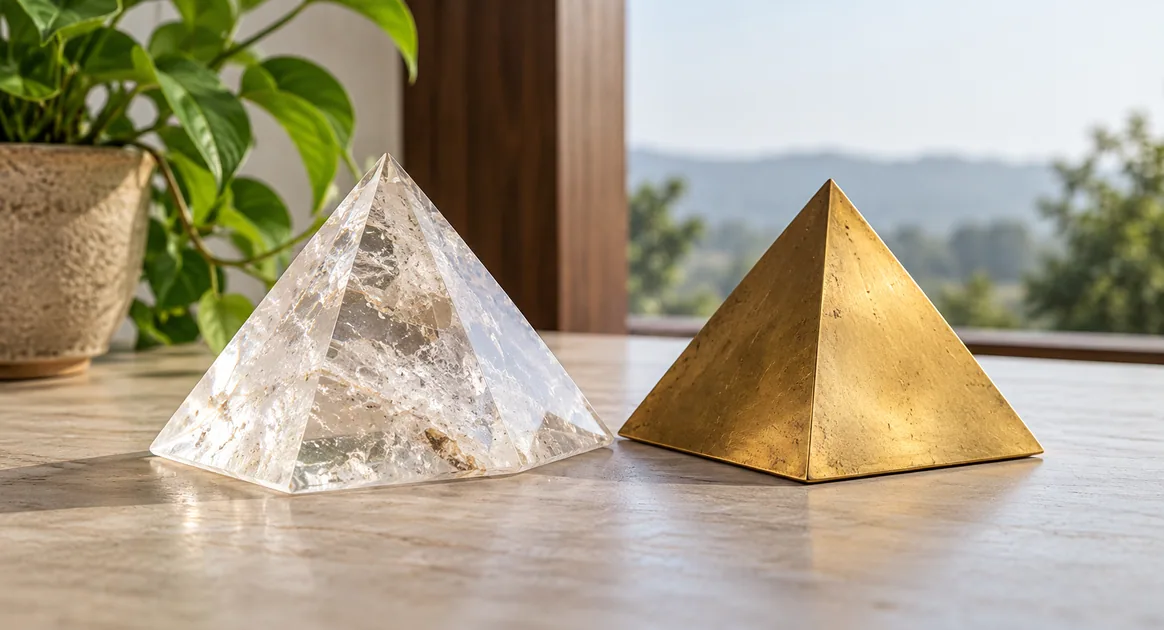
Clear quartz (often called Sphatik) is valued for its transparency, whereas common massive rose quartz is usually pink and softly translucent. Smoky quartz carries brown-to-grey colour centres; it should not be confused with a pink specimen that merely looks darker against black cloth. Pink glass can mimic either appearance, but its manufacturing history differs from natural quartz. Pink calcite and other softer stones may need more careful chemical handling; colour does not make them interchangeable.
A useful comparison examines both mineral species and the actual specimen. A finely finished glass pyramid might look more geometrically uniform than a natural quartz carving. That does not make it genuine rose quartz. Conversely, a natural rose quartz pyramid can be opaque or veiled and still be a legitimate quartz product. The decision should reflect purpose, material, workmanship, verified facts and an appropriate price—not just a “high vibration” adjective.
| Compared material | Main distinction | Why buyers confuse them |
|---|---|---|
| Clear quartz / Sphatik | Usually colourless and often clearer | Both belong to quartz and may be sold in pyramids |
| Smoky quartz | Brown to grey quartz colour | Thick or shaded rose quartz may photograph darker |
| Pink glass | Manufactured vitreous material | Polished glass can appear transparent and pink |
| Pink calcite | Different mineral, much softer | Similar gentle pastel colour in carvings |
| Dyed quartz or chalcedony | Colour may be modified | Vivid pink may resemble richly coloured natural material |
| Pink resin composite | Manufactured composition | Smooth surfaces and vivid colour can look attractive in photos |
| Rare pink quartz crystals | Different crystal habit and colour cause | Shared pink-quartz trade vocabulary obscures mineralogical differences |
12. Rose quartz care: cleaning without damaging a polished pyramid
For an identified, structurally sound and untreated rose quartz carving, lukewarm water with a little mild soap is a commonly recommended cleaning method. A soft damp cloth followed by a thorough dry is simpler for a display pyramid. GIA advises avoiding ultrasonic and steam cleaning for rose quartz. Unknown fills, coatings, glues or repairs make cautious dry cleaning even more sensible until the seller clarifies what was used.
Do not boil a pyramid, put it into saltwater for extended periods, apply acid, use abrasive powders or place it in a cleaning machine. Quartz resists many everyday scratches, but an apex can chip under mechanical impact. The pyramid form makes that risk especially visible because even a small damaged corner changes the silhouette.
Avoid storing several pyramids loose together. Wrap each separately in a soft cloth or fitted compartment and keep it away from harder gems or metal edges. If the piece is displayed near a diya, move it beyond flame, smoke and hot-oil splashes. A decorative pyramid is not a suitable item to balance on a narrow windowsill above a walkway.
Will sunlight fade rose quartz?
The answer depends on the material being discussed. Ordinary massive rose quartz is generally described as stable under normal light and heat conditions by gemological guidance. Rare transparent crystalline pink quartz has a different colouring mechanism and can be much more sensitive to ultraviolet light and heat. Because shop labels can blur those categories, long exposure to harsh direct sun or concentrated heat is unnecessary for either. It is more accurate to explain that distinction than to claim all rose quartz fades immediately in sunlight—or that every pink quartz object is entirely insensitive.
| Situation | Recommended action | Reason |
|---|---|---|
| Routine dusting | Soft dry or slightly damp cloth | Avoids unnecessary rubbing and abrasion |
| Sound untreated quartz needing a wash | Brief mild soap and lukewarm water, then dry | Standard cautious gem cleaning |
| Unknown coating, filling or adhesive | Ask supplier; prefer dry cloth | Cleaning agent may affect non-quartz additions |
| Steam or ultrasonic cleaner | Avoid | Fractures, fills and thermal shock can worsen |
| Harsh direct sun / hot window | Move to moderate light | Limits heating and uncertainty about the quartz variety |
| Open flame, diya or hot oil | Maintain safe separation | Prevents heat shock and surface contamination |
| Travel or storage | Cushion independently in a labelled container | Protects apex and edges from impact |
| Suspected cracked point | Stop rough handling and inspect | Prevents a small chip becoming a break |
13. Choosing a rose quartz pyramid for gifting
Rose quartz is often chosen as an anniversary, housewarming or personal-encouragement gift because pink is associated with warmth and care. The recipient may have no formal Vastu practice, and the gift can still be meaningful. A helpful gift note says what the material is, how to display it safely, and that its symbolic association is kindness or harmony. There is no need to make promises about marriage, reconciliation or a specific life outcome.
Check the recipient's home circumstances. A small stable carving may be better than a large heavy one for a compact flat. A smooth, slightly softened apex is sensible for an occupied desk. Include a proper inner box so the pyramid cannot move in transit, and ask the seller for an image of the exact item before shipping. If gifting a pair of matching pyramids, make sure their dimensions, colour and finish are reasonably coordinated rather than assuming a stock photograph represents both.
A Vastu practitioner might recommend placement after considering a home's layout; a casual gift should not force a particular direction on the recipient. When the recipient prefers a puja shelf, a clean dedicated tray can keep the carving separate from powders, oils and water used in ritual. The value of the gift lies partly in the thought and quality of the selected object, not in a fixed count of pyramids.
14. Pricing, grades, origin and what to ask before ordering
The term “AAA rose quartz” is often used as a commercial descriptor without a universal retail grading system that can be independently applied across every pyramid seller. Some suppliers grade primarily for colour, some for polish, some for translucence and some simply use the label in promotional copy. A consumer is better served by precise photographs, dimensions, a condition report and a clear mineral description.
A larger pyramid may show stronger colour because of thickness, and it will generally use more rough material. But price also reflects yield from cutting, finishing time, cracks in the rough, base stability, polishing, packaging and authenticity documentation. A high price is not proof of an especially rare origin. Ask whether the photos are individual or representative, whether the quoted price is for one piece or a set, and whether any repair or treatment has been disclosed.
For online ordering, request a return process that accounts for damage in transit and keep unboxing photographs if the apex arrives chipped. In a shop, examine the item in ordinary light and confirm it does not rock on the counter. Do not attempt a destructive test to establish authenticity; independent gem testing is appropriate when the financial stakes justify it.
15. Buyer checklist before choosing a pyramid
| Question to ask | Useful answer | Warning sign |
|---|---|---|
| What is the material? | Natural rose quartz or an accurately described alternative | Only “pink energy stone” with no mineral identity |
| Is the stone treated? | Known treatment disclosed or uncertainty stated | Unverifiable blanket “100% untreated” claim |
| Does the photo show my item? | Exact specimen or clearly labelled representative photo | Dramatically different batch supplied without explanation |
| How does the base sit? | Flat and steady on a level surface | Rocks or tilts |
| Are the point and corners sound? | Clear close-ups or honest notes on imperfections | Important surfaces hidden |
| Is there a repair or coating? | Specific disclosure | Glue or suspicious surface sheen ignored |
| What size and weight? | Actual measurements and tolerances | Only “large” or “premium” in the description |
| How should it be cleaned? | Advice appropriate to materials and treatments | Instructions to boil, scrape or use strong chemicals |
| What does Vastu placement mean here? | Thoughtful symbolic explanation fitted to room | Unqualified compulsory claims for every house |
16. Frequently asked questions about rose quartz pyramids
1. Is cloudy rose quartz real?
Yes. The common massive variety often has naturally cloudy translucence caused by microscopic inclusions. Cloudiness alone cannot determine authenticity or grade; examine the actual material and condition.
2. Must a genuine rose quartz pyramid be pale pink?
No single shade proves authenticity. Rose quartz ranges from extremely pale to noticeably pink, while apparent colour changes with thickness, lighting and photography.
3. Is dark pink always better quality?
A richer tone may be attractive, but quality also includes material identity, sound construction, polished faces, a stable base and truthful treatment disclosure.
4. Can rose quartz be transparent?
Some fine rose quartz is relatively transparent, but the familiar carving material is often milky. Rare naturally crystallised pink quartz should not be assumed to be identical to ordinary massive rose quartz.
5. Is a rose quartz pyramid naturally grown in that shape?
No. It is a fashioned object carved from mineral material. A natural starting stone does not imply naturally occurring pyramid geometry.
6. Why is one side pinker than another?
Colour zoning, internal inclusions, mineral thickness and light direction can alter the appearance of different faces of the same piece.
7. Can an internal veil be harmless?
Yes. Many are ordinary inclusion or fracture features. A crack reaching the point or outer edge warrants a separate stability inspection.
8. Can I identify glass by checking bubbles?
Bubbles may raise suspicion, but their absence does not establish quartz. Material confirmation may require professional testing.
9. Is rose quartz always untreated?
No. Some material is treated, and treatment information should come from the supplier or a suitable gemmological assessment when relevant.
10. Is an “AAA” pyramid officially certified?
Not by that description alone. The term is widely used commercially and is not a substitute for an item-specific grading explanation or laboratory report.
11. Which Vastu direction suits rose quartz?
Choose placement according to the actual space and the intended Sankalpa; traditions and contemporary guides differ. No universal mineral-only compass rule fits every household.
12. Is it used for relationships?
Rose quartz is commonly associated with affection, kindness and harmony in contemporary crystal practice. It can be used as a symbolic reminder within personal or shared routines.
13. Is rose quartz a classical Jyotish gemstone for a Graha?
Do not assume it replaces a chart-based Ratna prescription. Classical gemstone selection uses a different reasoning process involving the birth chart and relevant Grahas.
14. What is the Anahata connection?
Contemporary crystal-meditation practice often associates pink or green stones with the heart centre. This should not be presented as a universal scriptural rule for carved pyramids.
15. Does the size change the pink colour?
A greater thickness can make a pastel stone look more saturated. The change is optical and does not establish greater spiritual efficacy.
16. Can rose quartz be washed with mild soap?
Usually yes for sound untreated rose quartz; use lukewarm water, rinse briefly and dry. When coatings or fillers are unknown, start with cautious dry cleaning.
17. Should I use saltwater to cleanse it?
Extended saltwater immersion is unnecessary for ordinary cleaning and may affect repairs or nearby metal fittings. Use appropriate gentle physical care.
18. Will the pink fade in sunlight?
Common massive rose quartz is generally reasonably stable, but uncommon transparent crystalline pink quartz can be more light-sensitive. Avoid needless intense heat and direct sun, particularly when identification is uncertain.
19. How do I store a pointed pyramid?
Keep it separately padded, with the apex protected and no heavy item pressing on the faces. Check the base and corners after transport.
20. Can a shop use representative photographs?
Yes if they clearly say so and explain natural variation. For an expensive or individually distinctive carving, request photographs of the exact specimen.
17. Final selection guidance
A good rose quartz pyramid is one whose material has been described accurately, whose pink colour and soft cloudiness match the supplied item, and whose four faces, point and base are sound enough for its intended use. Its cultural meaning as a symbol of harmony or affection can enrich a home, gift or Vastu-inspired arrangement, while careful placement and ordinary cleaning keep the stone attractive for years.
Choose a piece you actually enjoy seeing; inspect all sides; avoid unsupported origin and grading claims; and keep traditional symbolism, gemstone identification and physical care in their proper roles. A gentle pink tone and a well-made, stable carving are more useful than extravagant promises or a dramatically edited photograph.
Explore existing OmmRudraksha collections
Browse Vastu for the existing collection, or explore gemstone products for other material forms. Each product’s construction and care information should guide your choice.