Black obsidian pyramids bring together a distinctive natural volcanic glass, the disciplined geometry of a four-sided pyramid and the contemporary practice of using dark-coloured objects for reflection, grounding and protection symbolism. The best purchase begins with accurate material identification. Obsidian is not a crystalline form of quartz, and a glossy black pyramid is not automatically natural obsidian: manufactured black glass, resin, black onyx, dyed stone and other carvings can look similar in a single photograph. A meaningful Vastu display therefore starts with the actual object, its condition and the intention behind its placement.
This guide explains where obsidian comes from, how to assess a polished carving without damaging it, why its points require careful handling, how black obsidian differs from snowflake and mahogany obsidian, and how to use one thoughtfully in a Bengaluru home, shop or professional reference kit. The physical facts and the traditional or modern symbolism are considered together without confusing one for the other.
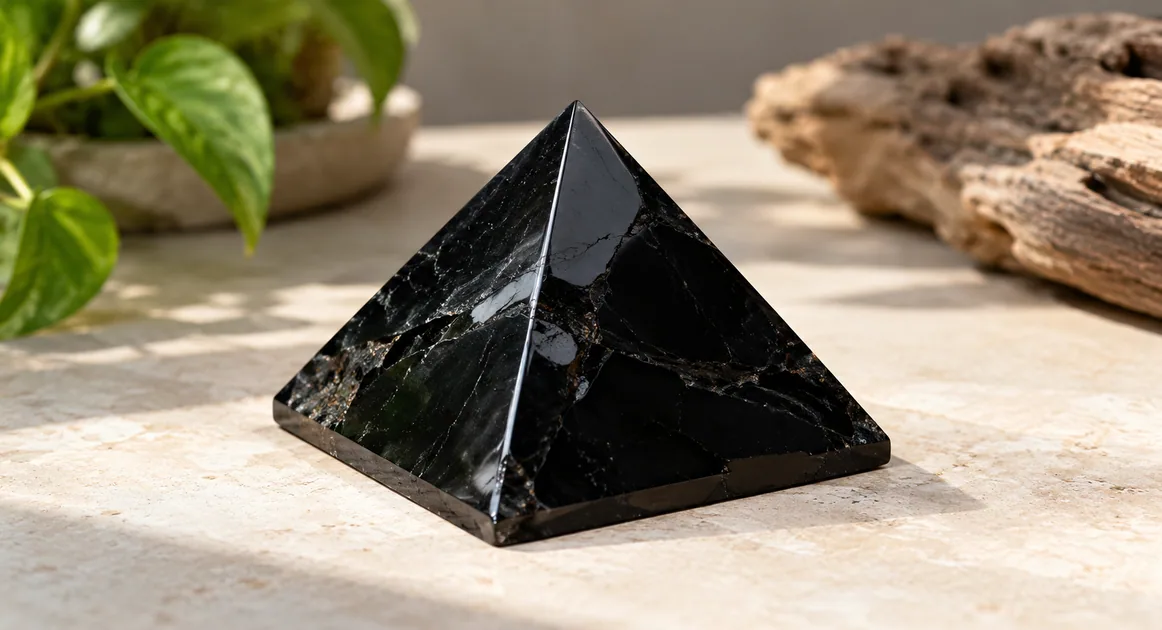
What is black obsidian and how does it form?
Obsidian is natural volcanic glass, formed when silica-rich molten material cools so quickly that an extensive, orderly crystal lattice does not develop. The United States Geological Survey commonly describes obsidian as dense volcanic glass, usually rhyolitic in composition. The American Museum of Natural History likewise explains its glossy appearance through rapid cooling. Its exact chemistry and internal features vary between deposits and individual objects. In commercial descriptions, obsidian stone is a familiar term, but scientifically it is better understood as a glassy volcanic rock rather than a single mineral crystal.
A polished black pyramid may look uniform at arm's length, but carefully observed natural material can show subtle brown translucency at thin edges, flow features, tiny internal inclusions or slight variation across the surface. Those details are not necessary in every genuine piece. A very even black finish neither proves nor disproves natural origin. The strongest description combines a reliable material declaration, meaningful seller disclosure, and, when warranted, independent examination of the actual item.
Obsidian typically displays a vitreous (glasslike) lustre and breaks with conchoidal fracture: smooth, curved shell-like surfaces that can form exceptionally sharp edges. This is historically why obsidian was useful for cutting tools. A polished decorative pyramid should have finished, safe edges; the physical ability to produce a sharp fracture is a handling concern, not a reason to test the ornament by breaking it.
Obsidian may be called a 'crystal' within contemporary crystal-shop vocabulary. That colloquial word does not change the geological distinction. Obsidian is non-crystalline glass; quartz is a crystalline mineral. A product page should not copy quartz hardness, crystal-structure claims or care directions onto an obsidian carving merely because the products appear together in a Vastu or gemstone catalogue.
Black colour, transparency and surface reflections
Black obsidian often looks deeply opaque when a carving is thick. In a sufficiently thin edge or translucent fragment, some pieces show smoky brown or grey transmission. The degree depends on the material, thickness and lighting. A seller need not create a sharp edge to demonstrate this; existing safe thin areas and ordinary side lighting can sometimes illustrate it. Avoid shining intense lights through a fragile point or using improvised scratch tests.
The highly polished faces reflect lamps, windows and phone screens. A photograph taken face-on under a large light source can hide fine scratches or chips; a second image under angled diffuse light is much more useful. The most informative set includes a front and three-quarter view, an apex close-up, a base/underside view and one image showing dimensions. If there is a repair, resin filling, coating or joined construction, it should be disclosed explicitly.
Different volcanic glasses and other materials can share a glossy black appearance. A fingerprint-resistant or mirror-smooth surface is not an authentication certificate. Nor do generic descriptions such as 'jet black', 'cool to touch', 'heavy', 'energised' or 'premium grade' independently establish volcanic origin. Real identification should be based on the material and its properties, not sales adjectives.
Black obsidian versus other dark pyramid materials
| Material | Physical character | Useful difference when buying | Caution |
|---|---|---|---|
| Black obsidian | Natural volcanic glass; vitreous polish | May show glassy texture or subtle flow features | Edges and points can chip sharply |
| Manufactured black glass | Industrially made glass | Can appear equally smooth and jet black | Visual colour alone cannot distinguish it |
| Black tourmaline | Crystalline mineral, often striated in rough form | Rough specimens may show prismatic texture | A polished carving may hide diagnostic texture |
| Black onyx / dyed chalcedony | Microcrystalline silica; trade naming varies | May have banding or treatment history | Ask whether colour is dyed and what 'onyx' means |
| Shungite | Variable carbon-bearing rock | Commonly a more subdued finish, depending on polish | Trade grade names do not establish composition |
| Basalt | Fine-grained volcanic rock | Usually not naturally glasslike throughout | A polished basalt surface can still appear dark |
| Black resin / composites | Manufactured polymer or aggregate | May have mould seams, filler or uniformity | Require clear material declaration |
This comparison is a buying framework, not a home laboratory key. Polished carvings can erase the rough-surface clues that help identify specimens. Some stones are assembled or coated. If identity affects pricing or an authenticity claim, obtain an assessment from a knowledgeable gemmologist or laboratory and make sure any document relates to the particular carving.
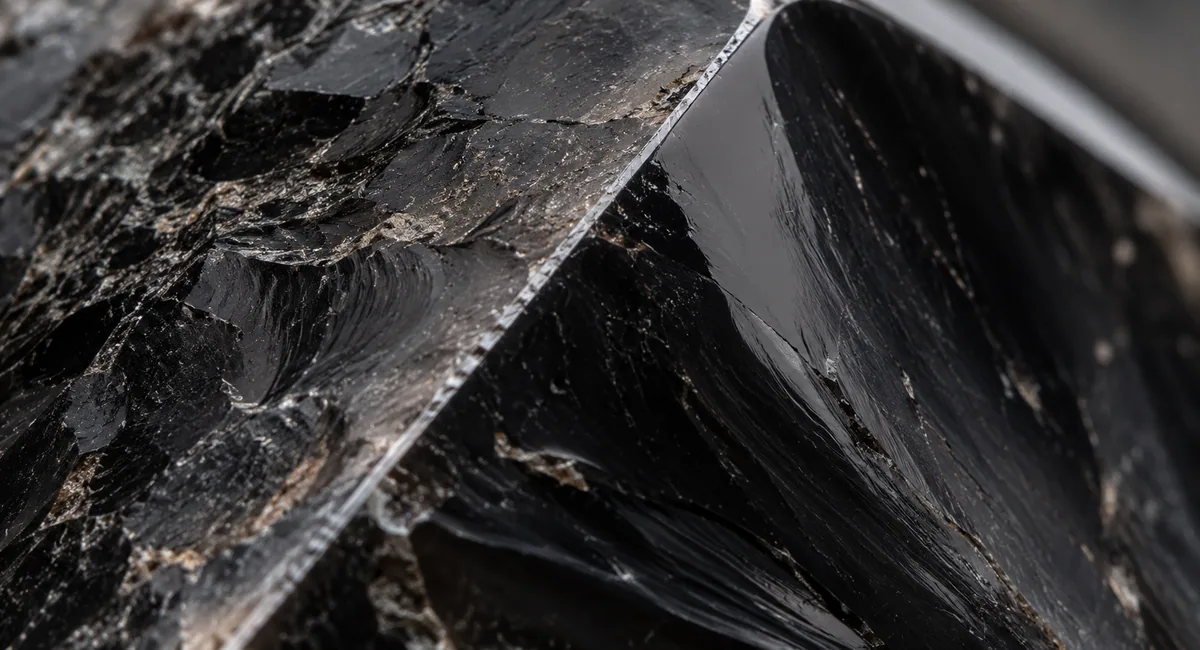
Mohs hardness, toughness and why a sharp-looking point is vulnerable
Obsidian is generally described in gemmological references as approximately Mohs 5 to 6, depending on composition and testing context. The Mohs scale concerns resistance to scratching, not resistance to cracking. A smooth obsidian pyramid can be fairly durable as a display object while remaining brittle under impact. A tiny accidental knock to the tip or a hard tile floor may cause a chip or break. Different parts of a piece and different treatments can behave differently.
Separate three kinds of condition when assessing a carving. Surface wear includes fine scratches and dull patches; edge damage includes small chips at corners or the apex; and structural damage includes cracks, glued repairs, fractures or unstable joints. An intentionally faceted pyramid should have straight edges as designed, but microscopic imperfection is not the same as a dangerous chip. Photographs should show both normal viewing distance and close detail.
Never use a steel knife, nail, quartz crystal or sandpaper to test an offered polished pyramid. Such informal tests are unreliable and can permanently damage the product. Avoid tapping the point or dropping it to demonstrate 'strength'. A normal-care demonstration is far more valuable: stable placement, safe handling, soft packaging and a simple condition checklist.
How to evaluate the carving and finish before purchase
| Inspection point | What to ask or inspect | Why it matters |
|---|---|---|
| Material description | Is this natural volcanic obsidian or manufactured glass? | Prevents material substitution |
| Apex | Is the point intact, symmetrical and free of sharp chips? | The most damage-prone part |
| Four faces | Are finish, bevels and geometry reasonably consistent? | Helps assess carving quality |
| Base | Is it flat, stable and free of concealed chips or adhesive? | Reduces wobbling and display risks |
| Surface | Any scratches, flow marks, bubbles, resin repairs or coatings? | Distinguishes natural character from repair or treatment |
| Measurements | What are the actual height, base width and weight? | Supports size selection and price comparison |
| Photographs | Are angled-light and underside images provided? | Catches damage hidden by strong reflections |
| Packaging | Is the apex protected and each piece packed separately? | Prevents transit damage |
A well-made black obsidian pyramid is not automatically the blackest, glossiest or most expensive option. Proportion, workmanship, condition, accuracy of the material claim and suitability for the intended shelf often matter more. The customer should know whether the piece is carved from a single mass or assembled from multiple parts. When advertised as 'natural', the word should describe the actual material, not simply the black colour or an unverified origin story.
If comparing multiple sizes, ask for a photo showing an ordinary ruler beside each item. A small compact pyramid may fit a desk or puja shelf more comfortably than a large one with a vulnerable exposed tip. A larger carving makes edge protection and stable support still more important.
What do black obsidian pyramids mean in Vastu and contemporary crystal practice?
Traditional Vastu Shastra discusses the arrangement of spaces, orientation, the elements and harmony between activities and surroundings. A polished volcanic-glass pyramid is a contemporary decorative and spiritual-practice object, not an item that should be presented as a mandatory prescription from every classical Vastu text. Modern practitioners sometimes assign black stone objects associations of steadiness, containment, introspection, boundary-setting or protection. Those interpretations can be explained in their own context without claiming they are universal scriptural rules.
The pyramid form provides a simple geometric focal point: a grounded square base, four rising faces and a meeting point at the apex. In a puja or meditation setting, a person may connect that form with deliberate attention or Sankalpa—an intentional resolve expressed before spiritual practice. The form can serve as a reminder of discipline and clarity, while its polished black surface evokes depth, reflection and composure. The physical pyramid alone does not diagnose a Vastu Dosha or replace an evaluation of light, airflow, accessibility and actual room function.
In some modern interpretations, dark stones are associated with Prithvi Tattva (earth-associated stability) or with protective symbolism. Such mappings are not a mineralogical property, and they vary among lineages and commercial systems. The five-element vocabulary—Prithvi, Jala, Agni, Vayu and Akasha—provides a meaningful cultural framework. It should not be reduced to a formula that assigns every black object one compulsory direction for every building.
Some contemporary chakra practices associate black obsidian with Muladhara, the root chakra, because of its grounding symbolism. This is a practice-specific association, not a geological feature. In Jyotish, Graha recommendations depend on the person's horoscope, planetary dignities, relevant Dasha and the method of the practitioner. Black obsidian should not automatically be represented as a substitute for prescribed gemstone choices such as Neelam or as a universally appropriate Shani stone.
Placement guidance: directions, purpose and practical safety
If you are choosing a display spot, begin with purpose, not an internet chart declaring that all obsidian pyramids belong in the same corner. An existing meditation shelf, an uncluttered reception counter or a stable bookcase may be more suitable than a cramped directional corner where the ornament is easily knocked over. Where a Vastu consultant specifies a directional placement, record the rationale and assess the actual floor plan before following it.
| Setting | Possible display approach | Practical check |
|---|---|---|
| Puja or meditation room | On a stable, clean shelf as a Sankalpa focal object | Keep clear of flame, oil and falling ritual objects |
| Home office | Beside a notebook or on a back corner of a desk | Keep away from keyboard traffic and moving cables |
| Reception or showroom | On a recessed display riser | Prevent customer contact with the point |
| Consultation table | Beside labelled reference specimens | Keep material-identification card visible |
| Bedroom | Small object on a secure shelf, if personally preferred | Do not place where it can fall onto a bed or floor |
| High-traffic entrance | Prefer a protected shelf rather than a narrow ledge | Avoid contact with bags, doors and children |
| Kitchen / wet area | Usually not the first choice for a decorative glass carving | Minimise slippery handling and thermal shock |
Directional vocabulary such as Ishanya (north-east), Agneya (south-east), Nairritya (south-west) and Vayavya (north-west) can be relevant when discussing a larger Vastu layout. But a reader should not infer from a generic article that a specific corner is always an authorised remedy for every person's home, office, plot orientation or concern. If a consultant recommends a location, note the intended use of the room, visual balance, structural safety and existing devotional practices as well.
Avoid placing a dark reflective pyramid directly where it catches distracting glare. A calm display often benefits from indirect lighting and enough background contrast to show its outline. Leave safe clearance around the apex. Keep the object away from unstable glass shelves, loose cloth edges and damp environments where it might slip.
Three realistic examples: a Bengaluru home, a jewellery showroom and a professional reference kit
Example 1: A Bengaluru apartment. A resident has a compact prayer-and-reading shelf beside the living room. They prefer one small black obsidian pyramid to several crowded ornaments. The right decision is to measure the free shelf area, check that incense and lamps cannot heat or strike the carving, and place the piece on a flat base with its apex clear. If the family uses Sankalpa during prayer, they may dedicate the object to a personal intention of steadiness or disciplined daily reflection. There is no need to claim that the object changes the building's physical orientation.
Example 2: A jewellery and gemstone showroom. A retailer wants to display black obsidian, black tourmaline and shungite side by side. A helpful display separates them into three clearly labelled materials instead of placing all under 'black healing crystal'. A small card can show the natural volcanic-glass identity of obsidian, the crystalline mineral identity of tourmaline and the variable carbon-bearing rock identity of shungite. Put a low barrier or recessed tray around sharp pyramid points; keep a soft inspection mat available for customers requesting close photographs. This turns a decorative shelf into useful customer education.
Example 3: A professional Vastu reference set. A practitioner carries multiple dark materials for explanation in client consultations. Label each piece with material name, construction, approximate dimensions, care precautions and any unknown treatments. Wrap pyramids individually, store them upright or in shaped compartments, and photograph each specimen against its label. Use the objects to explain contemporary colour and placement symbolism alongside actual site observations—directions, light, circulation, room activities and the client's existing traditions. Do not use a black stone in place of a complete building assessment.
Black obsidian, snowflake obsidian and mahogany obsidian: related but distinct appearances
Plain black obsidian is valued for its relatively uniform deep colour and glassy polish. Snowflake obsidian commonly shows pale radiating patches produced through crystallisation within volcanic glass; these patches are not flakes of actual snow. Smithsonian mineral collections describe the light features as crystallised regions such as cristobalite associated with devitrification. The snowflake name refers to appearance, not a separate guaranteed chemical purity grade.
Mahogany obsidian shows reddish-brown and dark areas, giving a patterned appearance. These names describe visual varieties within the obsidian family. They do not automatically mean that the three objects have different metaphysical powers or that one variety is an appropriate substitute for another prescribed stone. In practical buying, compare the actual pattern, quality of finish, edge condition, transparency, price, and whether the seller's photos correspond to the piece supplied.
Other trade varieties include sheen and rainbow obsidian. Highly saturated neon colours or implausibly uniform transparent products deserve careful material verification. A glossy appearance, vivid lighting effect or social-media video is never sufficient to confirm natural origin. It is more useful to know whether the described visual effect appears under normal lighting or only under a narrow spotlight angle.
Black obsidian versus black onyx and black tourmaline for Vastu displays
The three are sometimes advertised together because they are dark and fit minimalist displays, but they have different physical identities. Obsidian is volcanic glass. Tourmaline is a crystalline mineral group; a polished black tourmaline pyramid may lose much of the striated rough appearance visible on a natural crystal. The word onyx is ambiguous in commerce: black chalcedony may be natural, treated or dyed, while some shops use onyx loosely for other rocks. Ask the supplier for the material identity rather than equating the items by colour.
In modern spiritual vocabulary, dark stones can all be assigned grounding or protective associations. A consumer choosing a decorative object may reasonably select the one they find most suitable in appearance and handling. Someone following an established astrological or devotional practice should instead consider that practice's actual rules. The material and its purpose should be named clearly; interchangeable advertising slogans do not educate the customer.
For a business, precise product naming also improves search relevance. An article about 'black obsidian pyramid' should answer questions about obsidian formation, identification and safe care—not simply duplicate a general paragraph about negative energy across black tourmaline, shungite and onyx pages.
Cleaning, care and storage: protect the point and the polish
For routine household dust, use a clean, soft, dry microfibre cloth. If light dirt remains and the object has no exposed repairs, finishes or unknown coatings, a very lightly dampened cloth followed immediately by drying may be suitable. Avoid soaking an unidentified carving, abrasive pads, household acids, harsh detergents, steam cleaning, ultrasonic cleaners and sudden temperature changes. If the surface is treated or assembled, follow the seller's item-specific guidance.
Handle obsidian over a soft surface when inspecting it. Do not hold it only by the apex. Lift from below using the broad base, and avoid clinking it against other gemstones or jewellery. Although obsidian is harder than some soft minerals, its glassy nature and brittle fracture mean it can still chip under impact. Gem durability has more dimensions than scratch hardness: toughness and stability also matter.
If the point chips: stop handling it with bare fingers at the damaged edge; collect fragments safely, check whether the carving remains stable, and disclose the condition if selling or gifting it. Do not conceal chips under a shiny coating or use unapproved adhesive without disclosure. A newly sharp apex may be unsuitable for an open customer or children's display.
For storage and dispatch: wrap each pyramid separately in clean, non-abrasive material, protect the apex with clearance, and add cushioning around the base. Do not pack two glassy points face to face. Use a rigid outer box with enough padding to prevent movement. The object should arrive with care notes and the actual material description, not just a generic 'crystal' sticker.
Cleaning and handling troubleshooting table
| Observation | Possible issue | Better next action |
|---|---|---|
| Fine hairline marks in strong reflection | Minor polishing or handling scratches | Examine in diffuse light; do not scrape the surface |
| Tiny white-looking spot at apex | A chip catching light, or surface residue | Check close-up before cleaning; avoid pressure |
| Pyramid rocks on shelf | Uneven base or unstable support | Move to stable surface and ask supplier for base view |
| Mirror finish disappears after rubbing | Abrasion or unsuitable cleaner | Stop aggressive cleaning; use a soft cloth only |
| Sticky area or glossy patch | Adhesive, coating or handling residue | Request finishing/treatment information |
| Powdery material around package | Packing debris or damaged item | Isolate, inspect carefully and report the condition |
| Strong glare obscures faces | Poor display lighting | Change viewing angle and lighting, not the finish |
| Customer asks for 'EMF-blocking' proof | Unsupported product claim may be involved | Separate symbolic tradition from measured engineering performance |
A seller should describe what can actually be seen, and a buyer should be able to compare the object without conducting destructive tests. Good photographs, clear dimensions and accurate disclosure prevent more problems than elaborate cleansing rituals or hard-surface demonstrations.
Ritual use, Sankalpa and respectful placement
Some people choose to include a new pyramid in a short personal ritual. This may involve cleaning the display area, placing the object on a clean cloth, offering a simple prayer according to the family's tradition and expressing a Sankalpa for steadiness, attention or household harmony. The exact procedure depends on the individual practice. There is no need to invent a compulsory mantra or claim that every obsidian pyramid must be ritually activated to be genuine.
If the surrounding practice includes a diya, incense, flowers or water, position the pyramid so it is not exposed to flame, heat, wet offerings or repeated accidental knocks. A decorative volcanic-glass pyramid should not be immersed in liquids simply because a separate ritual object is traditionally bathed. Keep devotional observance respectful while adapting the practical handling to the object's material.
A consultant may discuss colour, form, directions or Panchabhuta as part of their chosen framework. The reader deserves to know when an association is a modern interpretive practice rather than a documented universal classical prescription. Meaningful traditional writing identifies the context and the purpose instead of mechanically assigning a black object to a fixed Graha, one direction or a guaranteed result.
Buying online: questions worth asking before payment
Before purchasing, request the actual dimensions, recent photos, exact material wording, construction and treatment information, and instructions for safe handling. For expensive or uncertain items, ask whether independent material verification is available. A laboratory report should be associated with the supplied object; a certificate shown for a different sample does not establish the identity of all stock.
Do not base authenticity on rituals, a static black colour, the seller's claims of a particular energy reading, or a uniform price band. Nor should one specimen's measured properties be copied onto every pyramid in the same category. Real material, a stable and safe carving, honest photographs, transport packaging and a clear replacement policy are the most helpful buying considerations.
| Customer question | Useful seller response |
|---|---|
| Is it natural obsidian? | State material basis, provenance if supported, and any limitations |
| Is it one solid carving? | Disclose joined parts, fills or coatings |
| Are there chips or scratches? | Provide recent apex, edge and underside close-ups |
| Which size should I buy? | Compare shelf space, dimensions and safe clearance |
| Can it go on a crowded shop counter? | Recommend protected placement or a recessed tray |
| Can it be washed or soaked? | Give item-specific care; avoid immersion without confirmation |
| Is it a Jyotish gemstone remedy? | Describe the practice carefully; do not imply a universal prescription |
| Does it protect against radiation or guarantee results? | Do not substitute a decorative item for measured safety controls or professional advice |
Frequently asked questions about black obsidian pyramids
1. Is black obsidian a natural crystal? It is naturally occurring volcanic glass, but it lacks the orderly crystal structure of quartz. In retail it is often grouped with crystals; geological terminology is more precise.
2. Does a mirror finish prove that a pyramid is obsidian? No. Manufactured glass and several polished black stones can look similarly glossy.
3. Why can natural obsidian have tiny bubbles or subtle flow patterns? Its volcanic-glass origin can leave internal features, but the presence or absence of visible bubbles is not a conclusive test on a polished carving.
4. Can black obsidian be scratched? Yes. It is not scratch-proof, and abrasive particles or contact with harder surfaces can mar its finish.
5. Why are chipped points a concern? The glassy conchoidal fracture can create sharp edges, so inspection, safe storage and cautious handling are important.
6. Can I use a black obsidian pyramid on my office desk? Yes, as a decorative or personally meaningful object, provided the base is stable and the point is away from busy hand movements.
7. Must a pyramid face a particular Vastu direction? There is no single universal rule for every home and tradition. Evaluate room purpose and consult an appropriate practitioner for a specific Vastu plan.
8. Is black obsidian the same as black onyx? No. They are different material categories, and 'onyx' itself is used inconsistently in retail.
9. What is the difference between black and snowflake obsidian? Snowflake varieties have pale crystal-rich patterns; plain black obsidian usually appears more uniform.
10. Is mahogany obsidian artificially coloured? Natural mahogany obsidian can have brown-and-black areas. A specific product's treatment status must still be checked.
11. Can I wash the pyramid with salt water? Avoid salt-water soaking and abrasive rubbing. Dust gently and follow care instructions appropriate to the actual finish.
12. Can I place it beside a diya? Keep adequate distance from heat, oils and flame. Do not allow the point to be struck or the glass to undergo abrupt heating.
13. Is black obsidian universally associated with Shani? Some modern associations exist, but Jyotish recommendations are chart- and tradition-dependent and should not be stated as universal.
14. Does a pyramid automatically cure Vastu Dosha? The presence of a decorative object does not establish that a building defect has been diagnosed or corrected.
15. How should it be packed for moving house? Cushion the base and apex separately, wrap each piece and use a rigid box with no internal movement.
16. What should I ask if the advertised pyramid is unusually cheap? Check whether it is natural obsidian, manufactured glass, resin or composite; ask for real photographs and actual size.
17. Can children handle the carving? Store delicate or potentially sharp pieces out of reach; supervise any handling.
18. Which is better for a Vastu consultation kit: obsidian or shungite? They are different reference materials. Choose according to what the kit is meant to demonstrate and clearly label both.
Final selection checklist and key takeaway
A satisfying black obsidian pyramid starts with five simple qualities: accurate natural-material identification; a sound, carefully polished carving; clear photographs of the actual surface and apex; safe placement and transport; and honest explanation of symbolic use. These practical qualities complement the object's visual depth and the intentional practices that some households or Vastu professionals associate with dark colours and geometric forms.
The geological identity of obsidian—as volcanic glass that can form conchoidal, sharp-edged fractures—is well established. Its use as a focus for Sankalpa, reflective meditation or contemporary Vastu symbolism is a different kind of description. Readers benefit most when both are explained precisely and neither is used to replace the other.
Research basis: material identification and volcanic formation were cross-checked against the USGS Volcano Hazards Program, USGS geological reports and the American Museum of Natural History. Snowflake variety interpretation was checked against Smithsonian mineral collections. Handling advice draws on the distinction between hardness, toughness and stability discussed in gemmological literature. The relevant sources inform the writing without adding unnecessary outbound commercial links.
Reflections can hide damage
Ask for a photograph with light skimming across the apex and base edges. Bright mirror-like reflections can conceal a small chip or surface scratch. Check the base for stability and any repair. A perfect black appearance does not establish natural origin, since manufactured glass can imitate a similar look.
Choose on construction and condition
A seller should state whether the pyramid is carved natural obsidian, another black stone or a manufactured object. Avoid assuming that a heavy or cool-feeling piece has been identified. If a report is supplied, verify that its identifying information corresponds to the actual object. Size differences alone generally make good variants of one plain design.
Keep the point safe
Glasslike edges can chip and a fresh break can be sharp. Handle the pyramid over a soft surface, away from children’s play areas. Clean gently with a soft cloth and modest moisture if the finish permits; avoid steam, ultrasonic cleaners and thermal shock. Pack each piece separately and keep pressure off the apex.
A modern association with reflection
Black obsidian is linked with reflection and protection in contemporary crystal practices. Someone may use a quiet black object as a focus for a personal ritual. That does not establish a physical shield or a remedy for illness or a building problem. The material’s reflective surface and simple silhouette are tangible reasons for choosing it.
Questions about shine
Does a mirror finish prove obsidian? No. Is a plain surface less natural than patterned obsidian? No: varieties have different appearances. Can a chipped point be ignored because the object is natural? No: damage should be disclosed and sharp fragments need careful handling. Inspect condition before making symbolic comparisons.
Explore existing OmmRudraksha collections
Browse Vastu for the existing collection, or explore gemstone products for other material forms. Each product’s construction and care information should guide your choice.