Black tourmaline, black obsidian and shungite pyramids may all be dark, polished and sold for Vastu or protection, but they are three different kinds of material. Black tourmaline is usually schorl, a crystalline mineral of the tourmaline group. Obsidian is natural volcanic glass formed when silica-rich lava cools rapidly. Shungite is a carbon-bearing rock whose mineral composition and carbon content can vary markedly. This distinction matters for authentic identification, carvability, finish, pricing, care and the kind of traditional or contemporary symbolism a buyer intends.
In Indian Vastu practice, the pyramid's form, orientation, the position of the object and the purpose of the space deserve attention before assigning it an elaborate benefit. The black-stone pyramid is primarily a modern addition to the broad market of decorative Vastu objects, not a substitute for the Vastu Purusha Mandala, the proportions of a building or a properly drawn classical Yantra. This guide compares the three stones carefully and offers meaningful ways to select, inspect and display them in a house, office, showroom or professional demonstration kit.
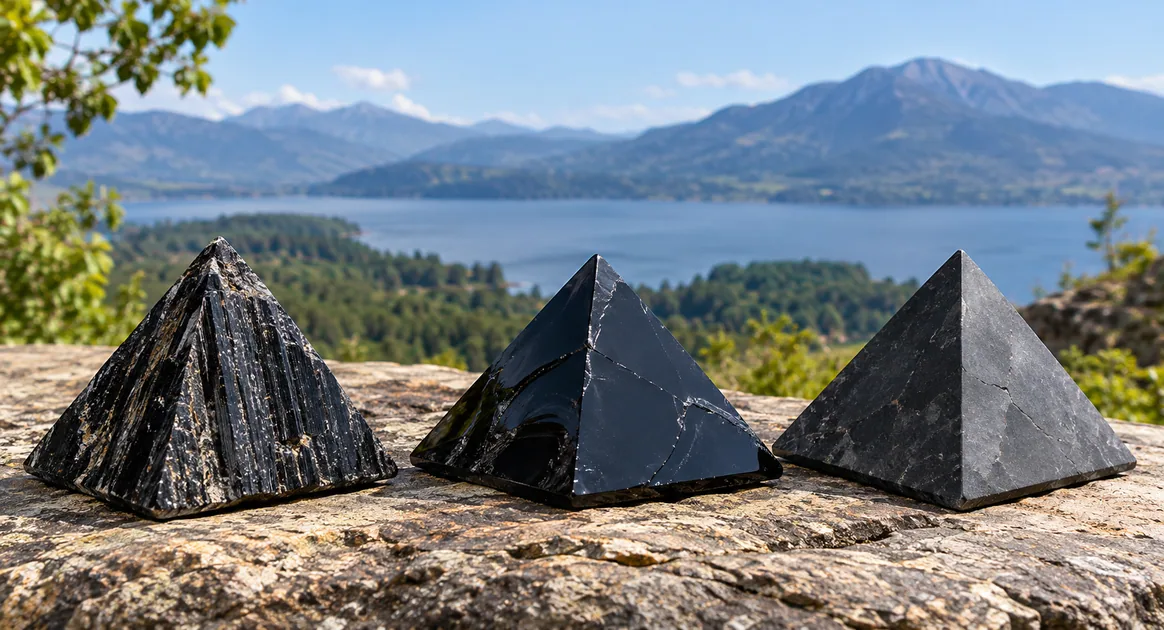
1. Three materials, three different geological identities
Black colour is a very poor identifier. Fine polish can conceal the texture of schorl; a matte treatment can make glass resemble stone; an opaque carbon-rich rock may have many grey or black lookalikes. First establish whether the object is a crystalline silicate mineral, volcanic glass or carbonaceous rock. Treat the carving's commercial name as the seller's description until the specimen is examined or substantiated.
| Property | Black tourmaline / schorl | Black obsidian | Shungite |
|---|---|---|---|
| Basic identity | Iron-rich tourmaline-group mineral; ordered crystal structure | Natural volcanic glass; lacks a mineral crystal lattice | Carbonaceous rock containing carbon and mineral phases |
| Typical appearance | Black, often striated in uncut crystals; seams or inclusions may appear in carvings | Deep black, vitreous reflection; sometimes brownish or smoky at thin edges | Black to grey-black, matte or polished; granular or layered features may occur |
| Mohs hardness, indicative | About 7–7.5 for tourmaline | Usually around 5–5.5, varies with composition | Variable because the rock contains different components |
| Specific gravity, indicative | Often near 3.0–3.2 for schorl | Often around 2.3–2.5 | Varies with carbon proportion and mineral inclusions |
| Important buying question | Is it a sound one-piece mineral carving, with natural seams disclosed? | Is the object natural obsidian, not manufactured black glass? | What is its documented rock composition and is any binder or coating used? |
| Typical care priority | Protect points and seams from impact | Protect sharp, brittle edges and polished surfaces | Avoid abrasive rubbing, dust release and unverified wet cleaning |
Hardness and density are approximate material references, not numbers that identify every polished carving. A bonded tourmaline aggregate, mixed shungite rock or coated glass item may not behave like an ideal laboratory specimen. An intact commercial pyramid should not be scratched, chipped or immersed merely to settle a name.
2. Black tourmaline pyramids: schorl, natural seams and solid construction
Schorl is the common black, iron-rich variety within the tourmaline group. Tourmaline crystals often grow as long prisms with fine lines running along their length and a broadly triangular cross-section. These features are easiest to inspect on rough pieces; a carved pyramid may have lost the original crystal faces entirely. Natural tourmaline also occurs with quartz, mica or feldspar, so a black carving can show lighter seams and intergrowths without automatically being defective.
Black tourmaline is prized in contemporary crystal practice for symbolic grounding, steadiness and an inward sense of protection. In a Vastu-themed arrangement it is commonly selected as a dark, weighty visual counterpoint to clear Sphatik or lighter gemstones. The choice is a modern material association; the ancient directional guardians were not originally assigned a fixed table of commercially polished black-tourmaline pyramids.
Inspecting a carved tourmaline pyramid
- Examine the apex under side lighting. Does the point consist of continuous stone, or does a pale line cross a damaged or filled tip?
- Follow seams across adjacent faces. A natural inclusion can be attractive; a loose fracture, adhesive-filled seam or chip requires different disclosure.
- Inspect the base. Look for a level contact surface, unsupported corners, cracks reaching the edge and uneven grinding.
- Ask about single-piece versus composite construction. Smaller crystals cemented in resin are not the same product as a pyramid carved from one mineral block.
- Compare several neutral-light photographs. Strong contrast and glossy editing can make repaired areas disappear.
For a work desk or puja shelf, a naturally veined tourmaline pyramid with a strong base can be preferable to an apparently flawless but poorly described black object. If the listing specifies tourmalinated quartz, that means quartz with tourmaline inclusions, not a solid schorl pyramid; it may be equally beautiful, but its material identity is different.
3. Black obsidian pyramids: volcanic glass and reflective carving
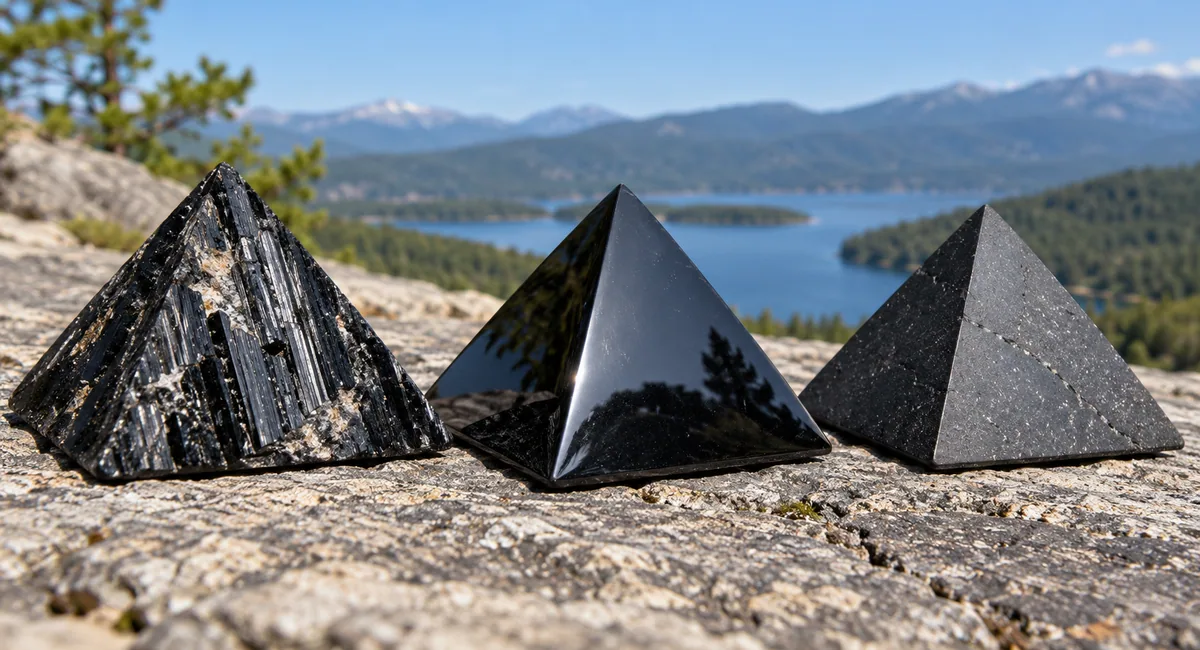
Obsidian forms when molten volcanic material cools too quickly for most crystals to develop. Because its structure is glassy, rather than a network of mineral crystals, it often accepts a smooth reflective polish. Thin areas can sometimes transmit brownish light. Some varieties contain flow bands, gas-bubble features or spherulites, as in the familiar snowflake obsidian. These details may add character, but they are not a universal authenticity test.
In modern crystal arrangements, obsidian is associated with reflection, boundaries and contemplation. Its mirror-like surface can make a simple black pyramid visually striking. However, manufactured black glass may also have an exceptionally glossy finish. A photograph of a smooth black pyramid cannot, by itself, establish volcanic origin. Ask whether the material is natural obsidian, glass or another stone before attaching a material-specific description.
Care: obsidian can produce very sharp edges when chipped. Place it on a stable tray or non-abrasive pad, keep the point away from the edge of a crowded shelf, and pack each pyramid separately. Do not assume that a darker or more reflective pyramid is stronger; high gloss and impact resistance are different qualities.
4. Shungite pyramids: carbon-bearing rock, not simply “pure carbon”
Shungite is a name used for carbon-rich and carbon-bearing rocks, especially material associated with the Karelia region. Scientific studies describe a complex composite of disordered carbon and mineral components such as silica and other inclusions. Different samples can contain very different percentages of carbon. Consequently, “shungite pyramid” does not identify one uniform chemical composition or density, and the grade cannot be determined from a thumbnail.
Some sellers describe elite shungite, Type I or high-carbon shungite. These terms need an agreed grading definition and appropriate evidence when a precise percentage is claimed. A matte, lightweight or conductive appearance is not a laboratory carbon analysis. Inexpensive pyramid shapes may be made from mixed rock, compressed powder, resin-bound material or surface-coated composites; sellers should identify the construction accurately.
Scientific research has examined the electrical properties of shungite materials and some engineered shielding composites, but these results do not show that an arbitrary small decorative pyramid protects an entire room from phones, Wi-Fi or other electromagnetic sources. A seller's claim about a specified shield, measured material and test arrangement is different from a generic protective claim about a desk ornament. This distinction matters when writing OmmRudraksha product descriptions.
Shungite is also not an automatic drinking-water purifier. A decorative pyramid's binder, mineral impurities and contact suitability may be unknown. Keep a purchased carving in its intended display role unless it is explicitly documented for another application.
| Shungite listing claim | What to request | What the claim alone cannot establish |
|---|---|---|
| “Pure shungite” | Rock identity, origin, measured carbon content and test method | That the entire carved object is one chemically pure substance |
| “Elite / highest grade” | Definition of grade; whether the particular lot was examined | Comparable quality across different sellers |
| “Solid shungite pyramid” | One-piece carving versus powder-bonded or composite construction | That no binder, repair or coating is present |
| “EMF protection” | Relevant measured test arrangement, frequency range, material dimensions and result | Whole-room shielding from a decorative pyramid |
| “Water purification” | Specific product certification and water-contact suitability | Safe direct immersion of an unrelated ornament |
5. How to identify the three materials in a shop
Use a staged observation method. Do not begin with a scratch, acid, flame, magnet or water-soak test; those can damage a finished item without establishing a complete identity. A reputable seller should be comfortable showing clear photographs, dimensions, weight, material descriptions and treatment information.
Stage 1: visual and tactile observation
Put the objects in the same indirect daylight, on the same background. Tourmaline can display directional seams, granular intergrowths or preserved growth features. Obsidian is more likely to show a continuous glassy, mirror-like face, although polish itself is not proof. Shungite may look matte, satin or irregularly polished depending on its carbon-mineral mixture. Examine the base and the junction of two faces at 5–10× magnification if possible.
Stage 2: compare like-sized specimens
Take dimensions and total weight. A typical solid schorl carving may feel heavier than an equally sized obsidian carving, but shape, cavities, repairs and rock mixtures affect comparisons. A density calculation can be useful when performed correctly on suitable samples; it should not be improvised by immersing a potentially porous, repaired or coated retail pyramid. If material identity affects a significant purchase, request a suitable gemological or mineralogical assessment.
Stage 3: document the seller's answer
Ask exactly: “Is this schorl tourmaline, natural volcanic obsidian, or shungite rock? Is the body one piece? Are there repairs, fillers, surface coatings or bonding? What is the actual weight, approximate base size and height? Does the description apply to this exact item or only a representative photo?” For shungite add: “Is any carbon percentage substantiated for this lot?”
| Observation | Possible explanation | Next sensible step |
|---|---|---|
| Parallel lines on a remnant crystal surface | Tourmaline's characteristic growth striations may be visible | Check whether the rest of the object is continuous mineral |
| Very glossy surface, thin edge admits some brown light | Consistent with obsidian or another dark glass | Seek origin identification; do not infer naturalness from gloss |
| Matte black surface and grey speckling | May be carbon-bearing rock or another dark stone | Request material and composition disclosure |
| Faint seam across the pyramid's point | Natural inclusion, repaired fracture or composite join | Examine the seam closely; seek condition disclosure |
| Impossibly uniform pitch-black coating | Could be coating, glass or a naturally uniform dark material | Inspect underside, edges and seller's treatment notes |
6. Lookalikes: hematite, onyx, spinel and black glass
Buyers comparing three black pyramids should keep a short list of other dark materials in mind. Hematite is an iron oxide mineral and may have a metallic sheen and noticeably high density. Retail black onyx is commonly black chalcedony or dyed agate; it is not tourmaline or obsidian. Black spinel is a separate crystalline gemstone. Manufactured black glass can be moulded or polished to resemble natural obsidian. Carbon-rich stones, slate-like material, jet and resin composites can introduce additional confusion.
The purpose of this comparison is not to reject those materials. Accurately named hematite, onyx or glass may make an attractive decorative pyramid, but the buyer should receive what the label states. A “black gemstone pyramid” assortment should not quietly treat these materials as interchangeable.
| Trade label | Material question | Appearance clue |
|---|---|---|
| Black tourmaline | Schorl or tourmaline-containing composite? | Possible striations, seams, non-uniform polish |
| Black obsidian | Natural volcanic glass or manufactured glass? | Glassy reflectivity; possibly translucent thin edge |
| Shungite | Carbonaceous rock, bonded powder or coated material? | Variable fine-grained, matte or satin finish |
| Hematite | Natural iron oxide or a manufactured magnetic imitation? | Metallic look, usually heavy for size |
| Black onyx | Chalcedony/agate, dyed or otherwise treated? | Uniform black, sometimes subtle banding |
| Black spinel | Natural spinel or synthetic/other black material? | Bright polished facets or dense-looking opaque finish |
7. What does a black pyramid mean in Vastu?
Vastu Shastra is principally concerned with the planning and relationship of space: its directions, layout, openings, proportions, functions and the Vastu Purusha Mandala. The eight directions are traditionally associated with the Ashta Dikpalas: Indra in the east, Agni in the southeast, Yama in the south, Nirrti in the southwest, Varuna in the west, Vayu in the northwest, Kubera in the north and Ishana in the northeast. Those associations belong to a much older architectural and ritual framework than today's mass-produced gemstone pyramids.
Modern Vastu practitioners sometimes select black tourmaline, obsidian or shungite for the symbolic themes of steadiness, boundaries, inward focus or grounding. The stone may be placed on a consultation board, in a study, on a stable shelf or as a small visual marker during directional discussion. These are contemporary selection practices; they should not be presented as fixed ancient mandates that one black mineral must occupy one particular direction in every property.
Do not replace important spatial decisions with an object. If a northwest room is cluttered, improve circulation and organisation. If the southwest shelf is unstable or the northeast prayer area is cramped, resolve the usable arrangement first. A pyramid can then complement a purposeful display rather than substitute for the practical Vastu plan.
How geometry contributes to the symbolism
The pyramid's broad base and rising apex are often interpreted as a journey from stability toward focus. A carved pyramid is not the same as a classical Yantra, which has its own established lines, proportions, mantra associations and methods of use. A pyramid with an Om engraving also differs from an unmarked black gemstone carving. Choose the combination of shape, material, symbol and intended space consciously instead of assuming that every object called a “Vastu pyramid” performs an identical ritual role.
8. Directional and room-by-room placement
There is no single classical black-stone placement chart that applies equally to tourmaline, obsidian and shungite. Use the actual floor plan, the intention of the display, household tradition and the object's physical safety. Here are useful starting points for a contemporary home or office arrangement—not compulsory remedies.
| Space / situation | Suggested display approach | Why this may suit the space | Practical check |
|---|---|---|---|
| Study or reading desk | One compact tourmaline or obsidian pyramid on a stable corner tray | Clear visual focus without adding many objects | Keep it away from the desk edge and heavy books |
| Living-room shelf | A single labelled black pyramid beside a lighter quartz specimen | Shows contrast of material and finish | Ensure children cannot knock it over |
| Office reception | One medium-sized, accurately named pyramid with a material label | Quiet decorative symbolism and educational value | Avoid obstructing reception work or circulation |
| Vastu practitioner display | Three individually labelled specimens together on a portable base | Teaches the difference between mineral, glass and rock | Use separate compartments for transport |
| Puja or meditation area | One carefully chosen specimen if consistent with the family's practice | Supports a deliberate visual arrangement | Keep away from diya flame, water bowls and crowded altar edges |
Where the household uses a direction-specific plan—for example, treating the northeast as the principal prayer area—take care that the room remains clean, accessible and suited to worship. Choosing a black stone for that room is a matter of the particular practice, not an automatic consequence of its black colour. For a client's southwest area, no physical stone should be offered as a replacement for resolving unsuitable loading, furniture placement or structural use.
9. Worked example: a three-material consultation tray
A professional Vastu consultant can teach the entire distinction using three real pyramids. Use a stable tray roughly 30–40 cm across, with three separate felt-lined positions. Select one black tourmaline pyramid, one natural obsidian pyramid and one shungite pyramid. Keep their base dimensions reasonably similar so clients compare texture rather than only size. Avoid a shared bowl where the tips touch.
- Position 1 — schorl: label “crystalline tourmaline-group mineral”; point out natural seams or remnant striations, if visible.
- Position 2 — obsidian: label “volcanic glass”; compare the glassy reflection and explain why polished appearance alone does not prove origin.
- Position 3 — shungite: label “carbon-bearing rock”; record the actual supplier declaration and avoid an unsupported precise carbon percentage.
- Record size and weight: note each base length, height, mass and any visible repairs in a simple inventory card.
- Separate physical observations from spiritual associations: tell the client what is known about material identity, then explain symbolic grounding, boundaries and contemplation as present-day crystal practices.
- Demonstrate placement: use a simple tabletop room plan; move the pieces to show proportional placement while leaving circulation, access and furniture use unchanged.
A display card might read: “Black tourmaline pyramid — schorl mineral; approximately 35 mm base; one-piece polished carving; natural visible inclusion; intended as a symbolic Vastu display.” Use the verified identity, not a speculative grade. The corresponding obsidian card should say volcanic glass, while the shungite card should say carbon-bearing rock, including a composition note only when supported.
10. Worked example: a jewellery showroom with black and clear pyramids
Consider a Bengaluru jewellery showroom with one wall of gemstones, a counter used for consultations and a compact shelf near the entrance. The shop wants to present black tourmaline, obsidian and shungite without confusing material names or crowding the counter.
Arrange the three black pyramids in one horizontal row on a matte neutral tray, then place a separate clear-quartz Sphatik pyramid behind them as a visual contrast. A small card explains the three underlying bodies—crystal, volcanic glass and carbon-rich rock—while a second card introduces contemporary Vastu symbolism. The display should have consistent lighting without harsh reflections, sufficient clearance from moving jewellery boxes and a flat base.
Give staff a short demonstration sequence: first compare surface features; next discuss the seller's material and treatment disclosures; finally explain the display's spiritual intention. If a customer prefers a black obsidian pyramid for its mirror-like finish rather than schorl's mineral texture, that is a legitimate choice. If they specifically request genuine tourmaline, a black lookalike should not be substituted without their agreement.
11. A black-pyramid kit for eight-direction Vastu teaching
For a training class, use a simple square chart with the four principal directions and four intermediate directions, then explain the traditional guardian deities. Keep the actual stone pyramids in a separate corner of the board until the class reaches the modern material-selection section. This prevents students from assuming that a historical Dikpala chart contains prescribed slots for black tourmaline, obsidian and shungite.
As a demonstration, present one schorl pyramid for discussing solidity of mineral structure, one obsidian for reflection and glass formation, and one shungite for the difference between carbonaceous rocks and single-crystal gems. Place only one sample at a time on the chart as participants discuss a room. The chosen direction is illustrative, based on the training question, rather than an assertion of a universal stone-to-direction rule.
If the kit also has a nine-gem Navagraha set, label that section separately. Classic planetary gems—such as ruby for Surya, pearl for Chandra and blue sapphire for Shani in commonly used Navaratna arrangements—should not be silently replaced by black tourmaline merely because it shares a dark colour with some stones. A Vastu demonstration kit and a Jyotisha planetary prescription are two distinct selection exercises.
12. Buying: how to compare price and craftsmanship fairly
Prices depend on material identity, purity or composition, carving yield, dimensions, workmanship, polish, repairs and supporting documentation. There is no useful universal ranking that “shungite is best” or “tourmaline costs more” for every pyramid. A small sound one-piece schorl carving may command a different price from a larger tourmaline-matrix composite. A verified natural obsidian pyramid can be more appropriate than an unexplained “premium black crystal” of unknown origin.
| Purchase checkpoint | What a good listing should disclose | Why it matters |
|---|---|---|
| Material | Specific name: schorl tourmaline, natural obsidian or shungite rock | Black colour alone cannot establish identity |
| Construction | Solid carving, natural intergrowth, repaired stone or bonded composite | Changes handling, value and suitability |
| Measurements | Base width, height, approximate mass; individual sizes for sets | Makes honest like-for-like comparisons possible |
| Finish | Glossy, satin or matte; coatings, wax and any fillers | Gloss is not a quality grade or authenticity proof |
| Condition | Close-ups of apex, base and all four faces | Shows chips, natural seams and repair locations |
| Origin or grade | Only claims backed by relevant supplier documentation | Especially important for carbon-percentage claims on shungite |
| Care | Suitable cleaning method, display position and packing advice | Protects the item after purchase |
When buying a set, confirm whether each pyramid is the same nominal size, whether different materials will naturally vary in mass and whether the photograph shows the exact pieces or a representative assortment. Avoid scoring specimens by shine or darkness alone. A well-finished obsidian pyramid, a seamed schorl carving and a properly described shungite rock can all be excellent examples of their own materials.
13. Cleaning and handling: materials need different care
Begin with a clean, dry, soft cloth and gentle dusting. For tourmaline, avoid striking visible seams and avoid sudden temperature changes. For obsidian, protect sharp corners and the apex from bumps; a soft protective sleeve is helpful for transport. With shungite, use dry cleaning as the starting point because the surface may be granular, porous, coated or bound. If a wet method is proposed, follow the specific supplier's tested instructions for that exact construction.
Do not perform ritual washing automatically on a material that may lose powder, discolour, contain a binder or develop surface damage. For people who follow a Shuddhi or Sankalpa practice, a clean dedicated place, a brief intention or prayer, and a physically non-contact form of observance can be chosen without immersing the carving. Keep black mineral pyramids away from saltwater, strong cleaners, perfume, aggressive brush scrubbing and direct diya heat.
14. Frequently asked questions
Is black tourmaline the same as black obsidian?
No. Black tourmaline is a crystalline borosilicate mineral, most often schorl; obsidian is natural volcanic glass. Their formation, density and typical carving features differ.
Can shungite contain less carbon than another black rock sample?
Yes. Shungite material is compositionally variable, and the amount of carbon cannot be calculated just from the darkness or polish of a pyramid. Ask for lot-specific material evidence if carbon content drives the purchase.
Does a polished black face prove that the pyramid is natural obsidian?
No. Manufactured glass and some polished natural dark stones may look similar. A responsible listing states natural volcanic glass where that identity has been established.
Which black pyramid is best for a Vastu remedy?
First identify the room's actual use and the practitioner's intention. Modern crystal practice assigns symbolic roles to all three materials, but there is no one compulsory classical rule that ranks these three black pyramids for every Vastu circumstance. Choose an authentic, sound piece that fits the intended arrangement.
Is a shungite pyramid a proven Wi-Fi or mobile radiation shield?
A decorative shungite object should not be sold as a demonstrated room-wide shield based only on the electrical properties of some shungite specimens. Engineering test results require a specific material, frequency range, configuration and measurement. Treat a shungite carving as a decorative or symbolic object unless a particular technical function is properly documented.
Should I put a black pyramid in the northeast prayer corner?
That depends on household tradition and the role of the shrine. The northeast's association with Ishana is part of directional Vastu thought, but it does not create a universal requirement to display—or exclude—a specific commercial black gemstone pyramid. Keep the area orderly and suitable for its spiritual use.
Can the three pyramids be stored together?
Yes, if individually protected. Use separate padded compartments so the obsidian tip, tourmaline seams and shungite surfaces do not rub or strike one another. Put the material label and dimensions in each compartment.
15. Final comparison and selection sequence
Begin with the actual material. A tourmaline pyramid offers a crystalline schorl identity with potentially visible natural seams. Obsidian provides volcanic-glass character and a notably reflective surface, requiring care at its edges. Shungite introduces a carbon-rich rock whose exact composition and construction should be disclosed rather than assumed. For Vastu or a spiritual display, add the chosen symbolic purpose only after confirming what the piece really is.
The most useful purchasing sequence is: identify → inspect all faces → establish one-piece or composite construction → check size and weight → understand finish and care → choose the room and symbolism → retain the product record. It works for a single black pyramid, a matched three-stone tray or a professionally labelled demonstration set. A good OmmRudraksha comparison helps buyers appreciate these three distinctive natural materials without reducing them to one generic black-stone category.
Explore existing OmmRudraksha collections
Browse Vastu for the existing collection, or explore gemstone products for other material forms. Each product’s construction and care information should guide your choice.