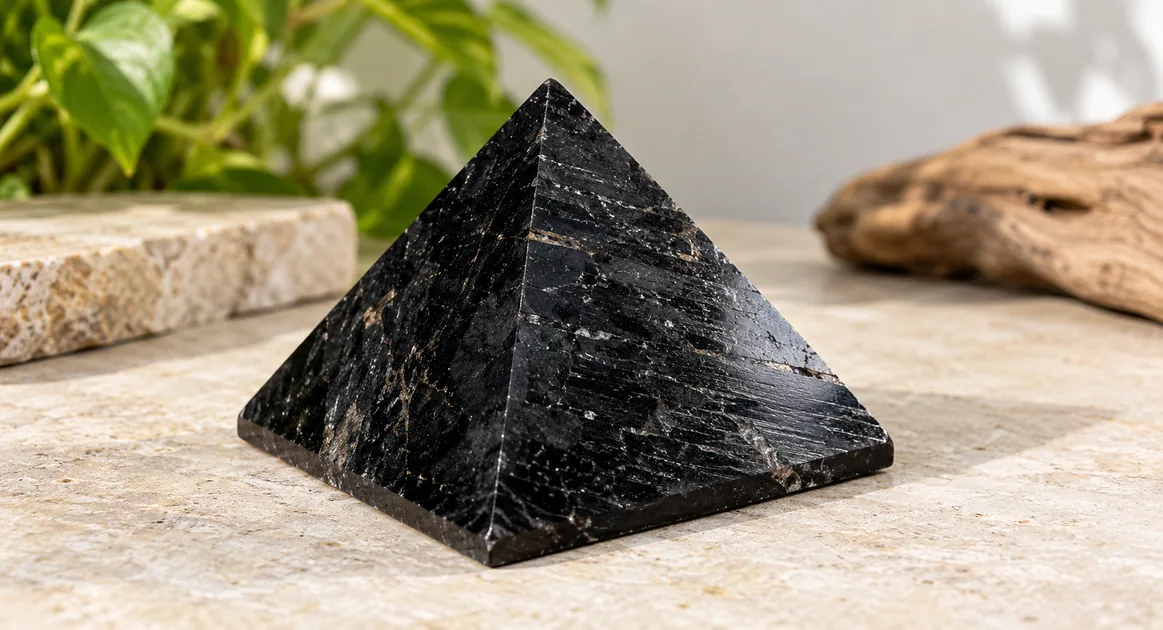
Black tourmaline pyramids bring together the dramatic appearance of a dark mineral carving and the symbolism of protection, steadiness and focused intention used in contemporary Vastu and crystal practice. In mineralogical language, much black tourmaline sold for carving is schorl, an iron-rich member of the tourmaline group. A carved pyramid, however, is not automatically one flawless schorl crystal. It can be cut from intergrown mineral material, fractured rough, a stabilized block, or, in a less clearly disclosed listing, a manufactured composite.
This distinction matters. The customer who wants a genuine mineral pyramid needs a truthful explanation of the material, visible seams, point and base quality, fillers or joining, real dimensions, and safe care. The customer choosing the same object for Vastu also needs a meaningful account of direction, Sankalpa, the five elements, devotional context and how modern protective symbolism differs from classical Jyotish gemstone prescriptions. This guide explains both sides, with material comparisons and realistic examples from an Indian home, retail showroom and professional Vastu kit.
1. What is black tourmaline? Understanding schorl
Tourmaline is a family of complex borosilicate minerals rather than a single simple material. The black, iron-rich member commonly called schorl belongs to the trigonal crystal system and often grows as long prisms with longitudinal striations. The colour can be black, blue-black or brownish-black; a freshly broken or polished surface may range from glassy to slightly resinous. A specimen can carry white feldspar, quartz or other rock-forming minerals from its geological setting. Such associated minerals should be identified rather than covered by the blanket claim “pure black crystal.”
Schorl typically has Mohs hardness around 7, while practical tourmaline care guides commonly give the group as roughly 7–7.5. That describes resistance to scratching, not the strength of every corner or the integrity of an internal seam. The mineral is brittle; a sharp carved tip may chip even if the main body is relatively hard. It has poor or indistinct cleavage compared with easily cleaving minerals such as fluorite, but fractures, inclusions and grain boundaries still affect handling.
| Property | Mineralogical reference | Meaning for the buyer |
|---|---|---|
| Mineral identity | Iron-rich member of the tourmaline group; complex borosilicate | Black colour alone does not establish schorl identity |
| Typical colour | Black, blue-black or brownish-black | Different lighting can change apparent blackness without changing material |
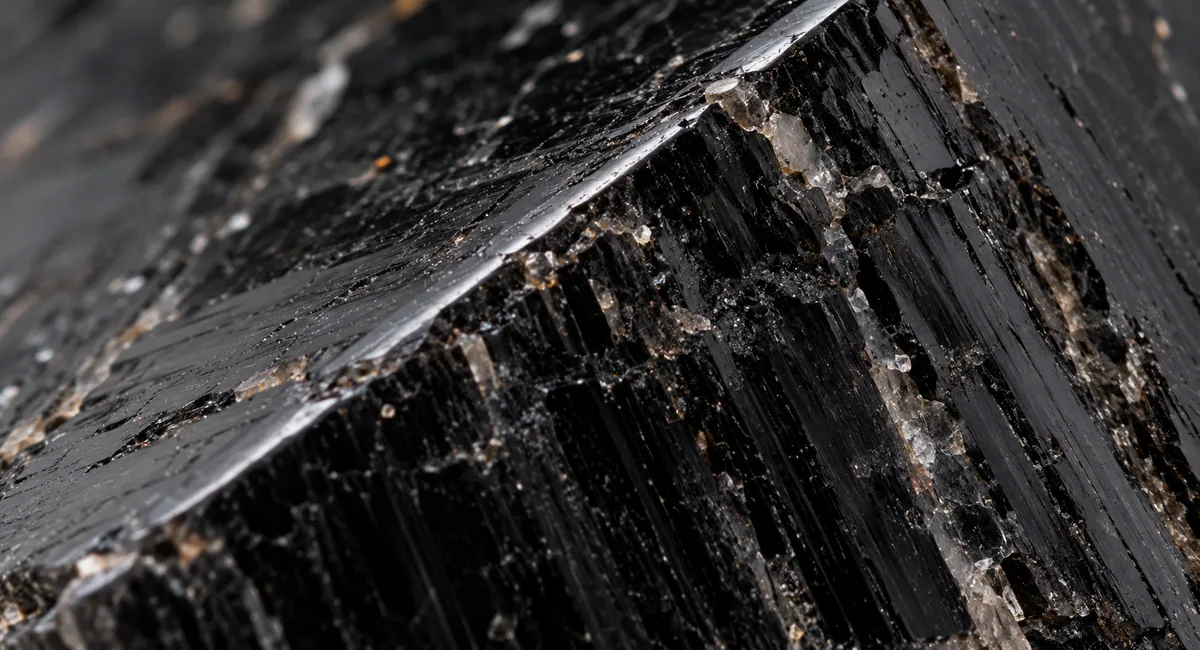
| Crystal system and habit | Trigonal, commonly prismatic and lengthwise striated | Raw striations are useful contextual clues but may disappear during carving |
| Mohs hardness | About 7 for schorl; tourmaline family often quoted 7–7.5 | Hard does not mean resistant to point damage or impact |
| Specific gravity | Often near 3.1–3.2 for schorl | A substantial feel is possible but is not definitive proof |
| Lustre | Vitreous to resinous | Matte, satin and polished faces can all occur after fabrication |
| Cleavage / fracture | Poor or indistinct cleavage; brittle, irregular fractures | Inspect tips, seams and fractured zones without testing destructively |
| Associated minerals | Quartz, feldspar and other minerals in many natural occurrences | Pale areas may be natural intergrowths, but require honest labelling |
These are mineral-species reference values, not a laboratory result for a particular OmmRudraksha stock item. Exact source locality, percentage of tourmaline, single-piece construction and any stabilization need verification for the specific physical object. A dark carving can resemble many unrelated substances, including volcanic glass and dyed chalcedony.
2. Why black tourmaline can show seams, grooves and pale patches
Buyers sometimes expect a black tourmaline pyramid to be an uninterrupted glossy black mirror. Natural schorl rough frequently tells a different story. Prismatic tourmaline crystals may grow together in parallel bundles, penetrate surrounding quartz or feldspar, or fracture and heal during geological change. A workshop cutting a square-based pyramid across that rough may expose dark linear textures, fine seams, pale patches, minute pits or differently reflective faces. Those observations can be compatible with natural mineral-bearing material.
They are not, by themselves, certificates of authenticity. Manufactured material can be deliberately textured, while natural stone may be filled, dyed, oiled, coated or bonded during processing. The right standard is specific disclosure: is this solid tourmaline-dominant material, tourmaline in matrix, several joined pieces, or crushed material in a binder? A natural inclusion can be acceptable in a stable ornament; a loose grain or opening crack near the tip is a different concern.
| Observed feature | Possible interpretation | What to ask or inspect |
|---|---|---|
| Parallel fine lines | Remnant crystal growth or cutting pattern | Are lines part of the mineral or machine marks? |
| White or pale patch | Quartz or feldspar intergrowth, filler or residue | What is the pale material, and is it stable? |
| Narrow dark seam | Natural fracture, grain boundary or bonded join | Does the seam run through the point or base? |
| Small pits | Grain pull-out, voids or finishing imperfections | Are edges sound, with no powder or loose material? |
| Very uniform finish | Fine polishing, coating or molded construction | Is it an actual carved mineral and what finishing was used? |
| Gloss difference by face | Cut orientation, mineral mixture or finish differences | Can each face be photographed in neutral light? |
| Hairline at apex | Surface mark, natural fissure or structural weakness | Request a close-up before purchase; do not press the tip |
A well-described pyramid need not hide geology. A careful product page can say “tourmaline-bearing rock with visible feldspar veins,” or “single carved piece with minor natural fissures,” if those statements are supported by the actual item. Those are more useful than promising “flawless 100% pure black tourmaline” on the basis of colour alone.
3. Solid carving, stabilized stone, joined blocks or powder composite?
Solid mineral carving ordinarily means the pyramid was shaped from one continuous piece of rough, although that piece can be a naturally intergrown rock rather than a single crystal. Some rough is fractured and impregnated with a suitable stabilizer to improve cutting yield. A joined block may combine two or more pieces with adhesive. A reconstituted composite can combine mineral particles and a binder; a fully manufactured resin or glass ornament may contain no tourmaline at all. The categories should not be quietly blended.
For an everyday decorative object, clearly labelled composites can still be attractive. For a customer specifically purchasing natural black tourmaline, however, these differences matter to valuation, wear, repair and care. The word energized—which describes a devotional or commercial preparation practice in some shops—does not provide mineral identification and should never replace construction details.
| Construction | Description | Suitable listing information |
|---|---|---|
| Single natural mineral-dominant piece | One block of tourmaline-rich material shaped into a pyramid | Natural material, any host rock, fractures and treatments |
| Tourmaline in matrix | Black schorl with quartz/feldspar or another rock component | Name both principal material and visible matrix when known |
| Stabilized natural piece | Fractured or porous rough strengthened with a filling agent | Type of stabilization if known and applicable care limitations |
| Joined or assembled pyramid | More than one piece bonded into one form | Assembled construction and visible bonding lines |
| Reconstructed powder composite | Tourmaline particles combined with a binder | Composite—not a solid carved crystal |
| Cast black glass or resin | Manufactured decorative body | Correct manufactured material name; no unverified mineral claim |
Photographs of the top, all four side faces, base and underside are essential because joins, filler patches, dents and unfinished grinding often appear away from the hero angle. If a listing offers only a dramatic backlit front photograph, ask for neutral-light images of the actual piece. A short rotating video is helpful, but even a video cannot substitute for material disclosure or professional testing.
4. Black tourmaline versus obsidian, onyx, shungite and other dark stones
Many black pyramids look almost identical in a small product thumbnail. The most useful comparisons begin with what the material is, not whether it is called a protection stone. Tourmaline is a crystalline borosilicate mineral group. Obsidian is volcanic glass; black onyx is chalcedony, frequently coloured or treated in commerce; shungite is a carbon-bearing rock with variable composition; hematite is an iron oxide; and basalt is an igneous rock rather than a single gemstone species.
| Material | Actual identity | Helpful distinction | Buyer question |
|---|---|---|---|
| Black schorl tourmaline | Iron-rich crystalline borosilicate | Often associated with prismatic striated rough, comparatively hard and brittle | Is this single-piece schorl-rich material? |
| Black obsidian | Natural volcanic glass | Conchoidal fracture and potentially very sharp broken edges | Is the carving verified as natural volcanic glass? |
| Black onyx/chalcedony | Microcrystalline silica | Often dyed to a uniform black appearance | Is colour treatment disclosed? |
| Shungite | Carbon-rich rock of variable composition | May have a different surface feel, density and smudging behaviour | What grade and rock description are supported? |
| Hematite | Iron oxide mineral | Commonly heavier for its volume; distinctive reddish streak in geological testing | Natural hematite, magnetite or manufactured hematine? |
| Basalt | Fine-grained volcanic rock | Can show small vesicles or a grainy texture instead of crystal striations | Is it sold accurately as basalt rather than tourmaline? |
| Cast resin or glass | Manufactured decorative material | May show bubbles, mould seams or uniform finish; exceptions exist | Is this a natural stone carving at all? |
Some products are genuine tourmalinated quartz: clear or milky quartz with dark tourmaline needles. This is not equivalent to an opaque solid schorl pyramid. The mixture may be an attractive item, but the product name should reflect it. Avoid depending on isolated clues such as “scratches glass,” “feels cold,” “floats in water,” or “sticks to a magnet.” None alone proves species, origin or construction, and several tests can damage an otherwise saleable object.
5. How to examine a pyramid without damaging the stone
Begin with non-destructive observation. Use daylight or a neutral white lamp, not only a dark, high-contrast advertisement. A clean white or grey background helps show the outline. Photograph all four faces, the central junctions, apex and base. Look for symmetrical geometry, a level underside, loose grains, open fractures and visible repair. A flat-bottomed pyramid should stand securely without rocking under a very light touch; never put pressure on a delicate point to test strength.
Keep a basic record of the actual length and width at the base, overall height, measured weight and photographed condition. “About two inches” is convenient as a shopping category, but not an exact specification. For mixed rock, natural variation means two pieces with equal dimensions may weigh differently. A weight that seems high or low is a prompt for questions, not a mineral identity certificate.
| Inspection | Why it matters | Accept or clarify |
|---|---|---|
| Top/apex close-up | Most vulnerable corner during shipping and handling | Minor polishing variation may be fine; broken or unstable point needs disclosure |
| Four faces | Reveals seams, cuts, pale inclusions and finish consistency | Ask what the visible material differences represent |
| Base and underside | Shows support, structural joins and finish quality | Reject unstable wobble or concealed damage if sold as perfect |
| Side light | Reveals topography and surface cracks | Different shine is not proof of alteration |
| Material and treatment label | Clarifies mineral-rich rock, stabilization or assembly | Ask for straightforward disclosure, not broad slogans |
| Dimensions and weight | Allows comparison and safe shelf choice | Use actual item measurements rather than sample figures |
| Packaging plan | Protects apex and projecting edges in transit | Individual padding and a rigid outer box are preferable |
A professional mineral laboratory can use tools such as microscopy, density measurement and appropriate spectroscopic or compositional methods when certainty is needed. Shop photographs and hand tests seldom establish a precise mineral percentage. Do not apply acid, fire, scratch tests, concentrated salt solutions, aggressive heating or strong physical pressure to a finished or purchased pyramid.
6. What makes a good black tourmaline pyramid carving?
The quality of a pyramid has at least three components: material honesty, structural stability and finish suitable for its intended display. A simple satin finish can reveal natural stone beautifully; a high mirror polish may be attractive but can highlight or hide different aspects of its surface. Perfect visual uniformity is not a requirement for genuine schorl. Equally, a deliberately rustic finish does not excuse loose chips or badly assembled construction.
Observe the geometric relationship between the four triangular faces, the apex and the square base. Differences in slope may be a design choice or a workmanship problem; evaluate against the advertised format. Tourmaline-rich rough can be challenging to cut where crystals radiate or intersect. A seller should say when natural fissures are prominent and should identify any repaired apex or reinforced area. A point that was re-glued should not be described as an untouched solid single-piece carving.
| Criterion | Strong presentation | Reason to ask for clarification |
|---|---|---|
| Material | Correct mineral/rock description, any treatments disclosed | Vague “100% rare energy crystal” with no material detail |
| Stability | Firm faces and apex; no loose fragments | Open fissures, powdering, falling chips or movement |
| Geometry | Level base and deliberate proportional shape | Rocking, irregular edge not shown in listing |
| Surface | Uniformly finished to the stated matte or polished style | Unexplained patches, filler, coating or abrasive damage |
| Transparency | Actual-object photos plus dimensions and weight | Only representative images for a variable natural piece |
| Packaging | Tip protected, isolated from other objects | Hard items packed together with unprotected points |
For a high-value item, request an invoice that states the proper material and declared treatments. If a seller cannot provide a defensible identity for a stone, a conservative descriptor such as black tourmaline-bearing rock pyramid, identity not independently laboratory-tested is more credible than an unsupported promise about purity, mine location or spiritual efficacy.
7. Traditional Vastu meaning: protection, stability and Sankalpa
In contemporary Vastu and crystal practice, black tourmaline is widely associated with protective boundaries, steadiness, focused attention and grounding. A pyramid adds a geometric symbol of concentration: its broad base evokes support and the converging faces suggest an intention brought into focus. For some householders, keeping such an object near a work desk or entrance is part of a disciplined daily reminder of order, calm and purposeful conduct.
Traditional Indian concepts give this language additional context. Prithvi Tattva, the earth principle within the Pancha Mahabhuta, is associated with firmness, structure and groundedness. A dark substantial stone can be used symbolically to express those qualities. Sankalpa is the stated intention behind a spiritual act or chosen discipline. Its significance does not depend on whether a mineral happens to be black; it is a purposeful way to connect a devotional or household practice to action.
Care is needed when describing historical authority. It is inaccurate to claim that every classical Vastu Shastra text specifically directs a schorl pyramid to one compass sector. A carved black-tourmaline pyramid is largely a modern commercial and spiritual object, often interpreted through broader Vastu symbolism. Recognizing this does not diminish the value someone may place on the practice; it allows classical architectural principles, family traditions and contemporary gemstone associations to be explained without confusion.
8. Which direction should a black tourmaline pyramid face?
Ashta Dik, the eight directions, provides a traditional vocabulary for discussing a space. But a universal “black tourmaline always goes north” or “every protection stone must face south-west” rule is not supported as a blanket prescription. Placement varies with the layout, function, family practice, the Vastu method used by a consultant and practical safety. It is useful to distinguish traditional directional deities or qualities from the newer custom of assigning a particular crystal to one sector.
| Direction | Traditional association | Practical question |
|---|---|---|
| East (Purva) | Indra and beginnings in many directional traditions | Does the intended location receive harsh direct sunlight or get handled often? |
| South-east (Agneya) | Agni, fire-related functions | Is the shelf safely away from cooking heat and open flames? |
| South (Dakshina) | Yama in Ashta Dik symbolism | Is the item on a stable surface out of a narrow walkway? |
| South-west (Nairritya) | Nirriti; often discussed for stability in modern Vastu | Does a heavy-looking object fit the intended room function and furniture? |
| West (Paschima) | Varuna in directional traditions | Will humidity or cleaning spray affect the piece? |
| North-west (Vayavya) | Vayu and movement | Is the location subject to frequent knocks, doors or airflow? |
| North (Uttara) | Kubera, wealth and custodianship | Would a desk or account-area display be useful without obstructing work? |
| North-east (Ishanya) | Ishana/Shiva and devotional orientation | Does the object suit the family's puja arrangement and remain away from liquids? |
In a consultation, start by identifying true compass directions, the purpose of each room, the actual item dimensions and the family's preferred tradition. The distinction between north as a Kubera-associated direction and black tourmaline as an automatic financial remedy is especially important. A practical display may be selected for convenience and Sankalpa, while a formal remedial prescription should reflect the consultant's method rather than an internet rule repeated for every stone.
9. Black tourmaline, Muladhara chakra and Navagraha: related but different frameworks
Modern crystal and yoga communities often associate dark stones with Muladhara, the root chakra, because the symbolism of a firm base aligns with stability and being grounded. A small black pyramid on a meditation shelf may serve as a visual cue for seated practice, posture or deliberate breathing. The exact choice of stone is a matter of spiritual preference; the mineral's iron content does not determine a measurable change to a chakra.
Jyotish and Navagraha recommendations operate within another system. Traditional gemstone considerations may depend on Lagna, Rashi, Graha strength, planetary rulership, Dasha, the relevant house, the intended remedy and the astrologer's school. Black tourmaline is sometimes connected with Shani or Rahu in modern crystal correspondences, but it should not be presented automatically as a classical substitute for Neelam (blue sapphire), Gomed (hessonite) or other chart-specific Ratna recommendations. A birth-chart-based recommendation needs an actual Jyotish assessment.
| Framework | How black tourmaline may be discussed | What should not be assumed |
|---|---|---|
| Vastu | A decorative symbolic item used with layout and Sankalpa | One mandatory sector for every building |
| Pancha Mahabhuta | Metaphorical relation to Prithvi and stability | Measured physical earth-element output |
| Chakra practice | Grounding symbol associated with Muladhara in modern crystal usage | Guaranteed healing or chakra diagnosis |
| Jyotish / Navagraha | Optional modern associations with particular grahas | Automatic replacement of a prescribed classical gemstone |
| Puja and Sankalpa | A personal object accompanying prayer or intention | That the object needs chemical washing, smoke or fire to work |
A homeowner can meaningfully follow one or more of these approaches, but a careful educational article labels the approach being used. That keeps traditional terminology intact without merging Vastu, tantra, yoga and chart-based astrology into a single unsupported set of universal instructions.
10. Worked example: a Bengaluru apartment entrance and study shelf
Consider a Bengaluru family living in a compact apartment with a north-facing main door and a small study table in the living room. They want a black tourmaline pyramid as a symbolic reminder to maintain calm boundaries during an active working day. A store shows them two options: one with distinct pale matrix streaks and a level base, and another with an unusually uniform glossy surface but no explanation of composition. The first is not automatically authentic and the second is not automatically imitation; both require construction disclosure.
The family asks for neutral-light images, exact dimensions, weight and underside photographs. The seller confirms whether visible pale minerals are part of the same stone and whether any repair or filling was used. The chosen pyramid is placed on a stable, low-traffic study shelf, not on the narrow entrance ledge where a bag might strike it. If the household prefers a Sankalpa, they may associate it with steadiness and disciplined work rather than relying on a specific object to control other people's actions or guarantee outcomes.
During weekly cleaning, a dry soft cloth removes dust and the family checks that the point and seams remain sound. This example illustrates a useful distinction: practical placement is determined by furniture, children, pets and traffic; the spiritual interpretation is an additional personal layer. A compass direction alone cannot correct poor physical placement.
11. Worked example: retail counter and jewellery showroom
A jewellery showroom in Bengaluru wants a dark pyramid near its reception desk. The staff prefer black tourmaline for its modern protective symbolism and because the shade contrasts elegantly with light wood. The owner first compares a natural schorl-rich carving with a black obsidian pyramid. Both can be visually attractive. The decision includes price, accurate product description, risk of chipping, surface care and whether the customer-facing label explains the material correctly.
For the tourmaline piece, an employee inspects the top under a small diffused light, records all four sides, and photographs the base. Any seam that crosses the point deserves extra attention. The pyramid sits on a broad non-slip felt mat behind—not directly in—the counter's payment and packing area. Customers can see the object, but repeated handling and accidental knocks are minimized. The tag states the stone identity and actual measurements rather than claiming that the pyramid ensures sales, protects cash or neutralizes electrical fields.
For a showroom that also sells Vastu objects, it is valuable to place a small explanation card beside the display: “Black tourmaline (schorl) is a dark crystalline mineral. In contemporary Vastu and crystal traditions it is associated with grounding and protection. Material and construction details are available on request.” Such a presentation respects both the subject and the customer.
12. Worked example: professional Vastu gemstone reference kit
A consultant assembling a professional reference kit may carry several physically distinct dark objects: black tourmaline, black obsidian, dyed black chalcedony, shungite, hematite and perhaps basalt. Their purpose is not to claim that visually similar stones behave alike. Each specimen demonstrates a different material family, possible trade naming, care requirement and traditional association. A mounted raw schorl prism, if available, provides a comparison for a carved black-tourmaline pyramid because natural longitudinal striations can be easier to see on the raw piece.
Each item receives a separate label including its source description, dimensions, purchase date, disclosed treatments, confirmed-versus-provisional identification and a photograph of a distinguishing feature. The consultant records whether a specimen is a single piece, natural intergrowth or composite. A dedicated box compartment protects the points. These records prevent the common error of handing a client any black pyramid while calling it “black tourmaline.”
In a client discussion, the consultant can then distinguish mineral facts, Vastu directional interpretations and Jyotish remedial considerations. Even when working within a strong spiritual tradition, precise language increases clarity: a material demonstration is not an astrological prescription, and a suggested desk placement does not constitute laboratory validation of a stone's purported energetic properties.
13. Cleaning and long-term care: protect the apex and seams
Tourmaline is relatively hard, but the carving's weakest structural area may be a fracture or pointed corner. GIA advises warm soapy water as a standard cleaning method for stable tourmaline gemstones and recommends against ultrasonic and steam cleaning. That guidance concerns known tourmaline gemstones; a retail pyramid may contain matrix, filling, glues, coatings or unknown treatments. When those details are uncertain, choose the more conservative approach of gentle dry dusting with a soft clean brush or cloth.
For a verified stable, unfilled mineral carving, an occasional lightly damp cloth can be appropriate if the supplier confirms the finish permits it; wipe dry promptly, particularly around seams and the base. Do not soak an assembled or unknown composite. Avoid saltwater immersion, lemon juice, vinegar, bleach, aggressive oils, abrasives, ultrasonic machines, steam, sudden temperature changes and intense heat. These methods are unnecessary for display care and can damage a finish or concealed adhesive.
| Situation | Recommended approach | Avoid |
|---|---|---|
| Routine shelf dust | Clean soft dry brush or microfiber cloth | Stiff scrubbers and abrasive powders |
| Verified stable solid mineral | Follow supplier's water guidance; dry promptly | Repeated soaking and sudden temperature changes |
| Matrix or visible seams | Prefer dry cleaning; inspect periodically | Immersion and forceful rubbing across fissures |
| Filled, glued or composite | Use the manufacturer's care method | Heat, solvents and prolonged moisture |
| Dust near puja shelf | Remove before lamp, ash or oil reaches the object | Holding near flame or immersing during rituals |
| Chipped or loose apex | Isolate from handling and seek qualified repair advice | Home scratch tests or pushing pieces back into place |
| Long-term storage | Wrap separately in soft padding within rigid box | Loose contact with other gemstones or metal objects |
Talk of “cleansing” a spiritual stone may refer to prayer, mantra, meditation or other customary practice. It should not be confused with chemical cleaning. A family may use a quiet Sankalpa or personal devotional practice without putting the object through salt, water, smoke or heat. The latter choices must be judged by the actual physical construction and finish.
14. Buying online: a practical question list for sellers
Before purchase, request answers in a form that can appear on an invoice or product page. Ask: Is the object schorl-rich natural material, a mixed rock, stabilized material, assembled pieces or a composite? What are the actual dimensions, approximate weight and finishes? Are there repairs, resin fills, surface coatings, dyes or adhesive joins? What do the underside and apex look like? Is the exact piece photographed, or is the image representative? How is the point protected during shipping? What does the return policy cover if the actual carving differs materially from its description?
Where a material's identity is uncertain, do not convert an unverified vendor claim into a categorical website statement. It may be reasonable to list a disclosed tourmaline-bearing decorative stone pending identification, whereas a statement about exact schorl content, a specific mine or exclusive origin should require evidence. Certification is meaningful only when its scope, testing laboratory and connection to the actual product are clear. A certificate for a bead or a separate source sample is not automatically a certificate for the pyramid being sold.
| Question | Good answer | Unresolved answer |
|---|---|---|
| What material is it? | Schorl-rich single piece, matrix or composite correctly identified | “Original energetic black crystal” alone |
| Are there treatments? | Known stabilization, filling or coating described | “Never treated” without information |
| How do I see its true condition? | Real-piece views of apex, all faces and underside | Only a highly edited hero photo |
| Will it fit my shelf? | Real base size, height and measured weight | Size shown only with a misleading reference object |
| Can it be safely cleaned? | Material-specific advice reflecting joins or coatings | Universal instruction to soak every crystal in saltwater |
| What if it arrives damaged? | Clear packing standard, photos and return procedure | No provision for chip or construction discrepancy |
Price alone does not establish authenticity. Unusually low prices may reflect a small size, composite construction or market conditions; higher prices may reflect presentation and branding rather than stronger mineral evidence. A transparent description is the foundation for comparing offers fairly.
15. Frequently asked questions about black tourmaline pyramids
- 1. Is black tourmaline the same as schorl?
- Much commercially described black tourmaline is schorl, an iron-rich tourmaline-group mineral. However, not every black tourmaline-bearing rock or trade-labelled carving is a pure single schorl crystal.
- 2. Is black tourmaline a crystal or a rock?
- Schorl is a crystalline mineral species; a carving can consist of crystalline schorl plus intergrown rock-forming minerals.
- 3. What causes the lines on black tourmaline?
- Raw schorl commonly has lengthwise striations; a cut pyramid may also show grain boundaries or polishing marks. A line's exact cause needs inspection.
- 4. Do white veins mean the pyramid is fake?
- No. Quartz, feldspar and other host minerals may be natural, but filler or bonding is also possible. Ask for the material description.
- 5. Does solid black prove a single natural crystal?
- No. Dark dye, glass, composite and dense natural rocks can all look very uniform in photographs.
- 6. How hard is black tourmaline?
- Schorl is commonly listed near Mohs 7; tourmaline family references often use 7–7.5. That does not prevent impact damage.
- 7. Can a pyramid be carved from joined pieces?
- Yes, but it should be sold as assembled rather than represented as a continuous single natural carving.
- 8. Is black tourmaline identical to black obsidian?
- No. Tourmaline is crystalline borosilicate; obsidian is natural volcanic glass with different fracture and material properties.
- 9. Is a smooth glossy face evidence of imitation?
- No. Natural material can take a polish. Appearance alone cannot establish origin or treatment.
- 10. What is tourmalinated quartz?
- Quartz containing dark tourmaline needles; it is not the same product as an opaque schorl pyramid.
- 11. Which direction is best in Vastu?
- There is no universal schorl-specific direction for every property. Room purpose, local tradition, the Vastu method and physical safety matter.
- 12. Can I keep it near the entrance?
- It may serve as a symbolic display, provided the ledge is secure and protected from knocks, children, pets and doorway traffic.
- 13. Is black tourmaline associated with grounding?
- Yes, grounding and protection are common contemporary crystal-Vastu associations. They describe the tradition's symbolism rather than a mineral laboratory measurement.
- 14. Is black tourmaline linked to Muladhara?
- Modern chakra practice frequently makes that association, but it is separate from the mineral's physical identification.
- 15. Is it a gemstone remedy for Shani or Rahu?
- Modern associations vary; it should not be automatically substituted for a chart-specific classical Jyotish gemstone prescription.
- 16. Can a pyramid protect against EMF or harmful radiation?
- Tourmaline's known electrical properties do not establish that an ordinary pyramid shields a room or electronic equipment from electromagnetic fields.
- 17. Can I wash it in water or salt?
- For unknown filled, joined or composite pieces, avoid immersion and salt solutions. Dry dusting is the safer default; follow actual-item guidance.
- 18. Can I put it next to a diya or incense?
- Keep it away from flames, intense heat, ash and oil. Thermal shock or coating damage may occur.
- 19. How should I store or ship it?
- Wrap it individually, protect the point, use a rigid outer box and avoid hard contact with other stones.
- 20. Is black tourmaline suitable for a professional Vastu kit?
- Yes, when clearly labelled and kept separate from obsidian, onyx, hematite and shungite, with construction and treatment notes.
16. Research basis and final selection guidance
Mineral-species information in this guide was cross-checked against the Mindat schorl record and the Mineralogical Society of America's mineral identification references, including schorl's iron-rich tourmaline classification, trigonal habit, hardness and striations. The Gemological Institute of America publishes tourmaline care advice concerning hardness, toughness, temperature sensitivity, ultrasonic cleaning and warm soapy water for suitable gemstones. These are educational research attributions rather than outbound commercial links.
For a black tourmaline pyramid for Vastu, begin with the material description and structural quality: is it natural schorl-rich stone, intergrown material, stabilized rough, joined blocks or a clearly labelled composite? Check the point and base, examine actual photographs, confirm size and weight, and use care suitable for the particular construction. Then choose a secure place compatible with room function, the family's spiritual tradition and Sankalpa. Accurate mineral identity and meaningful traditional interpretation work best together; neither requires an exaggerated promise or a universal direction rule.
Explore existing OmmRudraksha collections
Browse Vastu for the existing collection, or explore gemstone products for other material forms. Each product’s construction and care information should guide your choice.