Shungite pyramids are carved from a dark, carbon-bearing natural rock whose mineral composition, carbon concentration, finish and surface behaviour can differ from piece to piece. The name refers to a family of carbon-rich geological materials, not one uniformly pure crystal. A convincing black pyramid is therefore not identified simply by its colour, a fashionable grade label or whether it conducts electricity.
This complete guide explains shungite geology, its Karelian history, carbon-content claims, the difference between shungite and lookalike materials, the physical quality of finished carvings, dry cleaning, professional buying checks and thoughtful Vastu placement. It also separates traditional ideas of Prithvi, Sankalpa, protection and steadiness from modern technical claims about Wi-Fi, radiation, water treatment and fullerenes. Those are different kinds of questions and deserve different kinds of evidence.
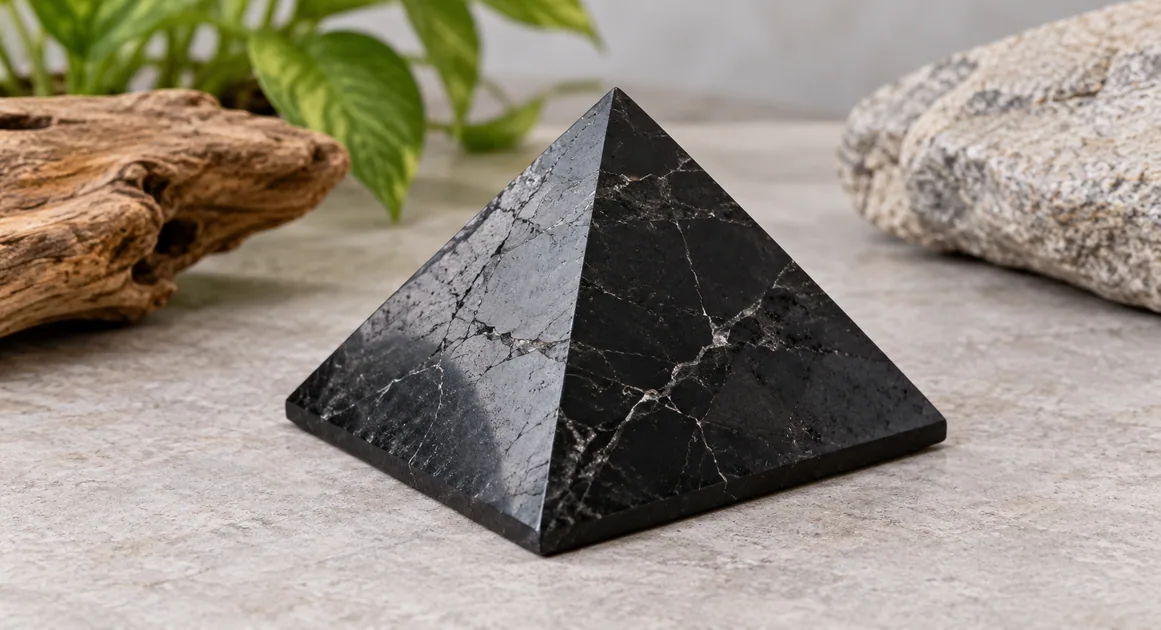
1. What is shungite? A carbon–mineral rock rather than one pure crystal
Shungite is commonly associated with ancient carbon-rich rocks of Karelia in northwestern Russia, particularly the Lake Onega region and the historical Shunga locality. Scientific authors use the term for geological material containing poorly ordered or mineralized carbon together with variable amounts of silicates and other minerals. Depending on the deposit and specimen, the mineral components can include quartz-rich material, aluminosilicates and accessory minerals. The carbon itself is not equivalent to a carved block of chemically pure graphite.
This distinction matters in retail. An ornament described as “100% pure shungite crystal” implies a uniform single mineral or near-pure elemental substance that many carved decorative pieces are not. A more responsible listing identifies the item as a shungite-bearing rock pyramid, and adds verified composition or locality details only when documents support them. If a composite contains resin, cemented powder, paint or a substrate, the description should specify that construction.
| Question | Sound explanation | What not to assume |
|---|---|---|
| Is shungite a mineral species? | The commercial name ordinarily describes a carbon-bearing rock or material | Every piece is one pure crystal |
| Is all shungite the same? | Carbon-to-mineral proportions and textures differ | One appearance or test describes all deposits |
| Does black colour prove identity? | No: many rocks, glasses and manufactured materials are black | A black pyramid is necessarily shungite |
| Does a carving preserve geological layering? | It can show seams, mineral veins and variable polish | Every line is a crack or defect |
| Can the source be verified from a photo? | A photo helps with appearance, not definitive geology | Karelian origin is proven by shape or label |
2. Karelia, geological history and the difference between a place and a guarantee
The name is strongly linked with the Karelian region and a distinctive ancient geological setting. Published research describes carbon-rich Paleoproterozoic rocks and a long debate over how the carbon was deposited, heated and reorganized. This makes shungite a genuinely interesting study material for collectors, even before any decorative or spiritual meaning is considered.
Origin claims need separate evidence. “Karelian shungite” should refer to traceable sourcing rather than a default sales phrase. A supplier invoice, quarry information and credible mineralogical documentation are more useful than a generic certificate that merely repeats the product name. Material from one mining district is not automatically identical in composition to another. If the shop cannot establish locality reliably, it can state that the material is supplied as shungite and avoid a specific geological provenance claim.
Names such as “Russian,” “elite,” “noble” and “premium” can convey different commercial ideas. They are not an analysis of the actual item on the counter. The geography of a source, the fraction of carbon, the quality of carving and the intended use should be treated as distinct attributes, because a customer might value one without needing the others.
3. Carbon percentage: why a black surface cannot tell you the number
Scientific literature reports a broad compositional range for shungite-rich materials, depending on the sample class and geological occurrence. A laboratory result on one specimen is not a certificate for an entire batch of pyramids. Some commercial descriptions quote very high percentages associated with specially selected carbon-rich material while the ordinary carved pieces may contain much more non-carbon mineral matter.
A merchant should not estimate carbon percentage by colour, surface shine, weight in the hand, conductivity or a viral demonstration video. For a meaningful quantitative claim, request the analytical method, the tested sample, the date, the unit and its connection to the actual sold lot. If no sample-specific analysis exists, describe the material and appearance without inventing a numerical percentage.
| Evidence presented | What it can establish | What it cannot establish |
|---|---|---|
| Black or shiny photo | Surface appearance | Exact carbon percentage |
| Basic conductivity demonstration | Possible electrical path through a given specimen | Material purity or medical protection |
| Supplier label “elite” | Commercial grade claimed by supplier | Universal scientific classification |
| Elemental or carbon analysis | Composition of the tested sample under stated method | All pieces in an unrelated batch |
| Mineralogical report | Identified components of the submitted specimen | Authenticity of an untested future delivery |
4. Elite, noble and ordinary shungite: retail language to decode
Retailers may use “elite shungite” or “noble shungite” for highly lustrous, carbon-rich and sometimes more brittle-looking materials. These terms can reflect marketplace conventions, but do not replace a report specifying the material. The polished pyramid seen in a shop may be a more mineral-rich rock capable of holding a regular carved shape; it should not automatically inherit the carbon figures advertised for a different high-carbon specimen.
An attractive pyramid can be a worthwhile decorative piece even when no special grade is documented. Ask how the piece was cut, whether it is monolithic or assembled, whether its black finish is natural or coated, and whether a specific material percentage has actually been measured. A seller who can answer those ordinary questions offers more real value than a dramatic technical claim.
| Sales description | Useful follow-up | Reason |
|---|---|---|
| “Elite shungite pyramid” | What measurable grade criterion is being used? | Trade language is not uniform |
| “Highest carbon content” | Can I see the dated lot test? | Appearance alone is insufficient |
| “Solid natural stone” | Any bonded blocks, resin or filler? | Construction changes care and value |
| “Polished to a mirror finish” | Is the surface waxed, oiled or coated? | Finishes can affect transfer and cleaning |
| “Karelian origin” | Is there supplier traceability? | A place name requires sourcing |
5. Recognising surface texture, mineral seams and carving quality
A finished shungite pyramid can show charcoal-black to dark-grey regions, dull or satin lustre, fine mineral streaks and different polish on adjacent zones. Depending on stone and workmanship, a pale inclusion or hairline feature may be part of the original rock. However, an actual open crack, shedding layer, chipped apex or loose aggregate affects durability and should be shown and described.
Inspect all four faces, the point, the edges and the underside. A symmetrical silhouette alone does not guarantee good workmanship. The base should be reasonably stable and not leave black powder on a delicate tabletop. The tip should be intact, the faces free of undisclosed adhesive joins, and the product dimensions clearly stated. If the seller uses a neutral coating to stabilize the surface, disclosure is preferable to presenting that gloss as a natural material property.
| Observation | Possible significance | Action before buying |
|---|---|---|
| Fine grey or pale streak | Natural mineral phase or vein | Check if it is stable and identified |
| Black residue on handling | Loose material or surface treatment | Ask for finish and care details |
| Abrupt straight join | Possibly assembled construction | Request side and underside pictures |
| Small clean natural pits | Variation in rock or carving | Ask whether any grains are loose |
| Rocking on flat shelf | Uneven base | Check stability before display |
| Very glossy uniform black | May be natural polish or coating | Ask how finish was achieved |
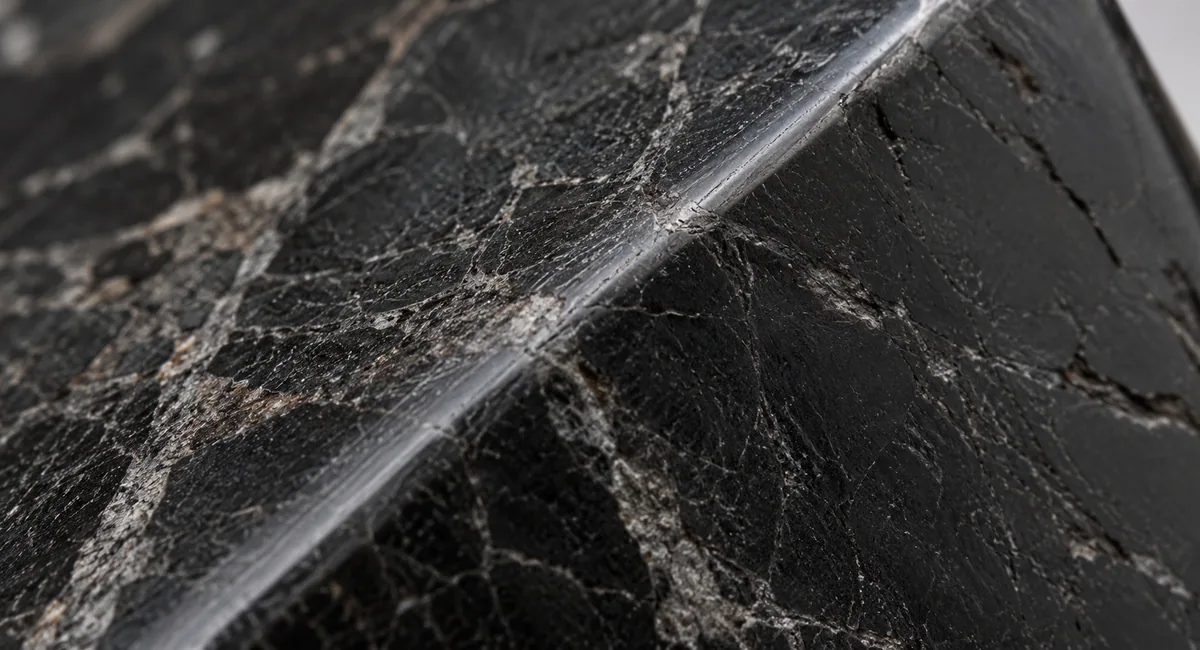
6. Shungite versus obsidian, black tourmaline and ordinary black stone
Shungite can be confused commercially with several dark materials. Obsidian is a volcanic glass that often breaks with a glassy conchoidal fracture. Black tourmaline, usually schorl, is a mineral that commonly forms striated crystals; a polished carving may obscure that habit. Black onyx is generally a chalcedony trade material, and black basalt is a fine-grained igneous rock. None can be distinguished from one black storefront photograph with full confidence.
The distinction matters most when a specific material is promised. Do not rely on scratch tests, ignition, acid drips or destructive electrical demonstrations in a shop. Clear photographs, seller provenance and, where needed, mineralogical identification are more appropriate. A polished pyramid sold for a decorative Vastu arrangement need not carry an expensive laboratory report, but it must not carry laboratory-style claims that the seller cannot substantiate.
| Material | What it is | Common appearance clue | Buyer caution |
|---|---|---|---|
| Shungite-rich rock | Carbon-bearing composite geological material | Dark matte to lustrous rock; variable veins | Carbon proportion is not visible |
| Obsidian | Natural volcanic glass | Glassy lustre; smooth even black possible | Glass identity differs from shungite |
| Black tourmaline | Tourmaline mineral, often schorl | Longitudinal crystal striations in rough form | Carvings may conceal crystal habit |
| Black onyx | Chalcedony commercial material | Dense smooth dark appearance; treatments possible | “Onyx” can be used for other rocks |
| Basalt | Fine-grained volcanic rock | Often granular or matte dark grey-black | Dark colour alone is not diagnostic |
| Dyed resin composite | Manufactured or assembled material | Uniformity, seams or bubbles may occur | Need transparent construction disclosure |
7. Fullerenes and carbon structure: interesting science, not a product guarantee
Natural fullerenes were reported in specific geological shungite samples and helped generate scientific interest in the rock. Later research showed that the occurrence and amounts are complex, sometimes confined to particular varieties or small fracture regions. It is therefore incorrect to describe every souvenir pyramid as a concentrated C60 fullerene product. The presence of carbon does not prove a measured fullerene concentration.
Laboratory studies on carbon structure use methods such as diffraction, spectroscopy and electron microscopy under controlled conditions. Those measurements are not reproduced by holding an object near a phone or observing a reflection. When reading a paper, ask whether its sample represents the same type of stone, whether its purpose was geological characterization, electrochemistry or another application, and whether its conclusions were ever tested on decorative finished pyramids.
This scientific history is well worth explaining in a product guide: it gives the stone an interesting geological identity. It does not justify turning a narrowly tested laboratory property into a broad household claim.
8. Does a shungite pyramid protect from Wi-Fi, mobile radiation or EMF?
Shungite’s electrical properties have prompted studies of particular materials and their possible applications. Some controlled arrangements of conductive material can affect electromagnetic fields. A small untested decorative pyramid positioned nearby is not an established EMF shield for a person, a room or a mobile phone. Shielding depends on frequency, geometry, coverage, electrical properties and a measured test setup. An isolated desk ornament is not the same as engineered conductive enclosure.
Avoid advertising a guaranteed protective radius, complete neutralization of Wi-Fi, “harmonised radiation” or certified 5G protection unless there is product-specific evidence from a suitable test. A buyer may still appreciate a pyramid as a reminder of calm and grounded attention in a technology-heavy workspace. That cultural or personal interpretation is different from claiming measurable reduction in exposure.
| Claim or test | What is justified | What needs additional proof |
|---|---|---|
| Rock contains conductive carbon | Some shungite materials can conduct electricity | Exact conductivity of this product |
| A laboratory electrode contains shungite | Material can have a research application | Household shielding by an ornament |
| Pyramid near a router | The object is placed beside equipment | A reduction in Wi-Fi exposure |
| “Protects the entire room” | Not established by colour or mineral name | Independent testing of this exact arrangement |
| Traditional protection symbolism | A personal or cultural interpretation | A physical radiation measurement |
9. Water purification: why a display pyramid is not a drinking-water filter
Research has examined adsorption and chemical behaviour of shungite-related materials, including laboratory treatment of water. Yet adsorption of one component does not demonstrate that untreated ornamental stones are appropriate for drinking-water contact. Published experiments have also identified potential release of unwanted elements under certain test conditions. Whether a specific preparation is safe depends on its composition, water chemistry, processing and independent testing.
Do not place an ordinary carved pyramid in a drinking-water bottle, food container, aquarium or cooking vessel on the assumption that it purifies liquid. Polishes, treatments, dust and the unknown mineral fraction create additional questions. A consumer seeking water treatment should select equipment and media certified for that purpose, rather than repurposing a decorative item.
This is a particularly important distinction for shop staff: the guide can acknowledge laboratory research while keeping the actual OmmRudraksha pyramid accurately categorized as an ornament and traditional display object.
10. Vastu, Prithvi Tattva and the traditional meaning of a dark pyramid
In contemporary Vastu-inspired arrangements, black or earth-toned stones are sometimes selected to symbolize stability, restraint, grounding, protection and boundary-setting. The pyramid shape itself may represent focus and ascent from a stable base toward a single point. Shungite is a geological material from a different regional context; claims that a specific shungite rock is prescribed in every classical Indian Vastu text should not be assumed. Modern practice often combines inherited spatial principles with newer gemstone and crystal products.
The Pancha Mahabhuta framework speaks of Prithvi (earth), Ap or Jala (water), Agni (fire), Vayu (air) and Akasha (space). A black pyramid is sometimes read symbolically through Prithvi because of its weight, colour and stable placement. Other contemporary systems may use black for water-associated directions or protective boundaries. Since these correspondences differ across schools, do not claim one universal grid rule without naming the tradition or system.
The spiritually meaningful use of the object may be quite simple: put it on a safe shelf, establish a clear Sankalpa for responsible work or household steadiness, and maintain the space thoughtfully. The ritual context gives the object significance without requiring geological or technical exaggeration.
| Traditional lens | How it may be interpreted | Practical use |
|---|---|---|
| Prithvi Tattva | Steadiness, rootedness and support | Stable dry base and orderly shelf |
| Sankalpa | Conscious intention and disciplined action | Personal focus before work |
| Directional Vastu | Placement according to chosen school and layout | Consider actual room function and access |
| Puja and devotional display | Symbolic protection or remembrance | Respectful placement away from oil and flame |
| Contemporary crystal practice | Grounding and reflective atmosphere | Quiet work or meditation corner |
11. Placement directions: entrance, desk, meditation room and Vastu assessment
People often ask for one mandatory direction for every shungite pyramid. A meaningful recommendation depends on the room, the building orientation, the chosen Vastu school and the purpose of the display. In some contemporary traditions dark stones are associated with protective spaces or grounded work environments; different schools attach different directions to elemental colours. Use those as stated interpretations, not a universal instruction.
At an entrance, place the item where it will not be knocked from a shoe rack or stepped on. On a desk, keep it away from the keyboard, cables and frequently moved papers. In a meditation corner, a modest dry shelf beside a notebook may be more useful than a crowded collection. In a professional Vastu session, note north orientation from a verified plan before discussing direction-specific suggestions. Do not claim a small pyramid can replace structural, drainage, lighting or ventilation corrections.
| Location | Traditional intention | Physical placement checks |
|---|---|---|
| Home entrance shelf | Mindfulness about boundaries | Clear walkway, stable padded base |
| Work desk | Focus and consistency | Away from spills, moving equipment |
| Meditation corner | Reflection and Sankalpa | Dry low-traffic shelf |
| Shop reception | Orderly welcome and calm | Not blocking stock or transactions |
| Professional reference table | Material comparison and directional illustration | Label actual specimen and source |
12. How shungite differs from Jyotish Ratna prescription
Vedic astrology or Jyotish uses concepts such as Graha, Rashi, Lagna, Nakshatra, Dasha and chart-specific gemstone selection. A decorative shungite pyramid is not automatically equivalent to a classic planetary Ratna selected for an individual horoscope. A colour-based association with protection cannot by itself establish a specific Graha remedy.
For a customer seeking chart-based recommendations, birth information and the context of the horoscope matter. A Vastu-inspired shelf ornament is a separate category of choice. The buyer may enjoy both, but the explanation should distinguish a general traditional display from a personally assessed Jyotish recommendation. No fixed wearing instruction or planetary cure should be inferred merely from the stone name.
This distinction helps keep articles internally consistent with the OmmRudraksha consultation service: the blog explains materials and traditional frameworks; individualized selection belongs to a separate recommendation workflow.
13. Bengaluru apartment: choosing a small black pyramid for a work corner
Consider a Bengaluru apartment in which a resident wants a neat reflective space beside a home-office desk. The resident first measures the available shelf and chooses a small pyramid that can stand on a felt pad. The seller provides its actual width, approximate height, photographs from each side, and a plain-language description of the dark mineral seams. The customer keeps it on a dry shelf beyond reach of children, rather than beside a water bottle or humid planter.
The owner may associate the dark colour with stability and use the object as a visible reminder to begin the workday with Sankalpa. If a supplier has no tested carbon percentage, the listing does not invent one. The desk setup is improved by useful practical habits—cable organization, sufficient light and an uncluttered working area—alongside whatever symbolic meaning the family attaches to the carving.
14. Jewellery showroom: presentation, authenticity questions and shop-floor care
In a Bengaluru jewellery showroom, a shungite pyramid might be displayed beside genuine mineral samples or on a dedicated Vastu accessories shelf. The display card can distinguish “carbon-bearing shungite rock,” “black tourmaline mineral,” and “obsidian volcanic glass.” Each should be labelled according to material, not merely as interchangeable “black protection crystals.” The staff member should be able to explain the photographed actual piece, composition documentation if available, and simple care instructions.
A dark pyramid should not transfer residue to white display fabric, jewellery boxes or delicate metal finishes. Test for ordinary visible dry transfer on a discreet clean surface without destructive abrasion. Keep it on an independent display pad and away from wet polishing stations, harsh cleaners and customer drink areas. If a finish sheds dust or stains the cloth, remove it from active display for supplier review instead of continuing to rub it.
15. Professional Vastu reference kit: label what you can verify
A professional consultant may carry multiple dark materials to demonstrate natural colour, texture and the difference between geological identity and traditional interpretation. A reference kit might contain a documented shungite sample, an obsidian piece, rough tourmaline and a dark chalcedony carving. Each specimen belongs in its own compartment, with a label noting material name, supplier, approximate dimensions, condition and any confirmed tests.
On a site visit, the consultant can use the examples to discuss the householder’s chosen symbolism while avoiding unsupported measurement claims. A good reference card lists what is known and what remains unverified. If the client asks whether one piece blocks mobile radiation or makes water potable, the consultant separates that technical question from Vastu selection rather than presenting a decorative stone as a measuring device.
| Reference-kit field | Suggested entry | Why record it |
|---|---|---|
| Sample ID | SG-01 | Prevents mix-ups between black stones |
| Material description | Shungite-bearing rock, supplier described | Clarifies certainty level |
| Origin | Documented locality or “not confirmed” | Avoids unsupported provenance |
| Dimensions and weight | Measured actual piece | Enables comparisons |
| Surface and finish | Matte, polished, coated if disclosed | Supports handling guidance |
| Analysis | Lab report ID if available | Separates test results from guesswork |
| Vastu use | Selected symbolic intention and chosen tradition | Avoids claiming universal placement |
16. Cleaning and dry storage: protecting carbon-rich decorative stone
Routine care should begin with a dry, clean microfibre cloth or a soft brush. Avoid soaking an unknown carved piece and avoid acid, bleach, strong household cleaners, abrasive powders, salt-water immersion, steam and ultrasonic devices. Even if some geological shungite samples tolerate particular conditions, a retail carving can contain different minerals, fracture fills and an applied finish. Its safest care instructions should match that specific finished object.
Handle the pyramid by the broader body rather than the apex. Keep it away from falling items, sustained dampness, hot burners and rough storage compartments. If a dark residue appears, do not spread it by vigorous polishing. Place the specimen on a protective tray, document the condition and ask the supplier whether a surface treatment is wearing off. Separate it from light-coloured porous materials and soft gemstones.
| Issue | Preferred action | Avoid |
|---|---|---|
| Ordinary shelf dust | Soft dry brush or microfibre cloth | Abrasive scrubbing |
| Minor fingerprint | Gentle dry wipe; confirm finish directions | Solvent or aggressive polish |
| Loose dark particles | Isolate, document and seek supplier advice | Repeated rubbing or immersion |
| Moving between rooms | Carry in padded pouch or rigid tray | Holding by apex |
| Storage in humid season | Dry ventilated cupboard, separate wrapping | Wet planters and sealed damp packaging |
| Cleaning near jewellery | Keep specimen on its own cloth or pad | Allowing black transfer onto merchandise |
17. Common purchase pitfalls and how to avoid them
The most frequent buying mistakes are not about mystical meaning: they involve unclear material descriptions, wrong expectations for carbon percentage, unreported coatings, missing underside photographs, and a shop relying on the same sample picture for every specimen. The buyer should ask for the exact object’s dimensions, weight, colour and finish, any visible cracks, whether the carving is one piece, and whether the supplier can identify its source. An invoice should make clear what was sold.
A premium price may reflect workmanship, rarity of a visually appealing sample, traceable sourcing or a carefully selected size. It should not be based only on the word “elite,” a purported shielding radius or a spectacular but unverified percentage. Some legitimate decorative items are composites; they can be offered transparently at an appropriate price. The essential requirement is clarity, not insisting that every product satisfy a single idealized definition.
| Before purchase | Ask or inspect | Reason |
|---|---|---|
| Material | Shungite-bearing rock or manufactured composite? | Correct object identity |
| Images | Four faces, apex and underside | Condition and joins |
| Carbon claim | Lot-specific analysis or no number | Avoid numerical guesswork |
| Origin | Traceable source if offered | Provenance claims are testable |
| Finish | Polish, wax, paint, resin or untreated? | Impacts cleaning and transfer |
| Dimensions | Measured base, height and weight | Actual display fit |
| Care | Dry handling and storage instructions | Protects product and surrounding items |
| Return process | Policy for undisclosed damage | Clear expectations |
18. Frequently asked questions
Is shungite a crystal or a rock?
The trade name generally refers to a variable carbon-bearing geological material or rock, not one uniform single-mineral crystal.
Where does shungite come from?
The best-known shungite-rich rocks are associated with Karelia in northwestern Russia. A particular retail piece needs separate source documentation.
Are all shungite pyramids 98 percent carbon?
No. Carbon content varies widely among samples and geological types; a precise percentage needs actual analysis.
What does elite or noble shungite mean?
These are commercial descriptions often associated with selected high-lustre or carbon-rich material; they do not certify every ornament.
Does black shine prove shungite is genuine?
No. Numerous minerals, rocks, glasses and coated products can appear black and glossy.
Can shungite be compared with obsidian?
Yes, but obsidian is volcanic glass, while shungite is a carbon-bearing geological material with different composition and history.
Does it contain C60 fullerenes?
Some geological shungite samples have been investigated for fullerenes, but a particular carved pyramid cannot be assigned a concentration without testing.
Will a pyramid block Wi-Fi or 5G?
An ordinary untested desk pyramid has no established room-wide shielding performance. A material experiment does not prove a household protection claim.
Can I put it in a water bottle?
No. A decorative carving is not a certified drinking-water treatment material; unknown constituents and coatings may be inappropriate for water contact.
Why does a shungite pyramid have grey streaks?
Mineral phases or veins may create contrasting textures. Actual cracks or shedding should be disclosed separately.
Is it normal for a piece to leave dark marks?
Loose material or applied surface finish may transfer; stop rubbing and ask the supplier how to handle the item.
What is the Vastu meaning of black shungite?
Some contemporary practices associate dark stones with grounding, steadiness and protection, depending on the tradition followed.
Which Vastu direction is compulsory?
There is no single universally substantiated direction for every shungite pyramid; consider the chosen system, actual room and safe placement.
Can I keep it in a puja room?
It may be kept as a respectful decorative object on a stable dry shelf away from oil, flame and water.
Is shungite a Jyotish planetary gemstone?
A carved shungite pyramid should not automatically be treated as a horoscope-selected classical Ratna or remedy.
Can I clean it with salt water?
Avoid salt soaking and wet cleaning when finish and mineral composition are uncertain. Use a soft dry cloth.
How do I know the carving is one piece?
Request photos of edges and underside and ask about fillers, bonded parts or coatings.
Is shungite suitable for a professional kit?
Yes, when labelled as a particular specimen with honest material details and used to demonstrate geological and symbolic distinctions.
19. Final perspective: meaningful Vastu symbolism and honest material description
A carefully selected shungite pyramid can be an engaging piece of geology and a meaningful dark-toned decorative object for the home, workplace or professional Vastu reference kit. Its value begins with identifying what is actually being sold: a carbon-bearing rock with natural variation, a stable and well-finished carving, visible condition, appropriate care instructions and clear treatment information.
Traditional Sankalpa, Prithvi-associated steadiness, reflective placement and contemporary symbolism can be discussed with appropriate depth. They are not substitutes for geological analysis, water-quality testing or engineered electromagnetic shielding. Keeping these domains distinct helps customers appreciate both the actual material and their chosen spiritual practice.
Research basis: geological identity and carbon variability were checked against peer-reviewed studies of Karelian shungite and its use as mineralized-carbon research material. Fullerene occurrence and its limits were checked against geological literature; broad EMF and water-treatment claims were evaluated separately. Sources inform these explanations without introducing unnecessary commercial external links.
Explore existing OmmRudraksha collections
Browse Vastu for the existing collection, or explore gemstone products for other material forms. Each product’s construction and care information should guide your choice.