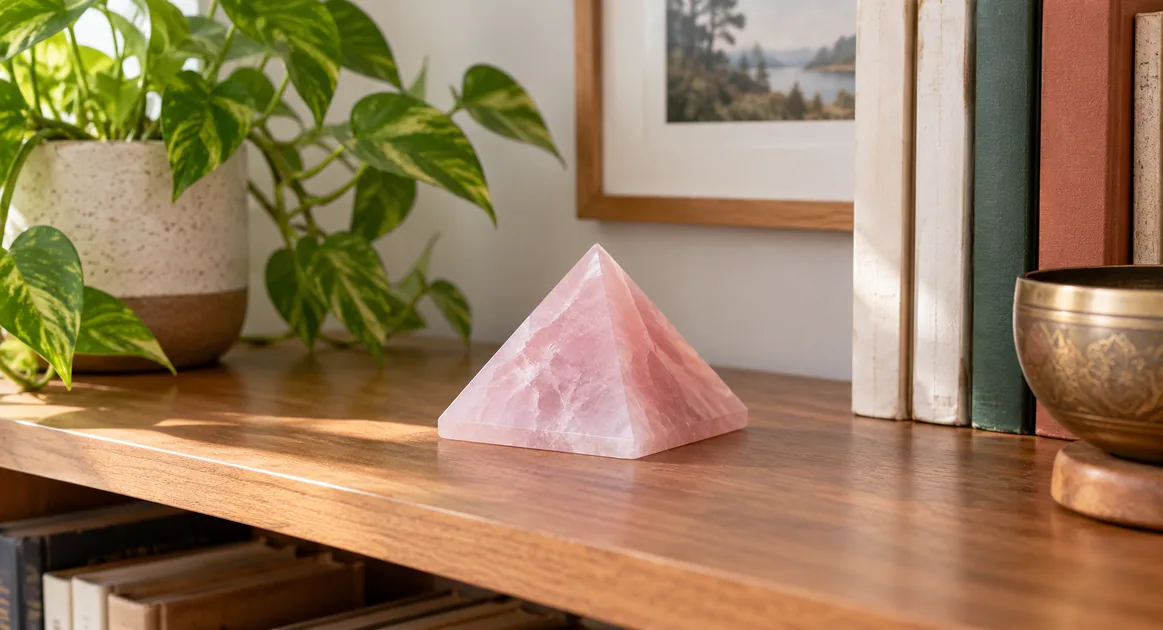
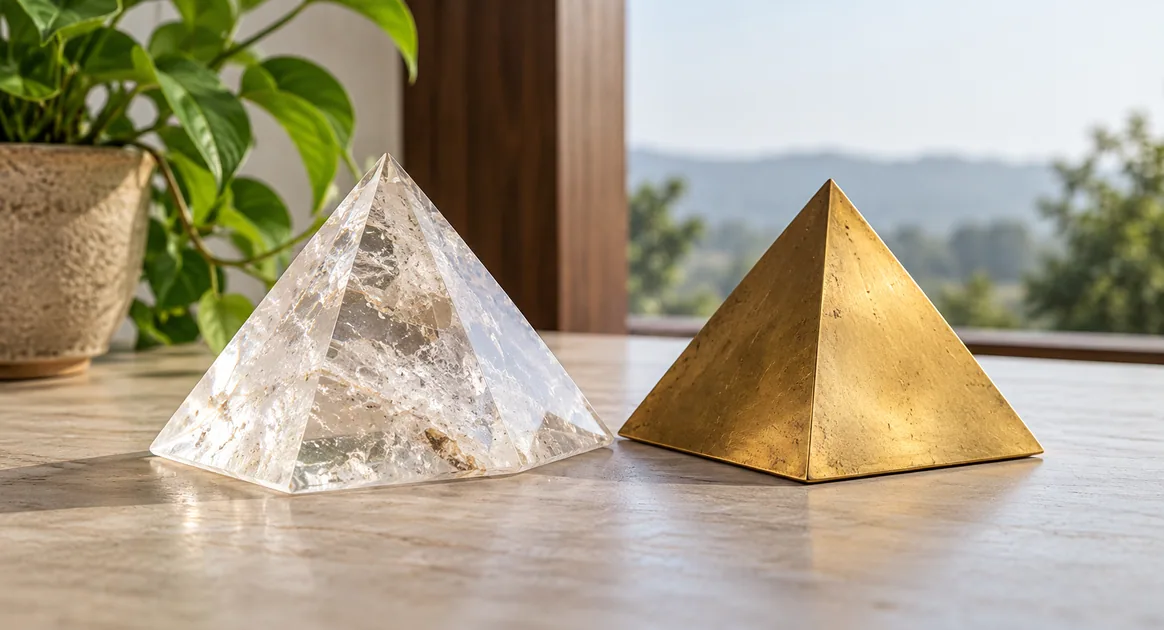
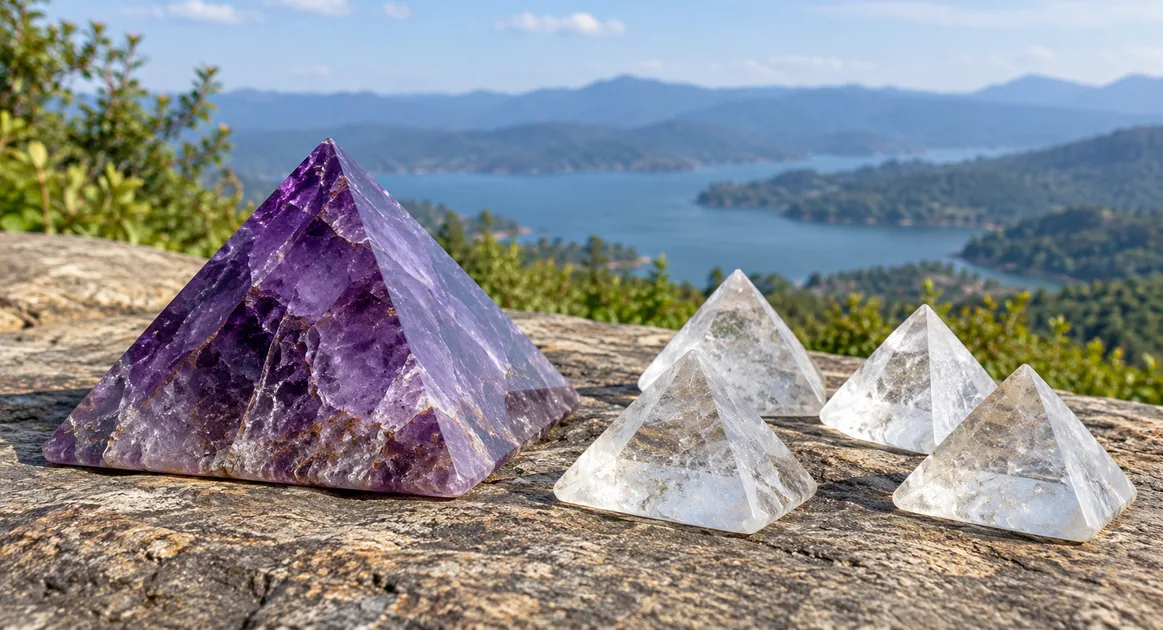
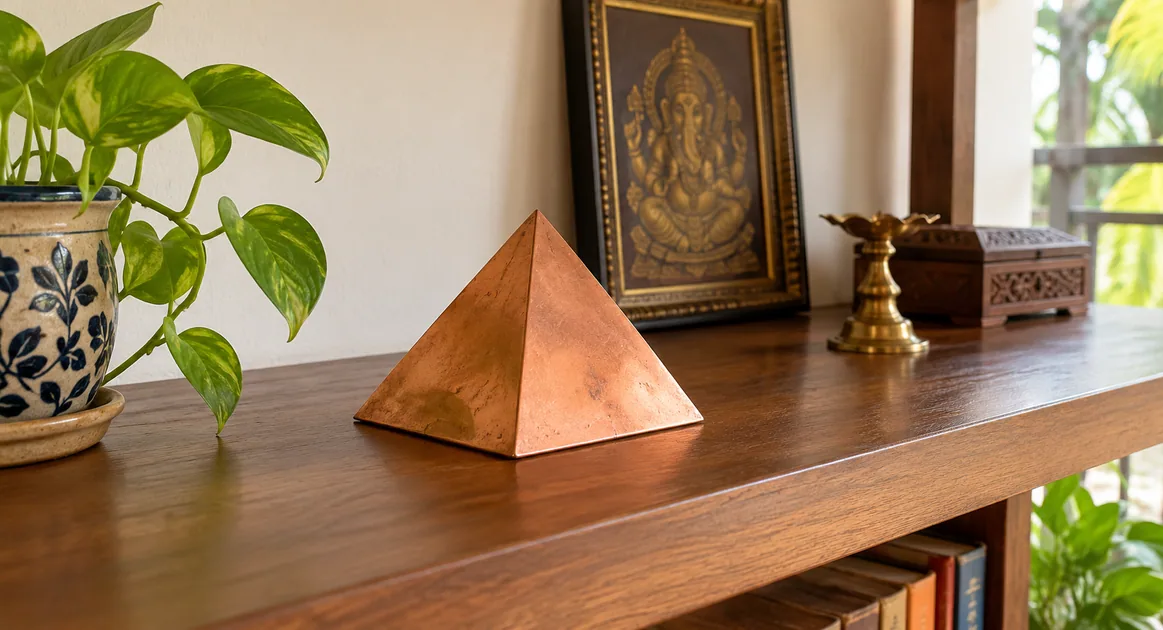
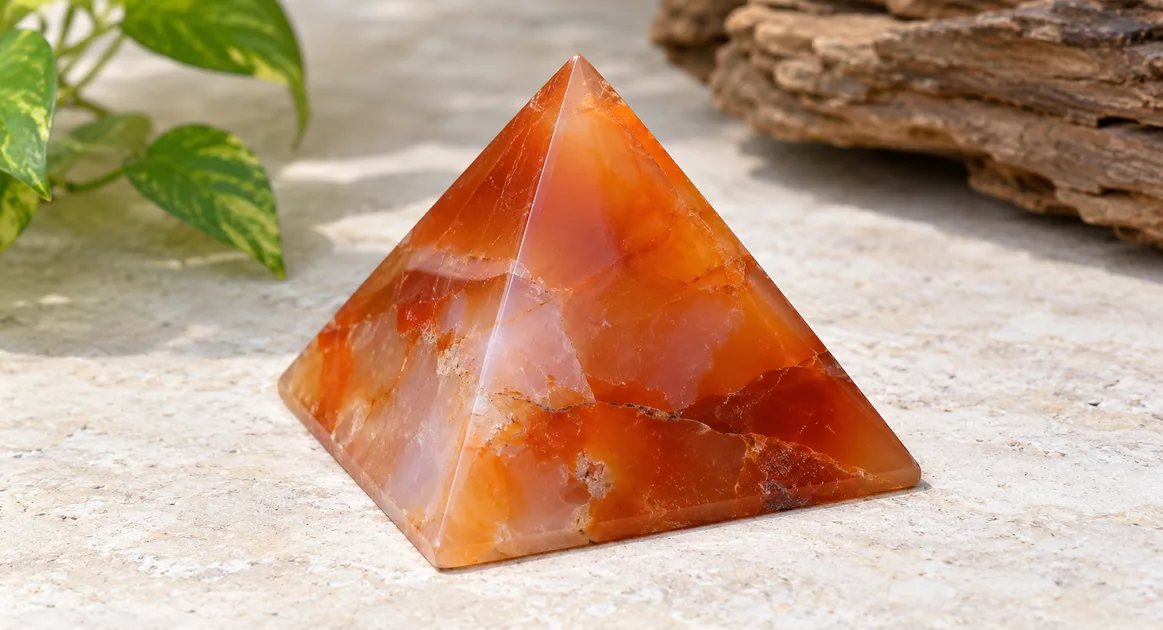
A carnelian pyramid combines a naturally patterned orange chalcedony stone with the deliberate geometry of a four-sided pyramid. Its visual appeal comes from translucency, warm colour, the play of light across carved faces, and the artisan's ability to form a balanced point and base. In an Indian spiritual setting, carnelian may be selected for utsaha (enthusiasm), resolve, disciplined activity or a daily sankalpa (intention). The material and the meaning should nevertheless be understood separately: carnelian is an established natural gemstone material with a long Indian craft history, while most crystal-pyramid placement conventions are modern applications of Vastu-inspired symbolism.
This guide explains what carnelian actually is, why some orange-red pieces have been heated or dyed, how to inspect a carved pyramid, how its associations differ from formal Navagraha gemstones, and how to choose a sensible display location for a home, workplace or professional Vastu collection. It also supplies a practical supplier checklist and worked examples so that a buyer can compare real pieces rather than relying on dramatic photographs or colour-based claims alone.
1. What is carnelian? Understanding orange chalcedony
Carnelian (also spelled cornelian) is an orange-to-reddish-brown variety of chalcedony, a fine-grained form of silica in the quartz family. Its chemical foundation is silicon dioxide (SiO2); its colour is associated with iron-bearing compounds. Carnelian may be yellow-orange, warm amber-orange, brick-red, rusty red or brownish red. It is commonly translucent at thin edges and less transparent toward the thicker middle of a carved pyramid.
Chalcedony is made of extremely fine intergrown quartz-family material, so it usually does not show the coarse sparkling crystals that a buyer might see in a drusy quartz geode. Its characteristic appearance is waxy to vitreous, sometimes with small pale clouds, curved bands or uneven colour. The Mohs hardness is approximately 6.5–7, useful for an everyday decorative carving but not immunity from chips, scratches, thermal shock or impact.
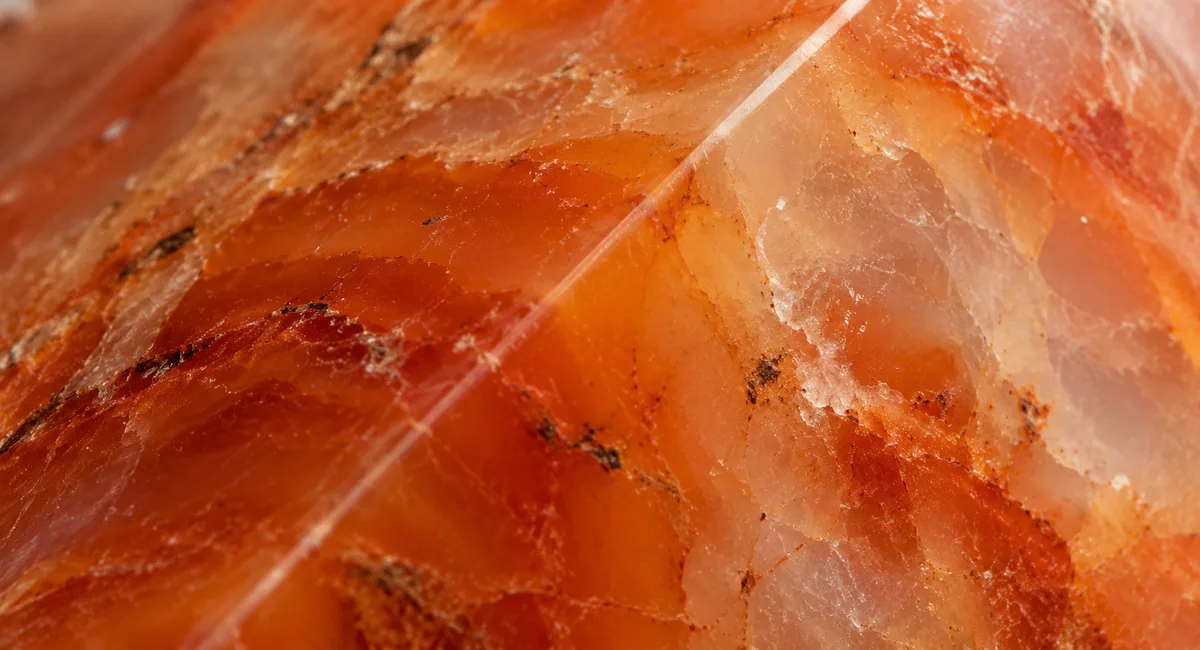
Thickness changes colour appearance. A pale, thin corner can glow orange when light passes through it, while the same stone's centre can look dark red-brown. Similarly, one face may have cloudy streaks and another may look almost uniform. These variations need not indicate a different gemstone. Examine the entire object in ordinary room lighting, diffused daylight and, if helpful, gentle edge backlighting.
| Property | Carnelian pyramid: what to expect | What the property cannot prove |
|---|---|---|
| Mineral family | Chalcedony / microcrystalline quartz (silica) | A red-orange appearance alone does not prove composition. |
| Typical colours | Orange, reddish-orange, red-brown; sometimes pale or cloudy | A more saturated colour does not prove untreated origin. |
| Translucency | Edges and thin sections may transmit more light | Backlit showroom photographs exaggerate apparent brightness. |
| Hardness | Around 6.5–7 Mohs for chalcedony | A high hardness does not protect a pointed tip from breakage. |
| Structure | Fine-grained material; possible clouds or bands | Natural-looking patterns cannot establish absence of dye or filling. |
| Carving | Square base, four sloping faces, central apex in typical form | The object may be one piece or bonded; look at the underside. |
2. Carnelian, red agate, sard and dyed orange stone: names that matter
Names in the gemstone trade often describe appearance rather than a strict boundary between mineral species. Carnelian, sard and agate all belong to the broad chalcedony family, but they are not automatically interchangeable product descriptions. Carnelian normally emphasises a warm orange-to-red appearance. Sard is often used for a deeper brownish-red chalcedony. Agate generally emphasises bands or layered patterning, and a carnelian-coloured agate can legitimately show both descriptions if the terminology is explained.
Some suppliers use phrases such as “red agate pyramid”, “orange agate pyramid”, “natural carnelian”, “sardonyx” or simply “red stone pyramid”. Those labels are not a reliable way to establish treatment or exact material. Sardonyx, for example, is a banded chalcedony form associated with sard-coloured and lighter layers, not merely any dark red stone. A seller should describe the visible body, banding, transparency and known treatment as separate facts.
| Trade name or appearance | Useful distinction | Supplier question |
|---|---|---|
| Carnelian | Orange or reddish-orange chalcedony | Is the colour known to be heated, dyed, or untreated? |
| Red agate | May be naturally banded chalcedony, sometimes colour enhanced | Are bands natural and has colour been introduced? |
| Sard | Often darker brownish-red chalcedony | What features justify the sard description? |
| Sardonyx | Layered sard-coloured and contrasting pale chalcedony | Can I see a normal-light image of the band structure? |
| Dyed orange chalcedony | Real chalcedony material with added dye | Is treatment disclosed on the product label? |
| Glass, resin or bonded imitation | Different construction despite similar colour | Is the pyramid solid chalcedony or another material? |
3. Why heat treatment and colour disclosure are central to carnelian
Many commercial carnelian stones have been heated. Heating can intensify orange and red tones in iron-bearing chalcedony; the effect is rooted in changes to the iron compounds that influence its colour. This has a long history in lapidary production. A heated carnelian carving can still be real carnelian made of real chalcedony. “Heated” describes treatment; it does not mean the base gemstone is synthetic.
Dyeing is a different matter: colourants are introduced into or onto a receptive material to alter its appearance. In some pieces, intense saturation near fissures, drill holes or irregular porous zones prompts closer scrutiny, but those visual clues are not conclusive. In a completed pyramid, its glossy finish, thickness and even colour may make treatment history difficult to infer by eye. There is no reliable consumer trick—such as shining a phone light through the apex—that can certify untreated colour. For a precise claim, ask for supplier provenance and appropriate professional testing or documentation, recognizing that even laboratory testing may not settle every historical heating question.
Natural gemstone, natural colour and untreated are three different assertions. A truthful description can say “natural chalcedony, heat-treated for colour” when that is established. If a supplier cannot substantiate treatment history, the product record can say “carnelian chalcedony; treatment status not confirmed” instead of declaring “100% untreated” on appearance alone. The source record and any disclosures should travel with the exact stock item, not just with the broad category.
| Seller statement | What it actually establishes | Better wording or action |
|---|---|---|
| “Natural carnelian” | May identify a naturally formed chalcedony substrate | Ask separately whether the colour was enhanced. |
| “No chemicals” | Does not demonstrate that the stone was never heated | Request the known treatment record. |
| “Deep red = best quality” | Colour preference, not a universal quality grade | Check colour with structure, polish, size and price. |
| “UV / flashlight proven natural” | Light transmission alone is not an authentication method | Use normal-light photos and evidence of material. |
| “Hand-carved from one stone” | Construction claim, if true, not a treatment claim | Verify seams, base and edge continuity. |
| “Certificate included” | Value depends on issuer, scope, methods and item match | Read what the certificate specifically confirms. |
4. The Indian carnelian tradition: beads, craft and the distinction from a pyramid
Carnelian has a substantial place in the history of South Asian stonework. Archaeological studies of the Indus or Harappan civilisation document carnelian beads, including long polished and decorated examples from sites such as Dholavira in Gujarat. The long-running lapidary tradition of Khambhat (Cambay) is also noted for working agate and carnelian. These are concrete historical connections between the material and Indian craftsmanship—not proof that a four-sided carnelian pyramid was a prescribed object in ancient Vastu texts.
Beads, seals, ornaments and polished stones have distinct historical purposes. A modern carnelian pyramid brings that familiar orange chalcedony into a contemporary display form. Its geometry may evoke upward movement, concentration and a defined central point; a sankalpa can give that arrangement personal ritual meaning. This can be meaningful without confusing three categories: the geological origin of carnelian, the archaeological history of carnelian craft, and contemporary crystal-pyramid practices.
The distinction also improves product descriptions. Rather than calling a new polished pyramid an “ancient Harappan Vastu remedy”, describe it as a modern gemstone pyramid carved from a material with a rich Indian lapidary heritage. A reader gets both cultural depth and an accurate understanding of the object.
5. Carnelian symbolism in Vastu, the five elements and personal intention
In modern Vastu-influenced gemstone arrangements, carnelian is commonly associated with activity, resolve, courage, enthusiasm and focused beginnings because of its warm orange-red appearance. A buyer may connect this with Agni Tattva—the fire element—and use the stone as a reminder of effort, discipline or kriya (purposeful action). The correspondence is symbolic and interpretive, not an automatic material-based rule for every home.
Pancha Mahabhuta refers to Prithvi (earth), Jala (water), Agni (fire), Vayu (air) and Akasha (space). Carnelian's actual composition is mineral silica; its colour can make it suitable as an Agni-themed accent in a five-element demonstration. It does not physically become the fire element or require a flame to be placed beside it. In a teaching kit, mark a stone as “orange chalcedony / modern Agni association” so historical and material facts remain clear.
Some contemporary chakra practices connect orange stones with Svadhishthana (the sacral chakra), and practitioners may choose carnelian for meditative reflection on creativity or self-directed action. That is a modern gemstone correspondence rather than evidence that every classical chakra text specifies a carnelian pyramid. The choice may be made within a person's own established practice and is not a substitute for precise Vastu or Jyotisha evaluation.
Navagraha distinction: In common Navaratna schemes, ruby is associated with Surya, red coral with Mangala, pearl with Chandra, and other named gems with their respective grahas. Carnelian is not a standard primary Navaratna replacement for ruby or red coral merely because it is red-orange. If a practitioner uses carnelian as a contemporary symbolic substitute or accompanying stone, that role should be explicitly identified rather than presenting it as a universal classical prescription.
| Traditional framework | Carnelian pyramid interpretation | Important distinction |
|---|---|---|
| Pancha Mahabhuta | Orange-red colour suggests an Agni-themed visual reminder | A colour association is not the physical nature of the stone. |
| Vastu Agneya / southeast | Contemporary display choice for initiative or activity | Avoid heat, grease and water near actual kitchen equipment. |
| East / Purva | A chosen location for a morning intention or study routine | Not a universal substitute for a full site orientation study. |
| Svadhishthana practice | Modern orange-stone association with creativity and intention | Not an item prescribed in every classical chakra system. |
| Navagraha / Jyotisha | Occasional personal or complementary symbolism | Not automatically ruby for Surya or coral for Mangala. |
| Sankalpa / sadhana | A small object used as a visual anchor for a chosen practice | The actual object remains a mineral carving. |
6. Inspect the carving: shape, faces, apex, base and joints
The visual attractiveness of a pyramid is only one part of its quality. The carving should have a stable base, reasonably consistent sloping faces and an apex that is neither dangerously needle-sharp nor badly chipped. Minor asymmetry may be expected in hand-finished natural stone, but an unstable or heavily filled piece needs disclosure. Measure the height and each side of the base rather than assuming the image represents an exact standard. When a listing says “50 mm pyramid,” confirm whether 50 mm refers to base width, vertical height, sloping length or a nominal product class.
Inspect the underside under ordinary lighting. A seam running through the material may be a natural band, a fracture filled with resin, or a join between separate pieces. The visual direction and texture of the line, the presence of a glossy adhesive zone and its continuity across edges can help frame questions—but photographs cannot conclusively settle the composition. Request an explicit statement whether the carving is a single chalcedony piece, assembled segments or a composite stone.
Check the edges without scratching the finish. Pale patches might be natural chalcedony variation; a surface-reaching fracture, loose material at the apex or an unfinished base is a different quality issue. Good sellers can show top, underside, all four faces and one oblique side view against a neutral background with an object scale. A bright red image under strong transmitted light is insufficient by itself.
| Inspection point | Good practical evidence | Question if something seems wrong |
|---|---|---|
| Apex | Point centred and free of major breaks | Is the point naturally blunt or chipped after carving? |
| Four faces | Smooth finish with visible colour and texture variation | Are deep pits, scratches or excessive filler present? |
| Base | Flat, stable and photographed from below | Is the underside uneven or bonded to another piece? |
| Seams and bands | Continuous mineral pattern or documented construction | Is a perfectly straight line a joint or a natural vein? |
| Colour | Images in diffuse daylight and normal indoor light | Has the stone been heated, dyed or coated? |
| Dimensions and weight | Individual item measured in mm and grams | Does the listing describe this actual piece or a sample? |
| Provenance | Meaningful seller statement, stock code and treatment record | Does a certificate cover composition only or treatment too? |
7. Vastu placement of a carnelian pyramid in a real room
A good arrangement begins with the purpose of the space and a reliable understanding of its directions. In a home, determine the room's broad orientation with a compass or accurate plan; do not assume the top of a photograph or the door-facing wall is north. A pyramidal object should be on a stable surface where it will not roll, fall or be exposed to food, detergent, cooking oil or steam.
Southeast (Agneya): In a contemporary five-element display, a carnelian pyramid may be selected for a stable shelf in the southeast part of a suitable room because its orange tone represents Agni or purposeful energy. This is not a reason to place it on a working stove, immediately beside a hot hob, or in a cramped electrical panel. The zone matters less than avoiding a physically unsuitable setting.
East (Purva): An east-facing desk or personal shelf can support a daily intention for study or project beginnings. Position the stone where it is visible during a short morning review, without creating clutter or glare near a computer screen. If east is occupied, a clear and clean desk in another location is preferable to forcing an inaccessible direction.
Professional workspace: A small pyramid on a reception table or consultant's material tray can serve as a labelled example of orange chalcedony. Customers should be able to examine the pattern and finish safely. A glass-covered shelf, rather than an exposed checkout edge, is usually preferable in a busy showroom. In a jewellery shop, treat a carnelian pyramid as one display element among correctly identified stones, not as a promised sales guarantee.
Prayer or meditation area: A carnelian pyramid may be included as a personal symbolic object, provided its placement respects the household's devotional arrangements. Do not assert that a mineral pyramid is a substitute for an established murti, mantra, yantra or the family's ritual practice. A short, calm sankalpa followed by regular purposeful action gives the object a clear role.
| Situation | Possible arrangement | Practical limit |
|---|---|---|
| Home study desk | Single small carnelian on clean corner of desk | Leave writing and screen space free; avoid direct knocks. |
| Southeast Vastu teaching shelf | Carnelian with an Agni label and compass diagram | Keep away from cooking flames, excessive heat and steam. |
| East morning intention | One pyramid beside a notebook and project goals | Location is secondary to consistent usable routine. |
| Jewellery showroom | Labelled sample with normal-light photo and item code | Do not put a fragile point on a crowded customer edge. |
| Professional consultation kit | Carnelian beside contrasting quartz and agate pieces | Separate modern symbolism from verified gem identity. |
| Pooja room | Optional personal symbolic stone on a stable side shelf | Respect the existing altar and avoid heat from diyas/incense. |
8. A worked example: a seven-piece stone comparison for a Vastu consultant
Suppose a consultant wants to explain carnelian without confusing it with red jasper, dyed agate or formal Jyotisha prescriptions. A useful seven-specimen training tray can be arranged with a clearly labelled centre and six comparative positions. The count below describes a teaching arrangement, not an ancient mandated Vastu diagram.
- Centre: one carnelian pyramid, photographed in ordinary daylight, with its dimensions and treatment status recorded.
- Upper left: a small natural-looking banded agate, to demonstrate the relation of chalcedony and visible bands.
- Upper right: a darker sard or sard-coloured chalcedony sample, with a note that trade boundaries overlap.
- Middle left: a red jasper specimen showing more opaque texture, for a contrast in appearance.
- Middle right: a distinctly labelled dyed agate sample, used to explain enhancement and truthful descriptions.
- Lower left: a clear quartz specimen to compare coarse transparency and typical quartz appearance.
- Lower right: a documented red coral illustration or sample card explaining Mangala's primary Navaratna stone, without claiming carnelian is its direct equivalent.
Put the physical stones in individual recesses, using photographs or printed cards for materials that are not actually in stock. Record the exact item count: one carnelian pyramid, five comparative physical stones if present, and one coral reference card. Do not label a card as a gemstone specimen. On a second sheet, show the southeast and east Vastu-inspired display options, clearly marked as contemporary interpretive placements.
For a product listing, the carnelian pyramid remains its own SKU. The teaching tray is not automatically a product bundle, and its individual comparison specimens must not be implied as free accessories. A consultant can show the entire tray during a session and then return each piece to its numbered pouch.
9. Worked home and showroom applications
Example A — Bangalore apartment with a compact work table
A resident has a 120 cm desk facing a wall with a laptop, lamp and papers. Rather than placing several stones in every zone, choose one modest carnelian pyramid and set it on a low, non-slip tray away from the lamp's hot bulb and the desk edge. Make a short sankalpa associated with completing the day's priority work, then record those priorities in a notebook. If the southeast corner is a wet sink area rather than a shelf, place the stone on a safe side of the desk instead of treating the direction mechanically.
Example B — Jewellery showroom displaying three orange-red materials
Display a carnelian pyramid beside a red jasper pyramid and a banded agate piece. Use separate labels: material, treatment status, approximate dimensions, weight and price. Photograph each in neutral light, then add a controlled backlit image only to explain translucency. A visitor can see that a darker red hue is not proof of rarity and that an orange stone need not be untreated. The result is a more credible display and more informed purchase.
Example C — Professional Vastu consultation with a direction chart
In a client meeting, begin with a floor plan and orientation rather than a bag of objects. Explain Agneya and its fire symbolism, describe carnelian's modern orange-stone association, then ask whether an accessible, protected shelf exists. If the chosen zone is cramped, damp or unsafe, recommend no physical carnelian object there. Use the stone as one possible symbolic accessory after the broader spatial decisions have been made.
10. Buying checklist: the questions to ask before paying
A photograph and a generic title are rarely enough for a carved pyramid. Use this checklist for retail or wholesale orders and ask the seller to identify whether photos refer to the exact piece or an assortment. For a mixed shipment, specify acceptable colour and dimension ranges rather than expecting every chalcedony piece to be identical.
| Ask the supplier | Acceptable evidence | Why it matters |
|---|---|---|
| What is the base material? | Carnelian/chalcedony identification appropriate to item | Prevents dyed glass or generic “red crystal” substitutions. |
| What colour treatment is known? | Heat/dye/coating stated or “not confirmed” | Keeps natural-stone origin separate from untreated claims. |
| One piece or composite? | Underside views, construction statement | Clarifies seam, adhesive or filler questions. |
| What are exact dimensions? | Base side, height, weight in mm and g | Makes it possible to compare items fairly. |
| Can I see all faces? | Diffuse-light images of four faces, apex, bottom | Reduces colour-lighting and flaw surprises. |
| How will it be packed? | Separately cushioned tip, protected base, box divider | Prevents transport chips and abrasion. |
| What happens if it is damaged? | Receiving procedure and documented return terms | Supports fair quality control for bulk orders. |
11. How to care for a carnelian pyramid
For ordinary shelf dust, begin with a soft, clean dry cloth or brush. If the identification and treatment history allow it, lightly wipe with a barely damp cloth and dry promptly. Avoid acidic cleaning mixtures, bleach, strong detergents, steam and ultrasonic equipment when the stone may have cracks, dye, fillers or unknown coatings. Do not soak a decorative pyramid to “energise” it merely because plain quartz can tolerate water; this exact object's treatment and construction matter.
Keep the object away from direct flame, sustained high heat and abrupt temperature changes. Carnelian may be heat-treated during production, but controlled workshop treatment is not a reason to heat a finished carving on a stove, in a hot oven or against a lit diya. The risk is to the stone, any treatment, the polish and the surrounding objects.
When storing multiple pyramids, wrap each separately in a non-abrasive pouch; position the apex away from neighbouring stones. Record size and weight on an external label so the stone need not be unpacked repeatedly. For a professional kit, photograph each piece before travel, and compare its apex and edges when it returns from a client session. Avoid leaving a polished point under heavy books or placing stones loose inside a bag.
A short ritual cleansing may be part of the owner's personal practice: tidying the display, using a spoken intention or suitable mantra, and returning the stone to a dedicated place. The physical cleaning method remains a separate decision based on actual material and treatment.
12. Common questions about carnelian pyramids
Does every carnelian pyramid have naturally red-orange colour?
No. Carnelian is a natural chalcedony material, but colour may have been improved by heat and, in some cases, dye. A naturally formed stone is not automatically untreated. Ask for known treatment history instead of using intensity as proof.
Is a pale patch proof that a pyramid is artificial?
Not by itself. Chalcedony can show cloudy or uneven colour, and different thicknesses change the transmitted-light appearance. A painted coating, adhesive join or surface-reaching break is a separate issue requiring inspection.
Is carnelian a replacement for red coral in Mangala remedies?
Not as a blanket Jyotisha rule. Red coral is the established Mangala stone in common Navaratna practice. Carnelian may be chosen for complementary personal symbolism, but substitution in an individual astrological recommendation depends on the practitioner and should not be asserted just from matching colour.
Should a carnelian pyramid always be in the southeast?
The southeast is one contemporary Vastu-inspired Agni association. The safest, cleanest and most purposeful accessible location may be elsewhere. Assess the actual room and household practice instead of treating a single fixed location as mandatory.
Does a larger or darker carnelian pyramid work better?
Size and saturation are measurable or visible characteristics, not a universal ranking of spiritual value. Choose a stable pyramid that fits its shelf, has reliable material disclosure and is well finished.
Can an orange pyramid be used near a diya or incense?
Place it away from direct flame, embers, oil and heat. A stone's symbolic association with Agni does not require actual thermal exposure.
What is the most useful photograph for online buying?
Use an ordinary daylight view, a close-up of the apex, two or more side views, a view of the underside and a scale reference. Edge backlighting can be informative but should be an additional photograph, not the only one.
13. A simple selection method
Begin by deciding whether you want a natural-stone decorative pyramid, a teaching specimen or an object for personal Vastu symbolism. Next confirm material and known treatment, examine actual colour in neutral light, compare construction and dimensions, and inspect the apex and base. Only after those checks consider where it will sit and which personal practice it will accompany.
For a first purchase, one clearly identified carnelian pyramid is more useful than a large anonymous set advertised with universal promises. For a professional kit, add a comparison sample of agate or jasper and a treatment-disclosure card. For a shop, give the customer factual identification and honest photographs alongside the stone's traditional and contemporary meanings. This keeps the beauty of orange chalcedony, India's long history of carnelian craft and present-day Vastu practice intelligible without conflating them.
Explore existing OmmRudraksha collections
Browse Vastu for the existing collection, or explore gemstone products for other material forms. Each product’s construction and care information should guide your choice.