A clay Vastu pyramid is best understood by its material, method of making and intended place of display. A reddish handmade pyramid may be air-dried earth, kiln-fired terracotta, high-fired ceramic, a pressed clay-and-binder mixture or even a cast composite with a clay-coloured finish. These objects can look almost identical in a product photograph but behave very differently when they meet moisture, dust, handling or a fall. For a devotional shelf, a home Vastu display or a professional consultation kit, knowing exactly what is being purchased is more useful than a generic label such as “mud pyramid.”
Clay has a longstanding role in Indian life: the earthen lamp, terracotta vessel, handmade image and ground itself connect craft with the Prithvi or earth element. A small square-based pyramid is a contemporary decorative and Vastu-market form, however; it should not be confused with a traditionally prescribed temple structure or an ancient earth-rectification instrument. This guide explains how a well-made clay pyramid can be chosen and displayed with respect for that symbolism, without confusing traditional cultural meaning with a modern manufactured product.
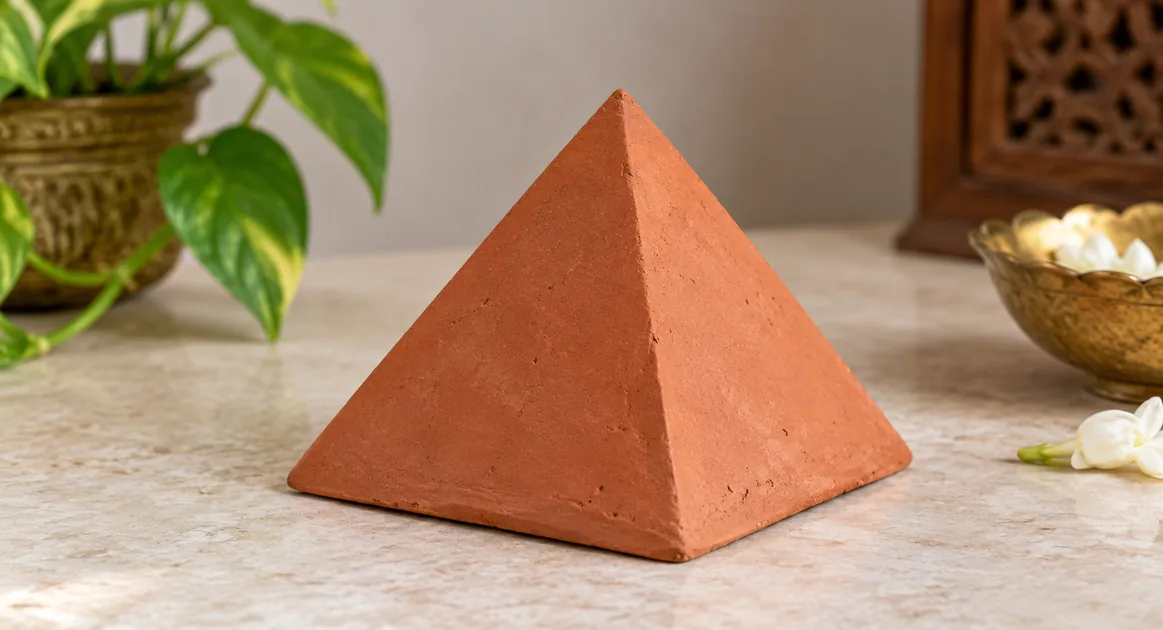
First identify the construction: fired, unfired or composite
“Natural clay,” “terracotta,” “mud,” “ceramic” and “earth pyramid” are not interchangeable technical descriptions. Natural clay is the starting raw material. Terracotta normally describes a low-fired earthenware body, often reddish because of iron-bearing minerals. A kiln changes clay irreversibly into ceramic through heat-driven mineral changes and particle bonding. A fully dried but unfired piece remains much more vulnerable to water. Some commercial pieces contain cement, plaster, resin or other binders that alter their strength and cleaning requirements.
| Construction | How it is made | What the buyer notices | Care approach |
|---|---|---|---|
| Air-dried / unfired clay | Moist clay shaped and dried without kiln firing | Can have an earthy matte texture; may shed loose particles at an edge | Dry interior display; avoid water and abrasion |
| Kiln-fired terracotta / earthenware | Clay fired sufficiently to make a ceramic body, generally still porous | Often warm red, ochre or buff; comparatively rigid, with handmade variations | Protect from impact and prolonged wetness; clean by material and finish |
| Higher-fired stoneware ceramic | Clay body fired to greater density and partial vitrification | Usually denser, harder and less absorbent than earthenware, though finishes vary | Can be robust, but check glaze, attachments and cracks before cleaning |
| Clay-and-binder / cold-cast mix | Clay or mineral filler held with an adhesive, cement or resin | May look like terracotta; often cast in repeated near-identical shapes | Follow binder and paint guidance; do not presume it is kiln-fired |
| Plaster or gypsum with earthy coating | Cast mineral body given a clay-like appearance | Painted surface may hide a white inner material at a chip | Very careful dry cleaning; avoid soaking and impact |
Colour is a clue, not a verdict. Dark terracotta can be genuine fired earthenware; pale clay can also be fired; a glossy surface can be glaze, lacquer or paint. A moulded base may be normal for a handmade craft item. When the seller does not know whether the piece entered a kiln, the accurate product description is simply “clay-look pyramid; construction to be confirmed,” not “kiln-fired natural terracotta.”
What firing changes inside a clay pyramid
Raw clay contains fine mineral particles and water. First, a maker shapes it by hand, slab construction, pressing or moulding. Controlled drying lets the water leave without excessive warping. Firing then heats the dry body: clay minerals undergo structural changes and particles join more firmly, producing ceramic. As the clay body and firing temperature vary, an object can remain porous or become substantially more vitrified. Even fired earthenware may absorb water. Firing does not automatically make it waterproof, weatherproof or safe for repeated washing.
Small pyramid shapes bring their own manufacturing challenges. The apex is thin and prone to chips, the four sloping sides must meet neatly, and the base should sit flat without rocking. An air-dried pyramid with a thick body may crack if its surface dries too fast while the centre remains moist; a kiln-fired piece can also develop cracks during drying or firing. Surface pigments, pressed motifs and added coatings introduce further materials that may not have the same durability as the clay body.
| Stage | Process | Common visible issue | Buying question |
|---|---|---|---|
| Clay preparation | Clay mixed, sieved and sometimes tempered with sand or grog | Unwanted coarse lumps or holes | What ingredients or fillers are present? |
| Forming | Hand modelling, moulding, pressing or slab joining | Uneven faces; seam lines; poorly joined corners | Hand-formed or mould-formed? |
| Drying | Slow moisture removal before optional firing | Warping; shrinkage cracks near the point | Is the piece fully dried? |
| Firing, if used | Heat converts dried clay to a ceramic body | Firing cracks; bloating; uneven coloration | Is it kiln-fired, and what clay body is used? |
| Surface finish | Natural bare clay, slip, glaze, paint or sealant | Flaking, runs, sticky coating or concealed repair | What is on the surface, and how is it cleaned? |
| Packing | Apex and edges protected for transport | Chipped tip or abrasion marks | Will this exact piece be packed separately? |
Terracotta versus unfired clay: how to inspect without damage
Inspection begins with the supplier's manufacturing details, not a home experiment. Request a photograph of the base, all four sides and the point, preferably in ordinary daylight. Ask for a close view of a natural uncoated patch, if one exists. For a premium or wholesale order, request a written statement of the body material, whether it was fired, the finish and care method. It is reasonable for a handmade workshop to know its firing process even if it does not provide a laboratory certificate for every piece.
Look at the condition of the actual item. A slightly irregular face is consistent with handmade craft; a deep open crack, spreading crumbly edge or point repaired with visibly loose adhesive is a different matter. Hold the object only by a broad supported area, not the tip. Check that the square base touches the surface evenly on all sides. Do not scratch it with a knife, soak it in water or drop it to “prove” it is fired; those destructive tests are neither necessary nor reliable for retail inspection.
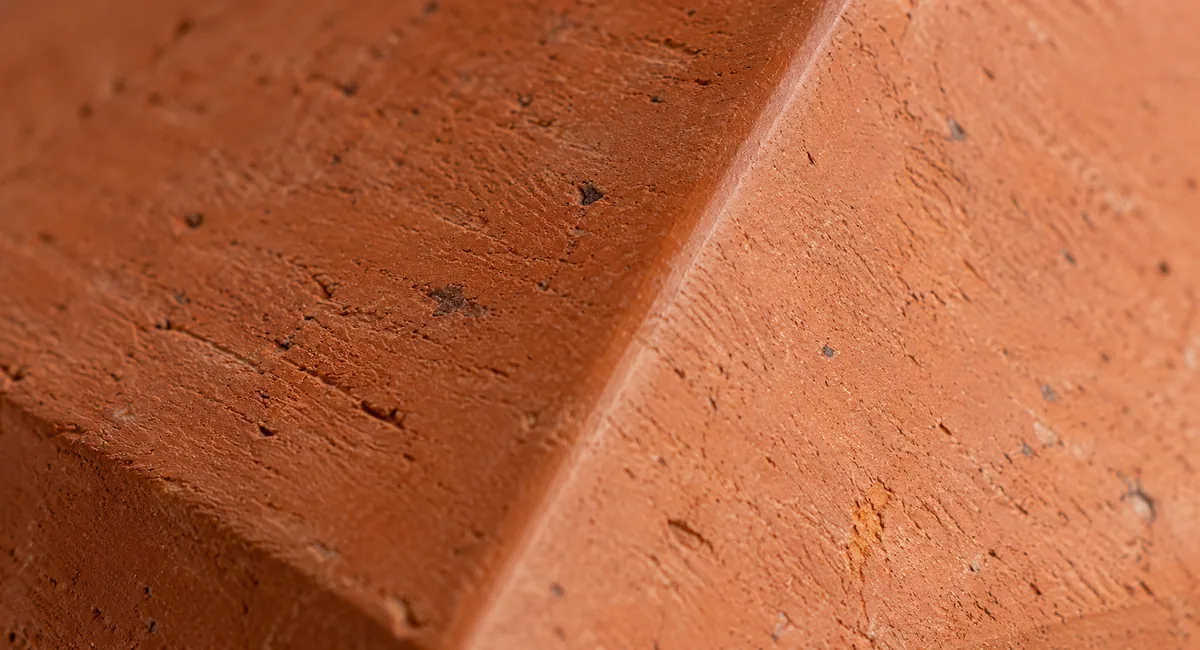
Five checks that separate good handmade character from a defect
| Inspection point | Acceptable handmade variation | Condition to clarify before purchase |
|---|---|---|
| Apex | Very slight natural rounding | Chipped, patched or crumbly tip |
| Faces | Subtle tool marks, hand-smoothing marks or colour variation | Long open cracks, soft powdering or flaking finish |
| Square base | Minor edge irregularity with a stable footprint | Rocking, sharp raised lumps or an unbonded base layer |
| Decorative coating | Intentional matte, wash or glaze with consistent adhesion | Sticky residue, peeling paint or unexplained artificial antiquing |
| Material description | Clear wording such as “unglazed, kiln-fired terracotta” | “Pure earth” used without knowing whether resin, plaster or binder was added |
Professional photographs should show the actual shape, not conceal the base or repeat a single stock image for every batch. Natural changes in the tone and small handmade measurements can be disclosed without creating a different product listing for every shade. A genuinely different composition or firing method, however, is meaningful product information.
Clay, Prithvi Tattva and the meaning of an earth-based object
In many Indian philosophical and ritual vocabularies, Prithvi is the earth element, associated with material solidity, support, fragrance and the tangible world. Earth, water, fire, air and space—the Pancha Mahabhuta—provide a symbolic framework that is often brought into Vastu discussions. Clay serves as a direct and familiar physical reminder of the earth element: the maker literally shapes earth into a chosen form.
There is also a recognizable living tradition of using clay in worship and everyday practice, including mitti diyas, terracotta vessels and earthen images made for particular festivals. These traditions make a clay ornament culturally intelligible. They do not establish a single scriptural rule that a square clay pyramid must sit at one compass bearing, or that the modern product can substitute for structural repair to a house. Its most useful role is as a chosen object of devotional attention, craftsmanship or an intentional arrangement.
Some contemporary Vastu advisers use earth-associated objects in the southwest, often discussed as a stable or grounding zone; others prefer an uncluttered northeastern prayer or meditation space. These are different placement logics. A southwest display can be selected for its earth association, while a prayer shelf can be chosen because that is where the household performs worship. Neither placement requires an invented “energy output” claim. Select the purpose and space first, then document the approach used.
Directions and spaces: where to display a clay pyramid
Direction is only one part of a good display. A porous clay piece should not be installed where it is splashed, steamed or exposed to damp soil. Whether a particular corner is suitable depends on its actual light, circulation, shelf stability and nearby activity. The table below combines common present-day Vastu associations with sensible physical placement decisions.
| Zone or location | Symbolic context used by some practitioners | Suitable display idea | What to avoid |
|---|---|---|---|
| Southwest | Earth, continuity or steadiness in contemporary directional schemes | One finished terracotta pyramid on a firm, dry cabinet or display niche | Floor-level corners with damp patches or repeated foot traffic |
| Northeast prayer space | Quiet contemplation, worship and uncluttered sacred space | Small handmade clay object beside a stable altar arrangement | Water offering runoff, diya flames, hot ash or crowded edges |
| East or north study shelf | Orderly attention and a thoughtfully arranged learning environment | Labelled example of Indian clay craft or earth-element symbolism | Sun-heated window ledge or accidental knocks from books |
| Shop or showroom | Presentation of a natural-material Vastu collection | Clear material label near other pyramid forms for comparison | Customer-handling zone without a protected stand |
| Consultation table | Teaching the difference between material, form and symbolic association | One fired and one unfired model in separate labelled positions | Carrying unwrapped pieces together in the same pouch |
| Garden, balcony or plant area | Outdoors can feel intuitively connected to the earth element | Only an explicitly outdoor-rated, weather-tested ceramic object | Unfired clay, uncertain coatings, rain, irrigation or pooling water |
A practical choice for a Bengaluru home during monsoon months is an elevated indoor shelf away from bathroom steam, kitchen washing and balcony rain. If the clay object is an unfired one, place it where regular mopping water will never reach it. Large or heavy pieces need a shelf capable of supporting them, and the sharp tip must not be within children's easy reach. For a shop, add a small card describing “kiln-fired terracotta,” “unfired clay,” or the verified construction to let customers see the difference.
How to use a clay pyramid in a Prithvi-element arrangement
A simple home arrangement can be meaningful without being complicated. Begin with a clean, dry, level surface and an unobtrusive mat or ceramic plate to protect furniture. Place one earth-coloured clay pyramid in the centre. Leave open space around the four sides so its shape is visible. A handwritten card can record the Sanskrit word Prithvi and the intention: steadiness, gratitude for the land or appreciation of traditional craft. Keep water vessels, soil-filled planters and oily lamps far enough away that spills cannot reach the object.
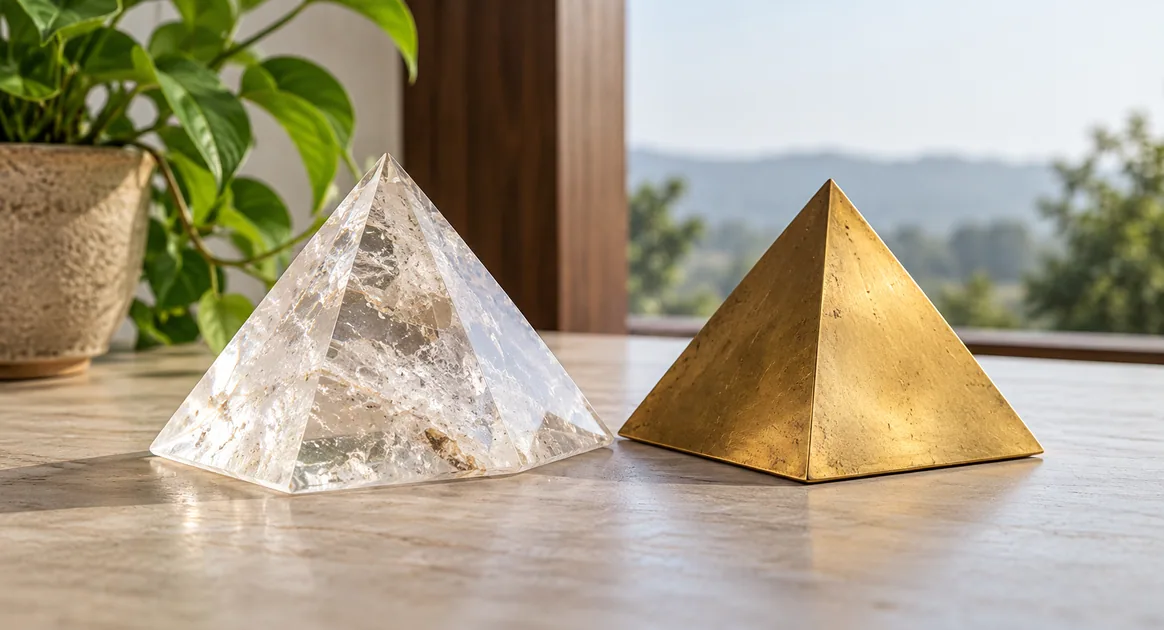
For a teaching display, position a fired terracotta pyramid beside a clear-quartz pyramid, a copper pyramid and a wood object. The point is not to say these objects emit interchangeable effects; it is to show the difference among earth-derived ceramic, crystalline mineral, worked metal and plant-derived material. Use labels describing each material's actual composition and making process. This helps a visitor connect a spiritual framework with real physical objects rather than choosing on colour alone.
Worked example: four-pyramid earth-material study tray
A professional Vastu consultant can build a small portable reference tray with four distinct specimens, each around a comfortably manageable display size. The sample below is a teaching comparison, not a mandated ritual set and not a substitute for the site's structural evaluation. Assign four separate padded positions and label them E1 through E4.
| Label | Specimen | What to explain | Handling priority |
|---|---|---|---|
| E1 | Unfired, air-dried clay pyramid | Natural earth body shaped without kiln conversion | Keep fully dry and separately cushioned |
| E2 | Unglazed kiln-fired terracotta pyramid | Fired ceramic with recognizable earthy colour and porous body | Protect point and avoid extended soaking |
| E3 | Glazed or sealed fired ceramic pyramid | Body construction and surface finish are two separate attributes | Check the coating for chips and cleaner compatibility |
| E4 | Documented clay-composite or resin-cast pyramid | Earth-coloured appearance need not mean the whole object is fired clay | Follow binder instructions; keep away from excess heat |
Place E1 and E2 at the back left and right, E3 and E4 at the front left and right. Record the exact product name, material declaration, size, net weight, source batch and condition for each. A consultant can then answer a customer's question by referring to the physical specimens: Why does one pyramid absorb moisture? Why is another glossy? Why does a third feel heavier? This is much more credible than declaring the four identical because they share a shape.
If a client wants the traditional earth association rather than a mineral collection, recommend the verified clay or terracotta form whose appearance and finish suit the location. If the client wants an item for an uncovered exterior wall, a deliberately manufactured outdoor ceramic with documented weather resistance is a different purchase decision. An indoor devotional object and an outdoor garden fixture should not share the same durability description.
Measure size, weight and stability before ordering
For a square-base pyramid, record the side length of the base, vertical height, approximate net weight and whether the base has felt, an inscription or an attached stand. These measurements are more useful than a catalogue term such as “small positive-energy pyramid.” A tall pointed pyramid can have more apparent height but a smaller footprint; the stable footprint matters on a narrow shelf. A solid and a hollow pyramid can have almost identical outside dimensions but very different weights.
When buying multiples, ask for a tolerable range instead of demanding impossible handmade uniformity. For example, a four-piece terracotta display might be specified as base width 55–65 mm, height 50–60 mm, with no open cracks and an intact apex. Those figures are an illustrative purchasing specification, not the measurements of any specific OmmRudraksha stock. If actual products are photographed together, the listing should state which measurements are typical and which are exact.
Clay versus stone, salt and metal pyramids
A clay pyramid is not a low-cost substitute for every other material. It has its own aesthetic and meaning as formed earth. A quartz pyramid shows visible crystalline material; a rock-salt pyramid is a soluble mineral body; a copper or brass pyramid is worked metal; and a cast resin piece may merely resemble terracotta. These distinctions affect everything from product naming to cleansing and placement. A product called “mud pyramid” should not be moved into a crystal category unless its material really is a crystal.
| Pyramid body | Key identity | Display quality | Care issue |
|---|---|---|---|
| Unfired clay | Dried earth, not kiln-converted ceramic | Natural, highly handmade appearance | Water and crumbling |
| Terracotta | Fired, generally porous earthenware | Warm earth tones and craft texture | Breakage, absorbed stains and coatings |
| Clear quartz / Sphatik | Crystalline silicon dioxide | Transparency and mineral inclusions | Point chips, scratches from harder contacts |
| Rock salt / halite | Sodium chloride mineral | Translucent salt-like appearance | Water solubility and humid conditions |
| Copper or brass | Worked metal or alloy | Metallic tone and fine surface finishing | Oxidation, fingerprints and polishing damage |
| Resin or composite | Binder-held cast material | Repeatable shapes and applied colour | Heat, coating and material-disclosure issues |
Cleaning and storing an unfinished or fired clay pyramid
When the construction is uncertain, start with dry cleaning. Set the object securely on a table, support the broad base and gently lift loose dust with a very soft clean brush. Do not scrub rough faces or repeatedly rub a powdering surface. A dry microfibre cloth can be appropriate for sound, smooth fired surfaces, but a brush is often better for deeply textured handmade clay. If pigment or a coating starts to lift, stop cleaning and address the material issue before using water.
Unfired clay should not be soaked, rinsed under a tap or washed with milk, oil or liquid ritual preparations. Porous earthenware can absorb moisture and dissolved salts even after firing. A fully glazed, stable ceramic item may allow different cleaning, but the seller's specific finish instructions should govern. Avoid vinegar, bleach, acids, abrasive powders, ultrasonic cleaning, hot water and sudden changes in temperature. The popular idea that every Vastu object must be regularly submerged is not suitable for material-sensitive clay.
| Condition noticed | What it can mean | Suitable next step |
|---|---|---|
| Loose surface dust | Normal exposure during shelf display | Gentle dry brush while supporting the base |
| Powder shedding at touch | Weak unfired body or deteriorating coating | Minimize handling; clarify material and condition |
| White crust or powdery bloom | Possible salts, surface residues or finish issue | Keep dry; avoid scrubbing; document the change |
| Hairline crack near apex | Drying, firing, impact or repair-related crack | Photograph and examine before display or sale |
| Dark wet-looking patch | Absorbed moisture, oil or stain | Remove nearby source of liquid; allow safe passive drying |
| Loose gilding or painted motif | Decoration not firmly adhered | Stop wet cleaning and friction; use protective display |
Store a clay pyramid in a dry, stable indoor environment, away from walls known to show seepage. Wrap it in clean soft tissue or place it in a padded, ventilated compartment rather than an airtight damp box. The apex needs clearance so it cannot hit the lid; heavy metal or stone pyramids should not be stacked over clay. For long-term storage in a humid season, periodically check that no condensation or damp packing material has developed.
Should clay pyramids be used with water, lamps or plants?
Clay's cultural association with diyas and earthen vessels sometimes causes confusion about a small clay pyramid. A diya is intentionally made for a flame, and a water vessel has its own appropriate shape and firing specification. A decorative pyramid is not automatically a diya, incense burner, planter or water-safe item. Keep a safe gap from a lit wick, hot charcoal, incense ash and oil. Do not place an unglazed, unidentified pyramid in a bowl of water or buried into wet potting soil to intensify an “earth connection.”
If a household wants a clay-based offering arrangement, put the pyramid on a separate dry stand and keep water and flowers in their own containers. This preserves the ritual arrangement while protecting the craft. For an outdoor courtyard or balcony, ask whether the product was made and tested for exposure; even strong ceramics may suffer from impact, wetting, defective glazes or attached coatings. An unverified handmade clay pyramid is best treated as an indoor decorative or contemplative item.
Quality and pricing: what actually changes the value?
Good handmade work has value beyond raw clay. The buyer may be paying for the maker's time, controlled firing, reliable symmetry, a hand-applied finish, carefully formed inscriptions or protective packing. But a description should make these features visible. A painted gold-looking outline is not metallic gold; a stamped sacred motif is different from a hand-incised one. A piece made in a mould can still be well crafted, provided it is sold with accurate material and manufacturing information.
For a wholesale order, specify acceptable dimensions, permitted colour variation, point integrity, absence of open structural cracks, whether a base pad is included and whether each object is packed separately. Record a reference sample and compare the delivered batch against it. The price comparison should be based on the product's actual construction and condition, not only the label “natural,” “energised,” or “handmade.” Any separate blessing or ritual service must be described only when actually performed.
Worked example: a Bengaluru Vastu showroom display
Imagine a shop counter with four pyramid materials: natural terracotta, clear quartz, copper and rock salt. A customer asks for a pyramid symbolising the earth element. First, the salesperson identifies the actual terracotta specimen as kiln-fired earthenware, shows the textured base and explains that it is intended for a dry interior shelf. They then compare the transparent mineral, metal and soluble salt specimen to show why each material has different care needs. The consultation becomes an informed choice rather than a promise that all four objects perform the same function.
On the product label, the counter card might read: “Handmade terracotta square pyramid — kiln-fired unglazed ceramic; natural tone variations; dry indoor decorative use; handle by base.” Only use that wording when the batch really is verified. The staff can add the buyer's preferred symbolic placement separately, for example: “For an earth-themed southwest display or an indoor prayer shelf, depending on the family's practice.” Keep material fact, workmanship and symbolic purpose as three distinct fields.
Worked example: home placement and a simple maintenance routine
A family chooses a small unglazed terracotta pyramid for a raised cabinet in the southwest of the living area. The cabinet is away from a damp exterior corner; the object rests on a wooden tray with soft padding beneath the base. Every fortnight, the family removes loose dust with a soft brush while holding the broad side. During monsoon months, they check the shelf and nearby wall for moisture before returning the object. If they move the display to the puja area during a festival, it sits away from open flames and containers of liquid.
This example illustrates a modest, repeatable approach: a chosen symbol, a documented location and care appropriate to its material. It does not require adding nine different directions, replacing a structural engineer, applying strong chemicals or conducting an elaborate cleansing routine that damages the clay. The same approach works for a single clay pyramid offered as a gift: a short handwritten explanation can carry more value than exaggerated performance claims.
FAQ: clay pyramid material, placement and care
Is a terracotta pyramid the same as an unfired mud pyramid?
No. Terracotta ordinarily refers to clay that has been fired to produce an earthenware ceramic. An unfired piece is dried but has not undergone that transformation. Surface colour alone cannot confirm the difference.
Does kiln firing make a terracotta pyramid waterproof?
No. Many low-fired earthenware bodies remain porous. A sound glaze may reduce water entry across covered surfaces, but chips and exposed bases can still absorb water. The safest rule for an unverified item is dry indoor display.
Which Vastu direction is best for an earth-material pyramid?
Some contemporary Vastu systems associate the southwest with the earth element and stability. A household may also choose its established prayer or study shelf. The actual room, moisture exposure and devotional tradition should guide the placement rather than a universal claim for every building.
Can a clay pyramid be kept in the garden?
Only when the manufacturer confirms that the specific material, firing and finish are intended for outdoor exposure. Unfired or uncertain clay pieces should be protected from rain, irrigation and wet soil.
Do all handmade irregularities mean poor quality?
No. Slight colour and surface variations are normal in handmade craft. Structural cracks, unstable bases, fragile tips, crumbling bodies and peeling finishes are separate quality issues that should be disclosed.
Is a clay pyramid a gemstone or a Navaratna item?
No. A fired clay ornament is ceramic, not a natural gemstone crystal. It may be used in a modern Vastu display, but its material does not make it one of the classical Navaratna gemstones used in Jyotisha.
What should a complete product listing say?
The material and whether it is fired, base dimensions, height, approximate weight, handmade or moulded construction, coating or glaze, colour, actual included components and care instructions. These details help a buyer choose the right object for the right environment.
Explore existing OmmRudraksha collections
Browse Vastu for the existing collection, or explore gemstone products for other material forms. Each product’s construction and care information should guide your choice.