What can you actually make with a 25-stone crystal grid kit? More than one attractive photograph. With thirteen Sphatik (clear quartz) tumbles, six amethyst tumbles and six rose quartz tumbles, you can build a complete circular grid, a five-by-five square grid and several purposeful variations without buying extra points, towers or wands. The difference between a helpful kit and a vague collection is knowing what each stone represents, where it belongs, how the pattern is counted and how the arrangement relates to your intention.
In crystal practice, a grid is an intentional arrangement of stones in a geometric pattern. The centre expresses the primary Sankalpa (intention); the inner and outer positions develop that theme. Clear quartz is often chosen for clarity and unity of purpose, amethyst for contemplation and disciplined awareness, and rose quartz for compassion, affection and relationship harmony. Their roles here come from contemporary crystal and spiritual practice. An Indian household may combine an arrangement with puja, meditation and selected Vastu placement customs, but a modern crystal grid is not automatically the same thing as a traditionally consecrated Yantra.
This guide works from a fixed, auditable 25-tumble example, supplies exact two-layout plans, explores how geometry is used symbolically, and shows how to use the kit in a home, shop, meditation room or teaching session. The inventory is illustrative of a proposed kit; confirm the contents of any particular product listing before ordering.
1. First understand the three gemstones
A crystal grid is easier to interpret when the stones are chosen for complementary meanings instead of arbitrary colour. These are the three varieties in our example:
| Stone | Traditional / contemporary spiritual association | Role in the 25-stone layouts | Useful intention |
|---|---|---|---|
| Sphatik / clear quartz (13 pieces) | Clarity, purity, focused prayer, unity of intention; Sphatik also appears in Indian worship and Japa traditions | One centre plus twelve outer positions in the circle; structural cross and corners in the square | Clarity before study, meditation or a new project |
| Amethyst (6 pieces) | Reflective awareness, restraint, spiritual contemplation and mental composure in contemporary crystal traditions | Six positions in the inner circle or six unfilled cells of the square | Quiet study, reflective decision-making or a calm prayer routine |
| Rose quartz (6 pieces) | Affection, kindness, reconciliation, heart-centred intentions and relationship harmony in contemporary crystal traditions | Six alternate positions in the inner circle or the other six square cells | Family harmony, patient communication or gratitude practice |
Do not confuse the names of the mineral varieties with special shapes. All twenty-five pieces in this example are tumbled stones. A tall central quartz point, a metal Sri Yantra, a crystal wand and a wooden grid board may be used in other arrangements, but they are not counted as included here. An article that shows a wand without stating it is optional can mislead the reader about what the kit contains.
2. What should come inside a complete kit?
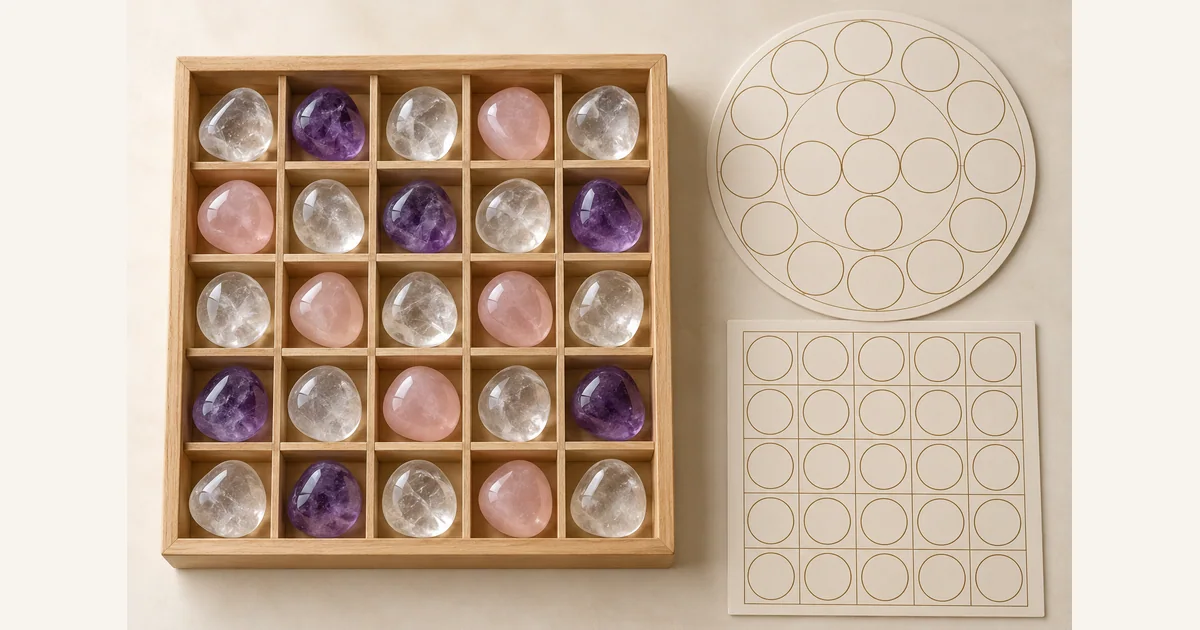
For the sample arrangement, the working inventory is 25 tumbled stones, two reference layout mats and a 25-cell storage case. The two mats provide different geometries, while the stones remain interchangeable. Useful extras are a printed inventory card, a compact explanation of stone meanings, and a care card. Packaging is not a substitute for confirming actual product specifications: list the number of pieces, approximate size band, acceptable natural colour variation and whether stones are natural, dyed or otherwise treated where known.
| Component | Quantity | Reason it matters |
|---|---|---|
| Clear quartz / Sphatik tumbles | 13 | Central focus and outer ring; also fills the cross and corners on the square mat |
| Amethyst tumbles | 6 | Inner ring and contemplative colour theme |
| Rose quartz tumbles | 6 | Inner ring and harmony-oriented theme |
| Circle layout mat | 1 | Printed centre, 12 inner positions and 12 outer positions |
| Five-by-five square mat | 1 | Twenty-five clearly numbered places; useful for comparison and teaching |
| Padded 25-cell case and inventory card | 1 each | Storage, stock verification and replacing a missing stone |
A new buyer can count the pieces immediately: 13 + 6 + 6 = 25. The minimum photograph set should show an overhead picture of the entire counted inventory and a separate close-up of the laid-out grid. Keep any candles, lamps, flowers, deity images or extra specimens labelled as setting props unless they are part of the actual listing.
3. Arrangement A: complete 25-stone circular intention grid
This is the simplest complete spiritual layout for the kit. It has three bands: one quartz at the centre, twelve alternating amethyst and rose quartz stones in the inner ring, and twelve quartz stones in the outer ring. It is symmetrical, easy to verify, and can be rebuilt after cleaning or storage.
- Prepare the surface. Put the circular mat on a stable table, shelf or low altar. If the space is used for puja or meditation, first clean it and remove unrelated clutter.
- Place C01 at the centre. Choose one clear quartz tumble as the focal stone. The centre represents the Sankalpa, for example: “May my speech and actions at home be patient and considerate.”
- Place the inner twelve stones clockwise. Starting at the top (12 o'clock), put A01, R01, A02, R02 and continue alternating until A06 and R06 complete the ring.
- Build the outer circle. Place the other twelve quartz pieces Q01 through Q12 around the inner ring at approximately equal intervals. Check the outer ring contains twelve pieces, not thirteen.
- Review the intention. The clear centre can represent focused awareness, amethyst mindful restraint, and rose quartz warmth in relationships. A short period of Japa, silent reflection or gratitude may accompany the layout according to the family's practice.
- Keep a photograph or diagram. Capture the complete twenty-five-stone arrangement so it can be restored correctly when the mat is moved.
Count check: centre quartz 1 + inner ring 12 (six amethyst, six rose quartz) + outer quartz 12 = 25. There are no leftover stones and no extra materials are required. If you prefer to position a clear quartz wand near the grid while setting the intention, call it an optional accessory; this layout does not depend on one.
Why use the circle? Circles and concentric arrangements are widely used as symbols of continuity and wholeness. In a crystal practice, repeating pairs encourages the practitioner to return to a chosen theme. The geometry gives the ritual an intelligible sequence: centre, inner qualities and wider expression.
4. Arrangement B: five-by-five grid with a quartz cross and corners
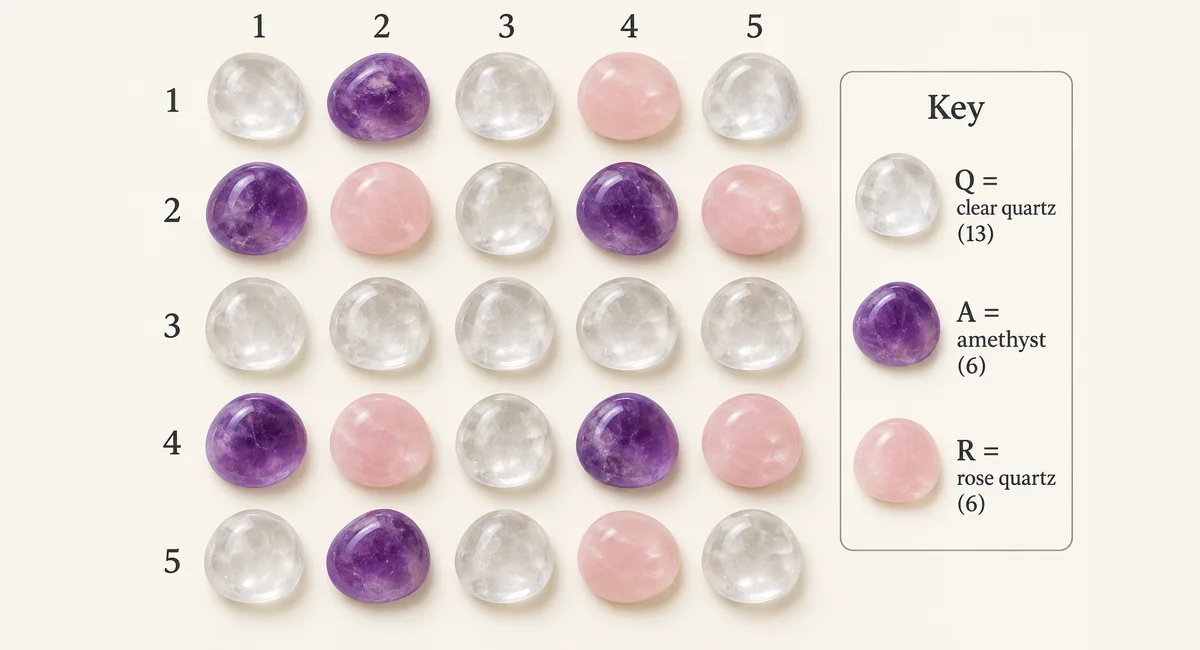
The second layout deliberately uses exactly the same twenty-five stones, this time arranged in five rows and five columns. Put quartz across the entire central row and central column: this uses nine quartz pieces because the centre cell belongs to both. Add clear quartz at all four corners: the quartz total becomes thirteen. The other twelve positions receive six amethyst and six rose quartz pieces.
The plan below is an overhead reference with the top row marked North merely for orientation on the teaching mat. It is not a compulsory Vastu remedy for every house.
| Five-by-five grid · top is North ↑ (Q = Quartz, A = Amethyst, R = Rose quartz) | ||||
|---|---|---|---|---|
| Q R1C1 | A R1C2 | Q R1C3 | R R1C4 | Q R1C5 |
| A R2C1 | R R2C2 | Q R2C3 | A R2C4 | R R2C5 |
| Q R3C1 | Q R3C2 | Q R3C3 | Q R3C4 | Q R3C5 |
| A R4C1 | R R4C2 | Q R4C3 | A R4C4 | R R4C5 |
| Q R5C1 | A R5C2 | Q R5C3 | R R5C4 | Q R5C5 |
The readable cell codes R1C1 through R5C5 identify row and column, not Rashi or crystal grade. For example, R3C3 is the centre quartz. There are thirteen Q cells, six A cells and six R cells. A printed square mat can use colour and printed letters, but an inventory card should also spell out the actual stones so customers are not forced to identify them by colour alone.
How to assemble: Lay the thirteen quartz stones into the middle row, middle column and four corners; fill the remaining twelve cells with alternating amethyst and rose quartz as shown. Photograph the finished square, then compare it with the circle. Both use the same symbolism but change how attention moves through the design: concentric circles emphasize a central theme and widening influence; the cross emphasizes a centre with four extending directions and grounded corners.
Do not tell a customer that a five-by-five gemstone square is the same as a classical Vastu Purusha Mandala. They may look alike because they are grids. A Vastu Mandala has its own directional, deity and planning framework, while this is a modern crystal layout. A knowledgeable article can explain the similarities of geometric organisation without erasing the different traditions.
5. Sacred geometry, Mandala and Yantra: what connects them?
The words Yantra, Mandala and crystal grid are sometimes used together, but they do not mean exactly the same thing. A Yantra is a structured sacred diagram whose form, deity associations, mantra and worship method belong to particular spiritual traditions. The Sri Yantra, for instance, has a specific interlocking-triangle design centred on a Bindu, not merely a pleasing arrangement of quartz tumbles. A Mandala broadly organises meaning around a centre, with forms varying across Hindu and Buddhist practices. A modern crystal grid applies an intentional geometric arrangement of selected stones.
| Form | What is distinctive | How it relates to this kit |
|---|---|---|
| Crystal grid | Stones intentionally placed in a repeatable pattern, commonly with a stated focus or Sankalpa | Exactly what the 25-stone example demonstrates |
| Mandala | A structured symbolic diagram often organised around a centre, with tradition-specific detail | Helps explain why centring and symmetry are meaningful to some practitioners |
| Yantra | A specific sacred diagram, sometimes linked to a deity, mantra, ritual and prescribed proportions | A separate object or practice; not automatically created by scattering stones |
| Vastu Purusha Mandala | Directional and spatial planning framework for a site or building | Useful context for discussing location; not interchangeable with the square tumble layout |
A practical question is whether to place the stones on a Flower of Life, Seed of Life, Sri Yantra or plain circle mat. For this example, a plain numbered circle or square mat is sufficient and lets every stone position be verified. A sacred-geometry mat may be chosen for additional symbolism, but the printed dots must match the actual twenty-five positions. Do not describe an arbitrary flower pattern as if it automatically has twenty-five correctly spaced places.
6. Choosing an intention: three complete examples
The intention should be specific enough to guide the choice of stones and a corresponding daily action. A word like “success” is too broad to help someone reflect. Consider these examples.
Example 1 — Family communication and harmony
A family wants a peaceful routine after recurring disagreements. They set up the circular grid on a clean shelf used for evening reflection. The central Sphatik expresses an intention to speak clearly; six amethysts represent pausing before reacting; six rose quartz stones represent kindness and reconciliation; the outer quartz circle reflects the wish to bring these qualities into daily household life. Their Sankalpa might be: “We will listen fully before responding, and begin each evening conversation respectfully.”
The grid remains in a safe place. Family members can revisit the intention for a few quiet minutes, and take an ordinary practical step such as putting mobile phones away during a shared meal. The spiritual symbolism is connected to actual conduct rather than left as an unexplained display.
Example 2 — Meditation or study corner
A student with a small study space uses the five-by-five square as an orderly focal layout. The quartz cross signifies clarity and continuity, while amethyst represents discipline and reflective concentration; rose quartz is used to cultivate patience toward oneself during long preparation periods. Before studying, the student states a simple Sankalpa, begins with a short breath or mantra practice according to personal custom, and starts the scheduled work session.
In Vastu-inspired placement, a home with a suitable Ishanya (North-East) prayer or meditation area may use that zone for contemplative practices. The square mat can sit there if the spot is clean, stable and appropriate for the household; it need not be forced into the North-East corner of every individual room regardless of the home's overall orientation.
Example 3 — Jewellery showroom or counselling desk
A Bengaluru jewellery or spiritual-products showroom uses the circle to explain what customers are actually purchasing. The staff member begins with the inventory card: thirteen quartz, six amethyst, six rose quartz. The shopper chooses a theme such as considerate customer communication, steady business decisions or calm discussion during consultations. Staff demonstrate one arrangement, then rebuild the five-by-five pattern using the same counted pieces.
This makes the kit educational as well as spiritual. It illustrates stone symbolism, the role of Sankalpa, kit completeness and respectful placement. It also lets customers compare a crystal grid with a Vastu collection item, a single gemstone, or a traditional Yantra without confusing the different products. A business owner interested specifically in directional Vastu may instead ask for a professional eight-direction set.
7. How Vastu placement influences a crystal-grid practice
Although a crystal grid can be arranged for a spiritual purpose without assigning each pebble to a separate compass sector, its location within the home or workplace may carry Vastu meaning. A crystal grid is best approached as a whole arrangement placed in one suitable area; moving each of its twenty-five stones to unrelated corners would destroy the pattern.
| Area or purpose | Traditional theme | How the 25-stone kit may be used |
|---|---|---|
| North-East / Ishanya | Prayer, reflection, clarity and spiritual practice | Contemplative quartz-and-amethyst grid on a clean shelf or altar, if appropriate to the home layout |
| North / Uttara | Resources, stewardship and the Kubera association | A decision-making Sankalpa near a workplace reflection spot; use the whole grid as one object |
| South-West / Nairritya | Grounding, steadiness and household relationships | Relationship-harmony Sankalpa using the rose-quartz symbolism, where a stable shelf is available |
| Home puja or meditation area | Devotion, concentration and reverent care | Use only when the grid does not obstruct existing puja items, flowers, lamps or daily worship |
For a property-specific Vastu decision, first identify the site's directions and its functional zones. A diagram on an instruction mat is not a substitute for the actual floor plan. Directional crystal prescriptions also differ among contemporary practitioners; explain which system you are using rather than silently changing the kit's meaning from one page to the next.
8. Sankalpa, mantra and a simple practice sequence
A person may use the stones as part of a quiet personal routine or integrate them into an existing family practice. The following is a simple example, not a mandatory initiation or a substitute for formal deity-specific Yantra worship.
- Shuddhi: Clean the mat and place the stones on a dry, stable surface. Wash hands if that is part of your household custom. Avoid wetting delicate or unknown stones.
- Sankalpa: State one positive, specific intention in your own language. An example: “May my home be guided by patience, clarity and kind speech.”
- Arrangement: Use the printed sequence for either the 25-stone circle or five-by-five square. Count the stones before proceeding.
- Japa or silent reflection: If you already practise an appropriate mantra or daily prayer, continue it with respect to that tradition; otherwise sit quietly and reflect on the intention. A fixed mantra is not required merely because stones form a grid.
- Daily action: Choose one practical behaviour linked to the Sankalpa—for instance, a family conversation, focused study session or thoughtful business decision.
- Closure: When the session ends, leave the grid securely placed or return stones to their labelled cells. Record the arrangement and date if using the kit for teaching.
Some contemporary crystal practitioners describe “activating” a grid by tracing lines with a quartz point or hand. If you use this convention, it is a symbolic focus exercise. No additional wand is required for the two layouts described here, and no separate ritual object should be represented as included unless supplied.
9. Materials, authenticity and maintenance
Gemstones used for spiritual purposes still deserve accurate material descriptions. Quartz and amethyst are both varieties of the mineral quartz; rose quartz is the familiar pink quartz variety. Natural pieces may vary in hue, inclusions, opacity, cut and polish. The correct label identifies the stone, not simply its preferred intention. A bright purple dyed agate is not amethyst merely because it fits the purple position on a mat.
- Inventory: Recount all 25 stones after demonstrations. Keep a cell-by-cell storage card and note replacements.
- Light: Avoid prolonged harsh direct sunlight, particularly for amethyst, whose colour may fade with extended exposure.
- Moisture: Wipe polished stones with a soft, slightly damp cloth when suitable and dry them. Keep printed paper mats, labels and padded inserts dry.
- Heat and flame: If the grid sits near a diya or incense, leave a safe distance from flames, hot surfaces and wax or oil spills.
- Handling: Small tumbles can be choking hazards for young children; store the kit out of their reach.
- Record keeping: If a centre stone is replaced, update the inventory photo so an assistant or purchaser can reproduce the same grid.
10. Common questions about crystal grid kits
Can the same 25 stones be used for more than one intention?
Yes. The circular and square layouts above use the same three gemstone varieties. What changes is the Sankalpa, interpretation and geometry. If a different intention specifically calls for citrine, green aventurine, carnelian or another stone in your chosen tradition, that is a different recipe requiring a different inventory.
Is an expensive centre tower compulsory?
No. A single clear quartz tumble at the centre makes the circular layout complete. A tower or point may be visually and spiritually meaningful in some contemporary practices, but it is not included in this counted example.
Is a crystal grid the same as a Sri Yantra?
No. Sri Yantra has its own sacred geometry and worship traditions. A modern set of tumbled stones may borrow the ideas of centring, repetition or geometry, but it should not be sold as an equivalent of a consecrated Sri Yantra.
Which design is better for beginners?
The circular design is easier to build and explain: one centre, twelve in the inner ring, twelve in the outer ring. The five-by-five square is excellent for training because it makes the count visible and encourages exact placement.
Can the grid be placed on a work desk?
Yes, if it is stable, does not interfere with work and suits the owner's spiritual practice. For business-focused Vastu work, the precise site orientation should be assessed rather than assumed from the direction a person happens to face while sitting.
How is a crystal grid different from a Navagraha or chakra set?
A Navagraha reference set is normally organised around the nine Grahas and their gemstone correspondences. A seven-chakra set uses a different seven-centre symbolism. The 25-stone quartz/amethyst/rose-quartz kit is defined by its intentional geometric layouts, not by the count of planets or chakras. Different sets should therefore have separate identification cards and instructions.
11. Choosing the right kit: quick buyer checklist
Before selecting a grid for personal practice or as a professional teaching product, check that the product page answers these practical questions:
- Are the exact quantities of each named gemstone stated?
- Do the photographed layouts use only the included stones, or are optional props clearly marked?
- Are the mats labelled with all twenty-five positions and a correct counting key?
- Does the product state the stone size band and whether natural variations or treatments are present?
- Is there a clear card explaining the meanings of Sphatik, amethyst and rose quartz?
- Are the intended spiritual practice and any Vastu location suggestions explained coherently?
- Can each piece be returned to a specific cell and replaced if missing?
In summary: this 25-stone example is most useful when spiritual meaning and practical accuracy support each other. A clear Sankalpa explains why the arrangement is made; correct stone identities explain what is being used; an exact numbered layout explains how to reproduce it; and suitable placement explains where the practice belongs in daily life. That is what makes a crystal grid kit worthy of repeated use, not merely an attractive arrangement.
Continue reading
- Crystal Grids: Geometry, Components and Decorative Layout
- How to Label and Organize a Tumbled Stone Reference Collection
- Professional Crystal Kit Packaging, Transport and Replacement
Explore the existing Vastu and gemstone collections for wider context.