How do you arrange crystals in a grid for a home, puja space or professional Vastu collection? The most useful starting point is not a complicated pattern or a large number of stones. It is a meaningful centre, an intentional geometric structure, carefully chosen gemstones and a layout you can reproduce. A crystal grid brings these elements together in a single composition. Whether you are arranging Sphatik for clarity, amethyst for contemplation, rose quartz for harmony or citrine for prosperity-oriented symbolism, each decision should have a purpose.
Crystal grids are especially interesting to OmmRudraksha customers because they sit at the meeting point of contemporary crystal practice, sacred geometry, Sankalpa and Vastu-inspired placement. This guide teaches the vocabulary, design principles and practical steps. It also shows an exact 25-stone grid using only three gemstone varieties, so the examples can be followed rather than imagined.
What is a crystal grid?
A crystal grid is a deliberate arrangement of multiple stones in a repeated geometric pattern around a selected centre. Some practitioners prepare grids for meditation, prayer, devotional focus, household harmony, prosperity intentions or a dedicated workspace. Others use them as visual teaching tools to compare gemstone meanings and directional relationships. The stones can be tumbled, raw, carved or cut, but the form must agree with the particular layout and the actual kit supplied.
The distinguishing feature is relationship. An isolated clear-quartz pebble is a single stone. A handful of crystals in a bowl is a collection. A grid establishes a centre, directions or rings, spacing, repetition and often a written intention. The maker decides why stones occupy the positions they do.
How crystal grids connect with sacred geometry, Mandala and Yantra
Indian spiritual traditions give rich importance to geometric form. A mandala represents ordered space, often organized around a centre. A Yantra is a sacred geometric diagram used within a specific deity or mantra tradition; the bindu, triangles, lotuses and enclosing shapes carry meanings defined by that tradition. In Vastu, the Vastu Purusha Mandala provides a directional planning framework for a site or building, commonly expressed as a square arrangement of padas.
These ideas help explain why practitioners find centre-based symmetry meaningful, but they are not identical systems. A modern crystal grid made from quartz and rose quartz is not automatically a consecrated Shri Yantra. A 25-stone circular design is not a 64-pada or 81-pada Vastu Purusha Mandala. The right approach is to respect each vocabulary while using geometry thoughtfully in contemporary spiritual practice.
| Pattern or tradition | Key structure | How to understand it |
|---|---|---|
| Circular crystal grid | A centre with one or more rings | Contemporary arrangement for a chosen Sankalpa, meditation or gemstone teaching |
| Square or compass grid | Four cardinal axes, sometimes eight directional sectors | Useful for discussing Vastu orientation and the Ashta Dikpalas |
| Triangular grid | Three or more repeated corners | Used as a simple geometric study of focus, balance and intention |
| Mandala | Ordered sacred diagram with a centre | Broader spiritual and ritual context; meaning depends on the tradition |
| Yantra | Specific sacred geometry and symbolic components | Associated with particular deities, mantras and practices; not interchangeable with a stone mat |
| Vastu Purusha Mandala | Traditionally a subdivided, oriented square plan | A framework for the proportions and directional organization of space |
For a practical crystal grid, simplicity matters: begin with a clearly defined centre and a ring or directional structure. More elaborate lines are valuable only if the stone count, positions and intended use are explained.
The spiritual meaning of the centre, circles and directions
1. Centre — Bindu and the primary Sankalpa
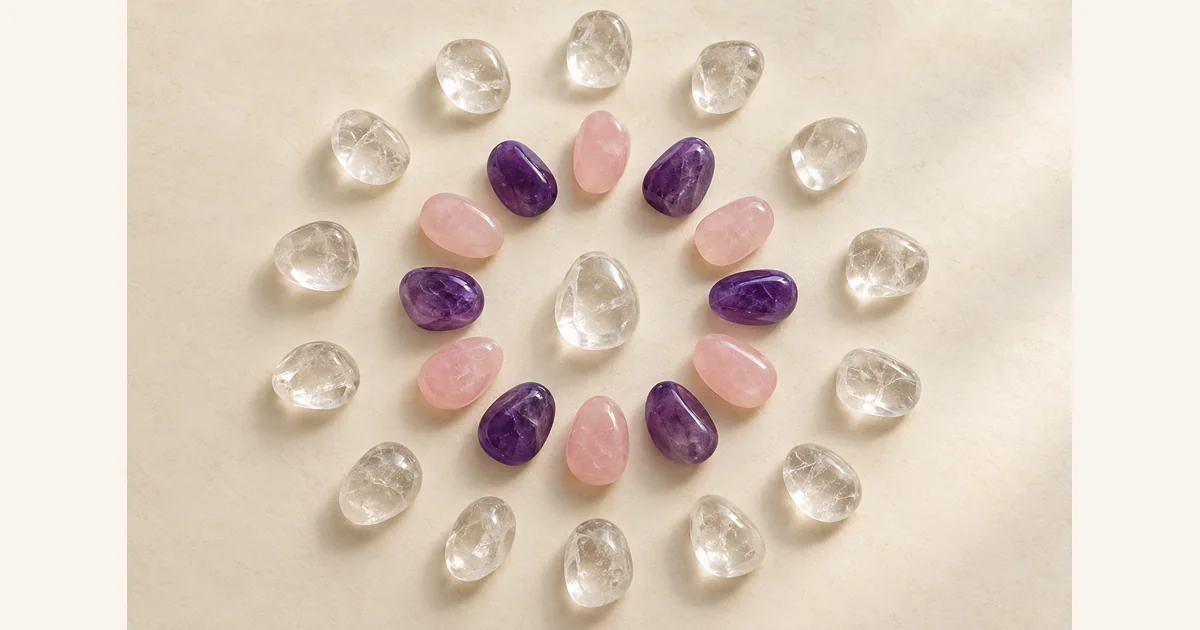
The centre is the visual anchor. In meditation-oriented grids, this may represent the main Sankalpa: peace in a family, steadiness in study, devotional concentration or an auspicious beginning to a business project. Some contemporary arrangements use a clear-quartz or Sphatik centre because transparent quartz is traditionally associated in crystal practice with clarity and focused intention. The centre is the point to which every ring visually relates.
2. Inner ring — supporting meanings
The first ring introduces supporting themes. For example, six rose quartz stones can symbolize relationships, kindness and emotional harmony, while six amethyst stones can represent contemplation, restraint and a peaceful devotional atmosphere. Alternation gives the diagram rhythm: rose quartz, amethyst, rose quartz, amethyst, repeated six times.
3. Outer ring — boundary and continuity
The outer ring frames the arrangement. In the 25-stone exercise below, twelve clear-quartz stones form the boundary. Some practitioners interpret the outer circle as a symbolic field of continuity, protection or integration. Its practical role is equally important: the ring makes the diagram symmetrical and easy to count, photograph and reproduce.
4. Directional axes — orientation in a Vastu setting
A crystal-grid layout can also have a north arrow and cardinal marks. Vastu traditions assign significance to the east, north, north-east, south-east and other zones, with directional deities and associated qualities. A practitioner might place a study-oriented grid in an east-facing study corner or a calm meditation arrangement in a north-east puja area, according to the household's practice. This is a choice about where the grid sits in the room, not an automatic rule that every individual stone must point toward one particular direction.
Gemstone choices: what each stone contributes to a grid
Begin with the traditional or contemporary symbolism of the actual stone. Colour is a useful clue, but mineral identity, authenticity and the purpose of the arrangement matter more than choosing solely by shade.
| Gemstone | Common spiritual association | Example use in a grid |
|---|---|---|
| Sphatik / clear quartz | Clarity, purity, meditation and focused prayer | Central anchor, outer ring or neutral linking stones |
| Amethyst | Tranquillity, contemplation, spiritual reflection | Inner circle for meditation or study |
| Rose quartz | Affection, harmony, compassion and relationships | Inner circle in a family-harmony design |
| Citrine | Prosperity, optimism, business growth symbolism | Selected positions in a workplace intention grid |
| Green aventurine | Opportunity, renewal, growth and enterprise | Complement to a business or new-project layout |
| Carnelian | Initiative, courage, vitality and purposeful action | Supporting stones in an action-oriented design |
| Black tourmaline | Grounding, boundaries and protection symbolism | Corner or perimeter accents in a modern protection-themed grid |
| Moonstone | Reflection, intuition and lunar symbolism | Contemplative or Chandra-themed arrangement |
These associations draw from different spiritual and crystal-practice traditions; they are not all a single classical Vastu prescription. Where a personal Kundali is relevant, a Jyotish-based gemstone recommendation follows a different method: Lagna, house lordships, planetary strength and Dasha are considered before choosing a gemstone for personal wearing. A decorative or teaching crystal grid does not substitute for that individual chart analysis.
An exact 25-stone crystal grid: materials and quantities
Here is a complete working design that uses 25 rounded tumbled stones, two rings and one centre. It is intentionally easy to teach, photograph and reproduce. No quartz point, wand, carved plate or extra centrepiece is required.
| Stone | Quantity | Position | Symbolic role |
|---|---|---|---|
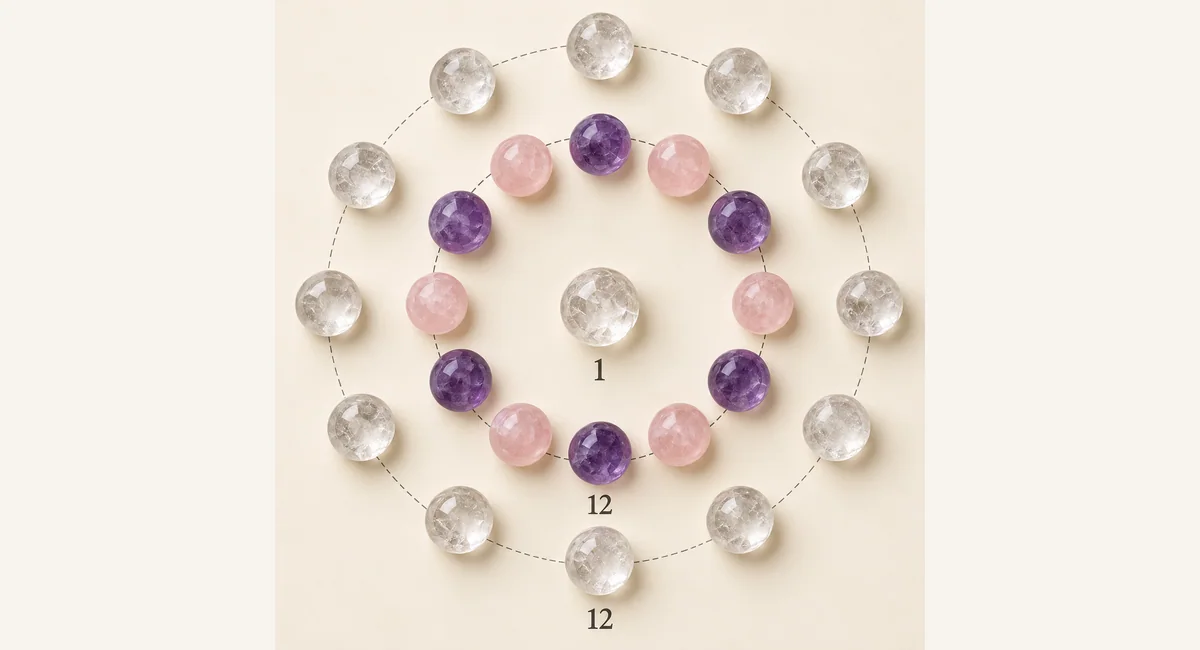
| Clear quartz / Sphatik | 13 | 1 centre + 12 outer-ring positions | Clarity, coherence and continuity |
| Amethyst | 6 | Alternating inner-ring positions | Contemplation and peaceful attention |
| Rose quartz | 6 | Remaining alternating inner-ring positions | Harmony and compassion |
| Total | 25 | 1 + 12 + 12 | Complete two-ring arrangement |
Layout A: the concentric mandala-style grid
- Prepare a flat, clean surface and place a small north arrow on a paper mat if orientation is part of your practice.
- Place one clear quartz at the centre. This is position C.
- Mark the inner ring with twelve equal positions, like the twelve numbers on a clock. Use an even circular spacing.
- Starting at the top, place amethyst at inner positions 12, 2, 4, 6, 8 and 10; put rose quartz at 1, 3, 5, 7, 9 and 11. You now have twelve alternating stones.
- Mark a wider circle with another twelve evenly spaced positions. Put the remaining twelve clear quartz stones on those marks.
- Check the arithmetic: 1 central quartz + 12 inner stones + 12 outer quartz = 25 stones.
- Write a short Sankalpa beside the mat, such as “May our home encourage patience, mutual care and thoughtful communication.”
The alternating colours create a measured rhythm, while the quartz perimeter ties the composition together. For a family-space grid, this makes a useful example of balancing contemplation with kindness. If your puja or meditation practice includes mantra or silent attention, you may sit before the arrangement and revisit the same intention regularly.
Layout B: the same 25 stones with a compass emphasis
A second arrangement can use the same physical inventory without adding a single stone. Keep the central quartz. Position the twelve inner stones on a circle, but draw thin north-south and east-west lines through the centre. The points at 12, 3, 6 and 9 now mark the cardinal axes. The other eight points lie between those axes. Keep the same six amethyst and six rose quartz pieces in alternating order, then frame all twelve with the quartz outer circle.
This version is particularly useful for a Vastu workshop because students can identify the axes, rotate the mat relative to a compass and discuss where the actual grid belongs in a room. The 25 positions are still circular; do not relabel them as the 81 padas of a Vastu Purusha Mandala. The diagram introduces directional literacy without turning a simple teaching tool into a different ritual object.
How to draw the mat to the correct scale
A grid that looks clear on a computer screen may be too cramped for real stones. For tumbled stones around 15–25 mm across, begin with an inner-ring radius of approximately 65 mm and an outer-ring radius of approximately 125 mm; check the actual stone sizes before printing. With twelve stones on each circle, the approximate centre-to-centre gap is 2r sin(15 degrees). That yields about 34 mm on the inner circle and 65 mm on the outer circle. A 25 mm stone therefore fits the inner circle with a small gap. Wider stones need a larger mat.
| Component | Suggested teaching dimension | Check before use |
|---|---|---|
| Centre | One marked position | Centre stone lies flat and does not roll |
| Inner ring | ~65 mm radius for 15–25 mm stones | Adjacent stones do not touch unintentionally |
| Outer ring | ~125 mm radius | All twelve positions are visible and accessible |
| Working mat | About 300 × 300 mm or larger | Outer ring fits with a margin; diagram states actual scale |
| Orientation | Small N marker, optional compass cross | North shown correctly after rotating the mat |
These measurements are a print-layout example, not a required sacred proportion. A practitioner using larger natural tumbles should increase spacing proportionally. A light-coloured, non-slip surface usually makes the pattern easier to use than a highly patterned cloth that competes with the gemstones.
Using a crystal grid with Vastu directions
When a crystal grid is intended for a home or office, begin by finding the actual north direction and the room's function. Vastu practice traditionally discusses the Ishanya (north-east), Agneya (south-east), Nairritya (south-west), Vayavya (north-west), and the four cardinal directions. Rather than placing identical grids everywhere, match the grid's Sankalpa and stones to the activity of the space.
| Space / zone | Grid theme to consider | Stone emphasis | Practical placement idea |
|---|---|---|---|
| Puja or meditation area, often north-east | Clarity and devotion | Clear quartz and amethyst | Stable low tray near, not on, the active altar surface |
| Study corner or desk, often east-oriented | Concentration and steady learning | Clear quartz with amethyst | Small grid beyond notebooks and electronic equipment |
| Business office / planning table | Prosperity and purposeful growth | Citrine, green aventurine, clear quartz | Side cabinet or shelf where it remains undisturbed |
| Family sitting area | Harmony and warmth | Rose quartz and amethyst | Safe, visible side table with a short Sankalpa card |
| Showroom demonstration counter | Teaching stone meanings and symmetry | Contrasting stones with readable labels | Behind a low transparent cover or supervised display |
Different Vastu teachers interpret directions and colour associations in different ways. In this article the examples are applications of a modern crystal-grid practice within a Vastu-oriented setting. They are not claims that every classical architecture text specifies a rose-quartz circle or an amethyst ring. The useful connection is that orientation, purpose, symbolism and arrangement are considered together.
Three worked examples
Example 1: a family harmony grid in a Bengaluru apartment
A couple wants a small, meaningful arrangement for a common room where family members read and spend time together. The objective is not an elaborate ritual installation; it is to give a simple place to a family Sankalpa. They select the 25-stone arrangement with a quartz centre, six rose quartz and six amethyst stones alternating inside, and twelve quartz stones outside. The grid sits on a dedicated sideboard rather than on the dining table, where daily movement would disturb it.
The family chooses the intention “Let conversation in this home be patient and respectful.” They arrange the grid together, identify the centre and two rings, and photograph it so that younger members can reconstruct it after cleaning. Rose quartz expresses warmth, amethyst contemplation and quartz clarity. The example is effective because the symbolic choices, quantity and daily practice all agree.
Example 2: a jewellery showroom's prosperity and learning display
A shop owner wishes to explain gemstone symbolism to visitors without mixing product-stock quantities with a spiritual display. On a supervised counter, the owner lays out two separate materials: the fixed 25-stone quartz/amethyst/rose-quartz teaching grid and a smaller display pairing citrine with green aventurine for prosperity and enterprise symbolism. Small cards explain the stones' names, common associations, and the different uses of the two arrangements.
The demonstrator points out that citrine is not automatically part of the fixed 25-stone kit. Adding it would make the kit a different inventory. If customers want a business-themed design, that should be prepared as its own accurately counted layout. This distinction matters for product clarity and for anyone creating an order or making a professional demonstration from the article.
Example 3: a beginner Vastu training workshop
A trainer has twelve students and wants a repeatable exercise. Each small group receives the same 25 stones and a printed compass-marked mat. The first task is mathematical: separate 13 clear quartz, six amethyst and six rose quartz. The second is visual: build Layout A. The third is spatial: convert to Layout B and mark north, east, south and west. Finally, each student describes the symbolic role of the stones and explains how the circular grid differs from a Vastu Purusha Mandala or Yantra.
The result is more than a decorative object. Students practise terminology, counting, spatial orientation, correct identification and traditional symbolism. They can compare two layouts with the same inventory and identify errors—such as a missing quartz stone or an inconsistent label—without relying on vague descriptions.
How to set an intention and maintain the arrangement
- Choose one purpose. A single clear Sankalpa is more coherent than a long list of unrelated wishes.
- Select the correct stones. Check material identification, size and count. Replace damaged or wrongly labelled pieces before assembly.
- Prepare the place. Use a clean, stable surface where the layout will not obstruct worship, study, business work or movement.
- Arrange centre to perimeter. Put the centre down first; then add inner positions and outer positions in a consistent order.
- Take a moment of attention. Practitioners may choose silent meditation, prayer, mantra japa or a simple written Sankalpa according to their tradition.
- Leave the grid undisturbed. Display it where meaningful; maintain the intended orientation if the mat uses a north marker.
- Review and reset. Dust the surface carefully, check the count and return the stones to their marked positions after use.
For most rounded quartz-family tumbles, a soft dry cloth is adequate for routine care. Do not automatically immerse a mixed kit in water, salt or oil: labels, coatings, softer minerals and certain mineral varieties may be affected. Keep small loose stones away from children and pets. A compact lidded tray is useful for travel or classroom storage.
Buying a ready-made grid or assembling your own?
A ready-made kit is useful when the exact number of stones, their identity, size range and the mat positions are supplied clearly. Building your own offers flexibility, particularly if you already know the meanings and have spare genuine gemstones. In either case, the most important product question is “Can I reconstruct the arrangement exactly from the information supplied?”
| Before choosing | What to check |
|---|---|
| Stone inventory | Exact numbers and individual varieties, not just “assorted crystals” |
| Physical form | Tumbles, points, chips or spheres must match the photograph and instructions |
| Drawing | All positions count correctly and use the same number of pieces included |
| Purpose | Clear statement of intended spiritual or educational use |
| Instructions | Centre-first assembly, orientation if needed and meaningful stone roles |
| Care and replacement | Stone identification, safe cleaning, storage and replenishment information |
For larger professional sets, it can be useful to separate single-stone study kits, directional teaching kits and crystal-grid arrangement kits. They serve different purposes even when they share mineral varieties. A structured inventory is particularly valuable when stones travel between demonstrations.
Common questions about crystal grids
Can I make a crystal grid with only seven stones?
Yes. A beginner can use one centre and six outer stones. That creates a simple, balanced pattern. It is a different inventory from the 25-stone exercise, but it demonstrates the same principle of centre and surrounding positions.
Do I need a quartz point in the centre?
No. Some contemporary traditions use a pointed quartz generator, but the design shown here uses a rounded clear-quartz tumble. Keep the material and photograph consistent with the actual set.
Should the grid face north or east?
If you are using directional Vastu symbolism, first identify room orientation and the purpose of the arrangement. A compass arrow on a mat makes north clear. A meditation grid without directional instructions need not be turned into a compass diagram.
Is the Flower of Life the same as a Shri Yantra?
No. These are different geometric patterns, with different symbolic histories and practices. A printed sacred-geometry mat should be described by its actual pattern rather than borrowing the name of a specific Yantra.
Can I mix Navagraha gemstones into the 25-stone grid?
You may design a separate Navagraha-themed arrangement, but its gemstone composition, sequence and purpose should be specified afresh. A traditional Navaratna selection and an interchangeable tumbled-stone teaching grid answer different questions. Chart-based gemstone selection for personal wearing deserves its own Jyotish analysis.
Is a crystal grid the same as a Vastu correction?
A crystal grid may be used in contemporary Vastu-inspired practice, especially for Sankalpa, contemplation and symbolic placement. It does not replace evaluating the building's orientation, layout, light, circulation and the broader Vastu Purusha Mandala. A practitioner should choose the level of intervention appropriate to the actual site.
What if one stone is missing?
Count the diagram again and replace the missing piece with the same variety and approximately the same size. Do not call a 24-stone arrangement the original 25-stone kit. A labelled inventory card makes replacements straightforward.
Continue reading
- Crystal Grid Kit Components and Arrangement Examples — complete component lists and assembly variations.
- Single Stones, Multipacks and Mixed Sets Compared — when to buy individual crystals or a ready-made set.
- How to Label and Organize a Tumbled Stone Reference Collection — practical identification and indexing.
Explore the existing Vastu and gemstone collections for materials and related spiritual products.