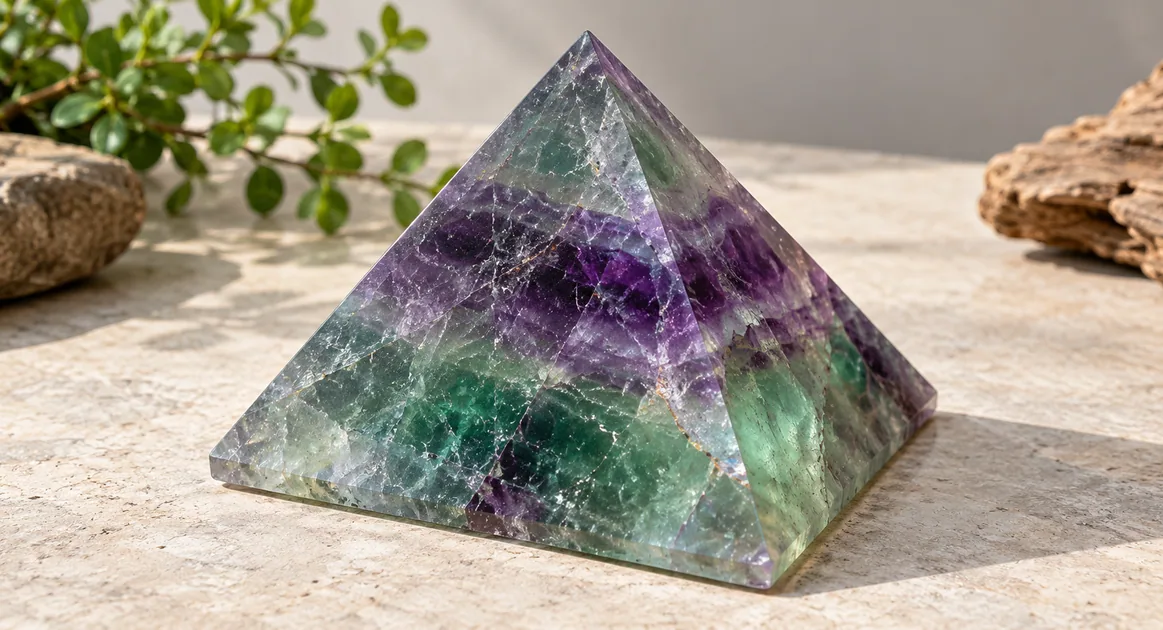
Fluorite pyramids are admired for green, violet, blue, yellow and sometimes near-colourless zones that run across their polished faces. The colours can form clear parallel bands, cloudy patches or changing transitions, and a single carving may reveal different patterns on different sides. In contemporary Vastu and crystal practice the colour becomes part of an intentional decorative arrangement; in mineralogy it is a property to understand and identify accurately.
This detailed guide explains genuine fluorite, banding and colour zoning, Mohs hardness, four-direction cleavage, carved-pyramid quality, Vastu symbolism, shop and home placement, buying questions and safe dry handling. It also separates fluorite from coloured glass, quartz, calcite, dyed materials and artificial imitations. Because fluorite is comparatively soft and brittle, care is not a minor detail: it should inform the decision before the pyramid is purchased or placed.
1. What is fluorite? Mineral identity and properties
Fluorite is a naturally occurring calcium fluoride mineral, written CaF2. It belongs to the halide mineral group and commonly crystallizes in cubic or octahedral forms. A square-based decorative pyramid is a human-made carving, not fluorite’s natural crystal habit. The polished shape is made by cutting a piece of suitable fluorite-bearing material and refining its faces and point.
Fluorite is the reference mineral for 4 on the Mohs hardness scale. Quartz is 7, so an item made from fluorite is more easily scratched than a typical quartz pyramid. It also has perfect cleavage along four crystallographic directions, which can create vulnerable splitting planes. A beautiful high-gloss surface does not remove this structural feature.
| Property | Fluorite information | Buying or care implication |
|---|---|---|
| Chemical composition | Calcium fluoride (CaF2) | Different mineral from quartz or calcite |
| Mohs hardness | 4 | More prone to surface scratches than quartz |
| Cleavage | Four perfect directions; octahedral | Protect edges, apex and faces from shocks |
| Colour | Colourless, green, violet, blue, yellow and mixed zones | Every piece can have different banding |
| Lustre | Usually vitreous on fresh crystal faces | Polish and surface wear affect appearance |
| Natural habit | Often cubes and octahedra | Retail pyramid is a carved ornamental shape |
| Light response | Some specimens fluoresce under ultraviolet light | Glow is variable, not a universal authenticity test |
2. How fluorite gets its purple, green and rainbow colour bands
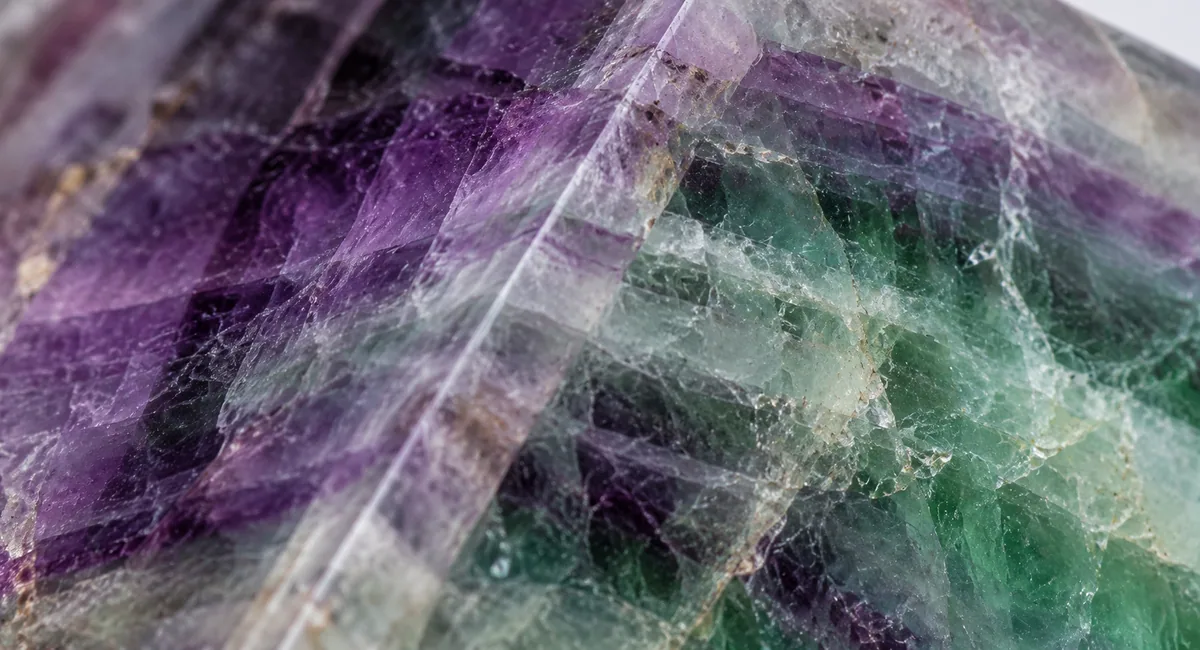
Fluorite may be clear or show purple, green, blue, yellow and other colours. Colour centres, trace elements, crystal defects, radiation history and changes during crystal growth can contribute to these appearances. Mineral-rich fluids and changing conditions during formation help explain why zones may develop successively in one specimen. A band viewed from the front can become a streak or broad patch on another face when a pyramid is cut through three-dimensional layers.
The trade description rainbow fluorite generally refers to mixed-colour or visibly banded fluorite, not to a separate mineral species. A plain green fluorite carving can be genuine even without a single purple stripe. Conversely, colour bands alone cannot prove that a carved object is fluorite: coloured glass, synthetic-looking laminates and other banded minerals can imitate the effect.
| Appearance | What it may mean | What it does not prove |
|---|---|---|
| Purple and green in one object | Naturally colour-zoned fluorite is possible | Every rainbow specimen comes from a named mine |
| Sharp horizontal bands | Growth zones intersected by the cut | A painted or layered imitation can be ruled out |
| Cloudy white areas | Inclusions, fractures or lighter zones | The stone is faulty without further inspection |
| Very bright uniform colour | Lighting, natural colour or treatment may explain it | The piece is necessarily highest grade |
| UV response | Some fluorites fluoresce | All fluorite must glow, or glowing proves authenticity |
3. Cleavage, brittleness and the vulnerable pyramid apex
Perfect cleavage is fluorite’s defining practical weakness. Under the right mechanical stress, the crystal can split cleanly along internal planes rather than merely denting. The pointed top of a decorative pyramid and the four base corners are particularly exposed to a knock or fall. A smooth face may contain internal planes that are not visible from the listing photograph.
Do not attempt to test cleavage or scratch resistance on a purchased carving. Those methods can permanently damage it. For an incoming shop batch, photograph the point, four corner transitions, underside and any visible cracks before display. An internal colour boundary is not automatically a fracture, and a fracture is not automatically a harmless growth band. A vendor should be able to describe any visible repair or instability without calling every problem “natural.”
| Observation | Reason to inspect | Suggested action |
|---|---|---|
| Tiny rounded apex | Can be intentional finishing | Confirm shape against product photograph |
| Fresh chipped point | Impact damage is plausible | Request replacement or clear discount disclosure |
| Straight internal lines | May be zoning, cleavage or fracture | Use multiple viewing angles and close-ups |
| Open cracks at base | Can threaten carving stability | Avoid rough handling; request condition confirmation |
| Glued or filled seam | May be a repaired or assembled item | Require honest construction disclosure |
| Cloudy natural veils | Often part of specimen character | Describe accurately without assuming damage |
4. Genuine fluorite versus glass, quartz, calcite and resin
Fluorite is sometimes casually called crystal simply because it transmits light. That is not enough to distinguish it from glass, quartz or another transparent decorative material. Quartz is harder and lacks fluorite’s perfect four-direction cleavage. Calcite, a different mineral, has hardness 3 and distinctive cleavage. Coloured glass is manufactured and can have bubbles or flow features; not every bubble is visible, so appearance alone remains inconclusive.
Professionally meaningful identification may involve measured density, refractive index, microscopy and contextual documentation. A retail customer should not be encouraged to put acid on a finished carving or strike an edge to test it. When a buyer is paying a premium for rare locality, unusual natural colour or untreated provenance, qualified gemmological evidence matters more than a seller’s colour-based certainty.
| Material | Key difference | Responsible seller question |
|---|---|---|
| Natural fluorite | CaF2; hardness 4; perfect cleavage | Is this solid fluorite, and is it repaired? |
| Quartz / amethyst | SiO2; hardness 7 | Is the mineral quartz or fluorite? |
| Calcite | CaCO3; hardness 3; reacts to acids | Was the mineral identified or labelled only by colour? |
| Dyed stone | Colour introduced to some natural material | Is the colour treatment disclosed? |
| Coloured glass | Manufactured amorphous material | Is it described honestly as glass? |
| Resin or bonded fragments | Composite or cast construction | Is this a single stone or assembled material? |
5. Evaluate the four faces, base, polish and banding
A well-made fluorite pyramid should be assessed as a specific object, not a generic photo of attractive rainbow stones. Ask whether the listing image represents the exact pyramid or a batch. Four triangular faces may not show matching colours because the carving intersects colour zoning at different angles. Natural variation is expected; unexplained cracks, poor polish or misrepresented size should not be hidden behind the phrase “each piece is unique.”
Check whether the base sits steadily on a flat shelf. Look for scratches under reflected light, sharp chips that could catch cloth, glue lines, and the finish near the apex. A square-based pyramid is a popular display form, but base width, height, total mass, finish type and source photographs should all describe the actual sellable item. If multiple sizes are offered, show clear dimension-specific information instead of implying that every colour arrangement will repeat.
| Check | Good documentation | Potential issue |
|---|---|---|
| Actual photograph | All faces and underside, normal lighting | Only one highly saturated stock image |
| Dimensions | Measured height and square base width | Vague small/medium/large claims |
| Colour variation | Actual zone pattern or honest assortment notice | Exact rainbow pattern implied for every item |
| Condition | Tip, corners and repairs disclosed | Fresh damage dismissed as “healing line” |
| Construction | One piece, jointed or treated explained | Material and processing left ambiguous |
6. Fluorite in contemporary Vastu and crystal traditions
In modern crystal-based Vastu arrangements, fluorite’s colours are often associated with order, mental clarity, focus and a reflective atmosphere. Purple fluorite may be chosen for meditation or spiritual reflection, green for renewal and balance, and a multicolour specimen for the harmonious meeting of several intentions. These are contemporary interpretive practices, not an ancient universal rule that every home must contain a fluorite pyramid.
A thoughtful Vastu conversation also considers the Pancha Mahabhuta—Prithvi (earth), Jala (water), Agni (fire), Vayu (air) and Akasha (space)—together with orientation, use of rooms, light, access and human activity. The natural mineral represents a material object, while its colours may be incorporated symbolically. Do not confuse mineralogical fluorescence or colour zoning with a measurable change to a room’s electromagnetic environment.
An owner may keep a pyramid near a puja shelf or a place for quiet work as a visible reminder of a Sankalpa, a consciously held intention. Material honesty and respectful use can coexist. A pyramid’s appearance does not establish a guaranteed change in examination results, career success, prosperity or health.
7. Directions, Dikpalas and selecting a respectful placement
Different Vastu schools and contemporary crystal practices can suggest different colour-direction pairings. The traditional spatial vocabulary includes Ishanya (north-east), Agneya (south-east), Nairritya (south-west) and Vayavya (north-west), alongside north, east, south and west. Associations with directional guardians or deities belong to the selected tradition, and should not be collapsed into a supposedly universal “fluorite must be placed in this corner” instruction.
Choose a stable, protected indoor location that matches the room’s purpose. A high-traffic entrance shelf where visitors constantly pick up the piece is unsuitable for fragile fluorite, even if the shelf faces a preferred direction. Avoid placing it in wet bathrooms or near the hot air of a cooking area. A quiet desk corner, protected display cabinet or dedicated meditation shelf is often physically more appropriate.
| Place | Contemporary symbolic intention | Practical check |
|---|---|---|
| Study desk | Clarity, orderly attention and Sankalpa | Keep away from laptop hinges and falling books |
| Meditation shelf | Reflection and calm ritual setting | No candle flame, dripping oils or wash water |
| Home display niche | Colourful focal object | Do not place at a vulnerable edge |
| Office consultation table | Demonstrate colour and mineral differences | Use a padded tray when passing between people |
| Shop counter | Show real zoning and workmanship | Keep protected behind stable glass or a holder |
8. Traditional colour language, chakras and Jyotish boundaries
Purple is often associated in recent chakra-based crystal discussions with Ajna and reflective awareness, while green may be connected with Anahata and emotional balance. A rainbow piece is sometimes used as a visual aid for the broader chakra system. These symbolic connections should be presented as traditions and interpretive frameworks, not as proof that fluorite is a classical prescribed Jyotish Ratna for a specific Graha.
A chart-based gemstone consultation may involve Lagna, Rashi, Nakshatra, planetary strength, Dasha and the objective of the recommendation. It is a different activity from choosing an attractive fluorite pyramid for a shelf. Budha, Chandra, Shani, Brihaspati or Shukra should not be assigned automatically to fluorite based only on green, white, dark or violet colour. This distinction protects the depth of Jyotish practice rather than reducing it to a simplistic colour chart.
Fluorite may be appreciated alongside Rudraksha, mantras, a lamp or other ritual objects according to the household’s practice. Leave enough distance from flame, incense ash, oil and water. In a traditional puja setting, devotion and care are not dependent on immersing a delicate mineral in liquids.
9. Worked example: a Bengaluru family apartment
Imagine a Bengaluru apartment where the family wants a green-and-purple fluorite pyramid on the living room display. The shelf receives bright afternoon sun and stands beside a frequently opened balcony door. Rather than selecting only by a compass label, inspect the direct-light exposure and the chance of a knock. Fluorite may fade under prolonged light exposure, and an accidental impact can chip a vulnerable corner.
A better option may be an inset interior shelf where the family can appreciate the banding without constantly moving the carving. Place it on a level non-abrasive pad, photograph the original colours in neutral light, and teach children that it is a fragile ornamental object. If the family associates the purple zones with meditation and the green with harmony, they can articulate that intention without needing to claim the mineral automatically corrects a building defect.
10. Worked example: jewellery showroom and retail counter
A showroom owner wants to display six fluorite pyramids in different hues. The supplier provides one dramatic image labelled rainbow fluorite, but the actual stock has varied patterns. Accurate individual or clearly batch-qualified photographs are essential. A small card can identify fluorite, CaF2, hardness 4, delicate cleavage, exact measurements and gentle-care instructions without promising the same green-purple stripe in every piece.
Use a stable display with barriers against tipping; do not stack polished fluorite pyramids against quartz specimens or metal fixtures. Staff can demonstrate banding by rotating the padded tray rather than handling each pointed apex repeatedly. If a repair, resin-filled gap or colour treatment is known, disclose it. Trustworthy descriptions create a stronger customer experience than exaggerated energy grades or misleading colour guarantees.
11. Worked example: a professional Vastu gemstone reference set
A practitioner’s reference kit may include fluorite alongside aventurine, calcite, quartz, pyrite, agate and other carved materials. The purpose is partly educational: to compare colour, density, polish, surface texture, durability and traditional interpretations. Fluorite provides a useful example of how a visually attractive translucent stone can require extra mechanical care.
Store fluorite in an individual lined compartment with a clear label: material, colour, exact dimensions, treatment status if known, and “handle gently—cleavage”. Add a card distinguishing colour symbolism from chart-based Jyotish prescribing. For client demonstrations, hand over a padded sample tray rather than letting multiple hard stones rattle together. A professional kit should be auditable as a set of genuine material descriptions, not only a collection of names and promised benefits.
| Kit field | Example record | Why keep it |
|---|---|---|
| Mineral | Fluorite, calcium fluoride | Correct identification |
| Visual | Green/violet natural-looking zones | Track the actual specimen |
| Handling | Mohs 4; perfect cleavage | Prevent avoidable damage |
| Measurements | Measured base, height and weight | Inventory and replacement |
| Treatments | Known, not known, or seller-disclosed | Honest product comparison |
| Interpretation | Contemporary Vastu colour use | Separate belief from mineral testing |
12. Cleaning, heat, light and storage
Gentle dry dusting with a clean, soft brush or lint-free cloth is a conservative default for a decorative fluorite carving. Lift loose grit before wiping, because abrasive particles can scratch this comparatively soft mineral. Avoid acids, strong alkalis, steam and ultrasonic cleaning. Do not use salt-water soaking as a generic “cleansing” ritual. For stubborn deposits, consult treatment-specific advice; a slightly damp cloth may be acceptable for an appropriate untreated specimen, but immersion is unnecessary and should be avoided.
Protect fluorite from prolonged direct sunlight and abrupt temperature changes, both of which can affect some specimens or promote damage. Do not use heaters, hairdryers, hot-water baths or chemicals to brighten the colour. A display cabinet away from direct sun, cooking vapour and accidental bumps gives the pyramid a better chance of retaining its finish.
| Situation | Care method | Avoid |
|---|---|---|
| Light dust | Soft dry brush and clean cloth | Hard scrubbing and polishing powder |
| Unknown coating or repair | Ask the supplier about the treatment | Unapproved liquids and solvents |
| Long-term display | Stable indoor shaded shelf | Extended direct sun and heat |
| Handling | Support the base with both hands | Holding only the pointed top |
| Storage | Separate padded dry compartment | Contact with quartz, metal and other hard items |
| Shipping | Firm inserts protecting tip and corners | Loose stones in one pouch |
13. Receiving, packing and shipping fragile fluorite
Each pyramid should be packed individually so that the apex and base corners cannot strike the box. Use soft tissue or a non-abrasive protective wrap, then a fitted foam or cardboard insert that prevents movement. Add cushioning around the outside of the insert. A generic bubble pouch with multiple pyramids knocking against one another is unsuitable for this soft, cleavable mineral.
Photograph the object’s point, base corners, faces and colour zones before dispatch. When the shipment arrives, inspect the packaging for impact, compare the received stone to the promised representation and record any fresh cracks immediately. Ensure any decorative stand has a broad stable footprint. Even a visually tiny flaw at the apex can matter to a customer buying the object specifically for its finished geometry.
14. Buying checklist: claims, prices and return questions
Before paying, identify the actual stone, exact colours, size, condition and known treatments. A source locality or “rare rainbow” premium needs credible supplier support; it should not be inferred from a photograph. Higher saturation is not a reliable scale of Vastu suitability, and UV fluorescence is not a substitute for mineral identification. Ask whether the photograph is of the exact object and whether the seller’s return policy covers transit damage.
| Seller statement | Question worth asking |
|---|---|
| “Rainbow fluorite” | Will my actual stone have these exact bands? |
| “Genuine crystal” | Is it specifically natural fluorite (CaF2)? |
| “Unbreakable polish” | How are cleavage and fragile points handled? |
| “Perfect natural markings” | Are cracks, repairs or fillings present? |
| “Healing and success guaranteed” | What tradition is being described, rather than a measurable product fact? |
| “Premium imported origin” | Is there verifiable source information? |
| “All colours glow” | Was UV response measured on this actual piece? |
15. Frequently asked questions
Is fluorite a type of quartz?
No. Fluorite is calcium fluoride, while quartz is silica. They differ in hardness, cleavage and other physical properties.
Why does my fluorite pyramid have purple and green bands?
Changes in crystal growth and colour-producing defects or impurities can create successive zones; carving angle affects their visible pattern.
Can genuine fluorite be colourless?
Yes. Natural fluorite can be colourless or show many different hues; rainbow banding is not compulsory.
What does Mohs hardness 4 mean?
Fluorite is considerably softer than quartz (7) and may scratch during careless cleaning or contact with harder objects.
What is four-direction cleavage?
It means the mineral can split readily along four sets of crystallographic planes, creating vulnerability to impacts.
Should I test fluorite with a knife?
No. Do not conduct destructive scratch tests on a finished item; professional mineral identification is preferable.
Is a cloudy internal line a crack?
Not always. It could be a colour zone or internal feature, but surface-reaching fractures should be disclosed and inspected.
Does rainbow fluorite always glow under UV?
No. Fluorescence varies among specimens; lack of visible glow does not by itself mean the material is not fluorite.
Can sunlight change fluorite colours?
Some fluorite can lose colour with prolonged light exposure, so shaded indoor display is a prudent choice.
Can fluorite be kept in a puja room?
It can be displayed as a personal object on a stable shelf away from heat, oil, ash and water.
Which Vastu direction is best?
No single direction fits every tradition or building; select based on the chosen practice, function of the space and physical safety.
Is fluorite a prescribed Navagraha gemstone?
A coloured decorative fluorite pyramid is not automatically a Jyotish Ratna for any planet. A chart-based gemstone consultation is separate.
Can I wash a fluorite pyramid with salt water?
Avoid immersion, salts and harsh cleaning. Dry dusting is a sensible default for a fragile decorative piece.
Can children handle fluorite pyramids?
They are fragile pointed ornaments rather than toys; keep them safely positioned and supervise any handling.
How should a shop ship fluorite?
Package each piece separately with a snug insert protecting its apex and four corners.
Is a very bright rainbow fluorite necessarily better?
No. Evaluate genuine identity, workmanship, the actual banding, condition, disclosed treatment and dimensions rather than exaggerated colour claims.
16. Summary: choose the actual mineral, not just the colour story
A compelling fluorite pyramid combines real calcium-fluoride mineral character, clearly represented colour bands, careful finishing and responsible handling. Purple-green zoning can be beautiful, but the practical decisions are equally important: verify the supplied piece, examine all faces and the apex, protect the four cleavage directions, and keep the object away from prolonged strong light and rough cleaning.
The spiritual interpretation can remain rich and personal. Vastu directions, Sankalpa, Panchabhuta and colour symbolism may help someone choose a meaningful location, while Jyotish gemstone prescribing retains its separate chart-based context. A useful buying guide makes these distinctions clearly without stripping the object of its devotional or cultural significance.
Research notes: mineral identity, colour variation, Mohs hardness and octahedral cleavage were cross-checked against Mindat, the University of Minnesota mineral collection and Ohio Department of Natural Resources. Gemstone durability and handling were checked against GIA material and the International Gem Society. These are editorial verification references, not additional commercial outbound links.
Explore existing OmmRudraksha collections
Browse Vastu for the existing collection, or explore gemstone products for other material forms. Each product’s construction and care information should guide your choice.