Labradorite pyramids: real feldspar colour flash, Vastu significance and an informed buying guide
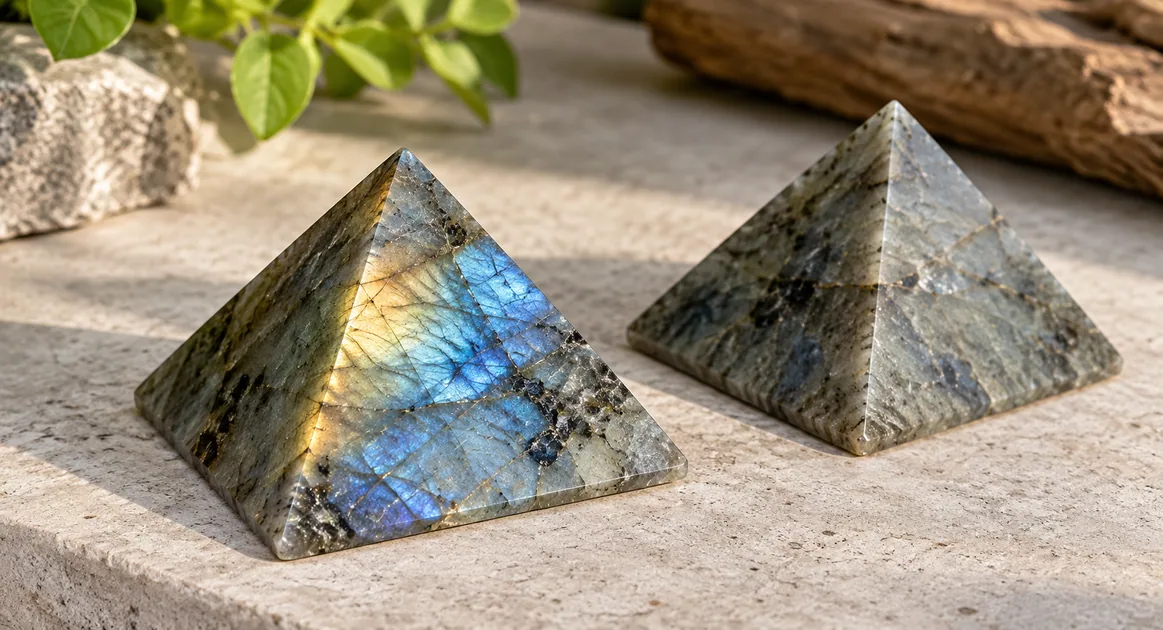
A labradorite pyramid can look like a modest grey or charcoal stone from one side and suddenly reveal a sheet of electric blue, moss green or bronze-gold colour as it turns. This change is not a defect and need not mean the seller has switched specimens. The effect, called labradorescence, is highly dependent on the stone’s internal structure, the direction of incoming light and the viewing angle. A well-chosen display position often matters as much as the brightness of the colour in a sales photograph.
The practical questions are more useful than a promise that every face will shine. Is this carving natural labradorite feldspar? Does a turning video show the actual unit in ordinary light? Are the apex, corners and underside sound? Is the advertised colour caused by the stone itself rather than a surface coating or image filter? How should a family or Vastu practitioner interpret the blue-green appearance, place the object and protect its vulnerable edges? This guide answers those questions together, with mineral identification, relevant Indian traditional terminology, comparisons, buying checks and safe-care examples.
What is labradorite? The feldspar behind the blue and green flash
Labradorite is a plagioclase feldspar within the albite–anorthite compositional series. Like other feldspars, it is a naturally occurring silicate mineral, rather than an artificial pigment suspended inside clear resin. Its name comes from Labrador in Canada, a historically important locality, although material sold as labradorite can be sourced from several countries. A name based on a place is not evidence that the actual retail pyramid came from that place.
A typical labradorite specimen has a grey, grey-green or dark ground colour; a polished piece may be translucent around thin edges while its thicker centre appears opaque. Its labradorescence can form blue, green, yellow, gold, orange or violet patches, and a single face can show more than one colour. The strongest effect depends on structural orientation; it is not distributed like ordinary paint across all faces. Some specimens are attractive even when their brightest colour occurs only on a limited portion of the carving.
Mineralogical references commonly report Mohs hardness around 6–6.5 for labradorite. Hardness describes resistance to scratching; it does not mean a pointed carving cannot chip. Feldspar also has pronounced cleavage, so a hard knock can cause damage even where the surface resisted ordinary light scratching. The attractive colour flash and physical durability are different properties and should be judged separately before purchase.
Because labradorite is one member of a wider feldspar family, there is no reason to label every flashy stone “moonstone,” “sunstone” or “spectrolite.” Those trade names have different meanings. Nor does every dull or opaque grey feldspar carving become labradorite merely because a listing says so. When a seller cannot establish a precise mineral species, the description should say what is actually known rather than assigning a confident laboratory identification from colour alone.
| Topic | Established information | What to ask about this exact piece |
|---|---|---|
| Mineral family | Plagioclase feldspar, albite–anorthite series | What mineral identification or supplier documentation supports the label? |
| Body appearance | Often grey to dark grey or green-grey | Is the neutral-light photograph representative? |
| Labradorescence | Directional internal iridescence, commonly blue or green | Can the same piece be rotated under one steady light? |
| Other colours | Golden, orange, violet or multicolour areas may occur | Which faces and angles really show the advertised colours? |
| Hardness | Approximately 6–6.5 on the Mohs scale | Are there scratches or chips despite the hardness? |
| Cleavage | Can break along particular internal directions | Is the apex, base and every edge intact? |
| Material construction | Natural carved solid or an explicitly disclosed assembled object | Any repairs, resin filling, backing, coating or glue? |
| Geographic origin | Labradorite is found in multiple regions | Is a Canada, Madagascar or Finland claim documented? |
How labradorescence works: the colour is not simply painted onto the surface
The spectacular flash results from how light interacts with very fine internal structures of differing composition and refractive properties. Labradorite can contain extremely thin lamellae formed as the mineral cooled and its components separated on a microscopic scale. Reflection and interference associated with these layers select particular visible wavelengths, producing coloured iridescence. In a rotating carving, the favourable geometry changes, so one area seems to light up while another goes grey.
That optical explanation matters to buyers because a single high-contrast studio photograph cannot describe the complete object. A grey side may carry no visible flash from the photographer’s position yet display green when the angle changes. The blue patch may be bright only when a light source is behind the viewer’s shoulder. The interior can be genuine labradorite even if the front-facing colour is uneven. Conversely, an intense uniform metallic blue surface under every angle may justify asking whether a decorative coating was applied.
Labradorescence differs from the individual glitter points of aventurescence, familiar from some sunstones, and from the softer billowing adularescence associated with traditional moonstone. An ordinary label such as “rainbow flash” is not precise enough to establish which phenomenon or mineral is present. The buyer need not become a gemmologist, but knowing these visual differences helps ask focused questions rather than trusting buzzwords.
A good product video should rotate the same pyramid slowly, keep the camera exposure and light source reasonably consistent, and reveal the ordinary grey appearance as well as the most dramatic colours. If the item is sold by batch rather than as an individually photographed unit, the listing should say clearly that pattern and colour coverage vary. That honesty reduces disappointment and allows genuine natural variation to be part of the attraction.
| Optical effect | Typical appearance | Material and distinction |
|---|---|---|
| Labradorescence | Large shifting patches or planes of blue, green, gold or violet | Commonly associated with labradorite feldspar |
| Adularescence | Soft floating, billowy, often blue-white glow | Traditional moonstone; not identical to a sharp labradorite flash |
| Aventurescence | Sparkling individual reflective specks that catch angled light | Seen in some sunstones and aventurine materials |
| Glass iridescent coating | Film-like surface rainbow or unusually uniform finish | Ask whether the colour belongs to the surface treatment |
| Opal play-of-colour | Patches of spectral colour from opal microstructure | Different mineral and optical mechanism |
| Surface reflection | Bright white glare that follows the lamp itself | Polish or lighting alone does not prove labradorescence |
How to photograph and judge the actual pyramid: best face, ordinary face and full rotation
Place the carving on a neutral surface, use a fixed soft light or nearby window, and begin with a photograph of the whole object from the position where it will normally be viewed. Then rotate it slowly without altering the light. Record the angle at which the strongest blue or green flash appears. Finally photograph at least one less colourful face so the description reflects the whole carving rather than only its peak photographic moment.
For a four-sided pyramid, ask for the front, back, left, right, apex and underside. Where the strongest flash occurs on only one plane, that plane should be labelled as the “best display face” instead of suggesting the effect covers all four sides. A brief annotated video or two photos of the exact unit usually communicate this better than a long string of adjectives such as “AAA energetic blue.”
Sellers should also avoid over-editing saturation or using coloured blue lighting that adds a tint to otherwise grey stone. A light source may be used to reveal optical behaviour; its purpose and strength should be clear. The stone can be impressive under a spotlight while looking subdued near an ordinary shelf light, and this difference is part of its real material behaviour, not something to conceal.
A successful home display does not necessarily maximize colour at every moment. Position the strongest flash toward the normal viewing area and accept that it changes as daylight or the viewer moves. A pyramid behind reflective glass may create additional glare; in that setting, a small directional lamp or change of shelf orientation can improve visibility without touching or repainting the stone.
| Check | Good evidence | Do not conclude |
|---|---|---|
| Neutral daylight | Natural grey body colour and real finish shown | A grey side proves the item is false |
| Stable angled light | Colour appears or disappears as the actual stone rotates | Every face must flash equally |
| Short turning video | Same unit and one continuous rotation | A sequence of different specimens represents one unit |
| Apex enlargement | Tip has no undisclosed break, patch or glue | Every inclusion near the tip is a crack |
| Four side images | Extent and direction of flash are visible | One glamour photo reveals all appearance |
| Base photograph | Sits level and underside condition can be judged | A glossy top proves solid construction |
| Treatment statement | Known coatings, fillings and assembled parts declared | Colour alone proves untreated natural material |
Labradorite versus spectrolite, rainbow moonstone and sunstone
Spectrolite is a name associated particularly with unusually colourful labradorite from Finland. Gemological sources often recommend reserving that trade name for qualifying Finnish material rather than calling every vivid blue-green carving “spectrolite.” If a vendor uses the term, ask for a meaningful origin trail, not merely a dramatic photograph. Strong colour by itself does not establish Finnish origin or a special mineral species.
Rainbow moonstone is a widely accepted gem trade name, but GIA explains that much material sold under the name is transparent or white labradorite rather than the traditional orthoclase-type moonstone. Because labradorite and moonstone belong to the wider feldspar family, the commercial names are easily confused. A dark grey pyramid with broad blue flash and a white translucent polished cabochon with rainbow sheen are not the same presentation, even if related optical principles are involved.
Sunstone is another feldspar trade category, recognized especially for aventurescence from reflective particles. Labradorite is best known for broad labradorescent colour planes; sunstone more often shows glittering flecks. Some feldspars can display more than one optical behaviour, so the terms are a buying framework rather than a substitute for proper identification. Do not sell a grey-blue labradorite pyramid as natural sunstone merely because both stones are feldspars.
Onyx, iridescent coated glass, resin and other decorative materials can be visually attractive but should be described honestly. Uniform surface shimmer, bubbles, odd seams or excessively regular colour bands can motivate closer examination; none alone proves an imitation. A basic visual examination is a first screening step, not an independent laboratory certificate. For high-value claims, request documentation appropriate to the price.
| Name on a listing | What it usually means | What requires confirmation |
|---|---|---|
| Labradorite | Plagioclase feldspar with possible labradorescence | Actual material, flash coverage and repairs |
| Spectrolite | Commercial name commonly tied to vibrant Finnish labradorite | Specific Finnish provenance, not just colour |
| Rainbow moonstone | Often white/transparent labradorite in jewellery trade | Not necessarily traditional orthoclase moonstone |
| Moonstone | Feldspar associated with soft adularescence | The mineral identity if comparison matters |
| Sunstone | Feldspar associated with metallic-looking aventurescence | Not automatically the same effect or species |
| Iridescent coated glass | Manufactured or surface-treated decorative material | Disclose as glass/coated rather than natural feldspar |
| Blue-flash stone | Descriptive retail shorthand | Ask for mineral name rather than equating flash with authenticity |
Carving quality: natural cleavage, tip damage and the difference between flash and cracks
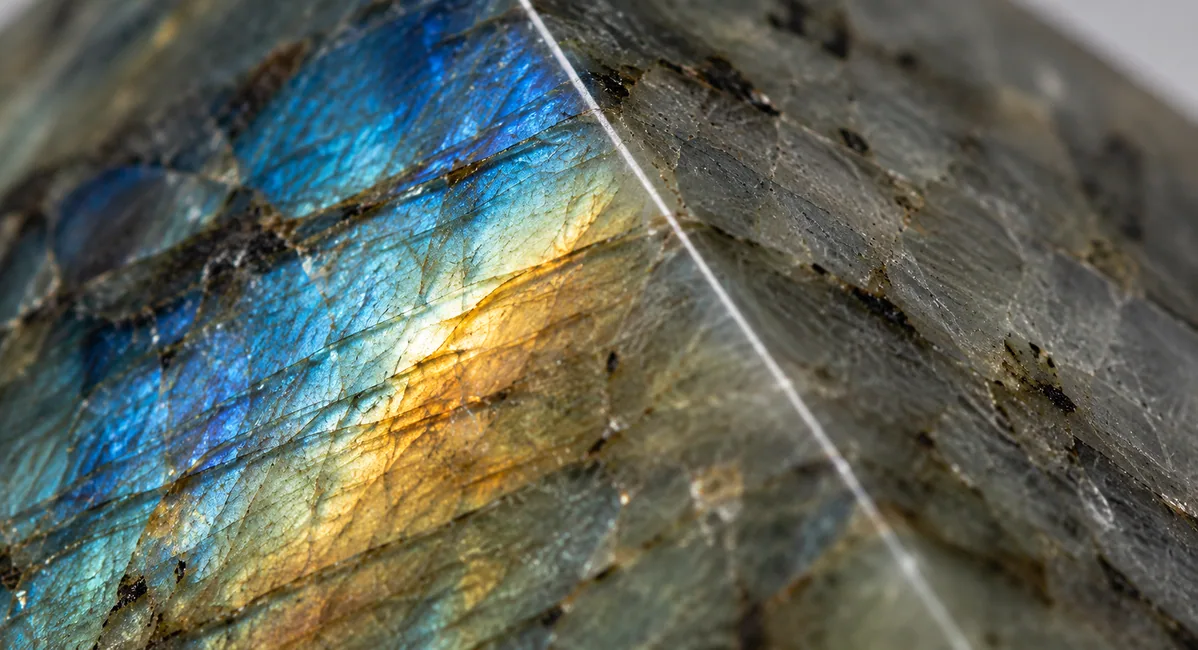
A labradorite pyramid should be assessed as both a gemstone object and a precision-shaped carving. Check whether the base is square and reasonably stable, the planes meet cleanly, and the apex is appropriately finished for its size. Slight differences in natural surface patterns are expected, but a repaired corner, loose fragment or rocking base deserves a clear description. A crack cutting through the apex can matter more for everyday durability than a small area without colour flash.
Feldspar cleavage may show up as planar weaknesses, and fractures may catch light in ways that resemble bright optical streaks. However, the presence of a bright band is not proof of a crack, and an attractive blue flash is not proof of structural soundness. Look for discontinuities that reach an edge, chips along corners, areas that seem filled with transparent resin, and colour sitting on top of a film rather than inside the surface. A professional assessment is appropriate when the price depends on a disputed feature.
The final cutting direction is a commercial trade-off. A lapidary artist may orient the rough to give one strong flash on the front face, while another cut may spread moderate flash across more faces. Neither outcome is necessarily wrong. Aesthetic preference depends on whether the customer wants a striking single-view showpiece or a calmer all-round object on a central table. The listing should say which result the buyer is receiving.
Avoid scratch tests, knives, open flames, household acids, impact tests or prolonged submersion as do-it-yourself authentication methods. Those can damage the specimen or its finish while failing to identify the mineral. A neutral-light photo sequence, a sound base and an honest material description are far better first steps, especially for online orders.
Vastu symbolism: colour, intention and the eight directions
A polished labradorite pyramid is a modern gemstone display that can be interpreted within contemporary Vastu and spiritual practices. Its recurring shift between dark ground and illuminated colour makes it a meaningful symbol for reflection, change, patience and seeing a situation from different perspectives. Some crystal traditions associate it with intuition, protection and transformation. These are the interpretive meanings people attach to the object; they need not be forced into a claim that an ancient architectural text mandates a labradorite pyramid in one specific corner.
Pancha Mahabhuta supplies a useful traditional vocabulary: Prithvi (earth), Jala (water), Agni (fire), Vayu (air) and Akasha (space). A natural carved mineral readily evokes Prithvi through physical substance and steadiness. Blue and green flashes may evoke Jala, sky, growth or calm in a modern symbolic reading. Such colour associations should not be presented as fixed mineral laws. Different lineages and contemporary practitioners may assign different correspondences, and the relevant room function, household custom and intention matter.
The eight-direction framework, Ashta Dik, names east (Purva), south-east (Agneya), south (Dakshina), south-west (Nairritya), west (Paschima), north-west (Vayavya), north (Uttara) and north-east (Ishanya). Familiar Vastu discussions associate north-east with prayer or contemplative activity, east with beginnings, and north with certain prosperity or work intentions. A blue-green labradorite piece may be selected to complement such a setting, but a universal “north-east only” instruction ignores floor plan, tradition and the actual person using the space.
For someone conducting a simple devotional practice, Sankalpa—the deliberately stated intention—can give the display meaning. A person may keep the pyramid beside a written goal for study, reflective work or home harmony and use it as a visual reminder during a few quiet minutes. That is different from declaring the object an obligatory yantra, consecrated murti or classical graha remedy. If a family follows a prescribed puja sequence, established worship practices remain primary and the carved mineral is an optional accompanying object.
| Concept | Context for a labradorite display | Practical interpretation |
|---|---|---|
| Prithvi Tattva | Mineral solidity, support and stability | Stable shelf or tray, away from traffic |
| Jala symbolism | Blue-green appearance may suggest calm or fluidity | Optional colour association, not mineral chemistry |
| Ishanya / north-east | Often discussed for prayer and introspection | Useful only if the space is clean, dry and appropriate |
| Purva / east | Beginnings, natural light and morning activity | Arrange for comfortable viewing, not harsh exposure |
| Uttara / north | Work and prosperity symbolism in some approaches | Personal intention does not dictate a fixed mineral placement |
| Ashta Dik | Eight-direction spatial framework | Read the actual floor plan before recommending placement |
| Sankalpa | Personal or household intention | Connect the item with a clearly chosen practice |
| Navagraha / Jyotish | Chart-based planetary interpretation | No automatic labradorite prescription from its blue flash |
| Ajna / Vishuddha | Contemporary chakra-colour associations | Schools differ; avoid claiming a universally mandated chakra stone |
Jyotish and gemstones: why labradorite is not an automatic graha substitute
In Jyotish, traditional gemstone recommendations are generally discussed with reference to a person’s Kundali, Lagna, Graha conditions, Dasha, relevant house lordships and lineage-specific methods. Classic recommendations frequently involve well-known stones such as Manikya for Surya, Mukta for Chandra or Panna for Budha, subject to the practitioner’s full assessment. Labradorite’s blue or green appearance alone does not make it interchangeable with a named planetary gemstone.
Some contemporary sellers describe labradorite as a Chandra, Rahu or Ketu stone, or associate its flash with Ajna or Vishuddha chakra. These may be meaningful within specific modern practices; they should be identified as such rather than stated as unanimous classical Jyotish rules. If a customer seeks a planetary remedy, that question belongs in an individual astrological consultation, not in a universal material-care article.
There is also a distinction between owning a gemstone object for aesthetic or devotional purposes and wearing a prescribed Ratna with a particular metal, day, mantra or ritual process. A tabletop pyramid should not inherit all instructions intended for a finger ring or pendant. This distinction keeps the article useful for both devotees and buyers who simply appreciate a striking natural feldspar carving.
Where to place a labradorite pyramid in a Bengaluru home
Imagine a Bengaluru apartment with a small north-east reading corner. The resident likes labradorite’s blue-green flashes and associates them with reflection before study. The practical first step is a firm, uncluttered shelf with enough space that the apex cannot be hit by a closing cabinet door. In one position, the face appears charcoal grey. Rotating the base slightly toward the reading chair reveals the blue plane under the existing lamp. That is a better adjustment than insisting that all sides should shine or moving the object into a damp window recess.
A family puja area may contain diyas, incense, flowers, turmeric, kumkum and vessels for water offerings. Keep the labradorite on a separate dry stand rather than beside oil drips, flames or frequently washed brass items. The family may select its position according to its existing practice and Sankalpa, but there is no reason to immerse a finished feldspar pyramid in salt water or expose it to steam as an “activation.” Such treatment creates unnecessary care risks.
On a shared work desk, choose a smaller piece whose base is not surrounded by phone chargers, cups or stacked books. A pyramid placed where hands frequently reach for a mouse is more likely to be knocked than one on a modest side shelf. If the stone has one especially beautiful blue face, orient it toward the person who uses the space most often. The changing visual effect may be appreciated without making promises about workplace performance or decision outcomes.
Consider natural light across the day: in the morning the colour may appear from the east; by evening the same face may show little effect unless a lamp is repositioned. That is normal optical behaviour. Heavy sunlight or hot display conditions are unnecessary. Where children or pets can reach the shelf, keep the pointed object in a secure enclosure or choose a safer location rather than a precarious ledge.
| Setting | Suggested layout | Main consideration |
|---|---|---|
| Puja-adjacent shelf | Separate stable dry stand with chosen Sankalpa | Avoid ritual oils, incense heat and wet cleaning |
| Study corner | Best-flash face oriented to seated view | Prevent knocks from books or cabinet doors |
| Living-room display | Neutral tray with comfortable viewing angle | A muted side is normal when the viewer moves |
| Office desk | Small stable piece away from working edge | Keep away from cups, cables and frequent handling |
| Window shelf | Moderate indirect light with secure footing | Avoid dripping condensation, rainfall and thermal shock |
| Children or pets present | Protected display case or inaccessible shelf | Sharp tip and chipped edges can cause injury |
Jewellery showroom, retail display and professional Vastu consultation kit
In a Bengaluru jewellery showroom, a labradorite pyramid makes an effective teaching example of angle-dependent optical phenomena. Display the actual specimen at rest with a small card describing it as plagioclase feldspar. A customer can view the stone from one safe side and observe the flash with a staff-assisted gentle rotation on a padded stand. A second photograph should show the ordinary grey face and the exact size. A description that says “blue flash appears mainly on front face” is more trustworthy than saying “blue fire everywhere.”
For a professional Vastu reference kit, store the labradorite separately from harder quartz points and metal items. Include a label recording trade name, mineral family, actual photographed specimen number, treatments if known, dimensions, strengths and limitations of its optical effect, and the user’s chosen symbolic associations. A comparison tray could include sunstone, a traditional moonstone, rainbow moonstone and dark labradorite; each should be labelled to avoid suggesting all are identical.
If the consultation concerns a customer’s planetary needs, the mineral demonstration remains separate from the client’s chart-based recommendation. A practitioner can explain the optional reflective symbolism of labradorite without presenting it as a mandatory Navagraha cure. For a commercial Vastu discussion, record the office orientation, purpose, traffic flow and available safe display location before discussing decorative placement. The object cannot compensate for an unstable shelf or obstructed route.
For gifting, include a short care card: “Natural labradorite feldspar; flash varies by viewing angle; handle by base; avoid impact, steam and ultrasonic cleaners; clean gently and dry promptly.” If the item is a mixed batch, provide a reasonable variation statement. Do not add claims of independent gem grading, a specific mining country or laboratory certification unless the particular stock has supporting records.
Buying checklist: exact unit, grading, price and packaging
Start with verifiable descriptions: height, base width, weight range, quantity, mineral identity, colour and treatment information. The exact amount of bright flash can materially affect a purchaser’s preference, so a seller offering individually selected pieces should show the real unit. When a shop sells a batch of similar carvings, specify the variation in flash colour, coverage, small inclusions and natural pattern. A generic hero photograph should be marked as representative rather than exact if that is how inventory is handled.
Ask what a quoted “AAA labradorite” grade actually measures. There is no universal grading standard that makes such a marketplace label independently equivalent between sellers. Stronger colour, better coverage, symmetry, smooth polish, large size and documented sourcing may affect value, but the customer should know which characteristics are being priced. Avoid equating the brightness of one flash with the mineral’s age, purity or spiritual merit.
If a seller charges a premium for “Finnish spectrolite,” request the country and acquisition evidence. “Madagascar labradorite” may be a legitimate commercial description when provenance is established, but colour alone is not a reliable geographic test. Retailers should also disclose any coatings, fillings, glued sections or substantial repairs. Some fractures are natural; others may create a structural risk to a thin pointed carving.
In shipping, a pyramid needs protection around its apex and all four corners. Individual soft wrapping should prevent the item from rattling against other stones; a rigid outer box and appropriate cushioning should take shocks without compressing the tip. Ask whether the return policy covers transport damage and whether the buyer should retain packaging photographs. This is especially relevant when ordering several display pyramids at once.
| Check | Evidence to request | Why it matters |
|---|---|---|
| Exact material | Natural labradorite/feldspar identification; known tests if claimed | Avoid confusing glass or a coated substitute |
| Actual colour flash | Same specimen in neutral light and turning video | Shows limited or broad flash coverage honestly |
| Size/weight | Measured height, square-base dimensions and weight | Useful for space planning and fair comparison |
| Craftsmanship | Apex and four sides clearly photographed | Reveals chips, glue, repairs and asymmetric base |
| Surface treatment | Description of coating, filling or colour alteration if present | Affects value and choice of cleaning |
| Country claim | Traceable source records where asserted | Blue flash alone does not establish locality |
| Grade claim | Seller-defined criteria such as flash coverage and finish | Avoid relying on universal-sounding marketing labels |
| Packaging | Individual wrap, tip protection and firm external box | Protects cleavage-prone corners during transport |
| Return condition | Clear rule for damage on arrival and photo documentation | Important for fragile polished objects |
Cleaning, handling and storage: protect the flash by protecting the carving
Routine care is straightforward when approached conservatively. Dust with a clean, soft, dry cloth, supporting the pyramid by its base rather than pinching its tip. If the finish and any adhesives are known to tolerate moisture, use a slightly damp cloth and dry promptly; do not leave the stone immersed. An old coating, repaired seam or unknown filling calls for even more caution. Keep abrasive powder, metal scrubbers, household cleaners and acidic liquids away from the polished faces.
Avoid ultrasonic cleaners and steam cleaners. Feldspar has cleavage and can contain internal fractures, while rapid temperature changes and machine vibration introduce avoidable risk. The GIA’s gemstone cleaning guidance notes special caution for feldspar materials. A pyramid need not be submerged in water, salt or vinegar to remain attractive. Do not attempt to “test” hardness by scratching a hidden corner; hidden damage is still damage.
When lifting or moving the carving, use a soft mat underneath. Keep it away from metal keys and other loose items in drawers; store it in a separate padded compartment if it belongs to a professional kit. Do not stack pyramids tip-to-base, even when individually wrapped in thin paper. A stable cloth-lined box and sensible humidity control are better than a damp bathroom cabinet or a sun-heated vehicle.
Inspect periodically under neutral light for new chips, lifted coatings or a repaired area that has opened. If an edge breaks, preserve fragments safely and ask a qualified lapidary or restoration professional whether repair is appropriate. Do not improvise with aggressive solvents or household glue on a valued or historically significant specimen. Cleaning should maintain the object’s condition, not attempt to alter its optical effect.
| Method or situation | Recommended response | Reason |
|---|---|---|
| Dry dusting with soft cloth | Recommended for routine care | Minimizes abrasion and moisture exposure |
| Slightly damp wipe | Only when finish and adhesives tolerate it; dry at once | Avoid trapped moisture in repaired areas |
| Salt-water soaking | Avoid | Unnecessary exposure to salts, water and possible seams |
| Steam or ultrasonic cleaning | Avoid | Cleavage, internal fractures and thermal/vibration risk |
| Vinegar, acids and abrasive cleaners | Avoid | Can damage finish or associated treatments |
| Puja oil, perfume and coloured powders | Keep separate | May stain coatings or collect in fissures |
| Moving home or shipping | Wrap separately; cushion apex and corners | Reduces impact damage |
| Persistent chip or suspicious coating | Seek qualified help, avoid DIY testing | Prevents further damage to actual material |
Frequently asked questions about labradorite pyramids
Is a labradorite pyramid fake if one side looks completely grey?
No. Labradorescence can be strongly directional, so a grey face may simply be outside the viewing angle. Ask for a full rotation of the actual carving and honest material information.
Does every face need to show the same blue flash?
No. A lapidary may orient the rough to concentrate strong flash on one face. Consider whether a single striking presentation face or more evenly distributed moderate flash suits the display.
What causes labradorite to show blue and green colours?
Light interacts with very fine lamellar structures inside feldspar, producing interference-based colour effects. The geometry changes when you rotate the material.
Can the colour flash disappear in ordinary room light?
Yes, because lamp position, intensity, camera exposure and viewing angle change the visible effect. The underlying stone has not necessarily changed.
Is labradorite natural glass?
No. Labradorite is a crystalline plagioclase feldspar; natural volcanic glass such as obsidian is a different kind of material.
Is labradorite the same as moonstone?
Both belong to the feldspar family, but traditional moonstone is known for adularescence and labradorite for labradorescence. Rainbow moonstone is a commercial name often applied to light-coloured labradorite.
Is spectrolite always a separate gemstone species?
No. Spectrolite is a trade designation associated especially with highly iridescent Finnish labradorite. Ask for provenance if that origin contributes to price.
Can one determine Canada or Madagascar origin from blue flash?
No. Flash alone cannot establish a country of origin. Seek traceable records before accepting geographic claims.
Is a vivid blue coating the same as natural labradorescence?
No. An applied colour film is a treatment or manufactured effect; natural labradorescence arises from internal structures. An expert may be needed to distinguish disputed cases.
What is the Mohs hardness of labradorite?
Common mineralogical references give approximately 6 to 6.5. It can still chip because hardness is not the same as toughness or resistance to cleavage.
Can I use a metal key to test authenticity?
Do not. Scratch or impact tests can damage a finished carving and often cannot establish its precise identity.
Can a labradorite pyramid be kept near a diya?
Keep it on a stable separate shelf away from flame, hot metal, spilled ghee, water and incense residues. It need not be directly heated to support personal devotional intention.
Is north-east the only correct Vastu location?
No one placement rule applies to every home or school. Consider Ishanya, other directional concepts, the room function, the owner’s Sankalpa and the actual safe display location.
Is labradorite a classical substitute for a planetary gemstone?
Not automatically. Jyotish recommendations depend on the Kundali and tradition; the colour of a tabletop carving does not establish equivalence to a prescribed Ratna.
Which chakra is associated with labradorite?
Some contemporary crystal practices associate its blue flash with Vishuddha or Ajna, but associations vary and are not a universal classical gemstone rule.
Can I cleanse it by soaking it in salt water?
Salt-water soaking is not recommended, especially if the pyramid has fractures, repairs, coatings or unknown adhesives. Gentle dry cleaning is safer.
Are steam and ultrasonic cleaning suitable?
No. Conservative care avoids these methods because feldspar cleavage, internal fractures and potential treatments increase the risk of damage.
Will brighter labradorescence guarantee higher spiritual benefit?
Flash intensity is an optical and commercial characteristic. A spiritual association belongs to the person’s chosen practice rather than a measurable promise derived from brightness.
What should a vendor show before I order?
Request measured dimensions, neutral-light images, a turning video of the actual or representative batch, underside and apex views, plus treatment and origin disclosures.
How should a professional Vastu kit label this stone?
Record labradorite/plagioclase feldspar, the specific specimen number, flash direction and colours, dimensions, known treatments, handling guidance and separately the optional traditional symbolic interpretation.
Research basis and final selection summary
The mineral and optical discussion draws on Mindat: Labradorite for the plagioclase series, hardness, cleavage and lamellar origin of labradorescence; the Gemological Institute of America’s explanation of optical effects in phenomenal stones and its feldspar/moonstone material descriptions; GIA’s distinction between rainbow moonstone and traditional moonstone; the International Gem Society’s discussion of spectrolite and cutting orientation; and the Slovenian Natural History Museum’s discussion of Finnish spectrolite. These sources provide mineral facts and commercial terminology rather than a single universal Vastu prescription. They are named for research transparency without adding repeated commercial external hyperlinks.
For an informed purchase, confirm the real mineral first; judge both ordinary grey body colour and directional flash; check the apex, corners, base and any repairs; request a sensible treatment and origin description; decide on a stable viewing position; and care for the feldspar gently. A family may appreciate the stone’s symbolism of perspective and reflection within its own Vastu or Sankalpa practice. The resulting purchase should be a well-identified, attractive, durable-enough object whose optical charm and traditional meaning are both explained accurately.
Explore existing OmmRudraksha collections
Browse Vastu for the existing collection, or explore gemstone products for other material forms. Each product’s construction and care information should guide your choice.