Lapis lazuli, sodalite and amazonite belong together in a useful blue-and-green gemstone comparison, but they are not interchangeable stones. Lapis lazuli is a rock with a prized history in jewellery and pigments, sodalite is a distinct mineral that often carries white veins, and amazonite is a blue-green feldspar whose stripes and cleavage make it different from both. When all three are offered as polished tumbled stones, colour alone can conceal those differences. Their material identity, customary symbolism, appearance and suitability for a home or Vastu display deserve separate attention.
A carefully selected set gives a person more than three attractive pebbles. It teaches how to distinguish royal blue from violet-blue and turquoise-green; how to read calcite, pyrite and feldspar streaks; how to choose stones for a prayer room or study desk; and how to understand a modern chakra or Vastu association without confusing it with the classical Navaratna prescription used in Jyotisha. The following guide is intended for buyers, collectors, jewellery retailers and practitioners assembling labelled demonstration kits.
At a glance: three blue-looking stones, three different materials
Under the same daylight, a group of lapis, sodalite and amazonite may appear like shades of a single blue family. A closer look reveals why accurate identification matters. The word lapis does not name a single mineral species. Sodalite does name a mineral species. Amazonite names a coloured variety of the mineral microcline. Those are three different kinds of naming, and the differences affect what can be stated in a product description.
| Feature | Lapis lazuli | Sodalite | Amazonite |
|---|---|---|---|
| Material identity | Metamorphic rock composed of several minerals; blue sodalite-group minerals such as lazurite are important constituents | Mineral belonging to the sodalite group | Green to blue-green variety of microcline feldspar |
| Frequent appearance | Rich ultramarine to violet-blue; white calcite or small brassy pyrite flecks may occur | Blue to violet-blue, often with irregular white veins or patches | Blue-green, sea-green or turquoise-green, often streaked or mottled with pale feldspar |
| Useful observation | Consider the entire pattern, not just the presence of gold-coloured specks | Observe areas of blue beside white veining, without assuming every piece follows one pattern | Look for feldspar-style pale streaking and distinctive greenish cast |
| Typical Mohs hardness | Approximately 5–6, varying with rock constituents | Approximately 5.5–6 | Approximately 6–6.5 |
| Buying question | Is it dyed, waxed, oiled, reconstructed or otherwise treated? | What supports the identification and has any colour enhancement been used? | Is it natural microcline amazonite, and is any coating or impregnation disclosed? |
Hardness indicates resistance to scratching, not immunity from cracking or chipping. Amazonite belongs to a feldspar family with cleavage planes; it can fracture when a tumble is dropped even if its measured hardness is higher than that of lapis. Moreover, mineral properties describe an identified specimen, not a guarantee based on a website photograph.
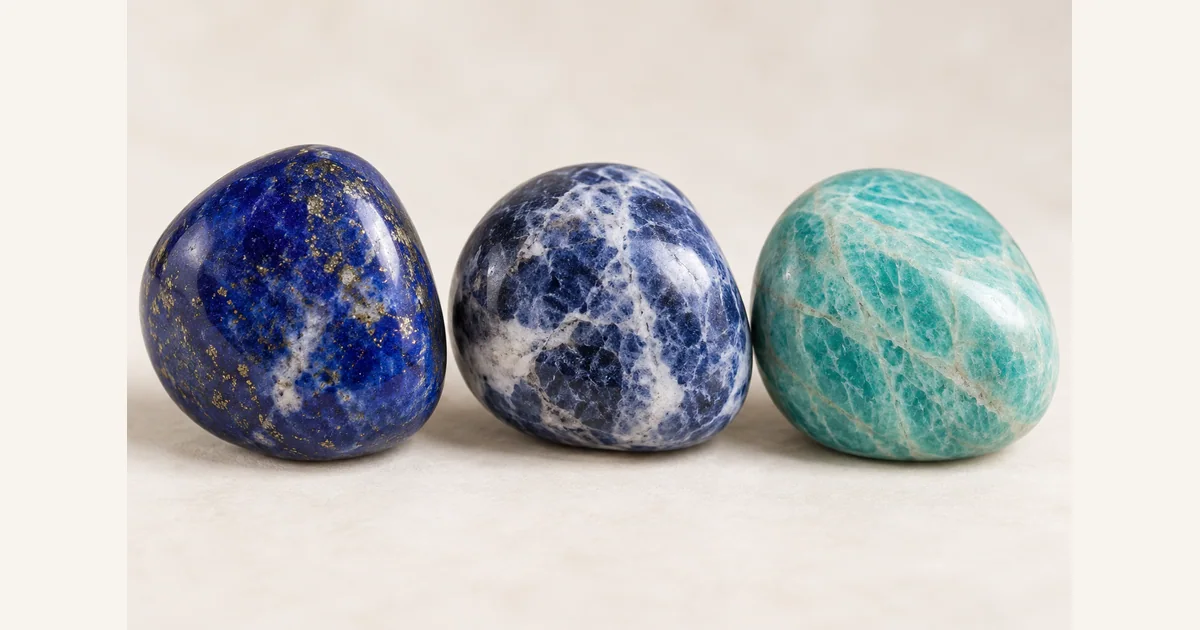
1. Lapis lazuli: the deep-blue rock with a long artistic history
The appeal of lapis lazuli lies in a saturated blue colour that has been admired in beads, carved objects and decorative arts for thousands of years. Lapis travelled from Central Asian mining regions to workshops in different parts of the ancient world, and finely prepared lapis was historically used to produce the blue pigment known as natural ultramarine. This artistic story explains why the material is often associated with refinement, wisdom and sacred imagery. It does not mean every modern lapis pebble carries one scientifically established spiritual effect.
In geological terms, lapis lazuli is an aggregate, not a single crystal. Its blue colour is associated with minerals of the sodalite group, especially lazurite, within a mixture that may also include calcite and pyrite. A natural piece may have white veins, blue patches of different intensity or fine metallic-looking grains. A nearly uniform blue stone and a visibly patterned stone can both be lapis; quality assessment depends on colour, composition, treatment, workmanship and the buyer’s purpose.
What do the gold flecks and white patches mean?
Small, brassy flecks in lapis are commonly pyrite. They look gold-coloured but are not native gold. White veining commonly comes from calcite. A delicate scattering of pyrite can be attractive, while large areas of white may make a specimen less desirable to someone seeking a continuous deep-blue colour. In a teaching collection, however, the specimen with clear calcite is especially valuable because it reveals that lapis is a rock made from several mineral components.
Pyrite does not automatically prove that a specimen is genuine lapis. Other blue materials or imitations can contain added metallic-looking particles. Equally, a lapis piece without visible pyrite should not be dismissed purely on that observation. Consider several characteristics together and obtain appropriate identification for valuable specimens.
Colour improvements and important trade descriptions
Lapis is sometimes dyed to strengthen its colour or disguise pale areas. Wax or oil may also be used to improve surface appearance; reconstructed material or imitations may be sold in the same marketplace. These treatments do not prevent the material being used decoratively, but the product name and price should reflect what is actually supplied. A listing should never imply that “royal blue”, “Afghan” or “premium” proves a natural, untreated specimen or a particular mining origin.
A practical buying record might say: “Lapis lazuli tumbled stone; medium-to-deep blue with visible calcite and occasional pyrite; treatment reported as [supplier statement]; approximate dimensions and specimen count supplied.” Where treatment is not known, keep the record as “not confirmed” instead of inventing certainty. This matters for both customers and later replacement of stones in a demonstration set.
2. Sodalite: blue mineral, often with white veining
Sodalite has its own mineral identity. It is an aluminosilicate mineral belonging to the sodalite group, and polished commercial specimens commonly display medium-to-dark blue areas interrupted by white or pale irregular patterns. The resemblance to lapis is understandable because related minerals can contribute to lapis lazuli, but a sodalite tumble is not automatically a lower grade of lapis. It is a separately named material with its own texture, composition and market.
Many sodalite stones have a soft violet or greyish cast under natural light. Some are predominantly deep blue; others are patchy and white. The white patches may be other associated minerals, often calcite in commercial material. The exact mineral mixture cannot be determined from a casual image. Buy two different pieces of sodalite for a teaching set if possible: one showing broad blue areas and another with strong white veining. Together they demonstrate a realistic range without suggesting the entire category has a single appearance.
How to distinguish a blue sodalite from blue lapis in practice
A common retail shortcut says “lapis has gold spots and sodalite has white spots.” It is memorable but incomplete. Both materials can show light veins, and not all lapis reveals pyrite at the surface. A better comparison uses multiple observations: the general colour under consistent light; the distribution of white patches; the possible presence of brassy inclusions; the seller’s naming and sourcing statement; and, for a valuable or disputed stone, a gemological examination.
A sodalite that lacks visible pyrite may be a good candidate for a sodalite-labelled teaching sample, but its absence cannot independently establish the mineral identity. Likewise, a very intensely blue product photograph can reflect lighting or colour enhancement. In a professional reference kit, labels should identify what is confirmed, what is supplier-described and what remains untested.
Symbolic meaning in present-day gemstone practice
Sodalite is widely used in modern crystal collections as a symbol of measured speech, clear thinking and reflection. Its blue colour makes it a common choice for contemporary Vishuddha (throat-chakra) arrangements, where the practitioner uses colour as a visual reminder to speak thoughtfully. This blue-stone connection is a later interpretive practice, not a historical rule that every Sanskrit account of the chakra prescribes sodalite. A more meaningful arrangement is one in which the user understands why the stone has been chosen and can identify it accurately.
3. Amazonite: blue-green microcline, not turquoise
Amazonite is a variety of microcline feldspar. Its colour ranges from subdued green to luminous blue-green and may be crossed by pale streaks or patchy zones. Some specimens show a cloudy mix of green-blue and white, while others are more uniform. The overall hue often resembles turquoise or sea-glass, which is why amazonite can be mislabelled in mixed tumbled-stone sets. Its mineral group is nevertheless different from turquoise, chalcedony or lapis.
Feldspar cleavage is an important physical feature. A polished amazonite pebble may have a glossy surface but can still break along internal planes when struck. Therefore it should be kept in an individual cell rather than scattered loosely with harder quartz pebbles. If the piece already has a crack or a pointed rim, it belongs in a protected reference tray, not in a bag designed for repeated handling by a large classroom.
Amazonite versus turquoise or dyed howlite
Turquoise is a hydrated copper-and-aluminium phosphate mineral, while amazonite is potassium-rich feldspar. Blue-dyed howlite or magnesite introduces yet another category. The difference matters in gemstone jewellery, where identity affects pricing and customer expectations. Neither bright colour nor the presence of white streaks offers an absolute visual test. A seller should state the material honestly, rather than using “turquoise”, “amazonite” and “blue crystal” as interchangeable decorative names.
For selecting amazonite, favour a clearly identified specimen with a pleasant polish, credible colour and a pattern that matches the intended purpose. In a teaching set, visible white feldspar streaks are helpful. For a small home arrangement, a modest smooth pebble that is easy to place may be more practical than an oversized or fragile specimen. Check for fillings, unusual surface coating and contradictory trade descriptions if the stock seems unusually vivid or cheap.
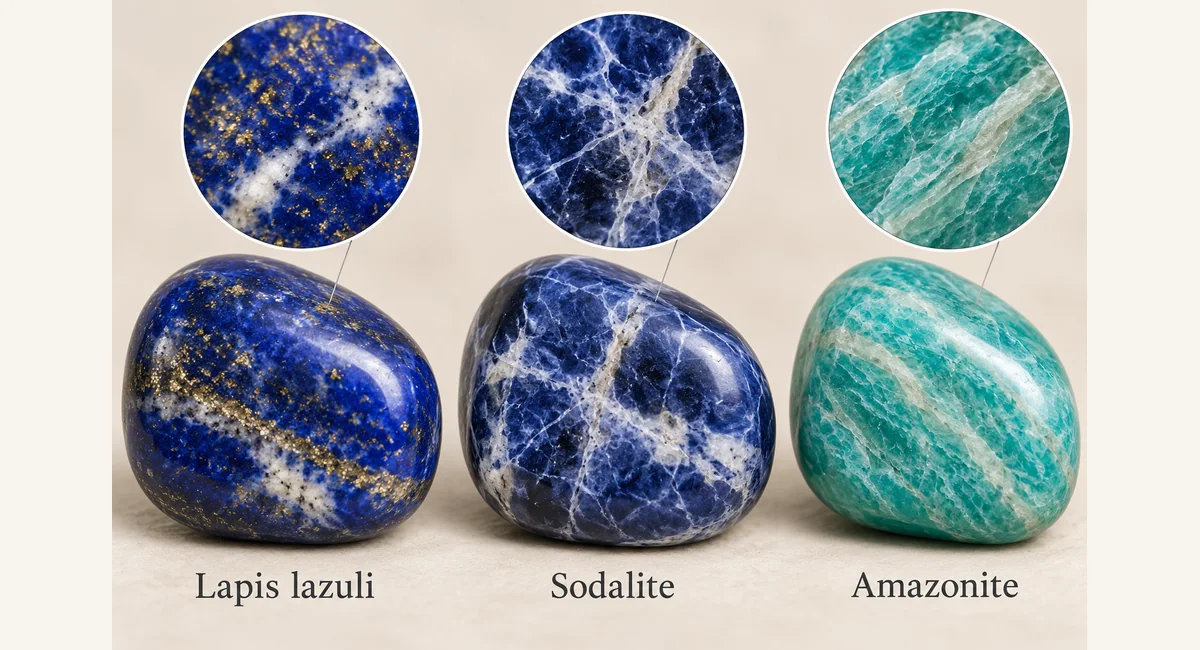
4. Recognise the stones without relying on one magic test
Identification begins with observation, not with a household chemical or scratch experiment. Set the three specimens on the same neutral cloth or card under indirect daylight. Rotate each one slowly and record the body colour, pattern, metallic-looking specks, translucency, visible fractures and surface texture. Compare the actual objects, because two samples from the same commercial lot may look different.
| Observation | What it may suggest | What it cannot establish by itself |
|---|---|---|
| Deep rich blue with white calcite-like areas | Lapis lazuli is one possibility | That the specimen is untreated lapis, or that the origin is Afghanistan |
| Blue-violet body with irregular white veins | Sodalite is one possibility | A conclusive sodalite identification or a complete separation from lapis |
| Brassy metallic flecks against blue | May indicate pyrite in lapis | That the whole pebble is natural or untreated lapis |
| Blue-green body with pale feldspar streaks | Amazonite is a useful comparison candidate | That the stone cannot be dyed, coated or another lookalike |
| Unusually uniform saturated colour | Worth asking about dye, coating or manufacture | Proof of treatment; some natural pieces are naturally even-coloured |
| Abrasion or chipped corners | Handling and storage conditions require attention | A unique mineral identification |
Photography should be treated as a viewing aid. A photograph taken under a yellow bulb can make amazonite look greenish grey; vivid lighting can intensify lapis. Ask for the actual lot photographed beside a neutral background and, where appropriate, a size reference. Avoid rubbing unknown stones with solvents, using acid drops, heating, soaking or attempting destructive scratch tests in a customer-facing showroom. Valuable or disputed specimens belong with a qualified gemologist for appropriate non-destructive identification.
5. What these colours mean in Vastu and Indian spiritual displays
Vastu Shastra places importance on orientation, spatial organisation, the uses of rooms, proportion and the qualities associated with the directions. The Pancha Mahabhuta framework speaks of earth, water, fire, air and space as a way of describing the natural world. In contemporary Vastu merchandising, polished gemstones are often arranged as visual reminders of those principles. This can be meaningful, but a particular modern retail set of lapis, sodalite or amazonite should not be presented as a mandatory formula found in every classical Vastu text.
The traditional eight-direction framework refers to east (Purva), southeast (Agneya), south (Dakshina), southwest (Nairritya), west (Paschima), northwest (Vayavya), north (Uttara) and northeast (Ishanya). Commonly cited Dikpala associations include Indra in the east, Agni in the southeast, Yama in the south, Nirrti in the southwest, Varuna in the west, Vayu in the northwest, Kubera in the north and Ishana in the northeast. These directional associations provide a traditional conceptual framework; selecting a modern blue stone for a zone is an additional design choice.
Three ways to use colour without turning it into a rigid prescription
| Stone | Contemporary symbolic theme | Possible setting | How to explain it accurately |
|---|---|---|---|
| Lapis lazuli | Depth of thought, learning, contemplation and dignity | Study or meditation shelf; a blue accent in a symbolic west/water discussion | “Chosen for its historic blue colour and reflective symbolism”, not a universal Vastu remedy |
| Sodalite | Clear speech, disciplined thinking and honest dialogue | Desk, teaching room, discussion space or Vishuddha colour display | “A modern blue-stone correspondence used for mindfulness and communication” |
| Amazonite | Composure, balance, refreshing colour and calm communication | Quiet corner, reception area, art table or greenery-themed display | “A contemporary decorative or symbolic choice, not traditional turquoise or a Navaratna replacement” |
For a home, choose placement based first on whether the shelf is safe, clean, accessible and appropriate to its use. A small lapis can sit beside study materials as a reminder to read with concentration. Sodalite might be placed on a communication or writing desk. Amazonite may bring a soft blue-green accent to a calm sitting area. There is no need to promise that moving a pebble from one room to another changes a building’s architecture or determines a person’s future.
Chakra references: Vishuddha and Ajna
In yogic and tantric traditions, chakra descriptions have their own symbolic systems, including lotuses, syllables, colours and deities. Modern crystal practice often associates dark blue stones with Ajna, the area commonly discussed as the brow centre, and medium blue stones with Vishuddha, the throat centre. Lapis is sometimes chosen for Ajna; sodalite for Vishuddha; and amazonite may appear in throat or heart-themed colour arrangements because of its blue-green appearance. These are contemporary gemstone correspondences, not claims that ancient texts specifically required these three commercial tumbled stones.
A meaningful practice can be simple: sit comfortably, select one correctly labelled pebble as a focus object, and spend a few minutes considering the intention of clarity, patient listening or disciplined study. A practitioner who uses mantras may follow the specific lineage they have learned rather than mixing syllables from unrelated traditions into a product promise.
Navagraha caution: similarity of colour does not make a gem a planetary substitute
Traditional Jyotisha gemstone practice distinguishes stones for the Navagrahas, and the best-known blue association for Shani is Neelam, blue sapphire, not automatically lapis lazuli or sodalite. Lapis, sodalite and amazonite can all be included in a decorative or comparative set without calling any of them a certified blue sapphire or an equivalent substitute for individual astrological recommendations. Similarly, amazonite’s green-blue hue does not make it an automatic stand-in for emerald (Panna) in Budha-related prescriptions.
For OmmRudraksha, a useful distinction is to label the collection “Blue and Green Gemstone Reference Set” when its purpose is comparison and Vastu display. If a separate product is intended for a person seeking an individual Jyotish stone, the description should identify the actual mineral, purpose and recommendation method, rather than allowing a general colour grouping to imply equivalence.
6. Assemble a nine-stone teaching set that shows real variation
A three-stone set is elegant for an introductory display, but a nine-stone reference tray teaches more because it records differences within each category. Use three lapis stones, three sodalite stones and three amazonite stones, grouped into three labelled rows. The stones need not be identical sizes; aim for comfortable handling and visibility, and choose variations on purpose instead of assuming that every piece should match the featured photograph.
| Slot | Suggested specimen | What the viewer learns |
|---|---|---|
| L1 | Lapis with predominantly deep-blue body | Colour concentration and polish |
| L2 | Lapis with visible white calcite | Rock composition and natural variation |
| L3 | Lapis with a few brassy pyrite specks | Inclusion observation without claiming definitive identity |
| S1 | Even blue or violet-blue sodalite | Typical colour range |
| S2 | Blue sodalite with prominent white areas | Pattern and associated material |
| S3 | Mottled sodalite from a separate batch | Variation between lots |
| A1 | Blue-green amazonite with pale streaks | Characteristic appearance of microcline variety |
| A2 | More green-dominant amazonite | Colour range within one trade variety |
| A3 | Amazonite with clear pale zones or a visible cleavage-related feature | Texture and careful handling |
Arrange the tray in three rows of three. Put a title card above each row and give every slot a specimen code. For example, label the third lapis stone “L3 — lapis lazuli; pyrite visible; treatment not independently determined.” If a stone is replaced, change the specimen record and take a new photograph rather than keeping the old identity statement. A professional reference kit is reliable because its record is reliable, not because its nine stones share a pleasing colour palette.
7. Three practical arrangements for home, showroom and consultation
Example A: a compact reading and meditation shelf at home
For a family apartment, choose one small lapis as the central focus and keep a sodalite to one side. A single amazonite can provide a contrasting blue-green accent. On a clean wooden or cloth-covered shelf, this creates an orderly arrangement with enough separation for each material to remain distinct. The lapis represents a commitment to learning, the sodalite prompts thoughtful communication, and the amazonite brings a visual reminder of calm. If the family also uses a deity image, diya or flowers, give the actual ritual objects safe space instead of crowding the shelf with stones.
Explain the display to family members in one sentence: “These are three different materials chosen for colour, interest and personal reflection.” It is more respectful to say that than to promise that a particular direction or arrangement will instantly alter relationships. Place the stones where children cannot accidentally put small objects in their mouths and where they will not fall against glass or tile.
Example B: an OmmRudraksha gemstone showroom comparison
In a retail counter, lay out three larger labelled samples and keep the saleable tumbled pieces in separate shallow compartments. Use a neutral card so blue-green amazonite does not take on the colour of a bright display cloth. Place a small magnifier and a simple printed comparison table nearby. Staff can point out calcite and pyrite in one lapis, white veining in a sodalite and pale streaks in an amazonite, while reminding customers that natural examples vary. Where the price depends on verified identity or treatment, the supplier record should be available.
The display can support three types of customers: someone choosing a decorative stone by colour; someone building a Vastu teaching tray; and someone comparing actual gemstone names for jewellery. Each customer may require a different answer. This reduces the risk of selling a generic “blue healing stone” as though it were a specific mineral or astrological recommendation.
Example C: a Vastu consultant’s blue-stone discussion kit
A practitioner can carry three pocket-sized samples alongside a printed eight-direction plan, without presenting the stones as permanent building rectifiers. Start with the layout and room use: entrance, natural light, study corner and movement through the space. Then bring out lapis, sodalite and amazonite to discuss how calm blue shades or contrasting blue-green hues are used in contemporary décor and spiritual practice.
For example, in a home-office discussion, the practitioner might use sodalite beside a writing desk to illustrate clear communication, lapis near a reading area to illustrate contemplation, and amazonite near plants to introduce a softer green-blue accent. Record these as aesthetic or symbolic choices; any actual recommendation about architecture, ventilation, daylight or usage comes from the site, not from the pebbles. After the session, return each piece to its labelled compartment.
8. Buying checklist: identification, treatment, sizing and price
When purchasing tumbled stones individually or for a professional set, begin with the intended function. A decorative display may prioritise colour and symmetry. A study kit needs material variety and truthful labels. A jewellery workshop needs consistent dimensions, surface quality and clear treatment disclosure. These are different purchasing criteria, so buying only by the lowest price per kilogram rarely produces the best reference collection.
| Ask the supplier | Why it matters | Useful record to retain |
|---|---|---|
| What exactly is the material? | Separates lapis rock, sodalite mineral and amazonite microcline | Commercial name, identified material and lot number |
| Are dye, wax, oil, coating or reconstruction involved? | Appearance, durability, care and pricing can change | Written treatment statement or “not verified” |
| Are these photographs of the actual batch? | Representative images may not show delivered colour variation | Actual-lot photograph against neutral background |
| What are the size and weight ranges? | Professional tray cells and jewellery assemblies need appropriate dimensions | Millimetres, approximate weight range, piece count |
| What is the breakage or replacement policy? | Chips, cracks and mixed naming affect usable stock | Accepted tolerance, replacement or credit terms |
| How is origin substantiated? | Country names should be factual rather than decorative marketing | Supplier documentation where origin is relevant |
There is no single “best blue stone” for all uses. If the customer wants an unmistakable deep-blue decorative object, a well-described lapis can be appealing. If a teacher wants to compare mineral specimens at an accessible price, sodalite is useful. If a designer wants a sea-green accent with characteristic pale streaks, amazonite may suit the palette. The best choice is the stone that matches a clearly stated purpose, is labelled correctly and can be handled and stored appropriately.
9. Cleaning and storage without losing the finish
Polished stones still require careful care. Lapis may contain mineral components with different properties and can be treated with dye or wax. Amazonite has feldspar cleavage. The simplest routine is dry dusting with a soft clean cloth and individually padded storage. For known, untreated lapis that needs cleaning, brief gentle washing with mild soap and water may be suitable, followed by prompt drying; when treatment is unknown, ask the supplier before introducing moisture or cleaning agents.
Avoid acid-based cleaners, bleach, household solvents, steam and ultrasonic cleaning for this mixed set. Solvents can affect certain lapis dyes or surface treatments. Keep stones out of a hot shop window for prolonged periods where coatings or wax may be affected. Quartz and other hard specimens should not tumble loose against these pieces in one shipping bag. For amazonite in particular, a chipped edge deserves inspection rather than further polishing or rough handling by a customer.
For routine storage, label three small padded cells, retain the purchase card and photograph each specimen before demonstrations. A professional kit should also have a simple replacement rule: replace chipped or disputed material with an accurately identified piece of the same category, update the photograph and note the date. This is more reliable than silently substituting a convenient shade of blue from an unlabelled mixed parcel.
10. Questions people ask about lapis, sodalite and amazonite
Is lapis lazuli the same as sodalite?
No. Lapis lazuli is a rock containing multiple minerals, while sodalite is a mineral species. They may share chemical-group relationships through some of the blue constituents of lapis, but they are not equivalent product names.
Are the gold-coloured flecks in lapis real gold?
They are commonly brassy pyrite, not metallic gold. The quantity and distribution vary by specimen and are not sufficient alone to authenticate a lapis tumble.
Can sodalite be used instead of blue sapphire for Shani?
A decorative sodalite and an astrological blue sapphire are different materials and belong to different recommendation contexts. Colour resemblance alone does not establish a Jyotish substitution. A specific planetary recommendation requires its own qualified consideration.
Is amazonite another name for turquoise?
No. Amazonite is blue-green microcline feldspar; turquoise belongs to a different mineral group. Both can be attractive, but the identities and price descriptions should remain distinct.
Which blue stone is appropriate for a study desk?
Choose for the intended experience. Lapis can serve as a historical and visual symbol of learning, sodalite as a reminder of measured communication, and amazonite as a softer blue-green accent. A tidy desk and good light matter more to its practical use than a strict gemstone formula.
Can these three be arranged together in a Vastu display?
Yes. A labelled three-stone arrangement can be a beautiful contemporary reference display. Keep the symbolic explanation separate from claims about classical Vastu prescriptions or astrological gemstone equivalence.
Choosing the right blue stone: final comparison
Choose lapis lazuli when deep historic blue, an aggregate texture and cultural artistry are central to the collection. Choose sodalite when a mineral reference, visible blue-and-white variation and a clear comparison with lapis are the priority. Choose amazonite when blue-green feldspar, pale streaking and a calm decorative contrast suit the purpose. If learning is the goal, use all three; they make an instructive trio precisely because their appearance overlaps while their mineral identities differ.
For an OmmRudraksha home, showroom or consultation set, the most valuable presentation combines meaningful symbolism with material accuracy: real photographs, truthful treatment statements, correctly named compartments and a clear distinction between traditional spiritual frameworks and modern gemstone colour arrangements. That combination serves both the heritage of the stones and the person choosing them.
Continue reading
- Moonstone, Labradorite and Sunstone Explained
- Green Jade and Its Common Gemstone Substitutes
- Cleaning, Storing and Handling Tumbled Gemstones
Explore the existing Vastu and gemstone collections for wider context.