Moonstone, labradorite and sunstone are all members of the feldspar family, yet they are not three names for the same gemstone. Their attraction lies in the way light moves across or through them: a moonstone can carry a gentle floating glow; labradorite may reveal a blue, green or gold patch only when turned to the right angle; and certain sunstones glitter with tiny reflective inclusions. Knowing the difference makes a home crystal arrangement more meaningful and a jewellery or Vastu demonstration much more accurate.
This guide compares the three stones at the mineral and visual levels, explains the important trade name rainbow moonstone, and then considers their symbolic uses in Indian homes, spiritual displays and contemporary Vastu practice. It also shows how to select and label actual tumbled specimens, rather than relying on colour-enhanced product photographs.
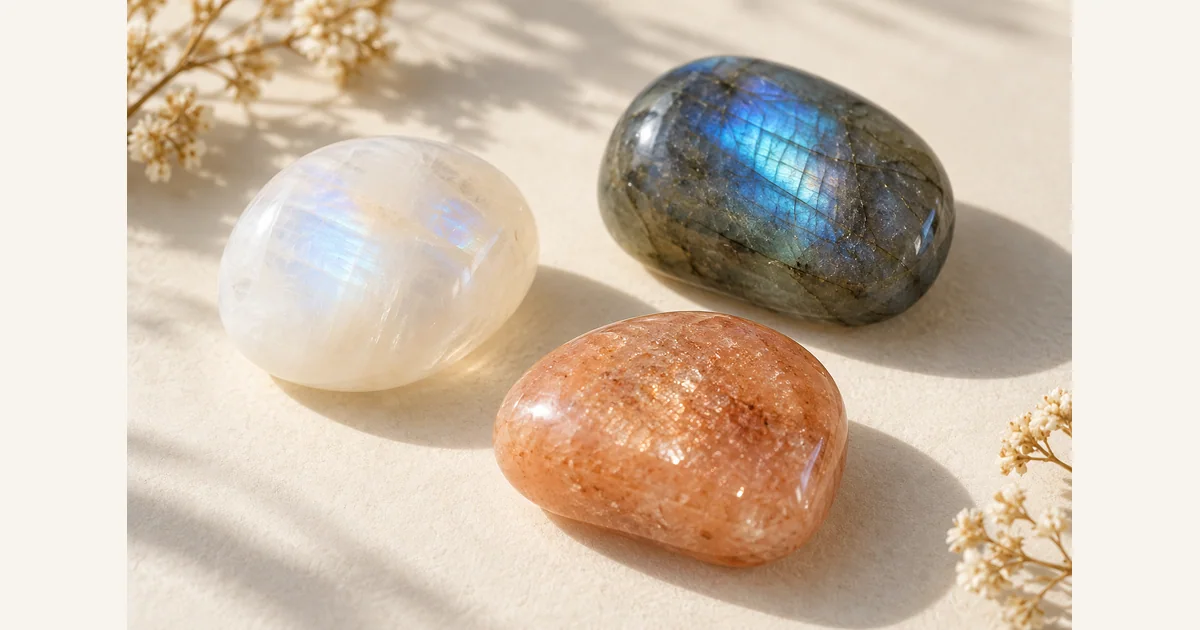
1. The feldspar connection: one family, several optical effects
Feldspar is a large family of rock-forming minerals containing aluminium, silicon and different proportions of potassium, sodium and calcium. Moonstone may occur in several feldspar compositions, with the well-known soft glow associated especially with fine intergrowth structures. Labradorite is a plagioclase feldspar, while the commercial name sunstone is applied to suitable feldspars from more than one branch of the group. A sales description that gives only the colour or a poetic name does not establish the underlying mineral species.
These stones are often sold as polished tumbles, palm stones, beads and cabochons. The form of the item changes the way the effect is seen: an evenly domed cabochon can be oriented to display the strongest glow, whereas a tumble may show one lively face and several quiet ones. A good educational set should demonstrate that difference deliberately.
| Stone | Typical appearance | Key optical feature | What to observe |
|---|---|---|---|
| Moonstone | White, cream, peach, grey or translucent body | Soft, floating adularescence | A billowing sheen that seems to move as the stone turns |
| Labradorite | Often grey to dark body; sometimes pale material | Angle-dependent labradorescence | Distinct blue, green, yellow or multicoloured flash from selected directions |
| Sunstone | Peach, orange, golden, reddish or sometimes other shades | Aventurescence in phenomenal examples | Individual sparkling reflections from minute flat inclusions |
| Rainbow moonstone | Usually light-bodied with colourful flash | Trade name commonly applied to labradorite-family material | Colourful iridescence; verify material naming with the supplier |
Important distinction: a visual effect is useful for recognising a material, but it is not by itself a laboratory identification. A white feldspar with a blue patch cannot automatically be certified as a particular species, origin or untreated variety by photograph alone.
2. Moonstone: the meaning of a floating, moonlike glow
In a classic moonstone, the light appears to float beneath the surface rather than sit on it like glitter. This effect is called adularescence. The glow may be white or bluish and can travel across the polished surface when the stone is gently rotated. A high dome or favourable orientation helps bring out the optical phenomenon; some naturally pale pieces are attractive even when the effect is subtle.
Moonstone is often selected for small meditation objects, silver jewellery, a bedside keepsake or a quiet devotional display. Its visual character invites associations with coolness, gentleness, reflection and lunar rhythm. Those are symbolic readings of the stone, not mineral properties that can be measured with an instrument. A practical buyer should inspect the actual body colour, clarity, cracks, polish and strength of the sheen.
For a three-stone teaching collection, choose a moonstone showing a broad luminous area on at least one face. If the specimen is milky and completely opaque, ask the seller whether an adularescent effect is actually present. A white tumble with no observable sheen might still be feldspar, but it is a weak choice for demonstrating adularescence.
3. Labradorite: why the same stone looks grey and colourful
Labradorite often looks subdued when viewed face-on without favourable lighting. Turn it a few degrees and a bright patch may suddenly appear. That effect, called labradorescence, is associated with fine internal structures that affect how light is reflected. The result can be a patch of electric blue, green, gold or several colours. The strongest area is not necessarily visible all around the stone.
This directional behaviour explains an otherwise puzzling customer experience: a beautiful catalogue photograph may show a brilliant flash, while the delivered stone appears grey on the table. It may simply be lying at the wrong angle. Before judging its quality, roll it slowly beneath a diffuse lamp, turn it toward the window and compare several faces. However, not every labradorite specimen has an equally strong effect, so a seller should not promise constant flash in every piece.
In modern spiritual displays labradorite is frequently selected to represent introspection, protection, boundaries or the meeting of light and shadow. A dark feldspar with an unexpected bright face works especially well in a teaching arrangement where the student can observe how perspective changes the appearance of a natural mineral.
4. Sunstone: metallic sparkle is not the same as iridescent colour
Sunstone is valued in some varieties for aventurescence: small reflective plate-like inclusions create a lively glitter. These particles may be related to copper or iron-bearing minerals depending on the material. The effect is different from a sheet-like moonstone glow or the broad flash of labradorite. Look for individual points of light that brighten and fade as the specimen moves.
Not every specimen sold as sunstone has conspicuous aventurescence. Some are sold primarily for their peach or orange body colour; others have strong sparkle. Oregon sunstone is a recognised commercial type, but the word sunstone by itself proves neither Oregon origin nor copper inclusions. Origin and treatment claims need their own evidence.
Sunstone is widely used in contemporary crystal displays for symbolic associations with brightness, confidence, creative effort and solar warmth. A small, peach-toned sunstone can be paired with a white moonstone to create a deliberate contrast of day and night. That visual symbolism is useful for display and discussion, but it should not be confused with a traditional Jyotish prescription for the Sun.
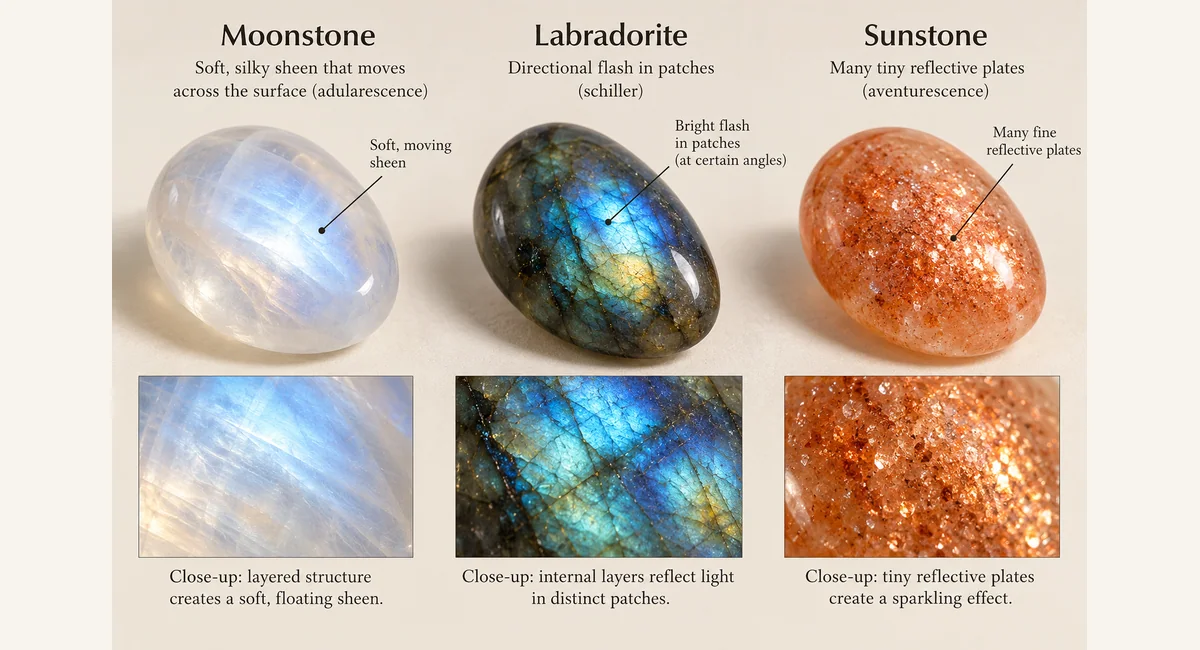
5. Compare the three stones under the same light
Place the specimens on a neutral, non-reflective cloth in indirect daylight, preferably beside a window. Observe them first without movement, then rotate each by a quarter turn. Finally, use a single ordinary lamp from the side. Do not use colour-changing LEDs as the only test: they can make subtle reflections look stronger or shift their colour. The purpose is to see how each specimen actually behaves.
| Observation | Moonstone | Labradorite | Sunstone |
|---|---|---|---|
| When the stone is still | Milky or transparent body with a possible soft glow | Often neutral grey or dark body | Peach or golden body, with or without sparkle |
| When rotated | A broad sheen shifts or floats | A coloured patch emerges and vanishes | Many small points reflect as angles change |
| Best photography | Show the moving glow over two or three angles | Show a plain face as well as the strongest flash | Show body colour and a close view of reflective points |
| Weak evidence | White body alone | One spectacular boosted photograph | Orange colour or glitter alone |
| Useful label | Moonstone — reported feldspar variety, sheen observed | Labradorite — flash colour and coverage noted | Sunstone — colour and aventurescence noted |
A single unidentified tumble should not be labelled merely from this table. A microscope, refractive-index observations on suitable surfaces or laboratory testing may be needed to distinguish closely related feldspars. For retail education, separate three things on each tag: the seller's material identification, the visible effect you personally observed, and any origin or treatment statement supported by documentation.
6. Rainbow moonstone, white labradorite and confusing trade names
“Rainbow moonstone” is a prominent trade name that deserves special attention. Much of the material marketed under this name belongs to the labradorite side of the feldspar family rather than being classic orthoclase moonstone. Its pale body and multicoloured flash are appealing, but a professional three-stone comparison should not silently place a rainbow moonstone into the moonstone compartment and then put essentially the same material into the labradorite compartment.
The correct description depends on the material actually supplied. A label such as “Rainbow Moonstone — trade name, commonly labradorite feldspar” is more informative than pretending the trade term proves a separate mineral species. Likewise, “white labradorite” is often a market description rather than a substitute for a precise mineral report. These terms are not necessarily evidence of wrongdoing; they simply require clarity.
| Name seen in shops | What it may mean | What to ask |
|---|---|---|
| White or peach moonstone | Light or warm-coloured adularescent feldspar | Does the actual piece display adularescence? How was it identified? |
| Rainbow moonstone | Often pale labradorite-family feldspar with colourful iridescence | Is it identified as labradorite, or is the name purely commercial? |
| Black moonstone | A variable commercial name for darker feldspar material | Which mineral is being supplied? Is the sheen visible? |
| Spectrolite | A term often associated with notably colourful labradorite from Finland | What origin and identification evidence accompanies the claim? |
| Oregon sunstone | Sunstone associated with the Oregon trade and deposits | Is Oregon origin documented? Are treatment claims supplied? |
| Goldstone | Manufactured glittering glass | Is it being sold openly as glass rather than natural sunstone? |
In an educational or professional Vastu set, clarity matters more than a dramatic name. When a vendor cannot establish a precise species, record the supplied trade name and the visible characteristics without inventing certainty.
7. Traditional Indian symbolism and the Navagraha distinction
Indian tradition offers a long history of relating colours, materials and ornaments to lunar and solar imagery. Chandra is associated with the Moon and Surya with the Sun in Jyotisha and devotional practice. In the familiar Navaratna gemstone arrangement, however, the Moon is represented by mukta or pearl, and the Sun by manikya or ruby. Modern promotional shorthand sometimes equates moonstone directly with “the Moon's Navaratna stone” and sunstone with “the Sun's Navaratna stone.” That conflates two different systems.
Moonstone can still be used as a lunar-themed ornamental or meditative object. Sunstone can be chosen for solar-themed decoration. Labradorite, with its changeable flash, is widely used in newer crystal practices for reflective or protective symbolism. These contemporary applications are not identical to older Jyotish gem prescriptions. If a customer seeks a prescribed planetary gemstone for personal wearing, the proper material and suitability are separate questions from choosing decorative tumbles for a shelf.
| Theme | Traditional reference | Modern decorative interpretation | How to describe it responsibly |
|---|---|---|---|
| Moon / Chandra | Pearl in the standard Navaratna set | Moonstone as a cooling or reflective visual symbol | “Lunar-themed feldspar display”; not “the prescribed pearl replacement” |
| Sun / Surya | Ruby in the standard Navaratna set | Sunstone for brightness, vitality and creative symbolism | “Solar-inspired display”; not “identical to ruby in Jyotish” |
| Change and inner perception | No fixed classical Navaratna assignment to labradorite | Labradorite for contrast, reflection and personal symbolism | “Modern crystal interpretation” |
| Home arrangement | Directions, room purpose, light and the five elements in Vastu frameworks | Loose stones as optional markers and visual aids | Explain the arrangement without claiming it is an ancient universal rule |
This distinction actually enriches the use of the stones. A person can appreciate moonstone's adularescence and lunar symbolism without treating it as a formal substitute for pearl. Similarly, a beautiful sunstone may belong in a study or creative workspace simply because its colour and sparkle suit that space.
8. Vastu placement: begin with the room, not the gemstone label
Traditional Vastu reasoning looks first at spatial order: entrance, orientation, circulation, light, ventilation and the function of the room. The five elements—Prithvi (earth), Jala (water), Agni (fire), Vayu (air) and Akasha (space)—form a symbolic language for discussing balance. Tumbled feldspar stones can be added as small visual reminders, but they are not a standardised replacement for architectural planning.
For a simple home arrangement, a white moonstone on a stable tray in a quiet contemplation area can reinforce a calm visual mood. A labradorite specimen can be used where someone frequently studies minerals or wants a reflective, layered display. An orange sunstone might brighten a writing desk or creative shelf. These are optional modern styling choices informed by colour and personal symbolism; the stone itself does not establish that a directional defect has been corrected.
| Setting or intention | Suggested stone | Practical placement | Reason for selection |
|---|---|---|---|
| Quiet reading corner | Moonstone | Small tray away from table edges | Soft glow and cool pale body colour |
| Mineral study desk | Labradorite | Near a movable daylight lamp, handled over cloth | Shows how viewing angle changes colour |
| Creative workspace | Sunstone | On a protected shelf near sketches or tools | Warm colour and visible sparkle |
| Mixed Vastu display | All three | Three labelled compartments on one neutral tray | Contrasts lunar, reflective and solar symbolism |
| Professional consultation | Three verified samples | Portable case, displayed only when relevant | Teaches material differences instead of selling an automatic remedy |
Where a client asks for a direction-based placement, first establish the actual compass orientation of the building and the use of that zone. An attractive stone in the wrong location for daily movement can create more nuisance than value. Do not obstruct a doorway, puja shelf, ventilation path or a work surface merely to follow a decorative diagram.
9. Worked example: a three-stone home display
Consider an apartment with a compact puja area, a shared living room and a study corner. The family wants an unobtrusive display rather than a collection of large crystal towers. Select a creamy moonstone with a visible floating sheen, a grey labradorite that flashes blue on one side, and a peach sunstone with modest natural sparkle. Choose stones of similar physical size so one does not dominate merely because it is larger.
Arrange them left to right on a washable cotton-lined tray: moonstone, labradorite, sunstone. Place a discreet printed card behind the set naming adularescence, labradorescence and aventurescence. The family can interpret the order as quiet reflection, changing perspective and action. That is a coherent contemporary symbolic story—not a claim that this three-stone sequence appears as a prescribed installation in a classical Vastu text.
Position the tray away from direct kitchen splashes, a child's play route and hot window glass. During cleaning, lift each stone onto a cloth before wiping the shelf. This straightforward maintenance plan matters more to the continued appearance of the specimens than a complicated placement ritual.
10. Worked example: a Bengaluru jewellery showroom
A showroom selling loose tumbles needs to explain what customers will really receive. Prepare one demonstration row with three known specimens and a second row showing ordinary stock. Beneath the moonstone place the caption “soft moving glow”; beneath the labradorite, “directional colour flash”; beneath the sunstone, “reflective sparkle—varies by piece.” Use a neutral light source and invite the customer to rotate each stone slowly.
Show two photographs of the same labradorite: one at a normal viewing angle and one at its strongest blue flash. Doing this demonstrates why a spectacular picture and a subdued in-hand appearance can both be genuine representations of the same stone. For sunstone, identify the actual glitter content of the batch rather than promising that every orange specimen sparkles. For rainbow moonstone, use a label stating the commercial name and the feldspar identity reported by the supplier.
Separate the retail price into understandable factors: material identification, strength and coverage of the optical effect, colour, size, polish, cracks, treatment disclosures and whether the buyer is receiving the pictured specimen or a randomly selected piece. The buyer then understands the difference between a reference-grade piece and a budget decorative tumble.
11. Worked example: a professional Vastu or gemstone teaching kit
A consultant who visits homes can carry six small feldspar samples: two moonstones with different strengths of sheen, two labradorites with different flash coverage, and two sunstones—one visibly aventurescent and one primarily peach coloured. The lesson is stronger with contrasting samples than with six artificially uniform stones. Pack each specimen in a separate labelled cell, with a soft cloth and simple observation sheet.
For each sample, record the supplier's material name, acquisition date, approximate size, base colour, observable phenomenon and the side from which the feature is best seen. If species or origin is not established, say so on the sheet. The consultant can use the kit first to teach recognition, then to discuss optional visual symbolism within a room. Keep Jyotish planetary recommendations separate from this decorative selection exercise.
| Cell | Example specimen | Observation task |
|---|---|---|
| M1 | White moonstone | Locate the moving pale sheen |
| M2 | Peach moonstone | Compare body colour with strength of glow |
| L1 | Grey labradorite, blue flash | Find its strongest viewing angle |
| L2 | Labradorite, weaker flash | Distinguish ordinary body colour from optical effect |
| S1 | Sunstone with visible sparkle | Recognise individual reflective points |
| S2 | Peach sunstone with little sparkle | Learn that a commercial name does not guarantee a strong phenomenon |
At the end of the demonstration, replace each stone in the correctly labelled cell. This prevents the classic kit problem: a beautiful selection that gradually loses its identities after several consultations.
12. Buying checklist: choose the actual specimen, not only a trade description
First, establish the material. Ask whether a seller is naming an identified feldspar, a known trade variety or simply a colour-based retail category. Where rainbow moonstone is involved, ask directly how it relates to labradorite. Second, inspect the optical effect. Request a short movement video in ordinary lighting and look at more than one face. Third, inspect the finish. Chips, pits, open fractures and uneven polish reduce suitability for handling and jewellery settings.
Fourth, check the order terms. “Assorted natural stones” may mean considerable variation in colour and flash; “specimen as pictured” has a different expectation. For professional sets, specify the minimum size range and what constitutes an acceptable visible effect. Fifth, assess the price category. Strong, well-oriented iridescence or aventurescence may command more than an otherwise similar specimen with little effect. Size alone is not a reliable quality grade.
A reliable supplier should not guarantee uniform blue flash on every labradorite tumble, insist every peach sunstone is copper-bearing Oregon material, or use the name rainbow moonstone without being able to explain its commercial usage. Transparent descriptions are a better foundation for a long-term gemstone collection than dramatic claims.
13. Care and storage for polished feldspar
Feldspars commonly fall around Mohs 6 to 6.5, but hardness describes resistance to scratching, not immunity from chipping. Many feldspars also have cleavage directions that can make a sharp impact damaging. Store the three varieties in separate compartments; do not allow them to tumble together in a loose metal box. In a teaching session, handle each sample above a cloth or padded mat.
For routine care, remove dust with a soft dry cloth. If necessary, a slightly damp cloth can be used on a sound, unmounted tumble and the surface dried promptly. Avoid abrasive powders, household acids, prolonged soaking and assuming an ultrasonic or steam cleaner is appropriate. If a stone is mounted in jewellery, consider the metal, adhesive and any other gemstones before choosing a cleaning method.
Do not place valuable display specimens on a sun-heated metal sill or an exposed edge where they can fall. A small protective case with a label for each item makes a home or professional collection easier to maintain. The objective is to keep the polish and the optical effect visible for years.
14. Frequently asked questions
Is rainbow moonstone the same as ordinary moonstone?
Rainbow moonstone is a trade term commonly associated with light-coloured labradorite-family feldspar; classic moonstone and commercial rainbow moonstone need not be the same mineral material. Ask how the seller identifies the actual stone.
Why does my labradorite look plain grey?
Its colour flash is directional. Rotate it under an ordinary lamp or indirect window light to locate the best face. Some pieces have weak or limited flash even at favourable angles.
Does every sunstone glitter?
No. Sunstone can be sold primarily for body colour, while the more visibly aventurescent examples contain reflective inclusions that produce distinct points of light.
Can moonstone replace pearl or sunstone replace ruby in Navaratna?
The standard Navaratna assignments use pearl for Chandra and ruby for Surya. Decorative feldspar symbolism and formal Jyotish gemstone selection should be described separately.
Can all three be kept together in a Vastu display?
Yes, they can form a compact and coherent visual collection when kept clean, stable and accurately labelled. Treat a particular tray layout as a modern arrangement rather than a universally prescribed traditional remedy.
15. Final comparison: glow, flash and sparkle
Moonstone invites attention through its gentle moving sheen; labradorite surprises by revealing colour at specific angles; sunstone brings a distinct form of reflective sparkle when the inclusions are present. These are genuine natural optical interests and excellent reasons to study or collect the stones. For meaningful Vastu or spiritual use, add the context of the room, the person's intention and the actual nature of each specimen. For professional buying, use precise material names, realistic photographs and observable quality criteria. The most convincing collection is not the one with the brightest marketing image—it is the one whose stones teach you something every time they are turned toward the light.
Continue reading
- Lapis Lazuli, Sodalite and Amazonite Tumbled Stones
- Fluorite, Malachite and Other Delicate Tumbled Minerals
- How to Choose Genuine Tumbled Stones
Explore the existing Vastu and gemstone collections for wider context.