Mahogany obsidian pyramids: a guide to the material, pattern and meaning
A mahogany obsidian pyramid brings two distinctive characteristics into one object: naturally glassy volcanic material and irregular reddish-brown markings against black. One face may be almost black, while another carries broad russet patches, ribbons or smoky transitions. This variation makes each carved pyramid visually different; it also means a single front photograph is not enough when selecting an item for a puja shelf, study, shop counter or Vastu display.
This guide explains what mahogany obsidian is, how to examine the brown-and-black appearance, which marks warrant questions, why glassy points and corners deserve care, and how a pyramid can be placed meaningfully within contemporary Vastu and crystal practice. It also distinguishes established geology from later symbolic interpretations, so appearance, tradition and purchasing decisions are described in their proper contexts.
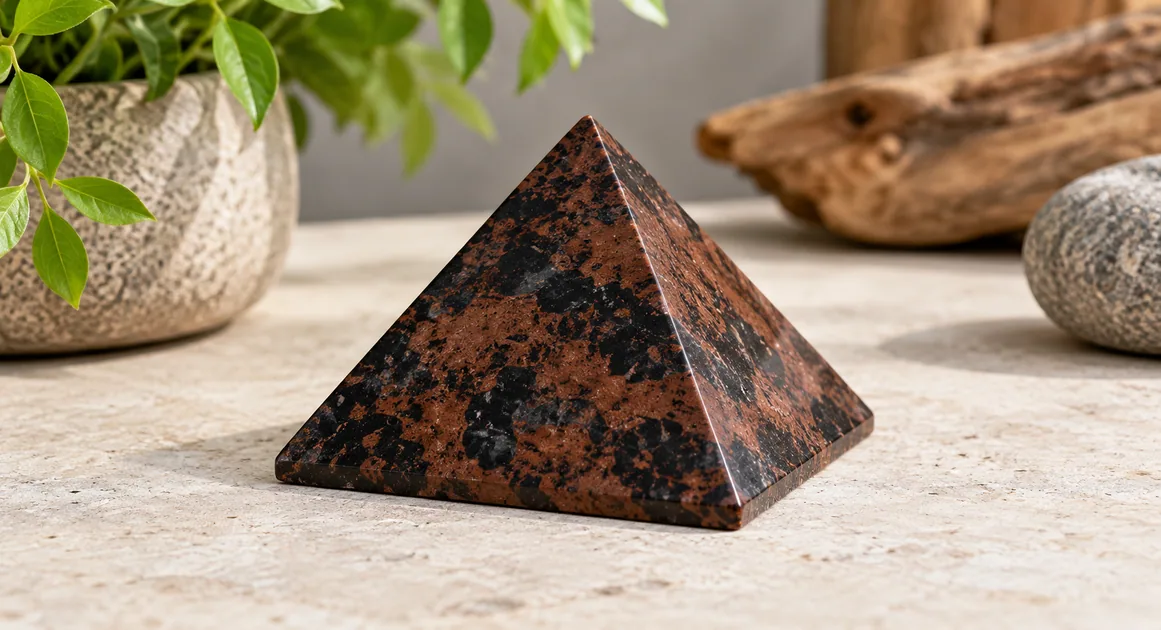
What exactly is mahogany obsidian?
Obsidian is volcanic glass, formed when silica-rich molten rock cools so quickly that much of the material does not develop a conventional interlocking crystal structure. Accordingly, obsidian is usually described as a natural glass or mineraloid rather than an individual crystal species such as quartz. The polished material can appear lustrous, almost mirrorlike, but its ability to produce sharp curved fracture surfaces is characteristic of glass.
“Mahogany” describes an appearance variety, not timber, an artificial stain specification, a laboratory grade or a particular mine. The name refers to reddish-brown, rust and dark areas resembling the colour of mahogany wood. Iron-bearing components and variations in their oxidation and distribution can influence the red-brown colouring. The exact mechanism and trace composition of one pyramid cannot be proved by appearance alone.
Fine internal bands, streaks, patches and irregular mottling can be integral to natural volcanic glass. A brown surface is not automatically a dye treatment, and a black area is not automatically a repair. Conversely, an attractive swirl by itself cannot establish natural origin. For a definite locality or laboratory identification, request credible provenance or appropriate examination.
Material facts worth understanding
| Property | Practical meaning |
|---|---|
| Material | Natural silica-rich volcanic glass; a rock/glass material, not a single crystalline gemstone |
| Appearance | Black and reddish-brown patches, ribbons, mottling or broad colour zones |
| Structure | Predominantly amorphous glass; may contain tiny inclusions or flow-related features |
| Lustre | Vitreous or glassy on sound polished surfaces |
| Hardness | Common references place obsidian around Mohs 5–5.5; a hardness rating does not remove chipping risk |
| Fracture | Conchoidal; a fresh chip may make a surprisingly sharp cutting edge |
| Cleavage | No regular mineral cleavage planes characteristic of a crystal |
| Care priority | Protect edges and apex from impact, grit and careless cleaning |
Why are the brown and black markings different on every face?
A rectangular photograph compresses a three-dimensional pattern into a single view. When a pyramid is carved from an irregular piece of brown-and-black obsidian, a cut may expose a broad brown field on the front, a narrow diagonal band on one side, and a nearly black back. Different viewing angles and lighting further change apparent colour depth.
Do not expect identical banding on all four triangular faces. Highly symmetrical markings may appeal to some buyers, while others prefer irregular patches or a darker, quieter piece. Neither preference establishes authenticity or a higher spiritual grade. Request daylight photographs of the front, back, side faces, apex and underside, ideally with a neutral background.
The colour boundary is usually a visual feature within the glass, not necessarily a crack. Inspect the transition under side light: an intact polished surface can be continuous across contrasting colours, whereas an open fissure, lifted fill or chipped corner creates a physical interruption. A loupe can reveal an edge defect more clearly than a beauty photograph.
How to identify a sound pyramid without destructive tests
Begin with the seller’s precise material declaration. A listing should say whether the item is natural mahogany obsidian, another volcanic glass, manufactured glass, resin, an assembled composite or a treated object. A photograph cannot substitute for the distinction. Where the supplier cannot verify the rough material, the listing should not claim geological certainty or a particular country of origin.
Look for a consistent vitreous surface and natural-looking variation, but remember that manufactured glass can also be polished and swirled. Small bubbles, flow traces and translucency at thin edges can be useful clues, not definitive proof. Avoid scratching a saleable piece, striking it to expose a fresh fracture, applying acids or heating it. Destructive tests can cause injury and ruin the carving.
A reliable evaluation considers geometry, material and condition together. Sight along the base for rocking; inspect the apex and all edges for damage; ask whether glue, resin filler or polish compound is visible. Reported dimensions and weight must correspond to the actual unit supplied, not a standard catalogue photograph.
Buying inspection: observation versus conclusion
| Observation | What it can suggest | What to do |
|---|---|---|
| Glassy surface | Consistent with obsidian; also found in manufactured glass | Seek supplier material declaration |
| Brown-black mottling | Characteristic mahogany appearance | Check all faces and lighting conditions |
| Tiny natural-looking inclusions | Possible internal variation | Do not use as stand-alone authentication |
| White or pale line at edge | May be scratch, inclusion or filling | Request close-up and disclose repair |
| Rocking base | Poor seating or irregular underside | Ask for level-base demonstration |
| Sharp or chipped apex | Breakage or unfinished polishing | Handle cautiously; request replacement or disclosure |
| Uniform printed-looking swirls | May warrant construction questions | Ask whether glass, resin, coating or assembly is involved |
Natural obsidian versus other dark materials
Mahogany obsidian is not smoky quartz, brown jasper or tiger eye simply because their colours overlap. Smoky quartz is a crystalline quartz variety; jasper is a fine-grained silica-rich material with a different structure and surface appearance; tiger eye is a fibrous-looking quartz material often valued for chatoyancy. Dark basalt is a volcanic rock too, but it commonly contains crystalline components rather than forming an obsidian-like glass.
A darker specimen may be confused with plain black obsidian. Both belong to the same broad glass material family, but mahogany describes the additional brown-red pattern. “Snowflake obsidian” instead shows light-coloured crystallization motifs. Identifying one object should begin with actual material and visible condition, not a claim that one named variety must produce a particular result.
Mahogany obsidian and common lookalikes
| Material | Difference to inspect | Buyer question |
|---|---|---|
| Mahogany obsidian | Glassy black and russet pattern | Is this natural volcanic glass? |
| Black obsidian | Usually predominantly dark without prominent reddish patches | Does this unit show any brown areas? |
| Smoky quartz | Crystalline quartz; different optical and fracture behaviour | Is a mineral identification available? |
| Brown or red jasper | Typically more granular or waxy appearance than glass | Is it jasper rather than obsidian? |
| Tiger eye | Distinctive fibrous directional sheen in many pieces | Are the shifting bands true chatoyancy? |
| Basalt | Crystalline volcanic rock; often duller and textured | Is the piece a fine-grained rock or glass? |
| Manufactured glass or resin | Appearance may imitate brown swirls | What is the documented material and construction? |
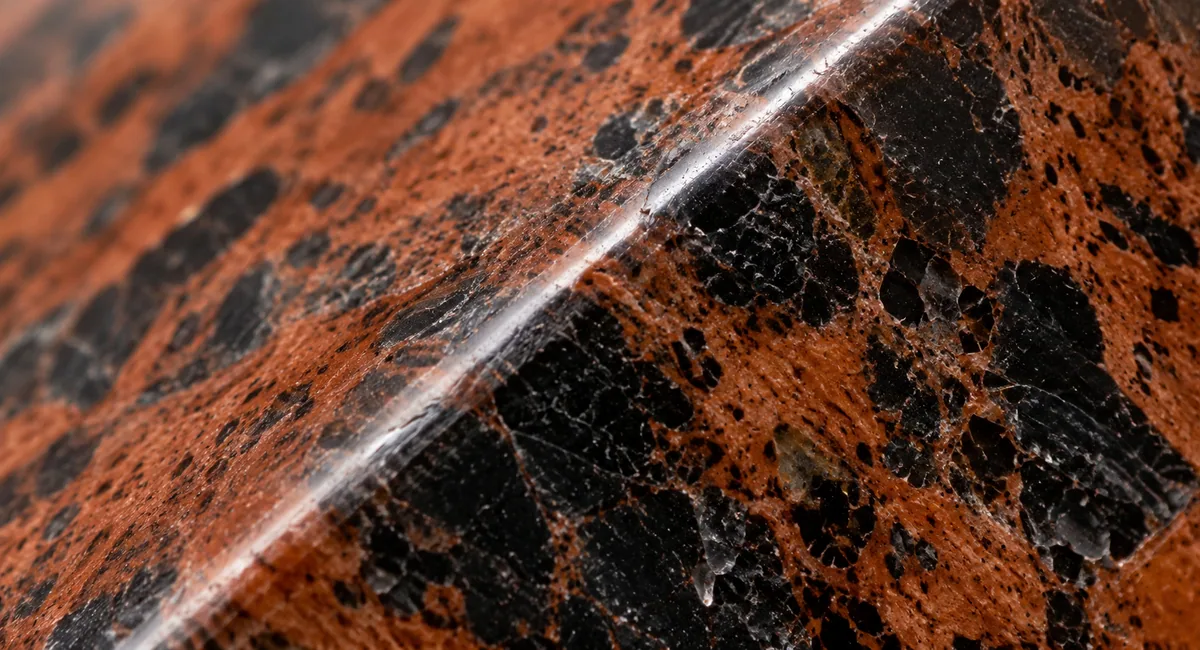
The carved pyramid: geometry, balance and finish
A pyramid shape is made through cutting and polishing. It is not the natural crystal habit of obsidian. A well-made object should have an intelligible square or other accurately described base, balanced triangular faces, stable seating and an apex finished appropriately for safe display. Sharp geometry can be attractive, but careless points are vulnerable to breakage.
Use a simple inspection sequence: measure the longest base dimension and height, view each edge against reflected light, check the underside, then test whether the piece rocks gently on a flat surface without forcing it. Slight colour asymmetry is natural to the visual design; a badly chipped corner or unstable bottom is a separate quality matter.
Polishing can soften some edges deliberately. This may be sensible for a frequently handled piece, a family shelf or a professional kit. A softly finished tip is not automatically inferior, but the photograph should represent the supplied object. Do not promise flawless geometry, exact dimensions, treatment-free condition or laboratory provenance without evidence.
Carving quality checklist
| Area | Good disclosure | Concern |
|---|---|---|
| Apex | Clear close-up, described finish | Missing tip concealed by lighting |
| Edges | Consistent finishing and safe handling | Fresh chips or hidden sharp splinters |
| Base | Size and seating shown | Wobble, deep abrasion or undisclosed pads |
| Pattern | Photographs from several faces | One attractive side only |
| Condition | Scratches and filling stated | Repairs or coatings omitted |
| Listing | Actual unit or clear representative-photo label | Unverified grade or origin claim |
Mahogany obsidian and Vastu: traditional interpretation
In contemporary Vastu and crystal-use discussions, brown-and-black stones are often chosen to express Prithvi Tattva, steadiness, containment, discipline and a sense of grounding. Brown may evoke earth and continuity; black may suggest a contained, quieter visual field. These are meaningful symbolic associations for the owner, not a fixed ancient rule identifying every mahogany obsidian carving with one direction.
The Pancha Mahabhuta framework—Prithvi (earth), Ap or Jala (water), Agni (fire), Vayu (air) and Akasha (space)—offers a language for discussing a space as a whole. A modern decorative pyramid should not be described as interchangeable with foundational architectural decisions. Consider natural light, airflow, cleanliness, movement, work needs and the household’s actual practices when selecting a position.
A Sankalpa is a clearly held intention. Someone placing the object near a study desk may choose a Sankalpa of patience and consistent work; a shop owner may reflect on honest trade and long-term stability. The pyramid can be a visual reminder within a larger practice of tidiness, devotional observance or focused attention. It should not be represented as independently guaranteeing protection, financial improvement or a medical outcome.
Vastu placement questions and practical choices
| Setting | Possible intention | Practical placement |
|---|---|---|
| Home entrance console | Order and steadiness | Stable side shelf away from the door swing |
| Study or work desk | Concentration and routine | Back corner, away from keyboard and loose cables |
| Puja area | Reflection or Sankalpa | Dry clean position compatible with family practice |
| Shop counter | Responsible prosperity symbolism | Visible but not at the cash-handling edge |
| Consultation display | Explain different mineral types | Clearly labelled compartment or cushioned tray |
| Child-accessible room | Decorative interest | Higher secure shelf due to glass edges |
Dik, Navagraha and chakra terminology: do not confuse systems
Vastu directional discussions may refer to Ashta Dik, the eight directions and their associated deities. A directional chart can help organize traditional concepts, but it does not prove that mahogany obsidian itself has an exclusive classical placement in the southwest or any other compass sector. If a consultant prescribes a position, ask which method and site conditions were considered.
In Jyotish, Navagraha refers to the nine planetary factors used in chart interpretation. A brown-and-black obsidian carving is not a standard substitute for a properly considered astrological gemstone recommendation, nor can its name establish a person’s planetary needs. Certain contemporary crystal practitioners associate darker stones with Muladhara (root chakra) symbolism; identify that as a modern correspondence rather than a universally prescribed Vedic rule.
Lakshmi and Kubera may be invoked in prosperity-related household or business contexts, but placing a mahogany obsidian pyramid does not by itself constitute a prescribed Lakshmi or Kubera puja. If the family uses an established mantra, puja or offering practice, the object should remain secondary to that actual tradition and its proper context.
Real-life example: a Bengaluru apartment
A family wants a small earth-coloured pyramid on a bookshelf near a home office. The buyer first checks the base so the glass object will not tip, requests close photographs of each edge, and chooses a position that is not disturbed when books are removed. The brown-and-black appearance fits the room without crowding a puja altar or claiming a universal directional cure.
The family explains its Sankalpa as consistency and calm in daily work. A dust-free shelf, steady lighting and a manageable object are useful irrespective of symbolic interpretation. If children use the room, the pyramid is placed well out of reach rather than beside toys, because chipped obsidian can be sharp.
Real-life example: a jewellery showroom
A Bengaluru jewellery showroom wants one attractive pyramid near a display case. Staff choose a unit with a stable base and a pattern visible under the actual showroom lighting, not only in a studio photograph. The description states “mahogany obsidian, natural volcanic glass” only to the level justified by sourcing, and it discloses any repair or unknown treatment.
The display relates the brown-and-black colour to grounded trade and responsible abundance symbolism. It does not promise higher sales. To preserve edges, staff place a felt pad under the object, keep metal jewellery stands from touching it, and handle the pyramid by its lower sides during cleaning.
Real-life example: a professional Vastu reference kit
A practitioner assembling a teaching kit may include labelled examples of mahogany obsidian, black obsidian, smoky quartz, jasper and black tourmaline. Their value is comparative: viewers can examine surfaces, pattern types, hardness references and the way named traditions use colour. Each stone should have a specimen ID, the supplier’s material description, measurements and care notes.
An accurate kit separates observation (“glassy surface with russet patches”) from interpretation (“earth-associated grounding symbolism”). It also tracks provenance and any uncertain claims. Padded compartments keep the glass carving from chipping neighbouring minerals, while a written inventory prevents the loose stone from losing its identification.
Safe cleaning, storage and packing
Dust with a clean, soft microfibre cloth and avoid scraping the polished glass with gritty cloths, metal jewellery or abrasive powders. If the item is untreated and structurally sound, a minimally damp cloth may be appropriate; dry it promptly and avoid immersing a piece whose repair, adhesive or coating status is uncertain. Strong chemicals, steam cleaning and abrupt temperature changes are unnecessary for ordinary display maintenance.
To pick up a pyramid, grip the broad lower sides or base, not the apex. Put the object on a stable shelf away from a moving window shutter or a frequently opened cabinet. If a point chips, stop handling the sharp edge; do not attempt to polish it by hand. An experienced lapidary professional can advise whether the item can be refinished.
For shipment, wrap the pyramid separately with extra cushioning around the apex and corners, place it in a snug inner box and prevent movement within the outer package. It should never rattle against pyrite, metal pyramids or other stone specimens. A fragile label does not replace proper cushioning.
Care: do this instead of that
| Situation | Prefer | Avoid |
|---|---|---|
| Routine dust | Soft clean cloth | Gritty sponge or abrasive powder |
| Sticky mark | Minimal gentle cleaning after checking treatment | Acids, solvents or soaking without material checks |
| Lifting | Support base and lower sides | Pulling on the pointed apex |
| Display | Stable padded position | Crowded shelf near heavy objects |
| Packing | Individually cushioned edges | Loose contact with other stones |
| Damage | Document chip and seek lapidary advice | DIY striking, heating or vigorous sanding |
What to ask before buying mahogany obsidian online
Ask whether the photographs show the exact unit for sale or a representative carving. Confirm height, base dimensions, measured weight, natural-versus-manufactured material declaration, known repairs or treatments, and dispatch protection. Where a “grade” appears in a listing, ask what measurable standard it reflects: pattern preference, polishing, dimensions or an actual material assessment.
Pattern is a legitimate aesthetic preference, but an unusually reddish face should not be sold as proof of rare origin or guaranteed spiritual strength. If the carving is intended for professional teaching, add provenance and photographed identification labels. If the item is a household decoration, physical stability and suitable appearance may matter more than elaborate labels.
Seller questions that lead to better decisions
| Question | Why it matters |
|---|---|
| Are these photos of the actual pyramid? | Shows the real patch distribution and finish |
| Can I see all four sides and the underside? | Exposes hidden chips, seams and rocking |
| Is it natural obsidian or a manufactured material? | Separates geological identity from appearance |
| Are there fillings, adhesives or coatings? | Changes care and value |
| What are measured dimensions and weight? | Improves shelf and packaging planning |
| How is the apex protected for shipping? | Reduces breakage risk |
| Can you document an asserted locality? | Avoids unsupported source claims |
Frequently asked questions
Is mahogany obsidian a genuine natural stone?
Mahogany obsidian is a recognised appearance variety of natural obsidian, a volcanic glass. The name alone cannot certify an individual retail carving; supplier evidence and material inspection still matter.
Why does it look like dark wood?
Reddish-brown streaks and darker areas resemble mahogany wood in colour. The pyramid is not wood and does not contain wood grain.
Does every face need the same amount of brown?
No. Variations in the source material and carving direction produce very different patterns from face to face.
Is a deep black area a defect?
Not by itself. Large black areas may be natural to the pattern. Open cracks, chips and hidden filling are separate matters.
Is it the same as black obsidian?
Both belong to the obsidian family. Mahogany obsidian is named for its additional red-brown mottling.
Is it the same as smoky quartz?
No. Smoky quartz is a crystalline quartz variety, while obsidian is volcanic glass.
Can the pyramid be used in Vastu?
It can be included as a decorative and symbolic item in contemporary Vastu practice. Choose placement in relation to the space, custom and purpose rather than assuming a universal direction.
Is mahogany obsidian assigned to one Graha?
There is no single universally established classical Navagraha prescription for this modern carved object. Individual traditions may offer associations; these should be labelled appropriately.
Which chakra is connected to it?
Modern crystal-chakra systems often place dark earth-toned stones alongside Muladhara symbolism. This is a practice association, not a test of the material.
Does it guarantee protection or prosperity?
No material object establishes that outcome. It may serve as a meaningful reminder of a chosen Sankalpa or practice.
Why is a chipped edge so sharp?
Obsidian fractures as glass, often along smooth curved surfaces that can create cutting edges.
Can it be washed under a tap?
A sound untreated piece may tolerate gentle water contact, but avoiding soaking is prudent when repairs or coatings are unknown. A soft cloth is usually sufficient.
Can I keep it near a sunny window?
Avoid positions subject to falling, knocks and abrupt thermal cycling; routine room light is not itself an authenticity test.
How should it be transported?
Wrap it separately, protect all points and corners, and prevent movement in a padded box.
Should I scratch it to check authenticity?
No. Scratching damages a saleable surface and is not definitive authentication.
Can it be kept beside a lamp or diya?
Keep it sufficiently distant from heat, flame, wax and accidental knocks; the object should not interfere with the family’s puja arrangement.
Can a professional kit include it?
Yes, with a clear material label, sourcing notes, physical care instructions and separation from stronger or heavier specimens.
How can I choose between two pieces?
Compare actual-unit photographs, soundness, pattern preference, base stability, size and seller disclosure before deciding.
Reference basis and interpretation
For geology, obsidian formation and sharp conchoidal fracture, consult the U.S. Geological Survey’s Volcano Watch article on obsidian and Oregon State University’s Volcano World material on obsidian. The U.S. National Park Service also documents obsidian as naturally formed volcanic glass historically valued for cutting edges. These references support the material discussion, not specific spiritual effects.
Statements about Prithvi, Sankalpa, Vastu directions and chakras above are contextual explanations of traditional or contemporary practice. A named modern obsidian carving should not be presented as a quotation from a particular Vastu Shastra text without a verifiable textual basis.
Explore existing OmmRudraksha collections
Browse Vastu for the existing collection, or explore gemstone products for other material forms. Each product’s construction and care information should guide your choice.