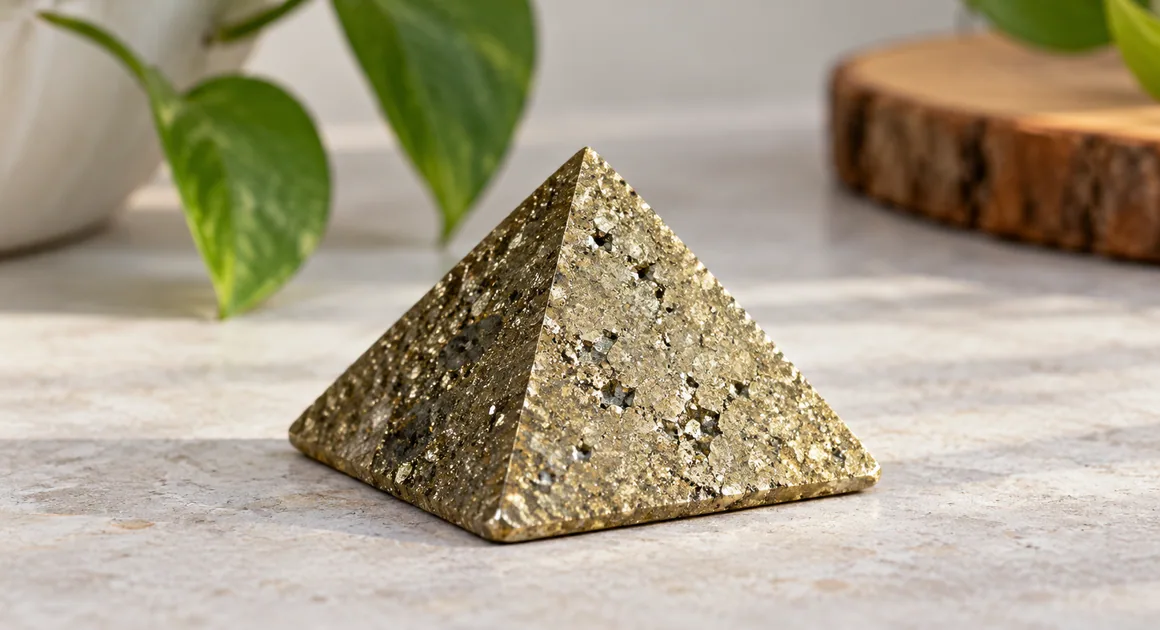
A pyrite pyramid is a carved iron-sulphide mineral whose golden metallic lustre, dense feel and naturally granular surfaces make it very different from an ordinary polished quartz pyramid. The attraction is easy to understand: the flat triangular faces gather light around a central apex, while brass-yellow flashes give the stone its familiar association with prosperity and purposeful work. Yet the most important questions are practical. Is it real pyrite? Is the pyramid carved from a solid mineral-bearing piece, assembled from chips, or simply metallic-coated? Are natural pits being mistaken for defects, or is a deteriorating surface being mistaken for natural texture?
This guide explains pyrite's physical identity, how to read the surface and workmanship, how it differs from gold, brass, chalcopyrite and marcasite, and how to keep a carving dry in Indian weather. It also explores pyrite's place in contemporary Vastu-inspired gemstone displays alongside older associations such as the north direction and Kubera. The result is a buyer's reference for a single home pyramid, a jewellery showroom display or a professional Vastu collection.
1. Pyrite is iron disulphide, not gold-plated stone
Pyrite is the mineral iron disulphide, FeS2. It is naturally opaque, normally pale brass-yellow, and has a metallic lustre. Well-formed crystals may be cubes, pyritohedra or other intergrown forms, but a polished decorative pyramid is a man-made shape cut or assembled from mineral material; its four triangular faces are not proof of an original natural pyramid-shaped crystal. Small crystal faces may still be visible as sparkles or angular grains inside the carved surface.
Pyrite is relatively hard for a metallic-looking mineral (approximately 6–6.5 on the Mohs scale), but it is also brittle. Its relatively high density—about 4.8–5.0 g/cm³ for pyrite itself—can make a small solid carving noticeably heavy. These values describe the mineral, not necessarily a finished commercial pyramid containing host rock, resin, cavities or coatings. Do not perform scratch, acid or streak tests on a finished item: such tests can permanently mark its polished faces.
| Property | Typical pyrite | Why it matters for a pyramid |
|---|---|---|
| Chemical identity | Iron disulphide (FeS2) | Different from elemental gold, brass alloy and iron oxide |
| Colour and lustre | Pale brass-yellow; metallic | Warm golden faces can look very different under warm shop lighting |
| Hardness | Mohs 6–6.5 | Can retain cut edges, but brittle corners can chip |
| Density | About 4.8–5.0 g/cm³ | Useful for checking a seller's dimensions against an implausible weight claim |
| Natural occurrence | Crystals, grains, aggregates and mineral-bearing rock | Explains pits, host-rock patches and differences among carved pieces |
| Environmental sensitivity | Susceptible to oxidation in moist conditions | Dry display and dry storage are essential considerations |
The name fool's gold comes from pyrite's visual resemblance to gold, not from a claim that pyrite contains commercial quantities of gold. A mineral description should say pyrite or pyrite-bearing stone as appropriate. Terms such as “24-carat pyrite,” “gold pyramid” or “gold-plated natural pyrite” require separate, verifiable material disclosures.
2. Why one pyrite pyramid sparkles and another has a grainy finish
Natural pyrite may be coarse-crystalline, fine-grained or mixed with other minerals. A pyramid cut across tightly intergrown crystals can show brilliant miniature facets. A finer aggregate may look almost uniformly metallic; another piece may have dark host-rock spots, pinholes or thin fracture lines. Those differences need not make one carving inauthentic. The relevant distinction is between stable natural texture and a surface that is shedding particles or breaking down.
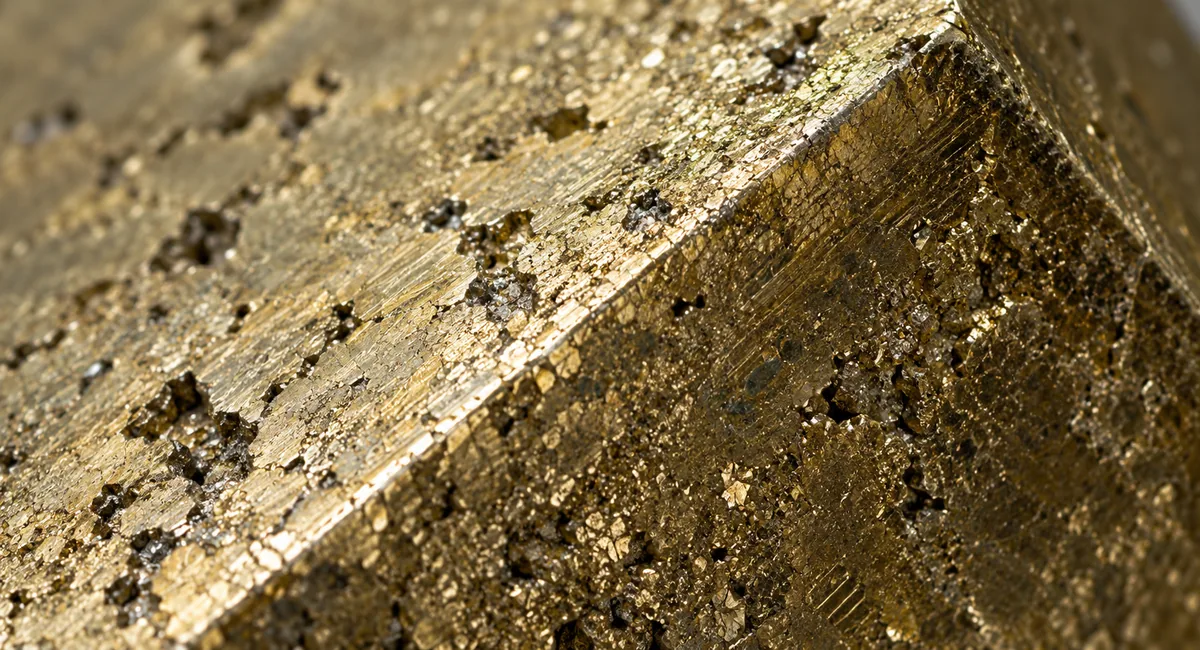
Inspect the pyramid under soft daylight, rotate it through four views, and ask for a close photograph of the apex, the square base and any rough patch. A small original pit that remains firmly bound is not the same as a new crumbly cavity. Similarly, a dark patch may be host rock or natural oxidation, but a spreading pale powder, damp-looking stain or a crack opening between grains warrants particular attention. A mineral specialist may be needed to establish the cause of suspected deterioration.
| What you notice | Possible explanation | Useful buyer action |
|---|---|---|
| Fine brassy sparkles | Individual mineral faces reflecting light | Compare a second photograph under diffuse light |
| Small fixed pits | Original aggregate texture or cutting loss | Confirm they are stable and shown clearly in the listing |
| Dark matrix patches | Other rock or minerals incorporated into the piece | Request “pyrite-bearing” composition disclosure if applicable |
| Uniform glitter with visible seams | Possibly chips/resin or a constructed object | Check the base for moulding, adhesive and visible joins |
| New yellow-grey powder or crumbling | Potential active mineral deterioration | Isolate, avoid cleaning with water and seek expert assessment |
| Mirror-perfect yellow coating over a light core | Possible plating or metallic paint | Ask what the core is and whether the finish is applied |
A good product photograph should not erase all natural texture. For an OmmRudraksha product listing, state whether the image represents the actual stone or a material example, and show a real close-up of the base and one face when individual pieces vary.
3. Pyrite, gold, brass, chalcopyrite and marcasite: five different materials
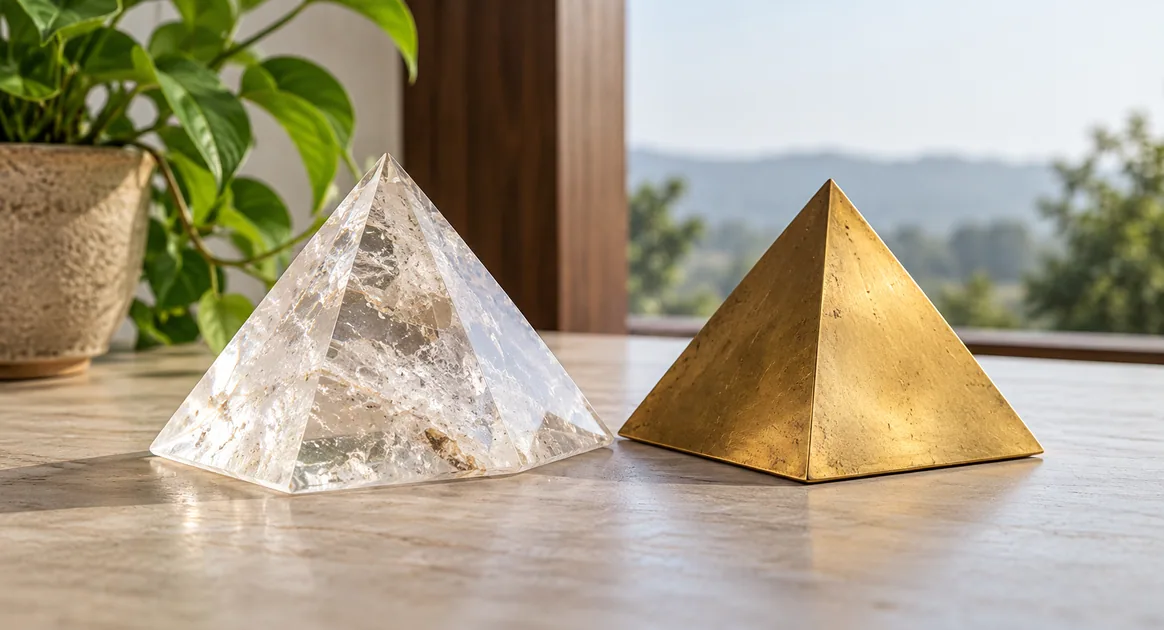
Metallic yellow is a colour family, not a mineral test. It is especially important not to confuse the golden look of pyrite with a traditional copper-alloy pyramid or with a pyrite imitation. A buyer should judge material, construction and dimensions together, not colour alone.
| Material | What it is | Typical distinguishing features | What the product should disclose |
|---|---|---|---|
| Pyrite | Natural iron disulphide mineral | Brassy lustre, hard/brittle mineral texture, potential crystal grains | Solid pyrite, pyrite-bearing rock or reconstructed pyrite material |
| Native gold | Elemental precious metal | Rich yellow, highly malleable and far denser than pyrite | Metal purity, mass and certification if sold as a gold item |
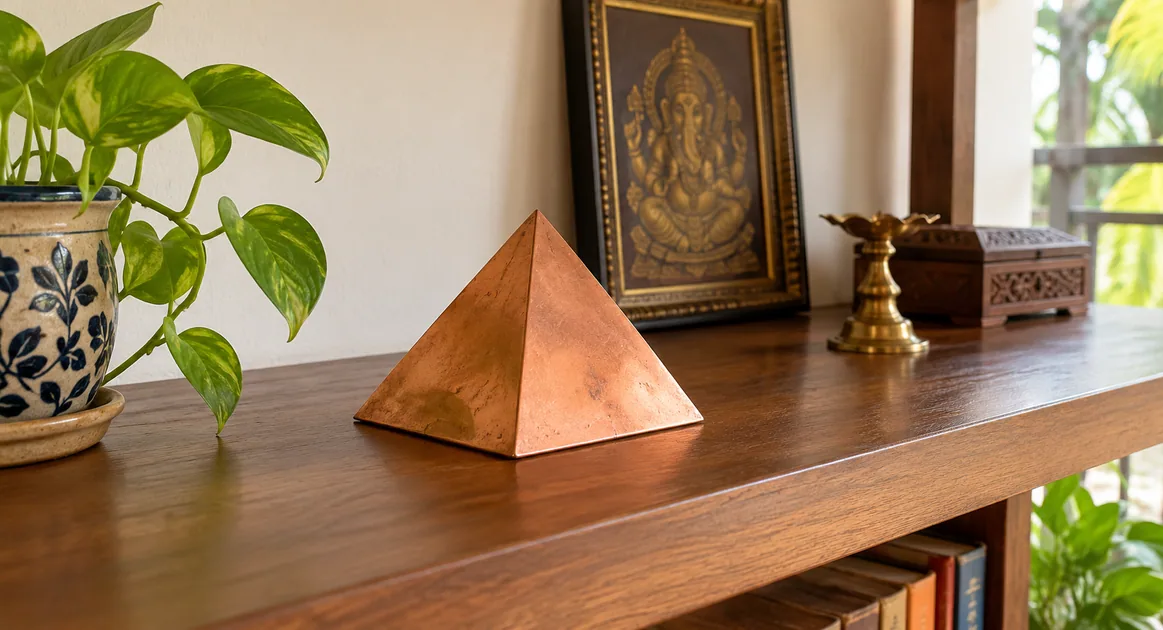
| Brass | Manufactured copper-zinc alloy | Metalworking seams, cast or sheet construction; alloy patina | Solid/hollow brass, finish, plating and sheet thickness when relevant |
| Chalcopyrite | Copper iron sulphide mineral | More yellow-golden, generally softer; may develop iridescent tarnish | Chalcopyrite identity; any colouring or surface treatment |
| Marcasite | Different crystal form of iron disulphide | Same formula as pyrite but different crystal structure; often less stable | Accurate mineral species, especially for specimens and jewellery |
| Metallic-coated composite | Stone, resin, ceramic or other core with a surface layer | Exceptionally consistent colour, possible seams or chipped coating | Actual core material and applied finish |
Marcasite and pyrite are polymorphs: both have FeS2 chemistry but different crystal structures. This matters because a product named merely “marcasite-pyrite” may refer to trade terminology rather than a properly identified mineral. Likewise, an iridescent “peacock ore” product is not automatically pyrite; products sold under that popular name can be chalcopyrite or treated material. These distinctions belong in product specifications, not solely in a FAQ.
4. Four different ways a “pyrite pyramid” might be made
Natural origin and finished construction are separate questions. An attractive carved surface does not establish the object's entire internal composition. Ask whether it was sawn from a block, carved from mixed mineral rock, consolidated to hold loose grains, or assembled from mineral chips. Fillers or resin do not necessarily mean a decorative object is unusable, but they change the nature of the product and should be described accurately.
Solid mineral carving: the item is shaped from one pyrite-rich specimen and may contain natural fractures, small pits or inclusions. Pyrite-bearing host-rock carving: the whole object includes other minerals; its apparent colour and actual density can vary. Consolidated or reconstructed piece: mineral particles or fragments may be bonded to form a carving, often giving a visually uniform glitter. Coated imitation: the principal form is another material, coloured to resemble pyrite. These four categories are not interchangeable when comparing price or authenticity.
Inspecting the underside can reveal layered coatings, unusual glue lines, filled pinholes or the nature of the core. Ask for size in millimetres, actual mass in grams and a photograph against a neutral background. The terms “natural,” “energised,” “imported” and “premium grade” alone cannot substitute for a clear material specification.
5. How to inspect the carving: apex, faces and underside
A pyrite pyramid needs three kinds of assessment: material integrity, geometric workmanship and visual character. For a square-based model, all four sloping faces should meet cleanly at the apex; the base should sit steadily without rocking. Compare the edge line from the tip to each corner. Natural mineral inclusions may interrupt the surface, but a long open crack running through a structural corner should be documented.
The apex is especially easy to chip during packing or shelf movement. Tiny polishing irregularities can be acceptable for a handmade specimen, while a noticeably broken point should be described as a condition defect rather than presented as ordinary mineral texture. Check for sharp metal-like splinters and any detachments. On the underside, uneven patchwork, a heavy sealant layer or unmentioned cavities may affect how the piece is represented and its stability.
| Inspection point | Acceptable variation | Request clarification when... |
|---|---|---|
| Apex | Minute hand-finishing variation | Tip is fractured, loose or missing |
| Four triangular faces | Subtle grain changes, mineral veins and fixed pits | Powder sheds or layers lift during gentle handling |
| Square base | Natural colour differences, minor tool marks | Base rocks, adhesive joins are hidden or edges are sharp |
| Finish | Matte-metallic through polished-metallic appearance | Coating, lacquer or surface filler is not described |
| Packaging | Individually cushioned and labelled stone | Heavy specimen can knock against another object in transit |
6. Why dry storage is essential for pyrite
Pyrite is not simply another waterproof decorative mineral. The combination of oxygen and moisture can oxidise susceptible pyrite, generating iron sulphate products and acidic by-products. In vulnerable specimens the products occupy more space, which can open cracks, produce powder and eventually break the mineral apart. Museum conservators often call this progressive damage pyrite decay. It is particularly important for pyrite-bearing rocks and reactive aggregates; not every stable, solid specimen deteriorates at the same speed.
Conservation guidance treats elevated relative humidity as a major risk. For a valuable or moisture-sensitive pyrite specimen, a sensible dry-storage objective is around 45% relative humidity or below where practicable, rather than merely avoiding visible water. The Canadian Conservation Institute describes concern above about 50% RH for pyrite; other institutions identify more pronounced problems above roughly 60% RH. These numbers are conservation guidance, not an exact promise of safety for every carved stone. A simple digital hygrometer is more informative than guessing by how the room feels.
In a humid Indian monsoon, move a pyrite pyramid away from bathrooms, kitchen steam, open windows, plant trays and damp masonry. A cabinet or stable enclosed display away from water sources is preferable. Where humidity remains high, a properly maintained low-humidity display box with appropriate desiccant can help; desiccant must be monitored or regenerated rather than treated as permanent protection. Avoid sealing a damp specimen into a box, since the trapped moisture can worsen the situation.
| Observation or environment | Meaning for pyrite | Practical response |
|---|---|---|
| Dry, stable room; no moisture source | Lower everyday exposure risk | Display on a clean, dry, stable base |
| Humid monsoon room | Oxidation risk increases for susceptible pieces | Check RH, relocate or use controlled dry enclosure |
| Water, salt solution or wet cloth | Unnecessary moisture and possible corrosion exposure | Do not soak or wet-wipe the mineral |
| New whitish/yellowish powder, crumbly surface | Possible active decay, not routine dust | Isolate from other objects and ask a mineral conservator |
| Stable, fixed surface pits | May be original mineral texture | Photograph and compare over time, rather than scrubbing |
| Damp storage pouch or cardboard | Can hold moisture against the object | Replace only after the pyrite and packaging are confirmed dry |
Active deterioration is more serious than a little dulling of lustre. Do not try to stop it with lemon, vinegar, saltwater, aggressive brushing, oil, incense smoke or household sealants. Once a specimen starts disintegrating, diagnosis and storage adjustment matter more than trying to restore an artificially shiny appearance.
7. Daily dusting, handling and longer-term maintenance
For a sound finished pyramid, minimise handling. Lift it from the base with clean, dry hands or suitable gloves; do not pinch the apex. To remove ordinary loose dust, gently use a soft, dry, non-abrasive brush or a clean dry microfibre cloth only where the mineral is firmly stable. A delicate granular face may be safer left alone than repeatedly polished. Never use ultrasonic cleaners, steam, aggressive polishing compounds, acids or household bathroom cleaners on pyrite.
Do not assume a store-bought jewellery polishing cloth is suitable: some cloths contain chemical treatments intended for metal jewellery rather than sulphide minerals. Test no chemical on the item without a competent material assessment. If the object has a disclosed protective coating, request the maker's specific instructions. The goal is to retain the identified mineral, original finish and safe structural condition—not to make every natural face look like polished brass.
Maintain a simple inspection log for a professional collection: record the date, approximate humidity, any discolouration or powder, the location and one repeatable photograph. Photograph the same face with similar lighting each time. A stable mineral can remain useful for many years, while a new change is easier to detect when you have a baseline image.
8. Storage and shipping for heavy, brittle pyrite
Relative to many similarly sized decorative minerals, pyrite can be dense. A small unpadded pyramid may chip its point against the side of a box or strike another gemstone during delivery. Use a fitted compartment or soft inert cushioning, protect the apex separately, and keep the object from shifting when the outer carton is gently tilted. Do not pack damp tissue or freshly cleaned stones with pyrite.
For an inventory of several minerals, store pyrite separately from softer calcite, salt carvings, metal tags and paper labels. This prevents physical collisions and limits contamination if pyrite deteriorates. Low-acid labels placed outside the immediate contact area are preferable to untreated paper wrapped tightly against the mineral. A clear box that allows visual inspection without frequent touching is practical for a reference collection.
A box should identify the material, finish, size, weight, batch or item number and care method. For OmmRudraksha's professionally used Vastu sets, record a dry-care note alongside the pyrite item so another staff member does not automatically rinse every stone in the set. If a package arrives with moisture stains, powder or unusual breakage, photograph it before opening further and keep the affected piece away from the other stock.
9. Pyrite's spiritual meaning: golden colour, intention and prosperity
Pyrite is commonly associated in contemporary crystal practice with abundance, confidence, disciplined activity and an organised approach to work. Its golden metallic face offers a tangible reminder of the desire to manage resources, complete tasks and pursue a sankalpa. Such uses are meaningful as part of an individual's home or business practice, but they do not turn pyrite into gold or change the mineral's care requirements.
In Indian tradition, Kubera is associated with wealth and the north direction; Lakshmi worship is associated with auspiciousness and prosperity. These traditions are far older than the marketing of small polished pyrite pyramids. A pyrite pyramid may therefore be placed in a modern north-facing prosperity display inspired by Kubera symbolism, but there is no need to portray that precise combination as a universally prescribed ancient Vastu remedy. The traditional directional idea and the newer gemstone choice should both be described faithfully.
Similarly, some commercial lists connect yellow-golden minerals with the Sun, fire or personal ambition. Formal Navagraha/ratna systems identify specific planetary gemstones and require their own interpretive framework; pyrite is not an automatic substitute for ruby, yellow sapphire or another prescribed planetary gemstone. A display object chosen by colour and appearance is a different category from a gemstone recommended after an individual horoscope assessment.
A coherent daily use might be to place a dry pyrite pyramid beside a written goal, bookkeeping diary, appointment planner or business intention. The pyramid then functions as a symbolic focus for orderly work and thoughtful decisions, rather than as a substitute for them.
10. Where to place a pyrite pyramid in Vastu-inspired interiors
First identify the room and the purpose of the display. The broader Vastu vocabulary includes Ishanya (northeast), Agneya (southeast), Nairritya (southwest) and the eight Dikpalas or directional guardians. A general Vastu plan accounts for the building, room function and existing arrangement; it does not require putting every metallic-looking stone in one fixed corner.
| Area or direction | Traditional directional association | Possible modern pyrite display | Material-care consideration |
|---|---|---|---|
| North | Kubera, resource stewardship and wealth symbolism | Work desk or tidy finance shelf used for a prosperity intention | Choose a dry shelf away from windows and damp walls |
| Northeast / Ishanya | Prayer, reflection and sacred focus in many Vastu traditions | Small secondary display if appropriate to the household's worship practice | Keep away from water vessels, washing and oil spills |
| East | Rising light, beginning and activity | Study shelf, planning desk or project-review corner | Do not put in direct rain or near open balconies |
| Southeast / Agneya | Fire and activity | Modern symbolic display for disciplined action where the room permits | Not near cooking steam or heat sources |
| Office reception / showroom | Welcome, trade and organised presentation | Clearly labelled pyrite specimen beside related products | Do not mist, wet-clean or place beside a water feature |
For an apartment with a frequently damp north wall, a dry east-side shelf is materially better than following an abstract directional rule at the expense of the stone. Symbolic alignment is not useful if the specimen deteriorates. A placement chosen by a Vastu practitioner for the whole property may also differ from a generic online directional chart; both the purpose and the physical setting should be recorded.
11. Sankalpa, worship and the difference between a pyramid and a Yantra
A household may include the pyramid in a quiet reflection or sankalpa routine. Clean the shelf by an appropriate method before placing the dry stone; do not perform a water or milk abhisheka on pyrite. If a family follows Lakshmi or Kubera puja, the pyrite display may be kept separate from ritual vessels and offerings. Ordinary respect for the worship setting is more important than imposing one ritual on every household.
A pyramid's geometry does not by itself make it a traditional Yantra. Yantras have particular diagrams, mantras, deities and ritual contexts. A decorative pyrite pyramid can be a meaningful accompanying object without being labelled a Sri Yantra, a consecrated ritual device or a guaranteed planetary remedy. This distinction supports more accurate product descriptions and more useful customer guidance.
12. Three practical placement and purchase examples
Example A: A Bengaluru home during monsoon season
A family wants a small golden pyrite pyramid for its north-side study shelf. The shelf is visually appropriate for their prosperity sankalpa, but it backs onto a wall that feels damp during heavy rain. The family compares another shelf across the room, checks humidity with a basic hygrometer and chooses the drier location. The stone sits on a clean tray, away from the nearby water-filled vase. Their intention remains the same; the actual placement respects the material.
Example B: A jewellery showroom's gemstone display
A shop stocks a pyrite pyramid, a brass pyramid and a golden-coated decorative resin pyramid. Displaying all three simply as “gold energy pyramids” would confuse the buyer. Instead the cards state natural pyrite mineral, brass alloy and coated composite. Photos show each base, and the pyrite card includes a “dry care only” instruction. A customer can choose for mineral authenticity, workmanship, metal tradition or decoration without guessing what the item contains.
Example C: A professional Vastu consultant's portable kit
A practitioner travels with pyrite, clear quartz, carnelian, black tourmaline and a brass pyramid. The pyrite receives a separate padded cell and a humidity reminder. During a consultation, it is introduced as a modern prosperity-associated mineral, while other items illustrate different material forms and directional ideas. The practitioner records a chosen display location and the customer's intent; the item is not presented as a replacement for a full property assessment or a prescribed Navagraha gemstone.
13. Worked five-piece comparison kit: don't confuse colour with composition
For staff training, a five-object kit can teach more than a tray of visually similar golden pyramids. Use one pyrite pyramid, one brass pyramid, one yellow calcite or citrine specimen, one chalcopyrite specimen and one metallic-coated sample. They need not all be the same material or shape; the purpose is to compare what the buyer sees with what the label actually states. Where a specimen is not verified, mark its identification as pending rather than guessing.
| Sample | Teach the customer to observe | Essential label detail |
|---|---|---|
| 1. Pyrite pyramid | Dense, metallic mineral texture; granular carving | FeS2; construction; dry care |
| 2. Brass pyramid | Manufactured metal surfaces, sheet or cast form | Brass alloy; hollow/solid; finish |
| 3. Citrine or yellow calcite | Glass-like or waxy/non-metallic mineral appearance | Correct mineral name; treatment where known |
| 4. Chalcopyrite specimen | Different sulphide texture, possible iridescent tarnish | Chalcopyrite; surface treatment if present |
| 5. Metallic-coated composite | Surface finish and core may be different materials | Core material and applied coating |
Photograph all five together under the same light, then separately photograph their undersides. Add a material-specific care card: dry care for pyrite, appropriate metal care for brass, and separate guidance for the softer or treated specimens. The exercise helps prevent the common sales error of applying the same identity, price, care routine and Vastu promise to objects that only share a golden colour.
14. Size, mass and a quick plausibility check
Manufacturers may report base width × height or simply “40 mm pyramid.” Confirm which measurements are meant. A square pyramid with a 40 mm base and 35 mm vertical height has an ideal geometric volume of about 18.7 cm³. If it were made from entirely solid, relatively pure pyrite with a density around 5 g/cm³, its theoretical mass would be roughly 93 g. This is an illustrative calculation—not a specification for a real product. Mineral mixtures, porous areas, a truncated point, rounded corners, recesses and internal construction can change the finished weight considerably.
If a supplier describes such an object as a pure solid pyrite pyramid but reports a surprisingly low mass, ask about actual dimensions, host rock, cavities or composite construction. If the measured mass is higher than expected, verify the scale and geometry before making any claims. Weight alone cannot prove authenticity, but combined with clear photos it can help expose inconsistent listings.
15. Supplier checklist for a pyrite pyramid
| Question to ask | What a useful answer contains |
|---|---|
| What exactly is the material? | Pyrite, pyrite-bearing rock, reconstructed pyrite or coated composite |
| Does the sample shown match the item sent? | Actual-piece photos or a clear note explaining natural variation |
| What are the dimensions and weight? | Base width, vertical height, mass and units |
| Is any coating, filler or resin present? | Known construction and surface treatments disclosed plainly |
| What do the apex and bottom look like? | Clear photographs without dramatic colour filters |
| Is the surface structurally stable? | No undisclosed loose grains, active powdering or open cracks |
| How must it be cleaned and stored? | Dry handling, stable storage, moisture warning |
| How is it protected in transit? | Separate cushioning, secured apex and dry packaging |
When a seller uses the language of “premium,” “original” or “energised,” ask for the underlying physical information as well. Retail claims about material identity should be supported by photographs and appropriately specific supplier records, rather than relying on the spiritual language of the listing.
16. Questions customers often ask
Is a rough-looking pyrite face necessarily defective?
No. Natural aggregates can include firmly bound grains, tiny pits and variations in lustre. What matters is whether the face is stable, honestly shown and appropriate for a finished product. Active powdering and loose particles are different issues.
Can I wash a pyrite pyramid in water, saltwater or milk?
Avoid wet cleansing and soaking. Pyrite can oxidise under humid conditions, and saltwater or acidic household solutions are especially inappropriate for its surface. Dry maintenance and a clean display area are better choices.
What is the best Vastu direction for a pyrite pyramid?
Many modern gemstone arrangements use the north for prosperity symbolism because Kubera is associated with north. That is a contextual modern application, not a fixed ancient prescription for pyrite. A clean, dry and usable location is essential, and a property's overall Vastu layout may point to a different placement.
Is pyrite suitable for a Navagraha gemstone remedy?
Pyrite is not one of the standard Navaratna planetary gemstones. A mineral display selected for its gold-like symbolism should not automatically be described as a substitute for a traditionally recommended ratna.
Is a heavier pyramid always more genuine?
No. Dense pyrite can be relatively heavy, but weight reflects size and internal composition too. A hollow metal object, mixed stone, resin composite and solid pyrite pyramid require different descriptions. Use dimensions, weight, close photographs and supplier disclosure together.
Why has my pyrite developed a powdery coating?
Some pyrite specimens deteriorate through oxidation, particularly under damp conditions. New pale powder, acidic staining, cracks or crumbling should be treated as a condition issue. Separate the object from neighbouring specimens, keep it dry and consult a mineral conservation professional rather than scrubbing it with liquids.
17. Choose material accuracy first, then meaning and placement
A successful pyrite pyramid purchase begins with a correctly identified iron-sulphide mineral, a well-formed and stable carving, transparent construction details and dry-care instructions. Its traditional or modern meaning can then be considered in the proper context: Kubera and north-direction symbolism inform a prosperity-themed display, while pyrite itself remains a modern gemstone choice rather than a formally required Vastu or Jyotisha remedy. Whether displayed at home, used in a showroom or carried in a professional kit, accurate identification and appropriate care allow the symbolic object to remain attractive and useful.
Explore existing OmmRudraksha collections
Browse Vastu for the existing collection, or explore gemstone products for other material forms. Each product’s construction and care information should guide your choice.