Snowflake obsidian pyramids: volcanic glass, natural patterns and Vastu meaning
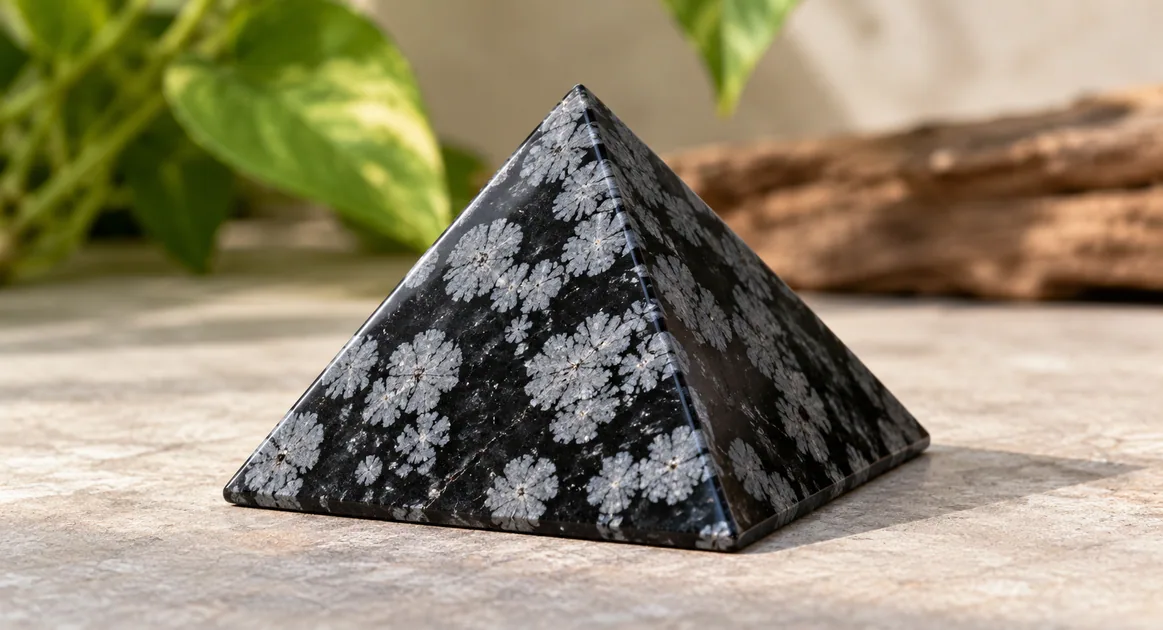
A snowflake obsidian pyramid combines a polished dark volcanic glass with scattered pale grey or whitish flower-like shapes. These markings are often called snowflakes or spherulites. Their distribution is rarely even: a small pyramid may show three broad patches on one face, fine star-shaped spots on another and a mostly black reverse. For this reason, photographs of the actual object matter as much as the attractive product name.
This detailed guide covers the geology behind the pattern, the difference between genuine mineral growth and a manufactured lookalike, how to check a carved pyramid for repairs or dangerous chips, and how to select, place and care for it in a home, shop or professional Vastu reference collection. It also discusses traditional ideas of steadiness, intention and balanced living without confusing the modern pyramid carving with an ancient prescription.
If you are choosing between two pieces, begin with the actual material, finish, visible pattern, measured dimensions and safe location. Only then consider the colour symbolism or personal Sankalpa that gives the object meaning in your setting.
What is snowflake obsidian?
Obsidian is naturally formed volcanic glass, usually associated with rapidly cooled silica-rich lava. Unlike crystalline quartz or granite, most of an obsidian piece lacks a regular mineral crystal lattice. This glassy structure gives it a characteristic vitreous shine and the ability to break along smooth curved surfaces called conchoidal fractures. The same reason obsidian was historically useful for sharp cutting tools makes an improperly handled chipped carving hazardous.
Snowflake obsidian is an appearance variety of obsidian. It is not another species of quartz and it does not contain snow, fossilized flowers or deliberately printed white pictures. Its light patches are commonly spherulites: small rounded or radiating zones of crystallization within glass. Museum specimens have been identified as containing the silica mineral cristobalite. Scientific studies of natural obsidian spherulites also describe more complicated mixtures, including cristobalite and feldspar, so it is better not to claim that every pale spot in every retail carving has an identical chemistry without analysis.
The visible phenomenon reflects partial devitrification, a process in which a previously glassy material develops crystalline zones. It is generally a natural geological texture, not an indication that the retail object is defective. However, one cannot authenticate a specific pyramid by snowflake-shaped marks alone because artificial glass, cast resin and decorated composites can imitate the visual effect.
Quick material reference
| Feature | What it means for a pyramid |
|---|---|
| Material | Primarily natural volcanic glass; a rock/glass material rather than a single mineral crystal |
| Pattern | Pale rounded or radiating spherulitic structures in a dark host |
| Known mineral phases | Cristobalite commonly reported; individual spherulites may contain other phases |
| Appearance | Black to dark grey host, white or pale-grey patches, occasional flow or surface variations |
| Hardness | Obsidian is commonly listed near Mohs 5–5.5; a harder rating does not prevent impact chips |
| Lustre | Vitreous on clean, polished surfaces; polish may differ over crystalline spots |
| Fracture | Conchoidal; broken edges can be sharp |
| Carving | A pyramid is cut and polished by a craftsperson, not a natural obsidian crystal habit |
| Main care issue | Protect corners, apex, glassy surfaces and nearby users from accidental impact |
How do the white snowflake patterns form?
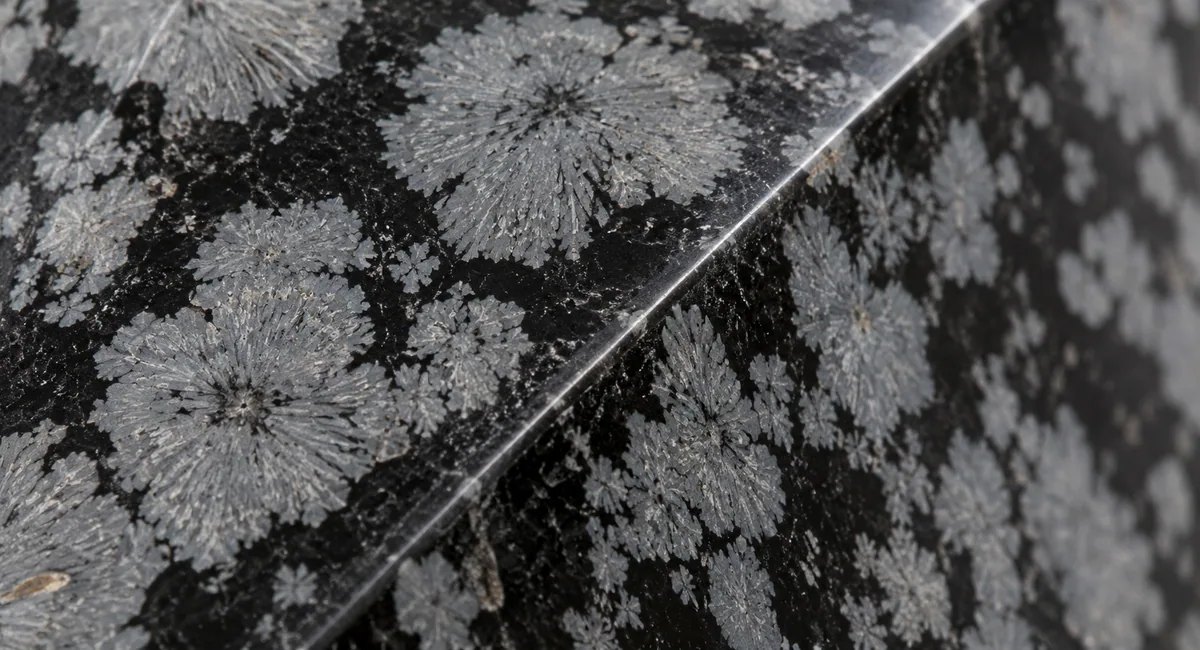
Imagine a rapidly cooled, silica-rich glass body that later develops localized regions where crystals can grow. Rather than becoming one large, neatly faceted crystal, many tiny crystals may grow outward from a point or nucleus. In cross section these radiating structures can appear as stars, flowers, circular patches or snowflakes. Some markings have clear spokes; others look like cloudy grey islands.
The Smithsonian National Museum of Natural History describes snowflake obsidian specimens with radiating cristobalite inclusions formed through devitrification. A peer-reviewed study of obsidian lavas from the Aeolian Islands describes spherulites with different shapes, sizes, textures and mineral combinations, including cristobalite, orthoclase, titanomagnetite and glass. This explains why the most accurate description is a geological texture rather than a guaranteed pure-white crystal embedded in black glass.
The light areas do not usually sit on top like stickers. They appear within the polished material and may intersect different faces of the same carving. A patch can be truncated by a cut edge or reveal a new shape as the cutter removes material. Natural-looking pattern continuity is helpful to inspect but cannot by itself rule out an artfully made imitation.
Do not interpret the spot count as a geological age, a rarity grade or a measure of spiritual potency. Two genuine samples from the same broad material type can look dramatically different. The word “snowflake” is a visual trade description, not a standardized size or laboratory grade.
What pale spots may indicate
| Visible feature | Possible explanation | Practical next step |
|---|---|---|
| Irregular grey-white radiating patch | Natural spherulitic crystalline growth in the glass | View under diffuse daylight and side lighting |
| Pale spot continuing across a cut face | A three-dimensional feature intersected by the carving | Request photographs of more than one side |
| Smooth grey patch with little visible detail | Fine crystalline zone or polish variation | Do not classify the exact mineral by appearance alone |
| Loose white residue near a chip | Polishing compound, dust, filler or physical damage | Ask for cleaning and a close-up before buying |
| Raised edge around an apparently painted patch | Possibly coating, decoration or applied material | Request an explicit material and treatment declaration |
| Open line crossing a pale spot | Could be a real crack rather than natural coloration | Inspect at changing light angles; ask about structural soundness |
| Identical repeated flowers on different units | May be stock photography or manufactured repetition | Request actual-unit photographs and construction details |
What natural variation should a buyer expect?
A large slab of snowflake obsidian may be cut into several individual pyramids. Where the cutter chooses to place each base, the direction of the cuts and the depth of material removed all affect which pale areas become visible. Large patches may look blurred on one face and sharply radiating on another. A small item can contain hardly any visible snowflakes even if the source rough is correctly named.
Look at the whole object, not just a professionally lit front view. Ask for a top view, all triangular faces, the underside and a photo beside a scale. An overly reflective image can hide fine scratches; a dramatic light may make grey patterns appear much brighter than they do on an ordinary shelf. A neutral daylight photograph helps compare realistic colour.
There is no universal rule that a pyramid with more white patches is better than one with fewer. Some buyers prefer dark faces and scattered small inclusions; others prefer large contrasting formations. Sound construction, accurate material description and absence of undisclosed repairs are more consequential than maximizing pattern coverage.
Identifying the material without scratching or breaking it
Begin by asking the seller to name the material accurately: natural snowflake obsidian, another natural volcanic rock, manufactured glass, cast resin or an assembled composite. “Crystal pyramid” and “energy stone” do not answer that question. Where an item is described as natural volcanic glass, the seller should be able to explain the supply chain, even if a laboratory report is not available for a low-cost object.
Obsidian may show a glasslike surface, occasional internal flow or bubble features and pale crystallized zones; artificial glasses may share many of these qualities. Fine lines can be real scratches, polishing streaks or internal textures. A home scratch test, hot-needle test, acid test or impact test is neither necessary nor definitive; these methods can permanently damage an item or create sharp fragments.
If a seller asserts a specific country, quarry, mineral percentage or “rare volcanic grade,” request evidence rather than guessing from colour. Gemmological examination or mineralogical testing may be needed for a scientifically certain classification. Retail descriptions should distinguish information provided by suppliers from independently confirmed composition.
Common lookalikes and how to distinguish the listing
| Listed material | Key difference | Question for the seller |
|---|---|---|
| Natural snowflake obsidian | Volcanic glass with pale internal spherulitic patterns | Are the patches part of the glass and are these actual-unit photos? |
| Plain black obsidian | Same broad volcanic-glass family without prominent pale snowflakes | Does the specific unit have visible pale growths? |
| Mahogany obsidian | Dark glass with reddish-brown mottling rather than pale rosettes | Are the markings brown-red or grey-white? |
| Snowflake agate or chalcedony | Microcrystalline silica, not volcanic glass | Is the trade name confirmed as agate or obsidian? |
| Black-and-white jasper | Opaque silica-rich rock often with different texture and inclusions | What geological material is declared on the invoice? |
| Rhyolite with spherulites | Can contain spherulitic structures but need not be glass-dominant obsidian | Is the rock predominantly volcanic glass? |
| Printed or dyed composite | Pattern can come from pigment, filler or assembled material | Is the item natural, reconstructed, coated or molded? |
| Manufactured patterned glass | May be transparent, swirled or formed by industrial methods | Is this a manufactured decorative object? |
Inspecting the carved pyramid: base, faces and sharp edges
A pyramid is a crafted shape. The important geometry is a stable base, coherent triangular faces, smooth joins at the edges and a finished apex. Natural snowflake patterns do not excuse poor cutting, a rocking base or sharp defects. Some small carved objects are intentionally rounded at the tip for safety; that is different from a broken point that has been disguised or irregularly reground.
Set the pyramid on a stable level surface and check whether it rocks with a gentle touch. Examine the apex against light, then the corners where the triangular faces meet the base. A tiny visible pale chip can expose a cutting edge even when the overall polish seems glossy. If handling a suspected chipped object, avoid touching the fracture line and request replacement or professional finishing.
Ask whether seams, glued sections, filling, coatings, wax or colour enhancement were involved. A single carved piece and an assembled decoration can both be attractive but should be named and priced honestly. Different surface reflections where pale spots meet black glass do not automatically mean glue; the key distinction is whether there is a structural separation.
Measurements should describe the actual piece. Base width, height, approximate weight and photographed orientation help shoppers plan a shelf, desk or puja arrangement. An unsupported claim of fixed “pyramid energy” based only on the size of a retail ornament should not take the place of physical product specifications.
A practical five-minute inspection
| Check | Good sign | Concern to clarify |
|---|---|---|
| Front and all side faces | Visible authentic pattern variation | Only one glamour photo |
| Apex | Consistent safe finishing | Sharp chip, glued top or hidden repair |
| Base | Sits steadily on a flat surface | Rocking, rough cut or unstable balance |
| Surface | Even polish appropriate to natural material | Deep scratches, peeling coating, filler |
| Pale zones | Appear integrated with the host material | Powder that wipes off, raised paint, loose grain |
| Seller details | Exact dimensions, material and treatment disclosure | Unmeasured weight, unsupported locality or fixed origin claim |
| Packaging | Separate padding around corners and apex | Loose packing with heavier metal or stone objects |
Meaning in Vastu: black, white and mindful balance
In contemporary Vastu-inspired crystal practice, the contrast between dark glass and pale flowers is often interpreted as an image of steadiness during change: a dark, stable background with lighter points of clarity. A pyramid may be chosen for a reading desk, quiet corner or office shelf as a physical reminder of order, patience and careful decisions. These are symbolic interpretations attached to a modern decorative object, not fixed classical Sanskrit instructions naming snowflake obsidian.
In Indian traditions, the Pancha Mahabhuta framework describes Prithvi (earth), Jala (water), Agni (fire), Vayu (air) and Akasha (space). The stable, weighty appearance of a carved stone can be used to reflect Prithvi symbolism, even though obsidian is geologically volcanic glass rather than soil or an Earth-element substance in a measurable scientific sense. The layered black-and-white appearance may also suit a quiet contemplative space.
Sankalpa, a clearly formed intention in a spiritual or contemplative practice, gives a more grounded way to use a decorative object than assuming that the number of white spots dictates its effect. A family might place the pyramid on a clean shelf and associate it with consistency in daily work. A shop owner might use it as a symbolic prompt for thoughtful handling of money and customer commitments. Neither practice depends on claiming that the stone itself changes income, removes a Vastu Dosha or substitutes for a structural Vastu assessment.
A practical Vastu interpretation attends first to ventilation, light, circulation, the function of a room and the family’s established puja customs. A tiny pyramid should not be promoted as a universal substitute for these aspects. If a consultant prefers a certain direction under a particular school of practice, that recommendation needs to be identified as tradition-specific and adjusted for the actual layout.
Direction and placement: choosing an appropriate setting
No single credible classical rule assigns every snowflake obsidian pyramid to one compulsory compass direction. Modern traditions sometimes recommend different placements based on the intended purpose, colour correspondence or the relationship of the object to a room. Instead of mechanically applying an internet diagram, define the purpose: a quiet work area, a tidy entry shelf, a personal meditation corner or a labelled comparative display.
A broad, stable shelf is preferable to the edge of a narrow railing. Keep the apex away from children, pets, frequently moved curtains, large books and drawers. If the item accompanies a puja setup, allow enough distance from a diya, incense embers or hot metal to avoid smoke buildup and sudden temperature changes. A bright window is not automatically disallowed, but a place with frequent knocking, falling or overheating is unsuitable.
For directional discussions, Ishanya (northeast), Agneya (southeast), Nairitya (southwest) and Vayavya (northwest) are established directional names. They provide a useful framework for discussing a room, but selecting a modern obsidian ornament is not the same as diagnosing the eight directions of a building. A consultant should document whether a recommendation comes from an identified lineage, a contemporary crystal convention or the client’s own intention.
Placement by purpose rather than an invented universal rule
| Context | Possible arrangement | Practical check |
|---|---|---|
| Meditation or japa space | Low-traffic shelf beside a notebook, mala box or simple altar | Keep it beyond reach of a moving diya or incense holder |
| Study or work desk | Stable back corner as a Sankalpa or organization reminder | Do not crowd keyboard, cables or a monitor stand |
| Living room shelf | Single contrasting piece with breathing room around it | Avoid heavy books that could fall onto the apex |
| Shop counter | Visible but protected presentation away from customer handling | Use a small pad and actual-unit material label |
| Consultation desk | One labelled sample alongside comparison stones | Separate physical observation from symbolic interpretation |
| Entry area | Protected shelf rather than a narrow door ledge | Check door swing, vibration and cleaning access |
| Family puja arrangement | A clean display compatible with household custom | Keep safe clearance from flames, oils and ceremonial washing |
Sankalpa, meditation and chakra associations
Some contemporary crystal systems connect dark obsidian varieties with themes of grounding, inner clarity and the Muladhara or root chakra. A snowflake pattern may be used to evoke the coexistence of stillness and change. These interpretations can be meaningful in meditation or personal ritual, especially when the object becomes a repeated cue to pause, focus and cultivate discipline.
It is useful to distinguish the broad Yogic tradition of chakras from newer stone-by-stone commercial correspondence charts. A particular modern carving is not automatically prescribed by an ancient chakra text. For a puja or contemplative practice, personal devotion, cleanliness, repetition of mantra and intentional conduct are more significant parts of the traditional context than a promise linked to a product name.
A simple way to use the pyramid is to keep a tidy space, articulate a short Sankalpa before work or prayer, and use the object as a visual marker when returning to that practice. If a family already has customary practices involving Rudraksha, mantra or offerings, the pyramid is optional decoration rather than a replacement for their established observances.
Jyotish and Navagraha distinctions
Traditional Jyotish approaches to gemstones usually discuss Graha, Rashi, Lagna, Dasha and a person’s chart before recommending a particular Ratna. Classical planetary gemstone associations such as ruby for Surya or pearl for Chandra should not be transferred automatically to a black-and-white obsidian pyramid. The item is not a standard classical Navaratna or a universally fixed Graha Ratna.
A practitioner might draw a personal analogy between darkness, steadiness and Shani, or between white symbolism and Chandra, but such analogies are not evidence that snowflake obsidian is a traditional prescription for those planets. Where the customer seeks birth-chart-based recommendations, that is a separate Jyotish consultation rather than an inference from the mineral’s colour pattern.
This distinction improves the buying decision: appreciate the material and symbolism for what they are, and keep gemstone therapy claims, chart interpretation and Vastu placement systems in their proper categories.
Distinguishing the different kinds of guidance
| Question | Appropriate basis | What not to assume |
|---|---|---|
| What is the pale pattern? | Mineralogical observation: spherulites within volcanic glass | Every spot has been individually certified as pure cristobalite |
| What does black-and-white mean? | Contemporary colour symbolism and personal intention | A uniform ancient Vastu rule for this exact product |
| Where should it go? | Safe room function plus identified family or practitioner custom | Every home must use the same fixed corner |
| Which Graha does it represent? | Specific, attributable Jyotish interpretation if one exists | A standard Navaratna replacement |
| Can it serve a prayer or study space? | Sankalpa, cleanliness and devotional suitability | Guaranteed outcomes independent of conduct |
| Should a building be corrected using it? | A full Vastu assessment when required | A small ornament can remedy every architectural problem |
Worked example: a compact Bengaluru apartment
Consider a two-bedroom Bengaluru flat with a shared living-and-study area. The family likes the pattern but has children who often reach for shelf ornaments. Rather than placing the pointed pyramid at the entrance or on a low coffee table, they choose a stable upper shelf near their books. A small non-slip pad makes the base secure, and the object stays clear of falling volumes and curtain movement.
They use it to mark a short daily review of their plans. The visual contrast between dark glass and pale clusters becomes a personal symbol of staying steady while priorities change. If they discuss a northeast or southwest location, they can compare that tradition-specific preference with the real safety and function of the room. An unnecessary rearrangement of the whole apartment is not required simply to display a small carving.
Cleaning is limited to a soft cloth. If a corner is chipped during moving, the family removes the object from general handling and seeks repair advice before putting it back on a reachable shelf.
Worked example: jewellery showroom or gift shop
A Bengaluru jewellery showroom displays snowflake obsidian beside black obsidian and mahogany obsidian so buyers can see three visual varieties of natural volcanic glass. The display labels explain material name, the presence or absence of pale spherulitic patches, approximate dimensions, measured weight and whether photos show the actual unit. None of the labels promises a particular spiritual result.
The staff invite the buyer to inspect the four faces and underside over a padded tray rather than letting heavy gemstone bangles knock against a polished apex. A close-up image shows the pattern, while another shows base stability. If the item is offered as a gift for a new workplace, the description includes the contemporary symbolism of steadiness, attention and balanced decisions, clearly separate from its mineral facts.
For dispatch, each pyramid is placed in a separately cushioned box; the packing checklist includes edge protection, condition photograph and an accurate invoice material description.
Worked example: a professional Vastu and gemstone reference kit
A consultant preparing a professional teaching kit places labelled specimens of snowflake obsidian, black obsidian, mahogany obsidian, smoky quartz and black tourmaline in different padded compartments. These examples help clients compare glassy texture, inclusion patterns and mineral identities. Snowflake obsidian has a specimen number, supplier details, photograph, approximate measurements, recorded treatment status and care instructions.
The kit has separate information cards for physical observation, traditional or contemporary symbolism and recommendation context. On the physical card, a pale spherulite is described as an observed material feature. On the contextual card, Prithvi, Sankalpa or Muladhara associations are discussed as interpretive traditions. A specific room-direction recommendation is noted only with the actual site conditions and the practitioner’s source system.
This approach supports professional credibility: a workshop participant can learn how a geological specimen looks without being led to believe that a scientific hardness test measures a Vastu outcome.
Daily care: soft cleaning, stable storage and careful packing
A clean, soft microfibre cloth is usually sufficient to remove dust from a polished snowflake obsidian pyramid. If a sticky mark remains, a sound untreated carving may be gently wiped with a slightly damp cloth and dried promptly; check first whether a coating, repair adhesive or porous filled area is present. Do not soak an unknown assembled object or apply abrasive powders, strong solvents or acid solutions to test it.
Avoid dropping the pyramid, putting it under heavy stones, using ultrasonic or steam cleaners, and exposing it to abrupt temperature changes. The glassy host can chip at an apex, while the pale crystalline areas may show a different surface finish after rough handling. The concern is mechanical damage and accidental cutting edges, not that ordinary household daylight somehow changes the stone’s identity.
Store the pyramid individually in a soft pouch or padded compartment, preferably upright on a firm base. For shipping, surround the apex and all base corners with non-abrasive padding, secure the item in an inner box and stop it from moving inside the outer carton. Do not pack it loose beside metal Vastu pyramids, heavy crystals or jewellery tools.
If the piece breaks, avoid touching fresh fracture surfaces. Use appropriate protection while collecting small fragments, keep them away from children and pets, and consult a lapidary professional if restoration is desired. Do not casually grind or smash silica-rich stone indoors, as unnecessary dust generation and sharp fragments create avoidable hazards.
Care and damage prevention at a glance
| Situation | Preferred handling | Avoid |
|---|---|---|
| Ordinary dust | Soft lint-free cloth | Gritty wipes or polishing powder |
| Light dirt | Minimal gentle wipe if treatment status permits | Unnecessary immersion or harsh cleaning fluids |
| Apex or edge | Lift by the lower body or base | Pulling or gripping a sharp point |
| Display surface | Stable shelf with non-slip support | Narrow sill, vibrating ledge or children’s play surface |
| Puja setting | Safe distance from flame, wax and hot vessels | Direct contact with diya or heat shock |
| Storage | Individually padded compartment | Loose contact with harder or heavier objects |
| Shipping | Protected corners, snug box, no rattling | Only a loose bubble wrap layer in an oversize carton |
| Fresh chip | Stop handling and seek professional finishing advice | Rubbing the sharp area by hand or striking it |
| Authenticity | Seller disclosure and qualified examination | Home scratch, heating, chemical or impact tests |
Buying checklist for an online snowflake obsidian pyramid
Before paying, ask for the actual unit’s front, reverse and side images, including a close view of the apex and bottom. Confirm base size, height, weight, material description, known treatments, whether it is a single carving and what packaging is used. If buying more than one, distinguish the exact photographed pattern from a representative catalogue picture.
The name “snowflake obsidian” describes appearance; it does not by itself establish colour uniformity, geographical origin, rarity, certified mineral composition or a guaranteed result from placement. Ask how the seller defines any grade such as A or premium. A grade that merely means “attractive pattern” is a retail preference rather than an international mineral standard.
For professional orders, maintain a simple record with the supplier invoice, images, measurements and any material claims that can be substantiated. For a household or gift purchase, prioritize a safe, well-finished piece and a presentation that fits the intended space.
Questions worth asking a seller
| Question | Why it matters |
|---|---|
| Do these pictures show the exact pyramid? | Snowflake distribution and chips vary by individual object |
| Is it natural volcanic glass? | Separates obsidian from manufactured glass, resin or composites |
| Are the pale areas natural internal growths? | Clarifies pattern versus applied decoration |
| Can I see the underside and tip? | Reveals construction, uneven seating and edge damage |
| Is it one solid carving? | Discloses assembly and possible care limitations |
| Has it been repaired, coated or filled? | Changes finish assessment, price and cleaning approach |
| What are the measured base, height and weight? | Makes display and packing decisions practical |
| Is the named locality documented? | Avoids unsupported origin claims |
| How will corners and apex be cushioned? | Reduces breakage in transport |
Frequently asked questions
Is snowflake obsidian a real natural stone?
Natural snowflake obsidian is an obsidian variety with pale crystalline patterns. An individual item still needs an honest material declaration; the name alone does not authenticate every retail carving.
Is snowflake obsidian a quartz crystal?
No. The host is natural volcanic glass. Its pale zones may contain the silica mineral cristobalite and other crystalline phases; this does not turn the whole object into a conventional quartz crystal.
Are the snowflakes painted on?
In genuine material the patterns are internal crystalline structures within the glass. Applied patterns and imitations can exist, so actual-unit inspection and seller disclosure matter.
Is cristobalite the same as quartz?
Cristobalite and quartz are different crystalline forms of silica, with different structures. A snowflake-shaped area cannot be assigned an exact composition through a simple retail photograph.
Why does one face have fewer snowflakes?
The carving cuts through three-dimensional patches at different positions. A quiet dark face can be natural and is not, by itself, evidence of inferior material.
Are the white areas cracks or damage?
Usually the natural pale spots are not cracks. Inspect separately for open lines, chipped edges, loose filler, new powder or a discontinuity in the polished surface.
Can it be kept on a study table?
Yes, if the base is stable, the location avoids frequent knocks and its point does not obstruct ordinary work or present a handling hazard.
What is the best direction according to Vastu?
No universally established classical placement assigns every snowflake obsidian pyramid to one direction. Use a specific practice framework and the actual room layout rather than an unsupported universal rule.
Does the pattern represent balance?
Many contemporary users interpret the dark-and-light contrast as balance, patience or clarity. This is personal and cultural symbolism, not a mineral identification test.
Is it a replacement for Shani or Chandra gemstone remedies?
It is not a standard classical Navagraha gemstone prescription. Jyotish recommendations should consider their relevant tradition and the actual horoscope.
Is it associated with Muladhara chakra?
Some contemporary crystal systems use dark obsidian varieties as symbolic grounding objects in root-chakra practice; that is distinct from a specific classical textual prescription.
Can it be put beside a diya?
Keep it on a stable surface with enough clearance from flame, hot metal, wax and accidental knocks. It need not be placed directly next to an active lamp.
Can I wash it with salt water or vinegar?
Do not use chemical soaking or salt solution as an authenticity or ritual test. Soft dusting and careful minimal wiping are generally preferable, especially when treatment status is unknown.
How hard is snowflake obsidian?
Obsidian is usually placed around Mohs 5 to 5.5, but hardness describes scratching resistance, not immunity to sharp impact fracture.
Why can a chipped pyramid be dangerous?
Glassy conchoidal fractures can produce cutting edges. Avoid touching damaged corners and obtain professional advice before continuing regular display or handling.
How is it different from snowflake agate?
The names refer to different materials. Snowflake obsidian is volcanic glass with crystalline patches; agate is microcrystalline silica. Confirm actual material rather than relying on pattern similarities.
Can professionals include it in a Vastu teaching kit?
Yes. Clearly label the material, show the surface and pattern, protect sharp edges, record sourcing and separate physical descriptions from interpretations.
How do I choose between two pyramids?
Compare actual photographs, carving soundness, base stability, pattern preference, dimensions, treatment disclosure and dispatch protection before selecting one.
Research notes and source distinction
The geological explanation above draws on the Smithsonian National Museum of Natural History specimen record for snowflake obsidian and the U.S. Geological Survey’s explanation of rapidly formed volcanic glass and conchoidal fracture. A mineralogical study by Bullock, Gertisser and O’Driscoll on obsidian spherulites in the Aeolian Islands documents variability in texture and constituent phases; the International Gem Society and Oregon State University offer additional general obsidian identification and handling context.
These geological references support descriptions of glass, crystallization and fracture. Vastu, Sankalpa, Pancha Mahabhuta, chakra and Jyotish discussions are presented as traditional or contemporary interpretive contexts, not as results established by mineral tests. They should be evaluated within the particular practice involved.
Explore existing OmmRudraksha collections
Browse Vastu for the existing collection, or explore gemstone products for other material forms. Each product’s construction and care information should guide your choice.