Sunstone pyramids: natural feldspar sparkle, traditional Vastu meanings and an informed buying guide
A sunstone pyramid may look like a small piece of warm light on a shelf: peach, coppery orange or reddish brown, sometimes with miniature glittering reflections that appear and disappear as the carving moves. That shifting optical effect is one reason people choose sunstone for a puja-adjacent display, study table or professional gemstone collection. But there is a serious buyer question behind the appealing colour. Is the object actually natural sunstone feldspar, a different stone with warm colouring, or goldstone, the manufactured glittery glass frequently mistaken for it?
A useful guide must answer several questions together. The mineral name needs to be accurate; the sparkle should be understood rather than exaggerated; the pyramid should have sound edges and a stable base; the supplier should be clear about treatment and source; and the owner should be able to interpret the warm-colour symbolism within an appropriate Vastu or Sankalpa practice. This article examines natural sunstone, Oregon sunstone claims, the difference between aventurescence and other optical effects, safe care for feldspar and practical placement in Indian homes and shops. It also gives a structured procedure for buying or including the stone in a professional Vastu reference kit.
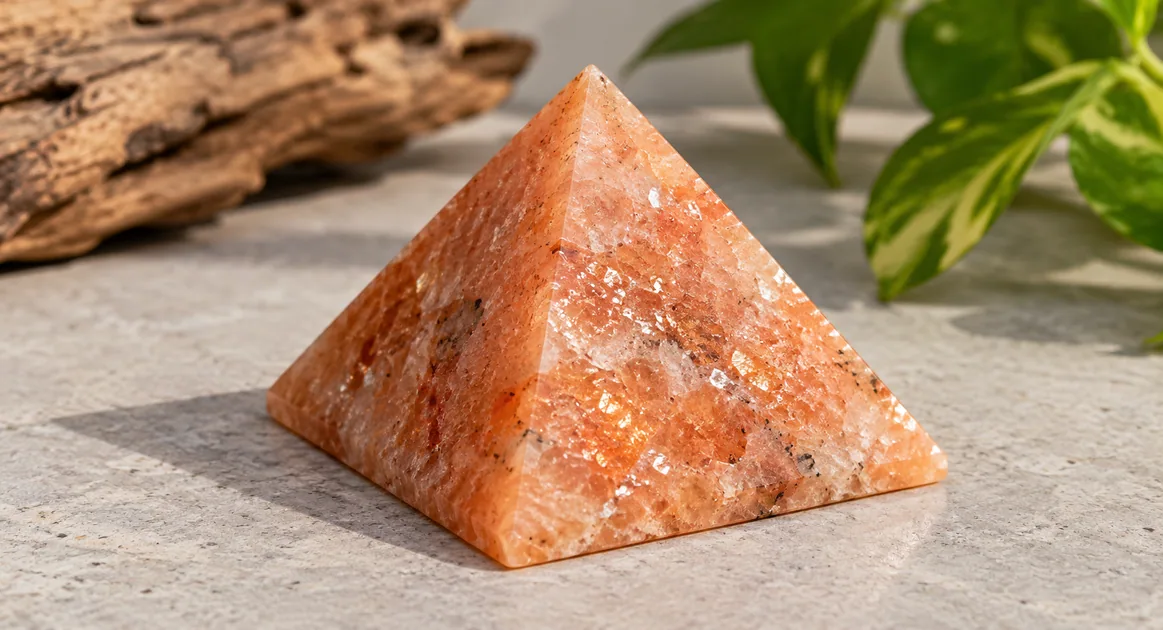
What is sunstone? The feldspar family, not one universal mineral formula
Sunstone is a gem trade name for certain attractive feldspars, especially those that show a metallic, glittery optical effect called aventurescence or schiller. Feldspar is a large family of rock-forming minerals. Its familiar gem members include moonstone, labradorite, amazonite and some sunstones. The family classification matters because the name “sunstone” alone does not tell you that all examples have identical chemical composition, optical properties or geographic origin.
The two broad feldspar branches are potassium feldspars, which include orthoclase, and sodium-calcium plagioclase feldspars, including oligoclase and labradorite. Natural gem sunstone can occur in both branches. Typical mineral formulas differ accordingly: orthoclase is KAlSi3O8, while plagioclase compositions range between sodium and calcium aluminosilicates. The stone sold as sunstone in one carved lot need not be chemically identical to a fine Oregon faceted gem.
Sunstone is often orange, pinkish orange, reddish brown, gold, yellow or pale and translucent. Exceptional red or green material occurs in particular deposits, but it is not sensible to use a striking faceted-gem photograph as the expected appearance of every ordinary carved pyramid. Colour, transparency, visible inclusions and polish all vary with the rough block and the way the craftsperson oriented the cut.
In general retail conditions, buyers should identify a sunstone pyramid as a natural feldspar carving only when that statement is supported by trustworthy supplier identification or testing. Colour and sparkling alone are not enough. An honest listing may specify “sunstone feldspar; exact feldspar species not independently established” when a more exact statement is not warranted. That is more accurate than inventing a species, iron percentage or locality from a photograph.
| Property | Reasonable material description | Question for the actual pyramid |
|---|---|---|
| Mineral group | Feldspar group; orthoclase or plagioclase species can qualify | Which feldspar, if known, and who identified it? |
| Appearance | Peach, yellow, orange, reddish-brown or other colours | Is the photograph representative in ordinary diffuse light? |
| Aventurescence | Directional flashes from reflective inclusions; not equally vivid in all pieces | Can the seller show the same face at several angles? |
| Possible platelets | Hematite, goethite, copper or other inclusions depending on material | Are inclusion species proven or merely assumed? |
| Hardness and toughness | Feldspar is moderately hard but has cleavage and may chip | Are tip, edges and corners sound? |
| Shape and construction | One carved block or a disclosed assembled/reconstructed object | Is the pyramid solid, bonded, coated or repaired? |
| Origin | Several sources produce feldspar sold as sunstone | Is an India or Oregon claim backed by lot records? |
| Treatment | Natural appearance or disclosed enhancements depending on stock | What is known about dye, coating, filling or colour enhancement? |
Aventurescence: why one sunstone face sparkles and another does not
The classic sunstone effect is called aventurescence. Tiny flat inclusions act as mirrors inside the feldspar. When light strikes them at the right angle, individual areas flash gold, copper, orange or reddish brown. Move the pyramid a few degrees, and those reflections can weaken or vanish; tilt it again, and a different face may flash. This is a real optical phenomenon, not a general claim that every orange stone has a mystical glow.
The visual expression depends on inclusion size, concentration and orientation as well as the carving. Smaller platelets may create a soft sheen, while larger or well-aligned platelets can give noticeable individual glitter. One side may look relatively plain under ceiling lighting yet come alive under a small directional light. Another piece can have a warm body colour but little or no obvious aventurescence; the seller should not promise dramatic flashes that the actual unit does not show.
Gem researchers describe iron-oxide inclusions such as hematite and goethite in some aventurescent sunstones, and native copper inclusions in distinctive Oregon material. Not every red or golden reflection establishes copper. Identifying the reflective mineral precisely may require gemmological microscopy and other instruments. The practical consumer question is simpler: are the flashes within the material, do they behave with a change in viewing angle, and does the overall item match the description?
A spotlight photograph can be useful when labelled as an angled-light detail. It should not replace a second photograph in soft daylight showing normal body colour and overall workmanship. Video of the same carving rotating slowly can be even more informative, because it records which faces actually flash. If the listing uses several different specimens, ask which exact piece the buyer will receive.
| Viewing condition | What it reveals | Common mistake to avoid |
|---|---|---|
| Diffuse daylight near a window | Realistic orange-peach body colour and surface finish | Treating the muted look as proof of poor quality |
| Small angled LED or directional lamp | Aventurescent flash and inclusion orientation | Using a blown-out bright spot as the only sales image |
| Slow rotation of the same specimen | Whether flashes appear and vanish with angle | Assuming sparkle intensity will be identical on every face |
| White background and neutral colour balance | Actual hue, edges and changes of translucency | Comparing colour-edited photographs between sellers |
| Close-up of apex and base | Chips, repair lines, flaws and glued assembly | Confusing an inclusion with a structural crack |
| Brief backlighting when safe | Translucent patches and internal inclusions | Interpreting every bright fleck as copper |
Natural sunstone versus goldstone: the most important distinction
Goldstone is a manufactured decorative glass containing glittering metallic-looking inclusions, often copper particles. It is attractive in its own right, and a carefully cut goldstone pyramid may be a perfectly reasonable decorative purchase. It becomes a problem only when labelled and priced as if it were an unmodified natural feldspar sunstone. The names sound similar, but the material categories are different.
Typical copper-coloured goldstone often has a comparatively uniform, densely starry sparkle against a brownish glass body; natural sunstone may exhibit more irregular patches of reflection, subtle colour zoning and directional flashes. These tendencies help a buyer ask questions, but no single phone photograph proves the material. Glass can be made to look irregular, and natural sunstone can sometimes display very vivid schiller. A seller should disclose whether the piece is natural feldspar or a manufactured glass product.
Distinguish goldstone from aventurine quartz as well. Aventurine quartz is a quartz or quartzite material with reflective inclusions, often green because of fuchsite mica but also present in other colours. Its name refers to a related optical effect, yet it is not the same mineral group as feldspar sunstone. A yellow aventurine pyramid, a feldspar sunstone pyramid and a copper-coloured goldstone pyramid therefore should not share one undisclosed material label.
| Material | What it actually is | Visual tendency | Buying question |
|---|---|---|---|
| Natural sunstone | Feldspar group gemstone | Peach/orange or other body colours, sometimes angle-dependent schiller | What supports natural feldspar identification? |
| Oregon sunstone | Specific gem feldspar from Oregon, often plagioclase | May show copper-related schiller, unusual colour or transparency | Is Oregon origin documented for this exact stock? |
| Copper goldstone | Manufactured glass with reflective metallic particles | Often densely and regularly glittering | Is it openly labelled as manufactured glass? |
| Aventurine quartz | Quartz or quartzite with reflective inclusions | Speckled or shimmering, often green | Is the stone quartz-based instead of feldspar? |
| Orange calcite | Calcium carbonate mineral | Often cloudy/translucent rather than plate-like schiller | Is calcite cleavage and acid sensitivity being considered? |
| Carnelian | Orange-red chalcedony | Warm translucent to opaque body, usually without schiller | Is the listing confusing body colour with sunstone identity? |
| Labradorite | Plagioclase feldspar, sometimes with labradorescence | Broad spectral flashes can differ from sunstone glitter | Which optical effect is actually visible? |
| Dyed or coated glass | Manufactured material with applied colour/finish | Surface film or colour concentrated in defects may appear | Are coatings or composite parts disclosed? |
Oregon sunstone, Indian sunstone and locality claims
Oregon sunstone is widely discussed because particular Oregon plagioclase feldspars contain fine native copper inclusions and can show brilliant schiller. GIA research documents the distinctive material, including copper platelets, optical effects and unusual body colours. Oregon is a specific geographic source; it is not a synonym for every peach-coloured sunstone sold in India. A supplier presenting a carved pyramid as “Oregon sunstone” should be able to offer credible provenance rather than pointing to a general internet page.
India also has a recognized history of aventurescent feldspar. Gemmological descriptions include red-brown material with warm glitter from Indian deposits; individual identifications may involve oligoclase or other feldspar compositions. If a seller labels a particular carving “Indian sunstone,” that locality should come from its supply records. An Indian shop address tells us where the item was sold, not automatically where the rock formed.
Some Oregon stones exhibit rich green, red or bicolour appearances that can command attention in the fine-gem trade. They should not become the automatic benchmark for a modest opaque orange pyramid. A retail buyer may reasonably prefer a calm peach carving with good edges over a dramatic yet costly specimen whose provenance is unclear. Material, quality, actual appearance and documented origin are four separate considerations.
Gem laboratories may establish species and detect certain treatments, but a laboratory identification of feldspar alone need not establish where the stone was mined. Provenance may require traceability from supplier to lot, and even instrument-based geographic conclusions have limitations. Write “origin not verified” when that is the factual position, rather than converting a reasonable possibility into an absolute claim.
| Seller statement | Evidence that would help | What does not prove the statement |
|---|---|---|
| Natural sunstone feldspar | Credible material identification; supplier traceability or lab work | Orange colour alone |
| Oregon sunstone | Lot records tied to Oregon mining source; suitable expert assessment | A coppery photograph alone |
| Indian sunstone | Supplier chain indicating an Indian deposit, with material identification | Item being sold in Bengaluru |
| Contains natural copper inclusions | Specialist microscopy or documented source analysis | Any warm-coloured glitter |
| Untreated material | Supplier declaration and appropriate identification for valuable material | A photo without obvious dye |
| Single solid carving | All-side images including base; consistent structure and inspection | Only a polished front-facing photograph |
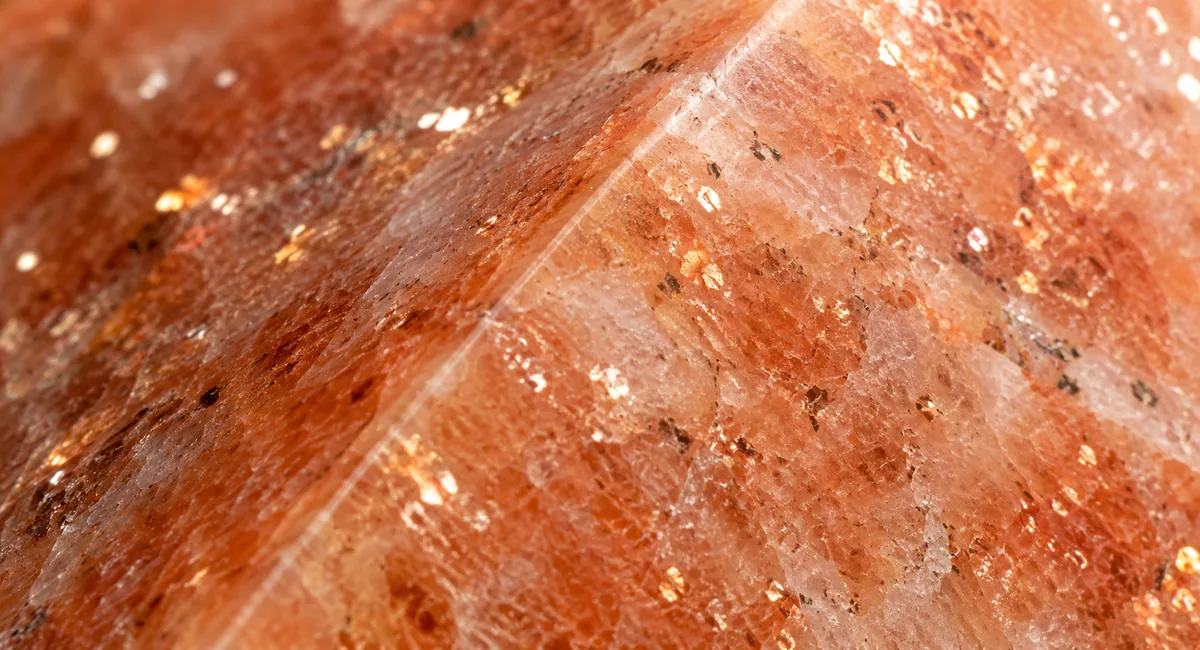
Inspecting a pyramid: point, four faces, base, seams and polish
A pyramid is not merely a gemstone name attached to a shape. Its geometry can make small flaws very visible. Check whether the apex is clean rather than blunted or filled, whether the four sloping faces meet neatly, whether the square base sits without rocking, and whether the corners have small chips. Natural colour bands and inclusions are acceptable parts of a natural stone; an unstable glue joint or active break is a separate workmanship matter.
Feldspar commonly has two directions of cleavage. A carving may therefore show fine-looking planes, subtle lines, or a corner that chips along a natural weakness when dropped. Do not mistake every internal line for a repaired crack, but do not wave away a structural opening as “energy lines” either. Compare the line across adjoining faces, view it in side light, and ask whether there was filling or repair. An expert may be needed for a costly or ambiguous piece.
Some lower-cost decorative pyramids are assembled from bonded stone pieces or powders with resin. An assembled item may be serviceable if honestly described, but it is not interchangeable with a single-piece natural feldspar carving. Request the underside photograph: an artificial seam, resin-rich area, flattened cavity or difference in finish can be easiest to notice at the base. A scale photograph, dimensions and weight are more useful than a grandiose grading adjective.
A polished sunstone pyramid may have slight differences in sheen between faces because orientation affects both optical flash and polishing response. A sound finish need not be a perfectly mirror-like synthetic surface. When comparing several pieces, judge whether the surface suits the material, whether corners are intact and whether the advertised optical effect is genuinely visible on the specific object.
| Part to inspect | Acceptable variation | Ask or reject when |
|---|---|---|
| Apex | Slightly softened handcrafted tip, clearly shown | Unreported chips, glued tip or sharp unstable splinter |
| Four faces | Natural variation in body colour and flash | A face is absent from photography or shows cracks |
| Edges | Minor natural polish differences | Loose fragments, fracture propagation or harsh sharp edges |
| Square base | Small saw/polish marks and stable contact | Rocking, structural separation or undisclosed adhesive |
| Inclusions | Natural-looking flakes and internal zones | Material description contradicts obvious construction |
| Polish | Consistent finish appropriate to stone | Deep machine grooves, coating peel or resin patches |
| Measurements | Actual height and base size in mm | Only a generic “medium/large” label |
| Provenance | Documented source or honest unknown origin | Unverified “Oregon certified” or “rare copper” claims |
Vastu significance: Surya, Agni, Sankalpa and warm-colour symbolism
In Indian spiritual language, Surya represents illumination, vitality, regularity, time and the visible source of daylight. The orange, coppery and golden appearance of sunstone makes it a natural visual metaphor for clarity, initiative and confidence in contemporary crystal and Vastu arrangements. Those associations help explain why a sunstone pyramid may be chosen near a reading desk, in a work area or as a small object marking the start of a new project. The symbolic association does not determine the feldspar’s geology, and the material name by itself is not a classical astrological prescription.
Sankalpa is an intention or resolution given meaning through practice. A shop owner may set a sunstone pyramid on a clean shelf while making a Sankalpa for disciplined customer service, careful record-keeping and honest trade. A student may associate the warm colour with steady daily study rather than a promise of instant examination success. These are meaningful devotional or reflective uses when expressed as part of an actual practice, without turning a decorative object into a guaranteed intervention.
Within Pancha Mahabhuta, different contemporary Vastu educators sometimes connect warm red-orange colours with Agni Tattva, the fire principle, while the carved stone as a physical object has an obvious connection to Prithvi Tattva, the earth principle. A symbolic colour association and an architectural directional doctrine are not the same thing. Some schools emphasize the south-east as the Agneya or fire zone, whereas the east is associated with dawn and Surya. This does not establish one compulsory universal placement for every sunstone pyramid.
Traditional names matter here. Ashta Dik refers to the eight directions, and the Agni association of the south-east should not be casually replaced with “sun direction.” Likewise, Surya is frequently connected with the east in household worship and daily Arghya practice. The actual home plan, cleanliness, natural light, safety and the family’s own tradition deserve consideration before a reader imitates a simplified compass claim from a product card.
Some modern chakra systems link warm gold and orange gemstones to Manipura (solar-plexus focus), and sometimes to Svadhisthana depending on shade and interpretive tradition. Those correspondences are variable. They should not be represented as a uniform statement in all Sanskrit yoga texts, and they are not diagnostic tools. If the owner uses a particular meditation tradition, describe the association in that tradition instead of declaring one mandatory chakra assignment for every sunstone pyramid.
Jyotish distinction: Surya symbolism is not the same as a ruby recommendation
In common Navagraha Ratna frameworks, Manikya (ruby) is associated with Surya. A peach-coloured feldspar pyramid is not automatically a gem substitute for ruby in a horoscope-based prescription. Jyotish interpretation uses the person’s Lagna, Graha placement, rulership, Dasha, strength and other chart considerations according to the practitioner’s method. The fact that sunstone looks bright or carries Surya symbolism does not establish that it should be worn as a ratna, used to counter a particular Graha Dosha or substituted into a Jyotish remedy.
A Kundali-based consultation may separately address jewellery worn on the body, devotional practice, mantra, daana, vrata or home decoration. Those categories should remain distinct. One can keep a sunstone pyramid as a symbolic reminder of Surya or Agni while following established family puja practice, but a person seeking individualized planetary gemstones should rely on the proper chart analysis rather than colour matching alone.
The same distinction applies to Surya Namaskara, sunrise prayers and offering water as Arghya to Surya. Those rituals have their own methods and cultural context. A moisture-sensitive finish or glued base should not be immersed or sprinkled simply because the object is called “sunstone.” Place the carving on a dry nearby shelf if it is to be part of the surrounding setting, and keep ritual liquids separate from the mineral object.
| Concept | Relevant connection | Editorial distinction |
|---|---|---|
| Surya / Aditya | Sun, daylight, discipline and illumination | A symbolic association, not a claim of mineral composition |
| Agni Tattva | Fire-element symbolism often connected with warm colours | Not proof of one mandatory direction for each home |
| Prithvi Tattva | Earth-element association of a solid natural carving | Can coexist with a warm-colour Agni analogy |
| Agneya / south-east | Traditional fire direction in many Vastu systems | Specific placement depends on tradition and floor plan |
| Purva / east | Dawn, sunrise and devotional Surya associations | Do not force sunlight onto the material to “activate” it |
| Sankalpa | Purposeful personal or household intention | Not a mineral testing method or guaranteed outcome |
| Manipura / Svadhisthana | Contemporary chakra-colour interpretations | Correspondences vary across schools and practices |
| Navagraha / Jyotish | Chart-based planetary study and remedies | Sunstone is not automatically a substitute for ruby |
Choosing a place in a Bengaluru home, workspace or puja-adjacent setting
Consider a Bengaluru apartment where the east-facing window brings strong morning light but the windowsill gets wet in monsoon showers. A family likes the warm colour of a peach sunstone pyramid and wants it visible during morning prayers. The more practical option may be a small dry tray or shelf a short distance from the glass, with enough room that curtains and cleaning cloths will not strike the apex. Morning light can make the feldspar look attractive, but direct sunlight is not a technical requirement for Vastu practice or an authentication test.
A working professional who associates the stone with focus could keep a compact pyramid on a side corner of a desk rather than beside the edge, where charging cables or a laptop bag might knock it over. The table should still serve work comfortably. If the desk is shared, choose an unobtrusive location and explain the item as a personally meaningful display rather than compelling colleagues to share the same beliefs.
In a puja area, keep the pyramid distinguishable from consecrated murti, yantra or established family ritual implements. Avoid placing it where ghee, oil, kumkum, water, incense ash and cleaning liquids will accumulate on the surface. A separate cloth or small stand is useful. The item’s warm colour can form part of a devotional ambience without inventing a required temple procedure for feldspar.
A Vastu consultant may suggest reviewing the north, east, south-east or other directions depending on the purpose and school. Rather than printing a universal “must face south-east” instruction, record the room function, orientation, natural lighting, safety and specific Sankalpa. This approach is easier for a reader to apply and more faithful to the fact that different contemporary schools use mineral objects in different ways.
Jewellery showroom, shop counter and professional Vastu reference kit examples
A jewellery showroom can place one correctly identified sunstone pyramid in a stable glass display case beside a small explanation of natural feldspar aventurescence. Under an adjustable spotlight, the same specimen can demonstrate how metallic-looking inclusions catch light. For buyer trust, the card should make clear whether the item is natural sunstone, its measurements, its actual body colour and whether the sparkle photograph was taken under directional lighting. A second goldstone example can be labelled as manufactured glass so visitors learn the distinction rather than being misled by a colour resemblance.
For a professional Vastu consultation kit, keep sunstone as one labelled specimen in a structured material family. Place it alongside orange calcite, carnelian, tiger eye, yellow aventurine, goldstone and labradorite in separate padded compartments. Each specimen label should record the mineral group, common trade name, whether provenance is documented, treatment information, approximate hardness considerations, and a short traditional symbolism note. This lets consultants distinguish aesthetic and spiritual selection from identification of a material.
At OmmRudraksha, an educational consultation can discuss why a customer likes the symbolism of Surya, Sankalpa or warm colours while also answering the factual buying questions about the carving. This creates a more useful experience than asking customers to pay extra merely because a photograph contains unusually bright glitter. If the particular unit lacks strong aventurescence, describe the soft shimmer accurately; if it shows it well, show a short rotation video of that same piece.
When a customer is commissioning several pieces for offices or return gifts, count inventory as actual units with actual measurements. One lot may contain slightly different hues and flashes. Assign identifiers to each photograph if the customer selects particular pieces; otherwise disclose that natural variations will occur. Avoid treating “AAA sunstone” as an official universal geological certification, since the term often functions only as a seller-defined commercial grade.
| Setting | Recommended presentation approach | Handling or disclosure point |
|---|---|---|
| Home shelf | One stable base on a dry tray; warm colour complements natural materials | Keep away from falls and wet window ledges |
| Study/work desk | Compact pyramid to one side of active work area | Avoid cables, bags and repeated handling |
| Puja-adjacent space | Separate clean shelf, with the owner’s chosen Sankalpa | Protect from oil, coloured powders and water |
| Showroom counter | Label actual feldspar and demonstrate angled-light schiller | Do not present goldstone as natural sunstone |
| Professional Vastu kit | Reference specimen with linked mineral and symbolism notes | Protect cleavage-related vulnerable edges in a padded box |
| Corporate gifting | Honest name, dimensions, neutral image, straightforward care card | No unverified “origin certificate” or guaranteed outcomes |
| Online shopping | Multi-view photos of actual piece or clear batch variability | Disclose whether photo is illustrative or exact item |
Buying checklist: dimensions, weight, grades, price and trustworthy descriptions
A good online listing starts with the boring but essential facts: height in millimetres, base width, approximate weight, number of pieces supplied, material, finish and actual colour range. A four-centimetre pyramid and a six-centimetre pyramid may look almost the same in isolated website photographs but occupy very different shelf space. The buyer should know whether the photograph depicts the exact item or only a representative example from a natural-material batch.
A higher asking price may reflect stronger optical sparkle, craftsmanship, rarity of the rough, verified origin, import cost or simply a seller’s margin. Buyers should request the reason rather than relying on terms such as “premium energy grade.” In gem trading, an attractive intense colour can add commercial appeal, but a carved decorative sunstone does not automatically inherit the pricing logic of a fine faceted Oregon gemstone. Weight by itself does not authenticate the material or establish energy-related properties.
Check whether treatment information is clear. Many ordinary sunstones are sold with their natural appearance, but some colour-treated feldspars exist in the wider trade. A seller should not promise that all stones called sunstone are untreated. Coatings, crack fillings and joined pieces may affect both value and cleaning. If a claim is material to the price and cannot be substantiated, ask for a specific explanation or choose a more transparent listing.
For marketplace comparisons, calculate price per unit only after verifying similar size, material, workmanship and inclusion visibility. A goldstone pyramid may cost less than a natural feldspar carving, but price is not an authenticity test. A collector may prefer well-documented natural sunstone; someone seeking merely an attractive coppery glitter display could knowingly choose goldstone. Both decisions are valid when labels are honest.
| Check | Acceptable answer or evidence | Potential problem |
|---|---|---|
| Material identity | Natural sunstone feldspar or clearly declared alternative | Generic “sun crystal” with no species/material explanation |
| Lighting | Same item shown in diffuse and angled light | Only enhanced spotlight or heavy colour filters |
| Dimension/weight | Measured base and height; approximate weight | Only broad “medium size” descriptions |
| Craftsmanship | Tip, corners, base and faces visible | Hidden underside or unresolved structural defects |
| Treatment | Disclosed known colour treatment, coating or filling | Unsupported “100% untreated” assertion |
| Geographic origin | Specific documented sourcing or honest unknown | “Oregon” inferred from coppery appearance |
| Quantity and variant | Exact unit or stated natural batch variation | Different stones in photos without variation notice |
| Return/packing | Clear procedure and padded shipping protection | Unprotected sharp apex or ambiguous replacement conditions |
How to clean and protect a sunstone pyramid
Feldspar is not as vulnerable as satin-spar gypsum, but it is not invulnerable. The widely used gemmological hardness ranges for feldspar sunstones are approximately Mohs 6–7 depending on the species; cleavage and imperfect toughness are important regardless of the exact numerical value. A collision with another hard stone can chip a thin pyramid point. Store individual carved items separately instead of piling them together in a loose bowl.
For normal shelf dust, start with a soft clean dry microfibre cloth or a soft brush. Support the base with one hand and wipe away from the apex, without pushing on the tip. If an intact, untreated carving is genuinely soiled, conservative gem-care guidance permits brief mild soapy water cleaning followed by gentle rinsing and complete drying. However, an unknown treatment, filled fracture, adhesive assembly or decorative coating changes the decision: use the seller’s specific instructions and the least wet method that works.
Avoid steam and ultrasonic cleaning, aggressive household chemicals, bleaching agents and acids. Hard scrubbing, abrasive paste and improvised polish can leave scratches or disturb a coating. Do not perform hardness or acid tests on the sale item. Keep it away from sudden thermal shocks and do not leave it loose beside keys, other mineral carvings or metal tools. Routine cleaning should preserve the finish, not seek to “recharge” a natural mineral through damaging household techniques.
Traditional household practices sometimes involve sprinkling water, keeping items in sun, placing objects on salt, applying scented oil or using incense smoke. They should not be assumed appropriate for every gemstone pyramid. A dry placement, the spoken Sankalpa and the home’s usual devotional practice can be maintained without immersing the feldspar in water, leaving coloured residue in pits or heating the item. Keep a puja oil lamp sufficiently distant that flame and soot cannot reach the carving.
When a pyramid arrives by courier during humid Bengaluru weather, let its packaging reach room temperature before opening a tightly wrapped box, inspect for impact damage, and keep the item in a dry padded compartment when not displayed. For a professional kit, label the compartment so sunstone is not confused with goldstone, a calcite pyramid or another warm-colour specimen during quick demonstrations.
| Situation | Preferred action | Avoid |
|---|---|---|
| Ordinary dust | Soft dry brush or lint-free cloth, supporting base | Pressure against the point |
| Sticky dirt on verified intact natural feldspar | Brief mild soap and lukewarm water only if suitable, then fully dry | Soaking repaired, filled or coated pieces |
| Unknown treatment or adhesive | Follow supplier care and keep cleaning conservative | Solvents or untested household polish |
| Display beside a window | Secure dry shelf with minimal knock risk | Wet sill, ledge edge or rapid temperature changes |
| Puja use | Separate stand and dry handling | Oil, acidic solutions, ash ground into surface |
| Packing for travel | Soft individual wrap and rigid padded compartment | Several unwrapped pyramid tips rubbing together |
| Scratches or cracks discovered | Photograph defect and ask knowledgeable seller | Home scratch test, acetone, bleach or heat |
Myths, common questions and correct expectations
Is sunstone a natural gemstone or a marketing name?
Natural sunstone is a feldspar gem material, but the trade name covers more than one feldspar species. Confirm the actual stone with credible identification rather than relying only on the name.
Is every orange pyramid a sunstone pyramid?
No. Carnelian, calcite, dyed stone, resin, glass and other materials can all look orange. Colour by itself does not establish mineral family.
What makes a sunstone sparkle?
Reflective inclusions within the feldspar can produce directional aventurescence, often seen as tiny golden, orange or coppery flashes.
Does weak glitter mean the sunstone is not genuine?
Not necessarily. Inclusion size, density, cut orientation and light angle vary. Some feldspars called sunstone show relatively little visible schiller.
Is goldstone the same as sunstone?
No. Copper-coloured goldstone is manufactured glass. It may be attractive but should not be sold as natural sunstone feldspar.
Are copper inclusions present in all sunstones?
No. Some show iron-oxide-related reflections, while Oregon material is especially known for native-copper inclusions. Identification of one specimen needs evidence.
Can a photograph prove Oregon origin?
No. Origin requires appropriate provenance or expert assessment. Warm colour or glitter does not establish where the material was mined.
Is “Indian sunstone” necessarily from India?
Not solely because a shop uses the phrase. Authentic sourcing documentation supports a locality statement; the place of retail sale is not proof of mine origin.
Why does the sparkle change between pyramid faces?
Flat inclusions reflect light directionally, and each cut face presents a different orientation. Moving the piece or light changes what the viewer sees.
Is sunstone softer than quartz?
Common feldspar sunstones are around Mohs 6–7 depending on variety, with important cleavage vulnerabilities; quartz is Mohs 7 without the same feldspar cleavage.
Can a sunstone pyramid chip even if its surface is hard?
Yes. Hardness describes scratch resistance, not resistance to fracture. Thin tips and edges can chip if struck or dropped.
Should a sunstone pyramid be placed only in the south-east?
No universal rule applies to every home. The Agneya association of south-east is one traditional Vastu concept; actual placement depends on purpose, room plan and the school followed.
Can it be kept in the east-facing puja area?
It can be kept on a stable dry shelf as a separate decorative or symbolic object, respecting established household puja practices.
Does sunstone replace ruby for Surya in Jyotish?
No automatic substitution follows from the name or orange colour. Chart-based gemstone recommendations require a distinct Jyotish assessment.
Does sunstone belong to Manipura chakra?
Some contemporary colour-based crystal practices associate gold/orange stones with Manipura, while other traditions differ. It is an interpretive association, not a universal stone classification.
Can it be placed in direct sunlight to activate it?
Direct sunlight is not needed to identify or meaningfully display the material. Choose a secure location and follow the intended devotional practice without heat or fall risk.
May I wash it in salt water or vinegar?
Avoid salt-water soaking and acidic liquids, particularly with unknown coatings, adhesives or fractures. Gentle conservative surface care is preferable.
What photographs should I request before purchase?
Front, all four faces, apex, underside and a short neutral-light rotation or two lighting conditions are useful, with actual height and base measurements.
Can goldstone be used as a knowingly manufactured decoration?
Yes, if clearly sold as manufactured glass. Its decorative appeal does not justify calling it natural sunstone.
What belongs on the label of a professional Vastu kit specimen?
Material identity, trade name, source confidence, known treatment, dimensions, safe handling guidance and the specific symbolic association used by the practitioner.
Research basis and closing buying checklist
The material explanations in this guide are grounded in GIA’s Sunstone Description, Sunstone Quality Factors, Sunstone Care and Cleaning and buyer guidance; published Gems & Gemology studies of copper-related Oregon sunstone; and the International Gem Society’s explanations of feldspar sunstone and Oregon varieties. These references establish the difference between feldspar and manufactured goldstone, the workings of aventurescence, locality-specific copper inclusions, and appropriate care. They are named for source clarity without loading the product guide with repeated external commercial links.
Before ordering a pyramid, identify what material it is; confirm actual light-dependent sparkle rather than relying on one enhanced image; inspect the point, edges, base and repairs; obtain dimensions and treatment details; ask for proof before accepting a rare origin claim; and decide whether the traditional Surya, Agni or Sankalpa interpretation suits the intended space. The best choice is an accurately described, safely handled and genuinely attractive object, with the spiritual symbolism explained in its proper context.
Explore existing OmmRudraksha collections
Browse Vastu for the existing collection, or explore gemstone products for other material forms. Each product’s construction and care information should guide your choice.