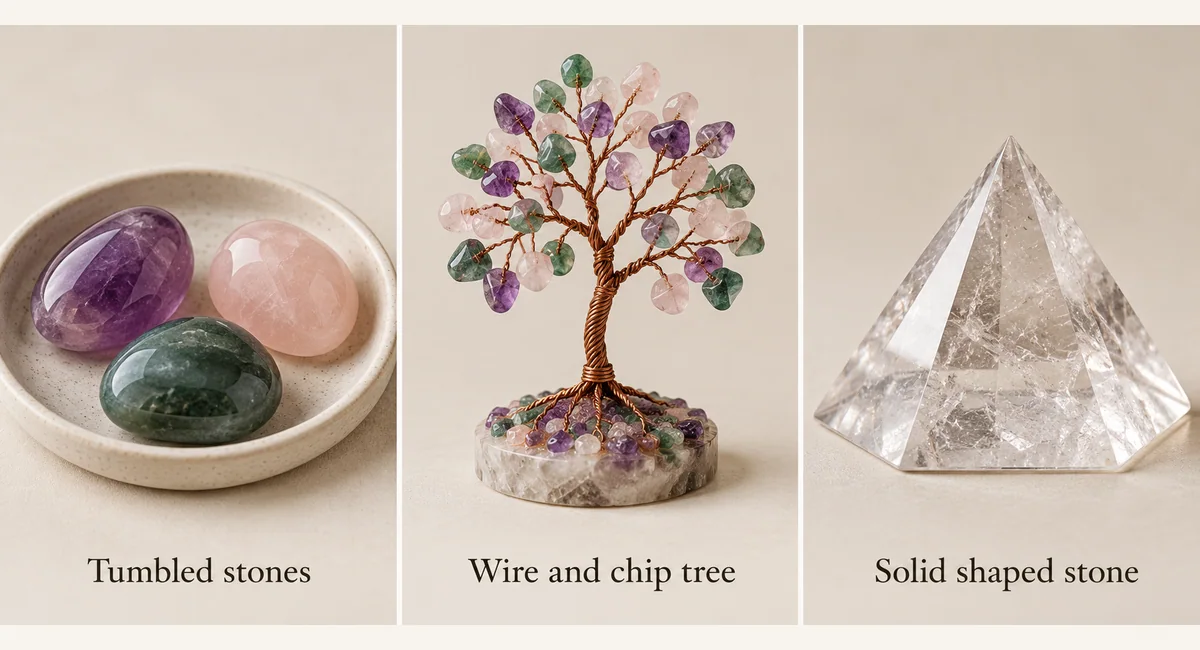
Should you choose loose tumbled stones, a gemstone tree, or a Vastu pyramid? All three can contain the same mineral, yet they support different ways of working with gemstone symbolism and Vastu placement. Tumbled stones are flexible: you can identify, arrange and move each specimen independently. A gemstone tree brings together the imagery of roots, a trunk and branching growth; it is widely chosen as a symbol of abundance, harmony and continuity. A pyramid gives a fixed geometric focus and is used in contemporary Vastu-pyramid practices for intentional placement within a particular area.
The best choice starts with the purpose: perhaps a prosperity-oriented shop counter, a peaceful family corner, an eight-direction consultation set or a single meaningful gift. Then consider the stone, the tradition being followed, the available space and whether the object must be moved. This guide compares traditional associations, stone-by-stone uses, directional placement, product construction and specific home/business examples so that you can select one intelligently—or combine forms without cluttering the room.
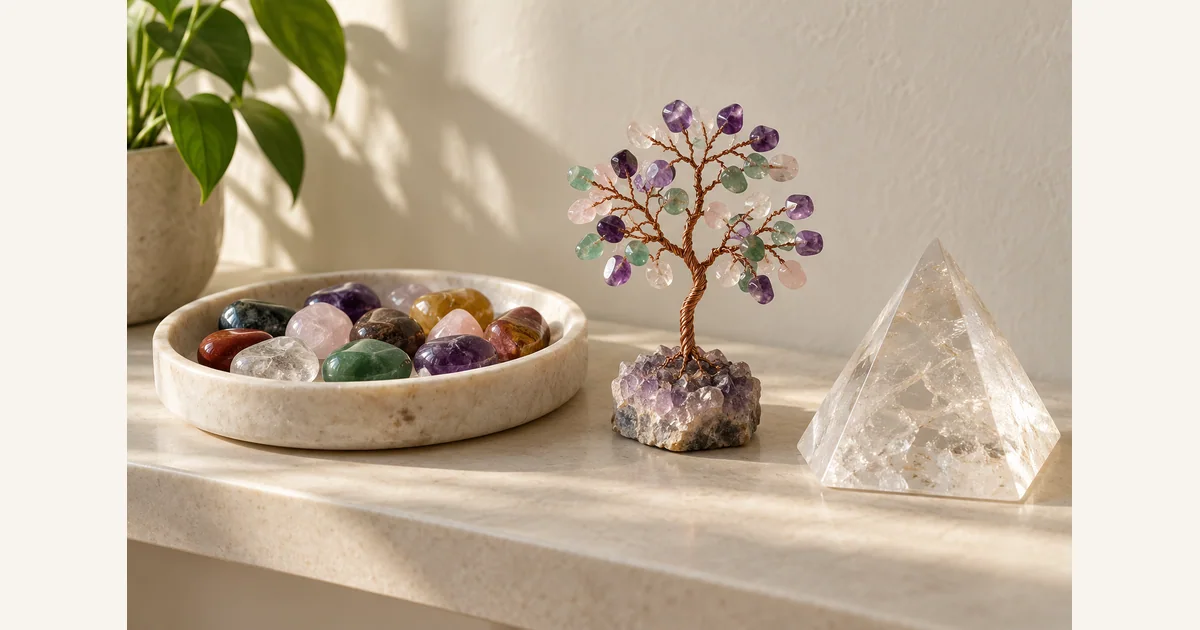
1. The difference at a glance: form, intention and use
| Question | Tumbled gemstone set | Gemstone tree | Vastu pyramid |
|---|---|---|---|
| What is it? | Separate polished stones, either loose or in a labelled kit | Gemstone chips or beads fixed to a branching tree on a stable base | A faceted pyramid made from gemstone, metal or a composite |
| How is it used? | Individual selection, Sankalpa, grids, directional teaching and portable sets | One recognisable symbol of growth, harmony, family or prosperity | A defined geometric focal point in a room or on a desk |
| Ideal situation | Learning and comparison; small spaces; changing arrangements | Home, shop, office, gift or reception where a tree motif is wanted | Counter, desk, altar, shelf or designated Vastu zone |
| Stone choice | Many individual minerals can be compared in one set | Usually one gemstone family or a coordinated multicolour mix | One material, layered materials or a specified Yantra/metal construction |
| Movement | Easy to reposition; must keep individual stones identified | Best handled by the base; branches can bend | Stable once positioned; pointed apex needs protection |
| Traditional frame | Stone symbolism, Graha and colour associations where relevant | Tree-of-life and Kalpavriksha-inspired prosperity symbolism | Pyramid geometry with contemporary Vastu-remedy practice |
Short recommendation: Choose tumbled stones when you need flexibility and multiple named samples; choose a gemstone tree when growth, abundance or family continuity is the central theme; choose a pyramid when a compact geometric object fits the chosen Vastu zone or working method. Buying the largest of the three is not inherently better.
2. Why gemstone trees have a distinct spiritual meaning
In Indian religious art and storytelling, Kalpavriksha is the wish-fulfilling tree, associated with abundance and the fulfilment of aspirations. The tree also evokes nourishment, rootedness, branching relationships and continuing growth. Modern gemstone trees draw on this symbolic language: a wire trunk suggests the support of a family or enterprise, branches suggest expansion, and the stones represent intentions selected by colour or mineral association.
A gemstone tree made with citrine-coloured chips therefore tells a different story from a little bowl of loose citrine. The underlying mineral symbolism may overlap, but the tree adds the visual idea of cultivated prosperity. A rose-quartz tree often becomes a shared family symbol; an amethyst tree may be selected for a meditation or reflection corner. For some customers, a multicoloured seven-chakra tree is a reminder of balanced spiritual practice rather than a single financial or family aim.
Important distinction: The Kalpavriksha is an old Indian symbolic motif; the modern wire-and-gemstone-chip tree is a contemporary product that draws inspiration from such imagery. It should be appreciated for the meaning and practice it represents, without pretending every chip arrangement appears in an ancient Vastu treatise.
Gemstone trees are also useful where someone wants one finished object rather than an open tray of stones. For a reception area or shop, a compact tree is easy for visitors to recognise. For a Vastu consultant demonstrating how several gemstones differ, however, a fixed mixed-stone tree is less instructive than individually named loose specimens.
3. What makes tumbled stones useful for Vastu and astrology-related study?
A tumbled stone is a mineral specimen that has been rounded and polished, usually through abrasion and finishing. Its benefit for a student or consultant is not merely that it fits a pouch. Each material remains separate, so the user can identify it, compare its colour and structure, put it on a directional diagram, or bring it out while explaining its customary symbolism.
Consider an eight-direction teaching tray. A consultant can put labelled pieces around a compass drawing: a clear-quartz specimen at a prayer-oriented northeast example, an aventurine specimen near a north/east growth discussion, a carnelian specimen for a southeast fire-themed example, and a grounding stone where stability is being discussed. These are illustrative contemporary gemstone pairings; the traditional Vastu directional system does not prescribe that every household must buy these exact minerals.
In a Jyotish class, the arrangement is different. A Navagraha teaching set groups gemstones by the nine Grahas—Sun, Moon, Mars, Mercury, Jupiter, Venus, Saturn, Rahu and Ketu—rather than by eight geographical directions. A stone held as a labelled example for the class is not automatically a recommendation to wear that material. Individual gemstone-wearing decisions belong to chart interpretation, including Lagna, planetary lordship, strength, Dasha and the intended purpose of the recommendation.
Loose stones are especially suited to professional kits, because students can compare a real mineral against dyed glass, another mineral of the same colour or an imitation. For a lasting decorative or ritual focal point, a tree or pyramid may make more sense than a box of samples.
4. The meaning of a pyramid in Vastu practice
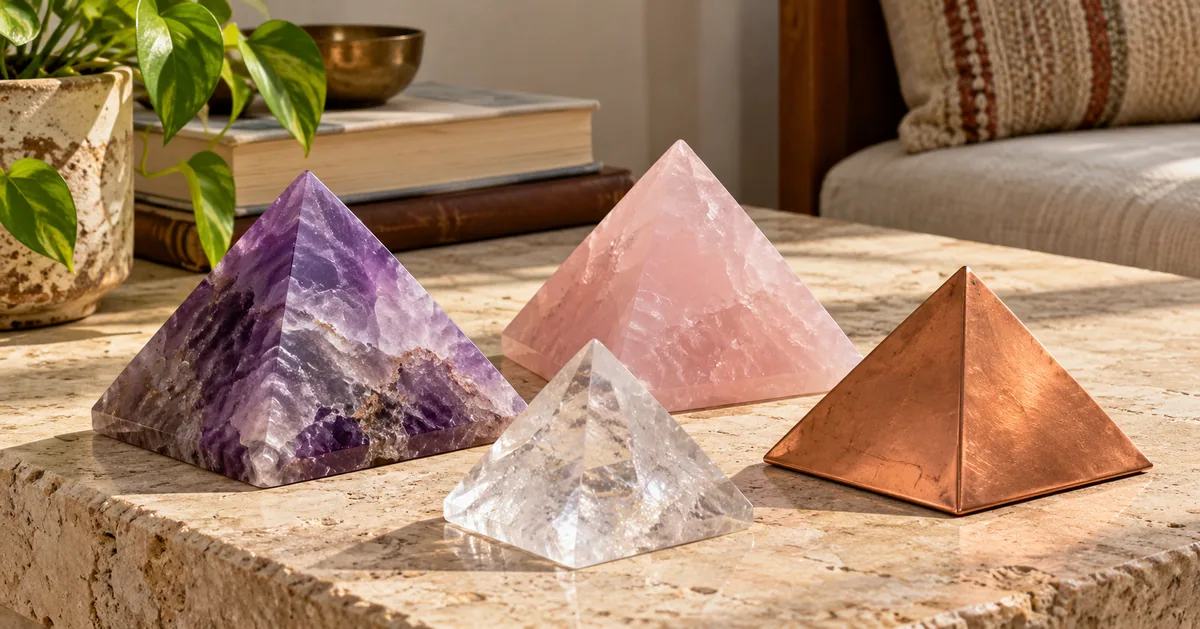
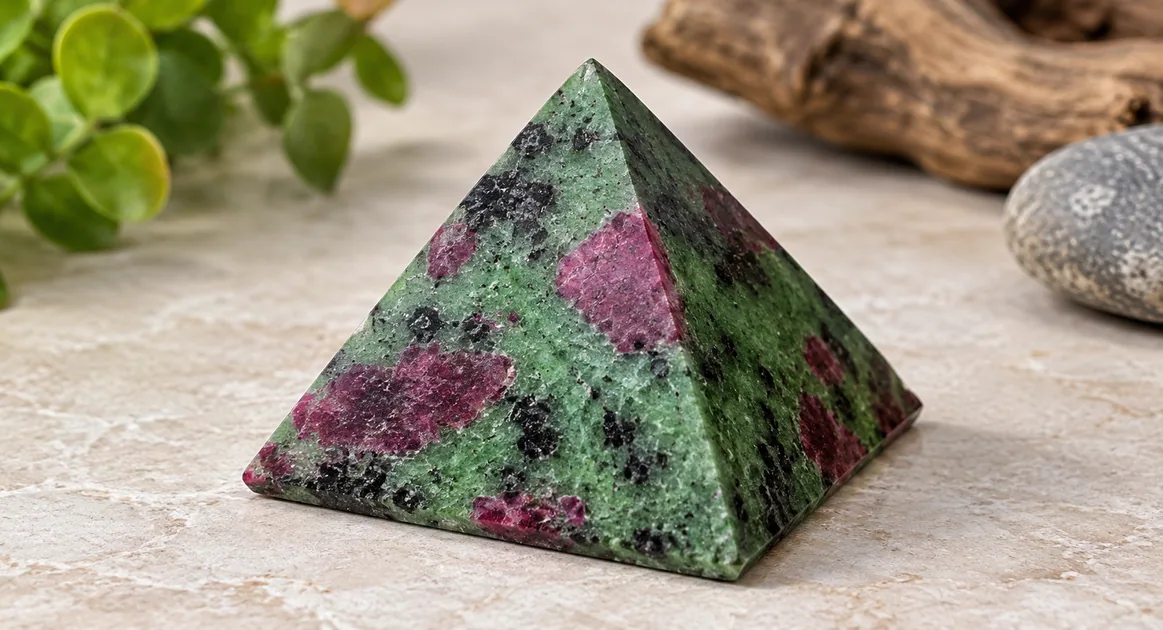
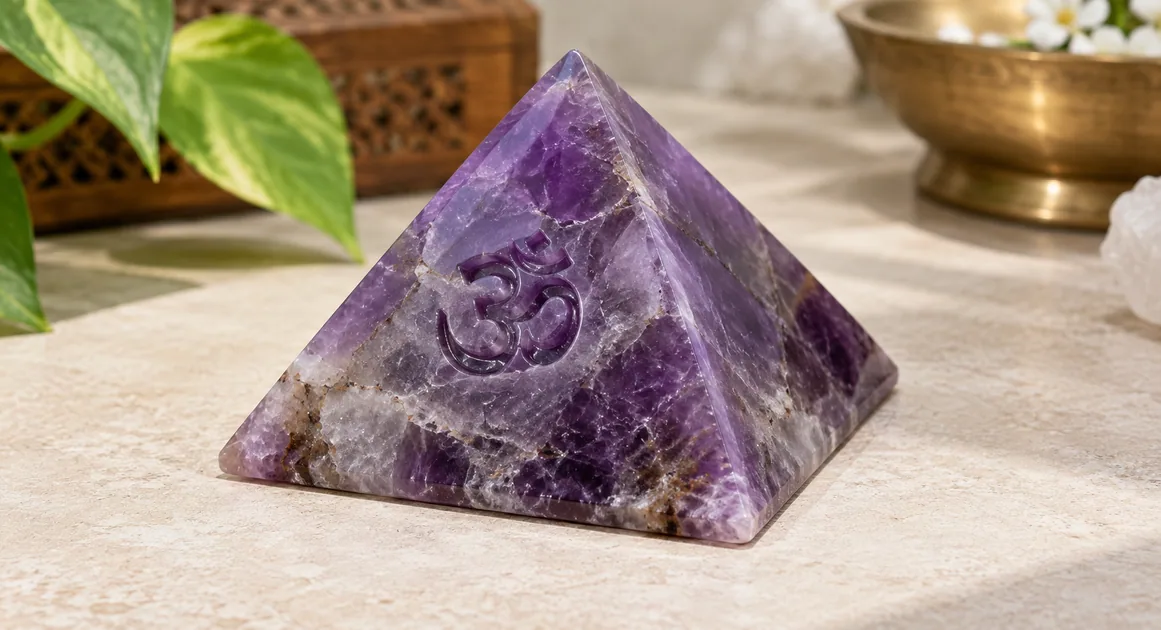
A pyramid is immediately recognisable through its broad base, triangular faces and rising apex. Contemporary pyramid-Vastu systems use this geometry as a symbolic focal point for order, directed intention and spatial correction. Some products incorporate copper, brass, gemstones, embedded Yantras or other specific constructions. Others are simply solid pyramids carved from quartz or a coloured stone. These are not interchangeable products: their materials, symbols and intended traditions differ.
For example, a copper pyramid may be selected within a particular metal-based Vastu remedy system; a clear-quartz pyramid is chosen in crystal-focused practice for clarity and focus; a rose-quartz pyramid brings the pink stone's customary harmony symbolism into a geometric form. A Navagraha or Yantra pyramid also introduces the particular planetary or Yantra iconography used in that item. Check the product's actual description rather than assuming that every pyramid performs the same role.
Traditional Vastu Shastra includes principles of orientation, spatial planning, direction, built form and the Panchamahabhuta framework. The popular market for miniature gemstone and metal “Vastu pyramids” is a more recent application. The useful approach is to explain how practitioners use such objects today and which traditional spatial concept their chosen placement relates to.
If you want a fixed, uncluttered desk focus, a small pyramid can be a logical choice. If the symbolism of a wish-fulfilling tree is central to your intention, a gemstone tree communicates it more directly. If the goal is to test several mineral options or demonstrate a complete plan, individual tumbled stones remain more adaptable.
5. Choose the stone first: nine gemstone meanings across all three forms
The stone supplies much of the customary colour and material symbolism; the form changes how that symbolism is presented and used. The table below gives examples commonly encountered in contemporary crystal and Vastu-inspired practice. It is a practical selection map, not a rule that a particular stone must be installed in every building.
| Gemstone / material | Common traditional or contemporary association | Useful form choice | Example intention |
|---|---|---|---|
| Clear quartz (Sphatik) | Purity, clarity, puja and meditation | Loose stone for altar or a clear-quartz pyramid | A simple focus in a prayer or study space |
| Amethyst | Reflection, calm and disciplined contemplation | Single stone, tree or small pyramid | A quiet corner for meditation or thoughtful work |
| Rose quartz | Affection, emotional harmony and relationships | Tree for family symbolism, or small stones | Shared family space or gifting |
| Citrine | Prosperity, confidence and abundance intentions | Tree for business growth; pyramid for desk focus | Workplace goal or shop prosperity display |
| Green aventurine | Opportunity, renewal and growth in modern crystal practice | Tree or labelled tumbled set | New enterprise or creative workspace |
| Tiger eye | Resolve, confidence and disciplined action | Portable tumbled specimen or pyramid | Decision-making desk or professional kit |
| Carnelian | Vitality, initiative and warm fire-like symbolism | Tumbled specimen or compact pyramid | Action-oriented work area |
| Black tourmaline | Grounding and protective intention in modern practice | Loose stone or solid object | Entrance or work desk symbolism |
| Lapis lazuli | Wisdom, insight and communication symbolism | Separate identified stone, tree or selected carving | Teaching, reflection or speaking practice |
Material note: A tree labelled “citrine” may contain natural citrine, heat-treated quartz or material described by a trade name, depending on the seller. Genuine citrine is a yellow-to-orange quartz; much commercial citrine is produced by heating amethyst. Rose quartz and amethyst are also quartz varieties, but they are different materials and should be correctly labelled. Names, treatments and actual components matter to the buyer regardless of the product's spiritual form.
6. Vastu direction and placement: the same room, three different choices
Begin with the room's actual compass orientation, then identify where its north, northeast, east, southeast, south, southwest, west and northwest areas fall. Traditional directional guardians—Kubera, Ishana, Indra, Agni, Yama, Nirrti, Varuna and Vayu—provide one way to understand the symbolism of the eight directions. Different Vastu lineages and modern crystal schools may apply their stone associations differently, so the following is a working selection guide rather than a universal prescription.
| Direction | Traditional directional reference | Possible intention | Object example |
|---|---|---|---|
| North | Kubera: wealth and resources | Business opportunity, finances, continuity | Citrine or aventurine tree on a suitable clean shelf |
| Northeast (Ishanya) | Ishana: sacred, contemplative dimension | Puja, clarity, prayer and study | One small Sphatik pebble or clear-quartz pyramid |
| East | Indra; sunrise and beginnings in spatial symbolism | Growth, learning, new work | Green aventurine stone or small tree |
| Southeast | Agni: fire | Initiative, activity and energetic work | Carnelian specimen or a carefully chosen warm-colour pyramid |
| South | Yama; duty and order | Discipline, purposeful activity | A compact, stable stone chosen for the room's practice |
| Southwest | Nirrti; stability and boundaries in many modern maps | Groundedness, continuity, support | One substantial grounding-themed stone, not a loose pile |
| West | Varuna: waters | Reflection, completion and receptivity | Simple clear or blue-toned specimen where appropriate |
| Northwest | Vayu: air and movement | Communication, relationships and mobility | Portable labelled stone or small focal arrangement |
One should not place every item from this table at once. An overcrowded room defeats the practical goal of a calm, purposeful arrangement. Pick the direction relevant to the space and the meaning most important to the user; then choose a single suitable form. A student may prefer a labelled stone that can move between lessons, whereas a shop owner may prefer one finished tree in the chosen commercial area.
7. Worked example: a Bengaluru jewellery showroom
Imagine a jewellery showroom whose owner wants an object that expresses growth and welcomes customers, but also wants a portable kit for explaining gemstones. After checking the actual compass orientation, the owner finds that a north-side shelf is available, while the main sales counter is busy and frequently cleaned.
- Front display: A modest green-aventurine or citrine gemstone tree on the north-side shelf suits the desired growth/prosperity symbolism. Its base should be stable, its chips accurately described, and it should not block customer sightlines.
- Consultation table: A professional tumbled stone kit with labelled specimens is more useful than a second tree. Staff can show the difference between clear quartz, amethyst, aventurine, tiger eye and other stones as customers ask questions.
- Desk focal point: If the owner wants a compact object for intention-setting at the office desk, a small quartz or gemstone pyramid may fit better than another branching display. Its meaning is different from the Kalpavriksha image represented by the tree.
- Review: Keep the actual product descriptions, labels and orientation in a simple plan. If the owner changes the display later, no complex ritual rearrangement of a full eight-direction kit is required.
Notice how the three forms serve different purposes in the same business: the tree expresses a continuing commercial intention, the loose stones educate, and the pyramid acts as a single geometric focus. More objects would not necessarily improve the layout.
8. Worked example: family apartment, puja corner and study desk
Consider a two-bedroom apartment where a family wants a peaceful puja corner, a gift for a new home and a few stones that a teenager can identify while learning about minerals.
For the puja shelf, a small Sphatik stone or clear-quartz pyramid may suit a minimal, clean arrangement. A large gemstone tree need not crowd the altar if the space is narrow. The family may instead place a carefully chosen rose-quartz tree in a shared living room as a symbol of harmony and care.
For the study desk, three separately identified stones—perhaps clear quartz, amethyst and tiger eye—allow the student to examine colours, structures and the different symbolic associations used in contemporary practice. A tiny labelled tray is easier to change than a fixed composite tree. The student can also learn that two purple-looking materials need not have the same mineral identity.
For the housewarming gift, a rose-quartz or multicoloured tree is often more immediately meaningful than twelve loose pebbles with no labels. But if the recipient is a gemstone enthusiast, a well-documented twelve-gemstone set may be the more thoughtful and educational choice. The correct selection depends on the person receiving it, not a single preferred product form.
9. Worked example: a Vastu consultant preparing a site visit
A consultant visiting a client needs to explain the eight sectors of a floor plan and compare materials without carrying many fragile display objects. Here, loose tumbled stones are the natural primary tool. A numbered kit can match eight example specimens to an orientation diagram, then regroup them by Panchamahabhuta or by gemstone family for a second exercise.
The consultant might demonstrate the symbolic meaning of a citrine tree in a photograph, or show a single portable pyramid as an example of a contemporary Vastu object. Those examples complement the teaching kit; they do not replace the kit's value in showing many separate minerals accurately.
At the end of the visit, the recommendation should identify the client's actual room, intended practice, selected object and material—not merely “place any yellow crystal in any prosperity corner.” If a Jyotish gemstone is being considered for wearing, use the birth chart and the relevant Jyotish method, rather than transferring a room-placement table directly into a personal gemstone prescription.
10. Decide in five questions before buying
- What am I trying to express? Family harmony, business growth, contemplation, study, protection-related intention, or education about gemstones?
- Where will it go? Check the real compass direction, shelf depth, handling frequency and whether the location belongs to a puja, family, work or public area.
- Should it stay assembled? A tree or pyramid creates a ready-made focus; loose stones are better when several different stones must be demonstrated or repositioned.
- Which mineral is actually supplied? Ask for gemstone names and whether items contain treatments, dyed material, resin, metal wire or mixtures. A gemstone tree may be genuine stone chips without being one solid gemstone object.
- Will I use it enough to justify it? A small object chosen for one clear intention is often preferable to a large mixed assortment that the owner does not understand.
| Your situation | Best starting choice | Reason |
|---|---|---|
| Want to learn the meanings of 12 or 16 minerals | Labelled tumbled-stone collection | Each specimen is separate, comparable and reusable |
| Want a symbolic business-growth gift | Citrine or green gemstone tree | The growth/tree motif communicates the intention |
| Want a minimal meditation focal point | Clear-quartz stone or small pyramid | Simple placement without a crowded surface |
| Want a portable professional Vastu kit | Numbered tumbled stones with compass guide | Can demonstrate several systems without fixed construction |
| Want a decorative spiritual centrepiece for a home | Carefully chosen gemstone tree | One coherent form, meaningful material and stable base |
| Want a particular contemporary pyramid practice | Named pyramid/metal/Yantra product | Specific construction and tradition can be checked |
11. What changes—and what does not—when the gemstone is the same?
Suppose a buyer compares a clear-quartz tumbled stone, a clear-quartz-chip tree and a clear-quartz pyramid. All may incorporate quartz, but it is sensible to compare the amount, quality and treatment of the material and the object made from it. The loose pebble is a single portable specimen; the tree also has wire and a base; the pyramid might be one piece of carved quartz, or a composite depending on the listing.
The symbolic associations of Sphatik—purity, clarity and prayer-oriented use—can inform all three choices. The objects differ mainly in their function and imagery: a tangible personal stone, a tree of continuing growth, and an upward-pointing geometric focus. One should not infer that a pyramid-shaped crystal must replace a tree, or that a tree is necessarily stronger than a tumbled piece. Match the object to how the customer intends to use it.
For stones sold in multiple forms, compare weight, size, material authenticity, craftsmanship, finish, stability and care. Quartz is a mineral family that includes colourless rock crystal, amethyst, citrine and rose quartz; the colour names represent different varieties or trade descriptions, not interchangeable pieces. Correct gemstone identity supports both spiritual selection and a responsible purchase.
12. Care, positioning and combining forms
Loose stones: Keep labels with the corresponding specimens, avoid mixing fragile stones with harder ones, and dust with a material-appropriate soft cloth. A labelled tray is particularly useful for teaching sets. If using a stone in a bowl, a small cloth lining can prevent rubbing on polished surfaces.
Gemstone trees: Lift by the base rather than pulling a branch. A tree may include copper-coloured wire, dyed chips, adhesive and a mineral or resin base, so clean according to all components rather than the gemstone name alone. Keep its branches clear of curtains, children reaching from a table edge, and frequent wiping or handling.
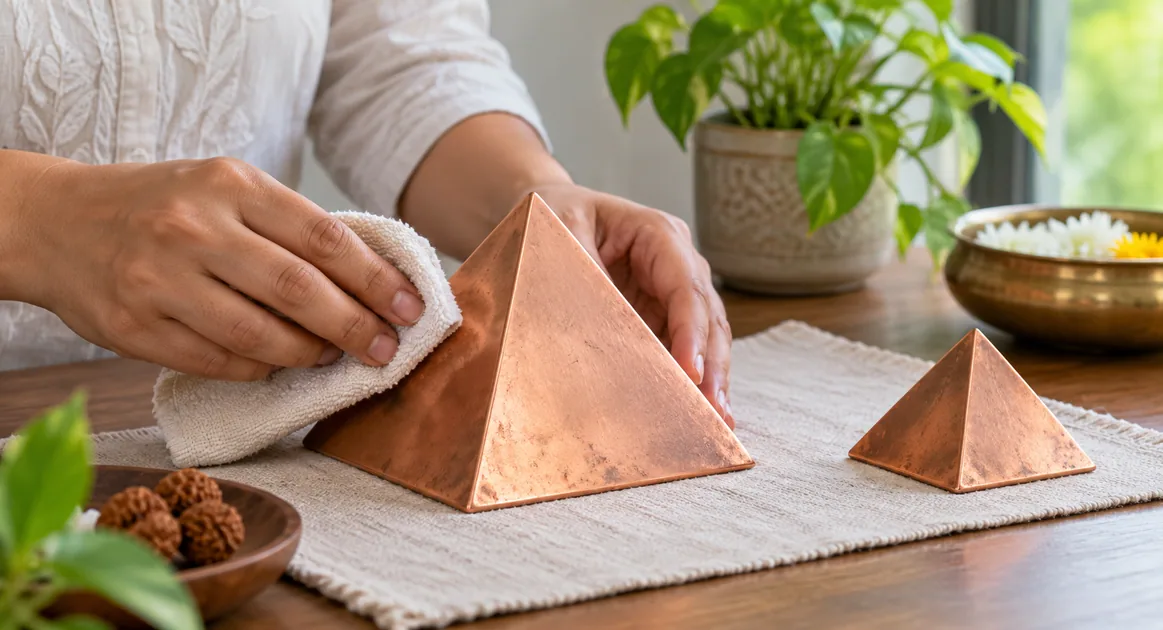
Pyramids: Place on a stable, level surface; protect the apex and edges; avoid wet cleaning if it includes metal fittings, glued layers or unknown treatments. For a sharp or heavy pyramid, choose a protected location away from walkways and unstable shelves.
It is possible to combine a gemstone tree, a pyramid and several loose stones, but give each a purpose. A north-side business tree, a single quiet-area pyramid and a labelled study kit can coexist without being placed together in one crowded corner. If an existing object already satisfies the intention, there is no need to duplicate it merely because a second form exists.
13. Frequently asked questions
Is a gemstone tree better than a Vastu pyramid for prosperity?
They express different ideas. A citrine or green gemstone tree is often chosen for the tree-of-growth and abundance symbolism. A pyramid may suit someone following a specified geometric or Vastu-pyramid method in a compact space. The better choice is the one whose meaning, material and placement match the buyer's practice.
Can I place a tumbled stone in the north instead of a gemstone tree?
Yes, in contemporary crystal-based Vastu arrangements a correctly identified single stone may be used as a modest focal object. A gemstone tree adds the Kalpavriksha-like image of expansion, but that extra form is not obligatory for every person or space.
Is the northeast always the best place for every crystal?
No. Ishanya is often kept open, orderly and suited to prayer or contemplation; practitioners do not normally treat it as a universal storage zone for every gemstone object. Use the intended purpose and actual floor plan to choose a position.
Can a seven-chakra gemstone tree replace a Navagraha set?
No. The seven-chakra framework and the nine-Graha Jyotish framework organize symbolism differently. A multicolour tree may be selected as a chakra-themed reminder, whereas a Navagraha study set identifies planetary gemstones and associations. If learning both, keep the reference charts separate.
Are polished stones less meaningful than raw crystals?
The mineral does not lose its name or traditional symbolic associations because it is tumbled. The polished surface makes handling and identification convenient; a raw crystal offers natural morphology. Selection is about material, use and personal practice, rather than a simple polished-versus-raw hierarchy.
Can I use one stone or pyramid at home and in the office?
A portable object can be moved, although if a particular Vastu routine calls for stable placement, keep track of where it is used. For teaching work, loose labelled specimens are designed to move between locations. A wired gemstone tree is usually more convenient as a fixed object.
Should gemstone colour alone decide the Vastu direction?
No. Start with the room's direction, its function, the stone's actual identity and the tradition being followed. Colour symbolism contributes to selection, but it should not replace the intended practice or a thoughtful layout.
What should I check when buying a gemstone pyramid or tree online?
Confirm the material, size, weight, treatment disclosure, whether stones are genuine mineral chips or beads, and whether the construction is solid, mixed, wired, glued or resin-bound. Review clear photographs of the base and actual product—not merely a representative illustration.
Do I need all three forms for a Vastu consultation?
No. A professional often needs identified loose stones to explain choices; a finished tree and a pyramid can be separate product examples. A single object with a clear purpose is preferable to buying forms that are not relevant to the client's plan.
Final selection principle
Start with meaning → mineral → location → form. For flexible study and eight-direction demonstrations, use properly identified tumbled stones. For growth, family or prosperity symbolism, consider a suitable gemstone tree. For a compact geometric focal point or a specific pyramid-based practice, compare the actual pyramid construction. Each form has a place in Vastu-oriented gemstone use; choosing thoughtfully is more valuable than buying every form at once.
Continue reading
- Tumbled Stones vs Raw Crystals, Points and Palm Stones
- Tumbled Stones for Home and Office Display
- Gemstone Bowls, Shells and Trays: How to Build a Display
Explore the existing Vastu and gemstone collections for wider context.
Compare the existing Gemstone Trees collection by its actual wire, stone-chip and base construction.