Which is better for your purpose: a tumbled gemstone, a raw crystal, a crystal point or a palm stone? The first distinction is not the mineral but its physical form. The same piece of quartz can be shown as a naturally formed crystal, cut into a polished six-sided point, rounded in a tumbling barrel or ground into a smooth oval for the hand. Each form reveals different features, needs a different display base, and suits a different way of studying, holding or arranging gemstones. Choosing the right form therefore matters for a small home altar, a Vastu consultation, a jewellery counter, a meditation room and a serious gemstone reference kit.
In traditional Indian spiritual language, clear quartz is commonly called Sphatik (Sphatika) and may appear in malas, worship objects and devotional settings. Contemporary crystal collections also use terms such as tower, generator, wand, grounding stone and palm stone. These names describe different objects and traditions: a modern polished tower is not automatically a traditional Yantra, and a raw cluster is not necessarily more authentic than a genuine polished tumble. This guide compares their construction, meanings, practical Vastu placement, mineral properties, buying specifications and care.
1. Four forms, four different objects
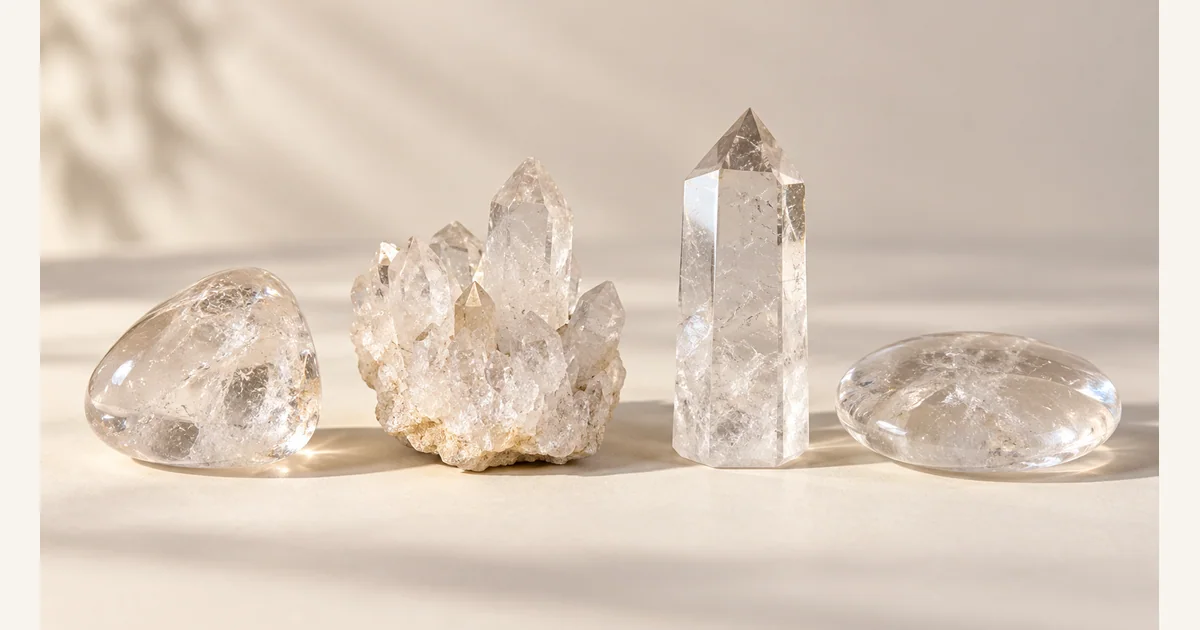
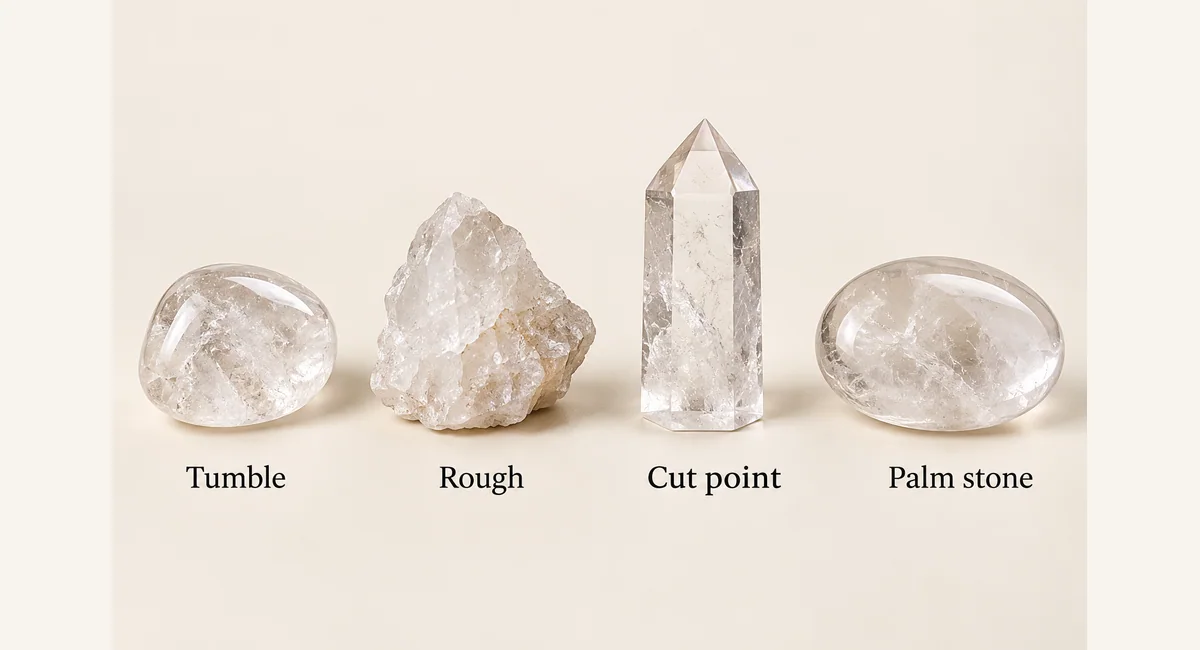
A raw crystal is a specimen left largely as found or minimally prepared. It may show natural crystal faces, a termination, fractures, surrounding host rock or a cluster of attached crystals. A tumbled stone has been abraded and polished, commonly in batches, to smooth its sharp corners; its outline is usually irregular rather than perfectly circular. A point has a pointed termination, but that termination may have grown naturally or been made by cutting and polishing. A palm stone is intentionally shaped into a relatively flat, rounded or oval piece suitable for comfortable handling. Some sellers also use “worry stone” for a smaller, thumb-sized form, often with a depression.
| Form | How to recognise it | Main advantage | What to verify |
|---|---|---|---|
| Tumbled stone | Smooth, uneven pebble with softened edges | Easy to group, handle and compare | Material name, dimensions, polish, chips, treatment |
| Raw crystal or rough specimen | Natural irregular surfaces, possibly intact crystal faces or matrix | Shows mineral growth and natural texture | Whether faces are natural, fragility, stability, loose particles |
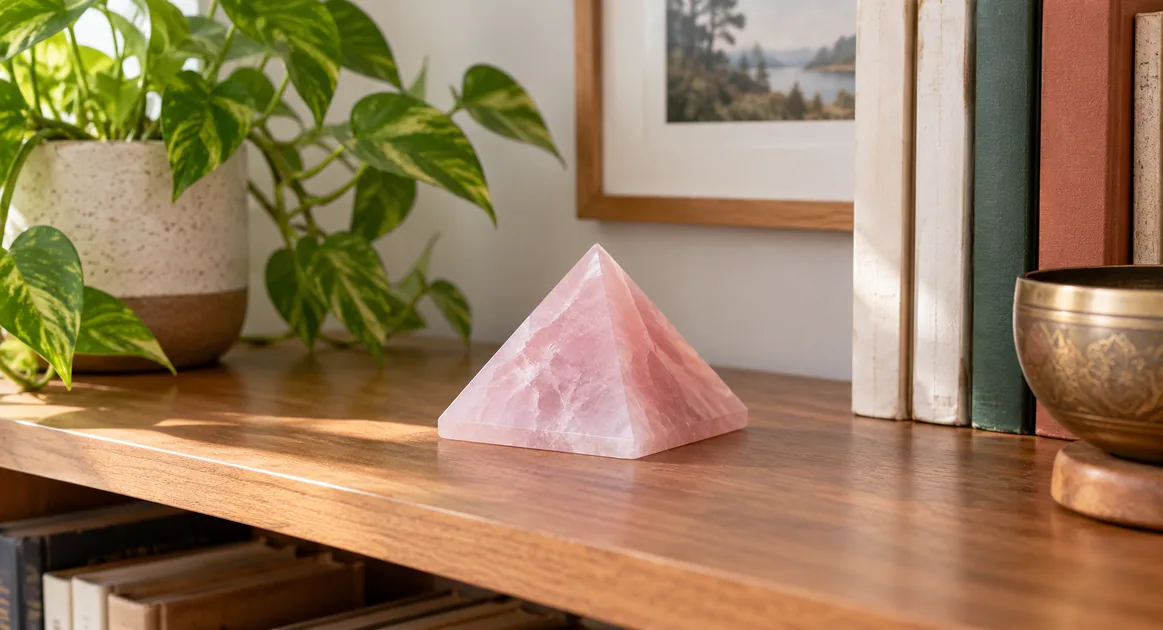
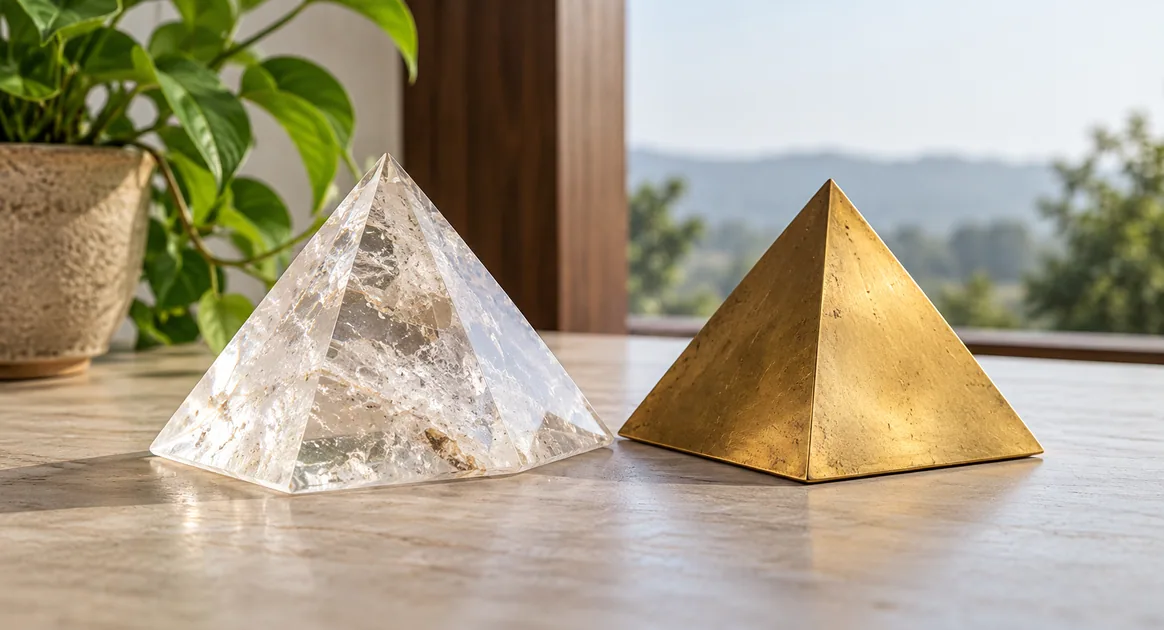
| Crystal point or tower | One or more pointed ends, often with faceted sides | Clear vertical geometry and focal display | Natural or cut termination, base, exact height and apex |
| Palm stone | Broad, smooth, flattened oval or freeform | Comfortable to hold; lies low on a shelf | Weight, thickness, edge finish, actual hand fit |
None of these labels alone proves that the underlying material is natural, untreated, rare or suitable for a particular ritual. A polished natural stone remains natural material after cutting; a carved glass object does not become natural quartz merely by being made into a point. The most useful retail description combines material identity + physical form + size + treatment disclosure.
2. Understanding raw crystals: natural geometry and mineral structure
When a mineral grows with enough open space, it may develop flat natural crystal faces. Clear quartz often grows as a six-sided prism capped by a cluster of sloping faces; amethyst may develop as purple quartz crystals lining a geode cavity. The specimen's form reflects its internal atomic arrangement and the conditions of growth. Some crystals grow together into a cluster; others remain attached to matrix, the rock in which they formed. These terms matter because a rough chunk with broken faces is not the same object as a complete, naturally terminated crystal.
For gemstone education, a raw crystal can teach what a tumble conceals: growth faces, twinning, mineral associations, natural fractures and the relationship between a mineral and its host rock. It also has limitations. A delicate cluster can chip during frequent handling, some rough surfaces retain dirt in crevices, and an uneven underside may be awkward on a furniture surface. Larger specimens may be better as fixed displays than portable teaching aids.
At a showroom, ask whether “raw quartz” means a natural terminated crystal, an unpolished broken piece, a cluster, or a cut point with a deliberately roughened finish. For a professional collection, these should be listed as separate specimen types. If the natural formation is the appeal, request images showing the termination, reverse side and matrix rather than only a front-facing photograph.
3. What tumbling changes—and what it leaves unchanged
Stone tumbling typically uses progressively finer abrasive stages and a final polishing stage to remove edges and smooth surfaces. The result may be a rounded quartz pebble, banded agate, dark obsidian or a mixed assortment. The process changes the shape and visible surface; it does not turn quartz into another mineral. Tumbling can reveal colour zoning, banding and inclusions that were hard to see through a weathered outer surface, but can also remove fragile projections or natural growth features valuable to collectors.
A well-selected tumble is useful when the intention is to compare eight Vastu directions, lay out a seven-chakra teaching set, assemble a portable reference box, or give someone a small identified gemstone. Smooth pieces generally occupy less space than mineral clusters. They can still show pits, surface-reaching fractures and variations in polish; a polished stone is not automatically flawless. Small rounded specimens should be placed in a compartmented tray or shallow bowl so they do not roll off desks or shelves.
Material still matters: a quartz tumble and a fluorite tumble can look equally smooth but have different durability. Rounded surfaces do not remove the underlying mineral's cleavage, softness, sensitivity to light or stability concerns. A mixed assortment should not be subjected to one universal cleaning treatment merely because everything is tumbled.
4. Natural points, cut points, towers and double-terminated crystals
In mineralogy, a natural crystal termination is formed during growth. In retail descriptions, a polished point may instead be cut from a larger mass and fashioned into a geometrical tip. A “tower” commonly means a taller, freestanding cut-and-polished point. A “double termination” refers to pointed ends at both sides, but those ends can be natural, manufactured or one of each. None of these terms guarantees origin or treatment, so the photographs and written description need to agree.
Cut points often have near-regular facets, crisp polished edges and a level base; natural quartz points may show uneven faces, striations, growth irregularities and an unpolished or broken base. These are useful indications, not an absolute method for identifying a specimen. A professional seller should state natural termination, cut and polished point or partly polished natural point as appropriate. Avoid calling every polished hexagonal tower “naturally formed.”
In contemporary crystal practice, people sometimes describe a point as “directing intention” toward the apex. That is a symbolic way of arranging an object, not a mineralogical property demonstrated by the tip. For Vastu interiors, the physically verifiable benefit is that a point creates an upright focal form. Put it on a stable, broad base away from the edge of a crowded shelf. Never place a tall point where a falling object or an exposed tip could injure someone.
5. Palm stones: a deliberately different hand-held format
A palm stone has a polished surface large enough to rest comfortably in the hand, typically as a flattened oval or freeform. Its practical purpose is different from a small tumble: the broad face makes patterns easier to view and the weight can feel steady during quiet contemplation or meditation. For teaching, one palm stone may reveal an entire banded agate pattern that is difficult to appreciate on a pebble. For display, it creates a low, horizontal accent instead of a vertical focal point.
“Palm” is a commercial description, not a fixed measurement. Ask for length, width, thickness and weight in millimetres and grams. A heavy stone may be suitable for desk display but cumbersome for travel. Some pieces are thick enough to rock when placed on a table, so check the underside or include a protective pad. If the buyer wants a thumb-rubbing piece, a small worry stone may be a better fit than a thick palm stone.
6. One mineral can appear in all four forms
Consider clear quartz. A natural crystal can preserve prism faces and terminations. A tumbled Sphatik stone offers an easily handled, rounded specimen. A cut quartz point is a shaped display object. A polished quartz palm stone emphasises smoothness and hand feel. All four can be genuine quartz, although their prices differ because of size, quality, crystal formation, labour, breakage risk and finishing work. Do not compare a rare intact crystal cluster to a small tumble by price per gram alone; they are selling different properties.
Some familiar materials are sold in every shape, while others are better suited to selected formats. This table keeps the mineral identity separate from the form.
| Material | Useful forms | Visual distinction | Special consideration |
|---|---|---|---|
| Clear quartz / Sphatik | Raw point, tumble, cut point, palm | Colourless or milky transparency; natural growth faces on suitable rough pieces | Check cut versus natural termination and internal fractures |
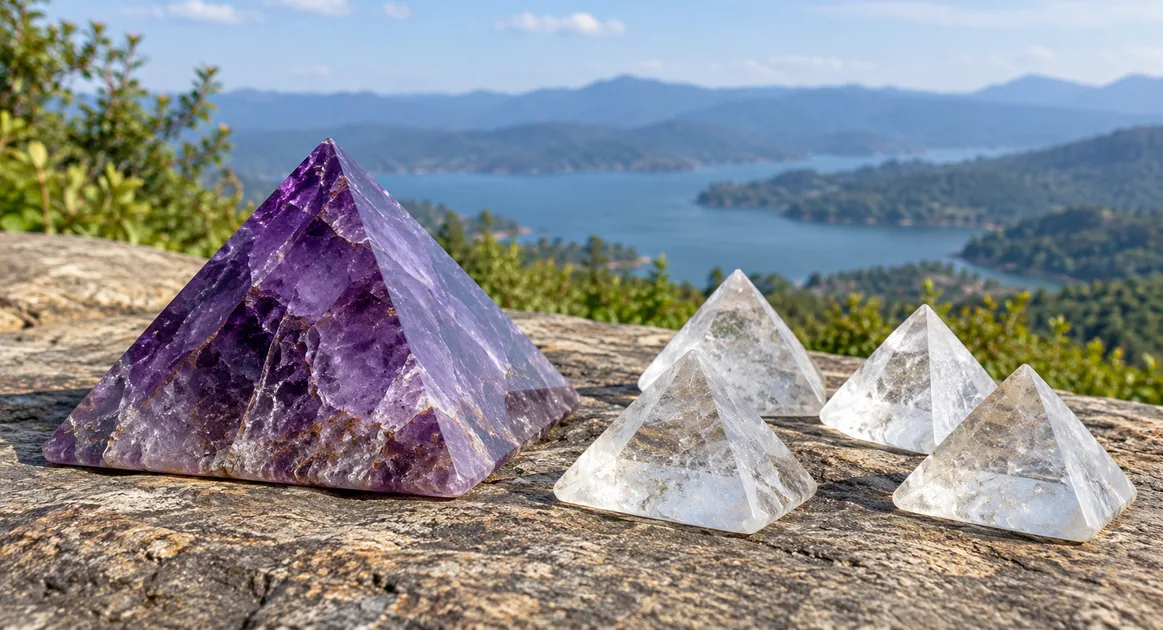
| Amethyst | Geode/cluster, tumble, point, palm | Purple colour and zoning; natural geode faces | Limit prolonged strong light; protect crystal tips |
| Rose quartz | Rough mass, tumble, carved point, palm | Pink, commonly translucent to cloudy | A cut point need not represent natural crystal habit |
| Agate / jasper | Rough slab, tumble, shaped point, palm | Banding or opaque colour patterns | Check dye or other treatment disclosure |
| Black obsidian | Rough glass, tumble, cut point, palm | Volcanic glass; may show glassy fracture in rough pieces | Sharp rough edges; verify it is not man-made glass |
| Labradorite | Rough, tumble, shaped point, palm | Colour flashes visible at certain angles | Orient the display for the flash; protect cleavage-prone pieces |
| Fluorite | Natural crystal, tumble, carved point, palm | Varied colours and sometimes visible cleavage | More delicate than quartz; avoid knocks and rough cleaning |
Natural crystals are not limited to quartz, and “rough” does not always mean an attractive pointed specimen. Obsidian is naturally occurring volcanic glass rather than a mineral crystal. Agate is predominantly microcrystalline chalcedony, so a carved agate tower should not be marketed as a naturally terminated macrocrystal. These distinctions matter particularly when purchasing educational sets or comparing suppliers.
7. Shape in traditional worship, contemporary crystal practice and Vastu
India has long-standing devotional uses for minerals, gems, stone icons, Shaligrama, Sphatik and traditional Ratna ornamentation. In such settings, the object's identity and ritual context may matter more than a retail shape category. A Sphatik mala has a specific devotional role; a polished clear quartz palm stone is not its automatic substitute. Similarly, Yantra refers to an established geometric and ritual tradition. A modern faceted crystal tower may visually resemble a geometric form, but it is not a Sri Yantra or another prescribed Yantra merely because it has a pointed shape.
In contemporary gemstone displays, the four forms are often used symbolically as follows. The language of “grounding,” “focusing” or “amplifying” below describes common modern spiritual associations, not a laboratory classification of one mineral form as more powerful than another.
| Form | Contemporary symbolic use | Practical arrangement | Traditional context to consider |
|---|---|---|---|
| Tumble | Personal intention, repeated simple arrangements, chakra assortments | Tray, compartment, labelled pouch or small bowl | Keep stone identity and purpose clear; do not confuse a modern set with prescribed Navaratna |
| Raw crystal / cluster | Nature, mineral formation, abundance of facets | Stable altar shelf or protected mineral-display stand | Distinguish a mineral specimen from an established sacred icon |
| Point / tower | Attention, direction, a chosen focal point | One upright piece on a secure, level base | Modern pointed layouts are not automatically classical Yantras |
| Palm stone | Reflection, quiet handling, a personal practice object | Hand, meditation mat, desk or low-profile tray | Material meaning should be interpreted separately from physical form |
For a traditional Jyotisha gemstone recommendation, material identity, quality, treatment, suitability and the method of wearing or use are central considerations. A tumbled decorative gemstone should not automatically be treated as equivalent to a prescribed gemstone ring. The same holds for planetary substitutions: a yellow-coloured crystal point is not automatically a substitute for Pukhraj (yellow sapphire), and a blue-coloured polished stone is not automatically Neelam (blue sapphire).
8. Vastu placement: begin with the space, not the pointed end
When planning an arrangement, first identify the room's function, compass orientation and usable surface. Traditional Vastu considers directions, the central Brahmasthana, elemental associations and the appropriate use of spaces. Frequently cited Ashta Dikpala associations include Indra in the east, Agni in the southeast, Yama in the south, Nirrti in the southwest, Varuna in the west, Vayu in the northwest, Kubera in the north and Ishana in the northeast. The precise remedial materials and placements vary across lineages and contemporary practitioner methods; therefore, a decorative gemstone form should support—not replace—the overall plan.
For example, the northeast (Ishanya) is widely regarded as a contemplative or worship-related zone, whereas the southeast (Agneya) is associated with fire-related function. In a real home, the safe and appropriate place for a mineral display also depends on the available shelf, sun exposure and foot traffic. A neat quartz display on a secure prayer shelf may be more suitable than a tall point placed precariously in the exact compass corner. Avoid forcing an installation that obstructs circulation or an existing household altar.
| Area or intention | Form to consider | Why this form is convenient | Placement note |
|---|---|---|---|
| Prayer or meditation corner | One Sphatik tumble, palm stone or modest natural quartz specimen | Simple, contained, visually calm | Use a clean, stable surface; preserve devotional-object boundaries |
| Study desk | Small tumble or low palm stone | Does not block books, screen or writing area | Keep it to the side, away from keyboard and cables |
| Reception or jewellery showroom | Selected crystal point with material label; cluster behind protective display | Visible focal object and clear visual merchandising | Secure the base and leave room for product handling |
| Professional eight-direction demonstration | Labelled tumbles of similar dimensions | Repeatable layout and easy specimen replacement | Orient the diagram first; separate symbolic demonstration from structural advice |
| Travelling Vastu kit | Tumbles and a small palm stone | Less protruding than a cluster or tall point | Use padded compartments and identity labels |
| Mineral education exhibit | Raw specimen plus matching polished tumble | Shows the change from natural texture to lapidary finish | Display both under the same material identity |
These are practical examples of arranging traditional and contemporary objects, not a universal prescription that one crystal shape belongs to only one direction. A Vastu consultant may specify different minerals, colours and ritual practices after reviewing the building and occupants' requirements. Record the method being used rather than presenting one modern crystal correspondence as an ancient rule shared by every Vastu text.
9. Worked comparison: one clear-quartz material, four forms
A useful study exercise is to assemble four genuine clear-quartz specimens—one of each shape. This holds material roughly constant while making the effects of shaping easier to understand. It also prevents a misleading comparison in which an amethyst cluster, rose quartz tumble, fluorite point and black obsidian palm stone differ in both mineral and shape.
| Specimen | Suggested retail specification | Teaching observation | Display method |
|---|---|---|---|
| 1. Quartz tumble | One identified clear-quartz pebble, approximately 20–30 mm | Rounded surfaces, internal clarity and surface polish | Shallow felt-lined tray |
| 2. Natural quartz point / cluster | One photographed rough specimen with stated natural termination | Growth faces, terminations and matrix or fractures | Small labelled mineral stand |
| 3. Cut quartz point | One polished point, approximately 50–75 mm high; disclose cut finish | Manufactured facets, geometric symmetry, polished apex | Stable base with clearance around tip |
| 4. Quartz palm stone | One smooth oval, approximately 45–65 mm long, weight stated | Broad polished face, thickness and handling comfort | Soft pad or hand-held observation |
Step 1: Identify the mineral and record any supplier-declared treatment for each specimen. Step 2: Photograph them under the same diffused light alongside a ruler. Step 3: Record length, width, thickness, weight and visible damage separately. Step 4: Compare natural and manufactured faces with a 10× loupe, without scratching or damaging the items. Step 5: Allow the learner to choose which object best suits a labelled display, repeated handling, a devotional shelf or a mineral-structure lesson.
The millimetre ranges are illustrative selection targets, not standard definitions for each category. Professional suppliers can stock smaller or larger pieces. To compare material characteristics fairly, do not claim that a size difference demonstrates a spiritual effect, and do not equate the four retail shapes with four different mineral species.
10. Three real-world ways to combine the forms
A. A family prayer corner and meditation shelf
A household has a small northeast-facing prayer shelf with daily use. A single smooth Sphatik tumble in its own small dish or a carefully chosen palm stone can be displayed without adding a tall, easily toppled object. If the family already follows a particular method of worship involving a Sphatik mala, the mala remains a separate devotional item. A raw crystal can be placed further back as a specimen if space permits; a tall tower is optional rather than required. Keep objects distinct, avoid loose pieces near the shelf edge and preserve room for the actual worship materials.
B. A gemstone and Rudraksha showroom demonstration
A showroom wants customers to understand the difference between a naturally formed mineral and a shaped decorative article. Put a labelled quartz cluster at the back, a cut quartz point in the centre, one tumble in a shallow compartment and one palm stone on felt. Each label states “clear quartz / Sphatik,” followed by the form, approximate size, actual weight and any known treatment. A small information card can explain that the tower was shaped by lapidary work. This teaches customers something useful and prevents terms such as “natural point” being applied indiscriminately to cut pieces.
C. A consultant's portable Vastu and gemstone training case
For a house visit, a consultant needs specimens that can be packed, counted and laid out quickly. Use labelled tumbles for directional comparison because they are compact and repeatable; include one palm stone for handling demonstrations and one protected natural quartz point for mineral education. A fragile cluster is better represented by a photograph or carried in an individually padded box, not mixed loose with pebbles. The professional case should include a compass or floor-plan orientation sheet, compartment index, material-identification notes and a packing checklist. It should not present the same specimens as a replacement for building-scale Vastu assessment.
11. How to buy: inspect the listing, not just the form name
A useful product listing distinguishes what the object is, what has been done to it and what exactly the buyer receives. The listed photograph should identify whether it shows the actual piece or a representative batch. For one-of-a-kind rough clusters, request actual-item pictures including the back and base. For cut towers, ask about height, number of faces and whether the apex is intact. For tumbles and palm stones, ask about size bands, weight ranges, surface finish, visible cracks and treatment.
| Question to ask | Tumbled | Raw specimen | Point / tower | Palm stone |
|---|---|---|---|---|
| Actual dimensions | Length and size band | Length, width, height | Height, base width, weight | Length, width, thickness |
| Finish and shape | Polish and edge quality | Natural faces or broken rough | Natural or cut termination | Carved form and edge smoothness |
| Common condition check | Chips, pits, coating | Loose matrix, fractured tips | Cracked apex, uneven base | Fractures, surface polish |
| Packaging requirement | Counted pouch or compartment | Individual padding | Apex guard and rigid box | Soft sleeve and padding |
| Commercial description | Named material, count, treatments | Named material, origin if documented | Cut / natural / partially polished | Named material, weight, hand size |
Remember that “AAA,” “premium,” “healing grade” or “natural crystal” may be a seller's own terminology. A valuable specimen needs a precise material description, transparent treatment information and a condition appropriate to its price. Two crystals of the same weight can have very different prices because one preserves an intact natural termination while the other has been heavily cut. Conversely, a well-polished tumble can be an excellent purchase even when it is not collectible rough.
12. Care depends on the mineral as much as on its shape
Start with the material name before choosing a cleaning method. Clear quartz and amethyst are relatively hard, but rough tips still chip under impact. Fluorite is more vulnerable to scratching and cleavage damage. Pyrite needs dry storage because prolonged dampness can encourage deterioration in susceptible specimens. Some dyed or coated stones can be harmed by soaking or aggressive cleaning. A polished surface does not eliminate these differences.
| Object | Recommended routine | Avoid |
|---|---|---|
| Quartz tumble or palm stone | Soft cloth; careful mild cleaning when treatment allows; dry thoroughly | Mixing loose with harder sharp specimens |
| Quartz or amethyst cluster | Soft brush for dust; support the matrix while lifting | Scrubbing tips, abrupt heat, precarious display |
| Cut point / tower | Hold near the base; use a protective pad or stand | Knocking the apex against other objects |
| Fluorite form | Gentle dry dusting and separate padded storage | Hard contact, aggressive brushing, long sunlight exposure |
| Obsidian rough | Keep edges covered and display securely | Handling unprotected sharp fractures |
| Pyrite specimen | Dry, stable conditions and occasional visual inspection | Immersion, persistently humid enclosed boxes |
For spiritual housekeeping, gently wiping a display surface and keeping the storage area orderly are straightforward practices. Some households also follow their customary Shuddhi or Pavitrikaran practices. Do not automatically immerse every mineral in water, saltwater, oil, incense smoke or direct sunlight: the material, dyes, coatings and setting may not tolerate it. Treat a Sphatik worship object with the care appropriate to its actual form and the family's practice.
13. Five misconceptions worth correcting
- “Raw is always more genuine.” A correctly named polished natural quartz tumble is genuine quartz. A rough-looking synthetic or imitation specimen can also be sold deceptively. Authenticity concerns material and treatment, not just texture.
- “Every pointed crystal is naturally grown.” Many retail towers are cut from a larger piece. They can be beautiful authentic minerals while still having manufactured geometry.
- “A crystal point is a classical Yantra.” A polished mineral shape and an established ritual geometric diagram are different objects. One can be used decoratively alongside a traditional practice without being renamed as that practice.
- “Bigger and heavier always means better.” Size changes handling, display and value considerations. An intact small natural crystal may be more informative than a large shaped imitation.
- “One cleaning method fits every shape.” The underlying mineral and treatment matter first, with additional precautions for sharp tips, clusters and polished faces.
14. Frequently asked questions
Is a tumbled Sphatik stone as real as a raw quartz crystal?
Yes, if both are accurately identified as natural quartz. The tumble is a shaped and polished form of the material. “Raw” and “tumbled” are descriptions of processing and presentation; neither is a substitute for checking the stone's identity and any treatments.
Which is more suitable for a small Vastu tray?
A compact, labelled tumbled stone is usually the easiest for a repeated directional demonstration. A point can add a single visual centrepiece, but takes more vertical space. Choose based on the actual Vastu purpose, safety and available furniture rather than a general ranking of shapes.
How is a palm stone different from a worry stone?
A palm stone is usually larger with a broad, comfortable face for holding. A worry stone is often smaller and may have a thumb indentation, though retail names vary. Dimensions and photographs are more dependable than the label.
How can I tell a natural termination from a polished point?
Natural terminations arise during mineral growth, while cut points are shaped by lapidary tools. Look for the seller's description, multiple views, face regularity, polishing marks and base information; if the natural origin of the termination affects price, ask for documented evidence rather than trusting shape alone.
Can I replace my Sphatik mala or a gemstone prescribed in Jyotisha with a palm stone?
A palm stone can serve as a modern handled or display object, but it has a different form and customary use from a mala or a gemstone set in a prescribed mount. For a specific devotional or astrological practice, use the form appropriate to that practice instead of assuming all quartz objects are interchangeable.
Are raw crystals, points or palm stones necessarily more expensive than tumbles?
Not necessarily. Price depends on material, size, quality, condition, intact natural formation, rarity, workmanship and provenance. A common cut tower can cost less than a rare, well-formed natural crystal, while a large, clean palm stone may cost more than several small tumbles.
15. Final choice: form should serve the intended use
Choose tumbled stones for compact labelled sets, portable teaching, repeated layouts and simple gifts; raw crystals for the study and appreciation of natural mineral growth; points or towers for a stable vertical focal display; and palm stones when broad patterns, low-profile arrangement or comfortable handling matter. For Vastu or devotion, begin with the space, the tradition and the correct mineral identity. Then select the physical form that fits the purpose, the user's routine and the conditions in which the stone will actually be kept.
Continue reading
- What Are Tumbled Stones? How Polished Gemstones Are Made
- Single Stones, Multipacks and Mixed Sets Compared
- Tumbled Stone Sets vs Gemstone Trees and Pyramids
Explore the existing Vastu and gemstone collections for wider context.