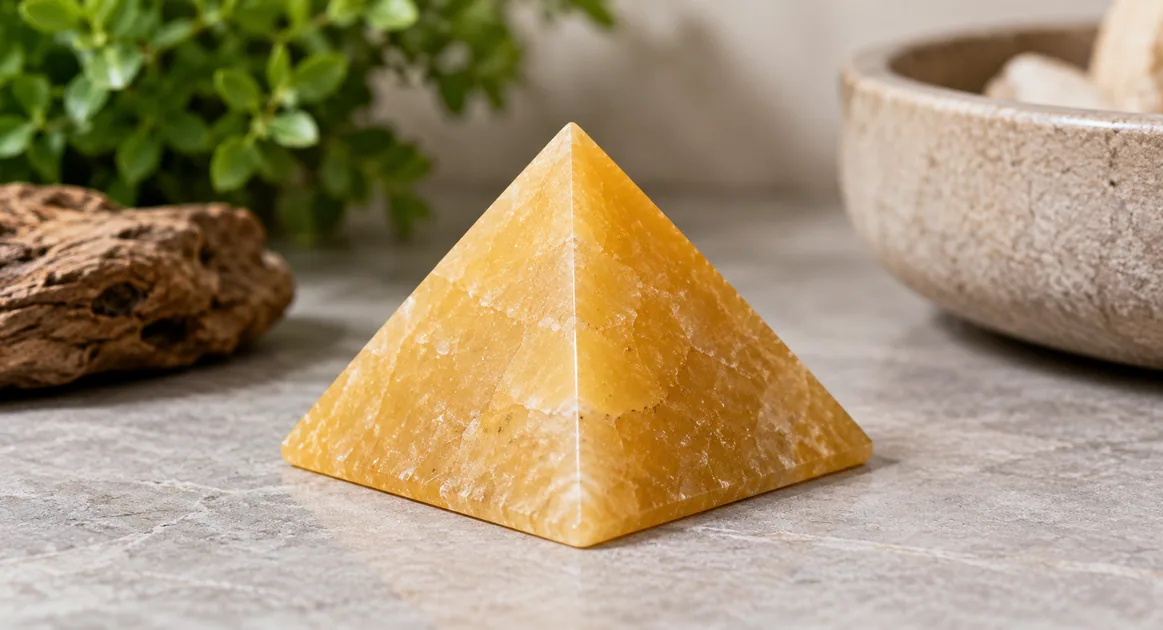
What exactly is a yellow aventurine pyramid? A warm yellow carving may look attractive on a Vastu shelf, a puja cabinet or an office desk, yet the commercial name can conceal several different materials. The key is not simply whether the pyramid is yellow. Genuine aventurine is a quartz-rich material known for tiny reflective inclusions and the optical effect called aventurescence. Some products labelled “yellow aventurine” show that characteristic shimmer; others are plain yellow quartz-rich rock, dyed material or a different stone altogether. This distinction matters for truthful product descriptions, treatment disclosure, meaningful comparisons and long-term care.
This guide separates the mineral and trade terminology from traditional associations. It explains what to look for under neutral light, how to distinguish similar yellow stones, what a seller should disclose, how to assess a carved point, and how to incorporate a golden-yellow pyramid into contemporary Vastu arrangements without confusing symbolism with gemological identification. The aim is to help a buyer choose a well-described item rather than assume that every yellow pyramid has the same composition or meaning.
1. What is aventurine? Quartz, quartzite and aventurescence
The word aventurine is used in gemology for quartz-rich material that displays tiny sparkling reflections from included platelets or flakes. The base is often described as quartzite, a rock composed largely of interlocking quartz grains, though retail writing also uses “aventurine quartz”. Mindat treats aventurine as a variety of quartzite; other gemological descriptions refer more broadly to quartz or quartzite. That difference in naming is not a licence to call any yellow rock aventurine. The characteristic inclusions and optical behaviour still matter.
Aventurescence is the scattered glint produced when small flat mineral inclusions catch incoming light. Micas are common contributors; iron-bearing minerals may create other warm colours or flashes. Green aventurine is best known, often because of chromium-bearing fuchsite mica, but aventurine-like quartz-rich materials occur in a broader range of yellow, orange, red, brown and other colours. In yellow material, the precise source of colour and reflection should not be confidently assigned to one inclusion mineral without evidence.
Typical quartz-rich aventurine is much harder than gypsum or calcite, commonly approximately Mohs 6½–7, but hardness depends on the actual composition and weaknesses in the carving. A buyer cannot verify this safely by scratching a polished pyramid. A laboratory or qualified gemologist may use optical and structural methods when the identity is commercially important. A retail photograph alone provides only partial clues.
| Term | Reasonable meaning | Important limitation |
|---|---|---|
| Aventurine | Quartz-rich rock or aggregate with reflective inclusions | Not a separate single mineral species |
| Yellow aventurine | Commercial description for yellowish aventurine-like material | Name alone does not prove identity, colour origin or treatment |
| Aventurescence | Small internal glints as light meets reflective platelets | Different from uniformly glossy surface polish |
| Quartzite | Rock largely composed of interlocking quartz grains | Quartzite can lack aventurescence |
| Goldstone | Manufactured glass containing glittering particles | Not the same material as natural aventurine |
| Aventurine feldspar | Commercial terminology associated with some sparkling feldspars | Different mineral group from quartz-rich aventurine |
2. Yellow body colour is not the same as internal sparkle
A yellow pyramid can look luminous because the entire surface is polished, because light passes through a translucent stone, or because small included flakes reflect light. These are three different optical experiences. A glossy finish gives a broad surface highlight. Translucence gives a gentle glow at a thin edge. Aventurescence appears as fine points or flecks of internal reflected light, often easier to recognise when the stone and light source move relative to each other.
Inspect the carving in indirect daylight or a neutral white shop light; rotate it slowly while watching a single face. Photograph a close-up without a beauty filter or highly saturated background. If a supplier calls the object aventurine despite no visible glints, ask whether microscopy confirms inclusions, whether the designation comes from the rough-lot paperwork, or whether the term is simply its supplier’s trade name. It is better to describe a specimen as “yellow quartz-rich decorative stone, sold as yellow aventurine; identification pending” than to assert unsupported precision.
Be especially careful with promotional pictures. Strong directional light, glitter editing, metallic paint and polished coatings can create or exaggerate a sparkle. Conversely, a genuine lightly included stone may show only modest aventurescence in a small photograph. Neither a single photograph nor a lack of dramatic sparkle settles every case. Request actual-piece images and accurate supplier notes.
| Observed appearance | Possible explanation | Best follow-up |
|---|---|---|
| Small flashes change as the stone rotates | Reflective mineral platelets within quartz-rich material | Ask for neutral-light video and inclusion close-up |
| One bright streak follows the light source | Ordinary surface reflection from polishing | Compare several faces under diffuse illumination |
| Uniform saturated lemon-yellow colour | Natural colour, dye or manufactured material are all possible | Request identification and treatment disclosure |
| Coarse, sandy crystalline texture | Granular quartz-rich rock or another aggregate | Inspect with magnification and ask about material |
| Very transparent amber-yellow body | Could be clear quartz, glass or another mineral | Do not identify aventurine by colour alone |
| Identical sparkles across many stock pictures | Image effect or illustrative photography possible | Request photographs of the actual sold piece |
3. How to compare yellow aventurine with similar stones
Yellow carvings are frequently compared with citrine, yellow jade, orange or honey calcite, dyed quartzite, sunstone and goldstone glass. Some of these names identify different minerals; others are themselves commercial labels. A visually convincing resemblance is not proof of equivalence. Distinguish material family, sparkle, hardness, treatment, colour distribution and construction rather than choosing a name because it is the most appealing one for marketing.
Citrine is yellow to orange quartz; a transparent or translucent citrine carving generally does not have the platelet-driven aventurescence associated with aventurine. Calcite is calcium carbonate, much softer, characteristically cleavable and reactive to acids. Sunstone is a feldspar gemstone whose aventurescent effect may come from included mineral platelets. Goldstone is man-made glittering glass. Yellow “jade” is not one dependable identification without specific nephrite or jadeite evidence: the word can be used loosely in decorative trade. Quartz-rich material that has been dyed yellow should be described accordingly when known.
| Material | Distinguishing context | Question before purchase |
|---|---|---|
| Yellow aventurine | Quartz-rich body with expected aventurescence | Where is the visible or documented inclusion effect? |
| Citrine | Yellow quartz, commonly more transparent | Is it natural or heat-treated and how was it identified? |
| Yellow calcite | Softer calcium-carbonate stone with cleavage | Is the name confirmed and what care is required? |
| Sunstone | Feldspar, sometimes visibly spangled | Is the material feldspar rather than quartz? |
| Goldstone | Manufactured copper-bearing glitter glass | Is the listing explicit that it is glass? |
| Dyed quartzite | Quartz-rich rock with enhanced colour | Was the colour enhanced and is it stable? |
| Yellow jade trade material | May denote a different yellow ornamental rock | Has it been identified as nephrite, jadeite or something else? |
4. Natural colour, dye, coatings and reconstructed carvings
A truthful product record answers four questions independently: what is the body material, where does its yellow colour come from, was it treated, and is the pyramid carved from one intact block? An authentic quartz-rich material may still be dyed or sealed; a manufactured imitation may be attractive but should not be sold as naturally occurring aventurine. Some treatments influence cleaning instructions, especially when pigment, glue or a coating is present. Words such as “natural”, “pure”, “untreated” and “certified” need evidence relevant to the exact object or batch.
Yellow colour may relate to trace constituents or included mineral matter, and commercial material can also be coloured by dye or other processes. A yellow-green, muted honey or deep mustard surface is not enough to establish origin. Inspect colour accumulation around fractures, unusual uniformity and any visible coating boundaries; treat these as reasons for inquiry, not as conclusive diagnosis. Avoid home bleach, acid or solvent challenges, which can ruin finishes while proving little about mineral identity.
A single-piece carved pyramid should be distinguished from an assembled pyramid, a resin-bonded stone composite, and a coated synthetic decorative piece. Fillers may be used in an otherwise natural carving. Each can be suitable for a decorative purpose if it is described accurately. For OmmRudraksha product data, do not quietly rename a quartzite or calcite item to match a popular keyword; use the verified material name in the product title and explain the market term in the article.
| Claim in a listing | Evidence or clarification needed | Safer wording if uncertain |
|---|---|---|
| 100% genuine yellow aventurine | Supplier identification and plausible quartz-rich aventurescent material | Sold as yellow aventurine; identity subject to verification |
| Naturally yellow, untreated | Traceable declaration or appropriate assessment | Yellow appearance; treatment status not confirmed |
| One solid gemstone pyramid | Actual-piece inspection of seams and underside | Carved decorative pyramid; construction to be confirmed |
| Healing-grade or premium energy | No standard physical grade established by such phrases | Describe measured size, finish and chosen symbolism |
| Certified genuine | Document tied to the tested object or batch | Laboratory information available only when documented |
| Rare Himalayan material | Credible traceability to claimed source | Origin not verified |
5. Physical checks: apex, base, cracks and polished faces
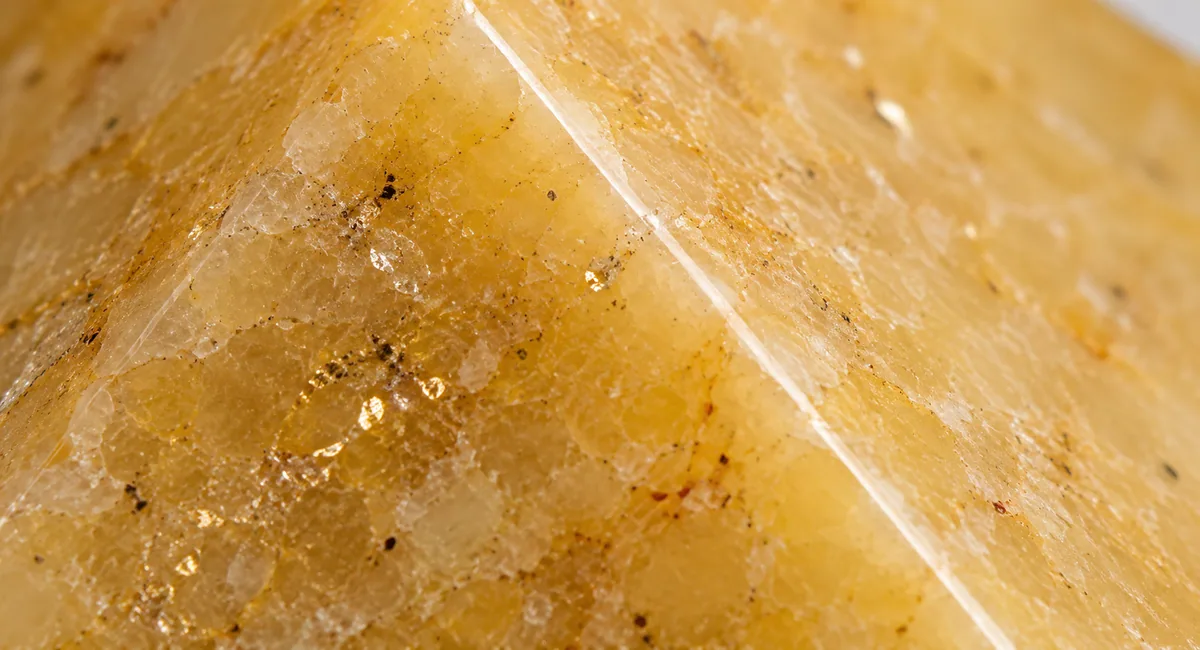
In a square-based pyramid, inspect the apex, four sloping faces, four lower edges, corners and underside. The tip is vulnerable even when the body is quartz-rich and relatively hard. Look for tiny breaks at the apex, uneven planes, repaired corners and glued joins. A clean stable base is more useful than a perfectly symmetrical promotional picture. Hand-carved pieces may show small dimensional variations; those variations should be described rather than hidden.
A seller should supply actual measurements, weight and tolerance for the unit or variant offered. Do not calculate a “standard” weight from a generic gemstone density and then present it as a measurement of the product. Irregularity, porosity, inclusions and any filler change mass. If multiple sizes share the same construction, size options can be variants rather than invented separate material categories. The retail description should specify whether the photographed pyramid is the precise piece being shipped.
Check lighting on all sides. A pale seam can be a natural quartz-rich boundary, a fracture, or a glue join. Pits can reflect dislodged inclusions or poor finishing; a small harmless pore is different from a crumbling edge. When a professional Vastu kit is intended to show materials to clients, a representative sample should have an accurate label and clear handling instructions. A single impressive photo is no substitute for a verified specimen record.
| Inspection point | What to examine | Why it matters |
|---|---|---|
| Apex | Chip, fracture, repair or uneven point | Safe handling and visible finish |
| Side faces | Polish quality, texture, reflective inclusions | Identity clues and presentation |
| Lower corners | Hairline cracks and bruising | Impact resistance in shipment |
| Underside | Level support, glue lines, filled pits | Stability and construction |
| Colour across faces | Changes around cracks and edges | Treatment inquiry |
| Actual dimensions | Length, height and weight | Accurate listing and display planning |
6. Yellow symbolism in Vastu and Indian devotional practice
Within contemporary Vastu and crystal traditions, a golden or yellow palette is often associated with light, positivity, clarity, learning, auspicious beginnings and prosperity. A small yellow pyramid may be chosen as a visible reminder of Sankalpa—a deliberate intention adopted during puja, meditation or the start of a project. These associations concern the owner’s practice and interpretation, not a mineral identification test. “Yellow aventurine” is a modern commercial name and should not be presented as an ancient text’s uniquely mandated remedy.
Some practitioners relate warm yellow and golden hues to Surya imagery, the radiance of Agni, the prosperity symbolism of Lakshmi, or to the learning and wisdom associations of Brihaspati/Guru. Those are different contexts. The colour does not establish that the item is an astrologically prescribed Jupiter gemstone. In classical Jyotish, gemstone advice involves chart interpretation, planetary strength, Rashi, Lagna, Dasha and the practitioner’s tradition; a decorative pyramid is not automatically a substitute for a suitable yellow sapphire or other prescribed stone.
The Pancha Mahabhuta framework—Prithvi (earth), Jala (water), Agni (fire), Vayu (air) and Akasha (space)—provides another language for thinking about the material and arrangement. The stone’s grounded physical mass may evoke Prithvi, while its yellow colour evokes the brightness associated with Agni for some practitioners. These are symbolic mappings, not universal or exclusive rules. A household may use its established puja lineage or the specific guidance of its Vastu consultant, while keeping the object dry and stable.
7. Directions and placements: home, office, puja and shop
Before selecting a compass direction, ask what the arrangement is meant to support: an uncluttered prayer space, a new-business Sankalpa, a reception display or a teaching reference for professional consultations. Different Vastu lineages make different directional associations, and modern crystal recommendations vary widely. Do not declare that every yellow pyramid must face one direction or that moving it to a particular corner ensures income or health improvements. Function, accessibility, daylight, cleaning and stable mounting are immediate considerations.
A compact pyramid can be placed on a dry shelf near—but not directly in—a puja arrangement; at the side of an office desk where it will not interrupt work; in a showroom cabinet with an accurate mineral label; or in a consultant’s tray alongside clearly differentiated stones. Avoid heat, wet floors, bathrooms, unstable windowsills, children’s reach and the path of swinging cupboard doors. If the display is part of a specific ritual, maintain the practice respectfully without subjecting a treated or assembled carving to liquids and powders that may damage it.
| Setting | Possible intention or context | Practical placement note |
|---|---|---|
| Bengaluru apartment | Quiet Sankalpa before daily work | Stable dry shelf, outside heavy handling |
| Small business desk | A visual cue for focus and new beginnings | Keep clear of cables, food and drinks |
| Jewellery showroom | Golden-colour accent and material education | Use a neutral-light labelled cabinet |
| Puja space | Devotional decoration with household tradition | Separate from oil lamps and liquid offerings |
| Professional Vastu kit | Compare yellow mineral categories | Label identity, treatment and material uncertainty |
| Gifting | Symbol of auspicious beginnings | Include honest care and identification notes |
8. Worked example: a Bengaluru apartment and two similar yellow stones
Consider a customer choosing a small pyramid for a compact Bengaluru apartment. One online item is listed as yellow aventurine; another is labelled citrine pyramid. The first photographs show a grainy opaque surface; the second is translucent and fairly uniform. Rather than choose solely by the most optimistic traditional description, the customer asks for neutral-light close-ups, measured size, actual-piece photos and information on any dye or coating. The supplier of the first item explains it is quartz-rich decorative stock sold under the aventurine name, with no verified inclusion analysis. The customer can still like the warm colour, but the listing should not imply confirmed natural aventurescence.
At home the chosen pyramid sits on a low, stable dry shelf, where it accompanies a short morning Sankalpa without obstructing other devotional items. This is a practical and respectful use of the selected symbol. Neither the yellow hue nor the pyramid geometry supplies evidence of a fixed financial outcome. The usefulness of the purchase begins with accurate disclosure and a manageable display.
9. Worked example: showroom display and professional reference kit
A jewellery showroom may use three separate labels: “yellow aventurine—trade name, quartz-rich identity under review,” “citrine—identified quartz,” and “yellow calcite—identified carbonate.” A staff member can explain why the transparent item looks different from the granular one and why the calcite needs special care. That comparison is more informative than calling every golden pyramid a prosperity stone. If an item has a confirmed dye treatment, place that information beside the material name rather than burying it.
For a professional Vastu consultant, the catalogue entry should record an item ID, the original seller name, confirmed or unconfirmed composition, colour-treatment declaration, dimensions, weight, provenance if known, and a close-up under neutral lighting. A professional set can include modern symbolic interpretations but should keep them distinct from gemological data. When material identification remains uncertain, use the piece as a labelled example of trade naming ambiguity rather than as a definitive reference specimen.
10. Care: dry-first cleaning, storage and ritual handling
When identity, dye or construction is uncertain, begin with the most conservative care: a clean soft dry cloth, gentle dust removal and a padded individual compartment. Do not soak or steam the piece, use ultrasonic cleaning, polish with abrasive powder or apply acids, bleach or household solvents. Once the material is properly identified as stable untreated quartz-rich stone, suitable handling may differ; the cautious approach remains appropriate for an assembled or dyed decorative object.
Keep the pyramid out of prolonged strong heat or harsh sunlight when dye or coatings may be present. Do not place it where a cleaning worker is likely to spray glass cleaner or disinfectant. In a ritual context, a spoken mantra, folded-hands offering, dry decorative base or symbolic Sankalpa avoids the need to immerse the stone in milk, water or other offerings. Dry and clean handling is particularly sensible for jewellery stores, mixed-stone collections and professional sample kits.
| Situation | Recommended action | Avoid |
|---|---|---|
| Routine dust | Soft dry microfibre cloth | Abrasive rubbing and rough brushes |
| Unknown dye or coating | Keep dry and away from chemicals | Soaking, solvents and steam |
| Puja offerings | Use a separate offering vessel | Oil, kumkum paste or liquids on uncertain finish |
| Shipping | Pad point and corners, protect each item separately | Loose contact with harder objects |
| Display near window | Control heat and harsh light | Assuming every coloured item is lightfast |
| Storage with other gems | Individual labelled pouch or compartment | Unpadded rubbing against hard quartz pieces |
11. How to evaluate price and choose an actual piece
Price should reflect the actual item and its documented quality, not a promised spiritual outcome. Check the measured size, weight, workmanship, surface polish, stability, identification work and the quality of seller disclosure. Confirm whether a photo represents the exact specimen, an ordinary batch sample or a digital illustration. Ask about replacement policy for an unexpectedly different colour, chipped point or undisclosed joined construction. A transparent treatment statement may be more valuable than an unsupported claim of rare origin.
For an online OmmRudraksha listing, one physically verified carved design can be offered with size variants when they are truly available. Do not invent additional products to represent only a different measurement. If an actual-stock item proves to be yellow calcite, coloured quartzite or manufactured glass, its name and care information should be corrected before publication. An attractive decorative object does not become less attractive because its material is identified precisely.
12. Frequently asked questions about yellow aventurine pyramids
Is yellow aventurine a distinct mineral species?
No. Aventurine is a commercial and gemological variety term for quartz-rich material with reflective inclusions, often quartzite. Yellow is a colour descriptor, not an independent mineral species.
Does every yellow aventurine pyramid sparkle?
Aventurescence is the defining optical idea, but visibility varies with the material, inclusions and lighting. Ask the seller for close-ups when the effect is not visible.
Can I identify aventurine just from its yellow colour?
No. Citrine, calcite, dyed quartzite, glass and other materials can appear yellow. Colour, reflected light, structure and verified identification must be considered separately.
Are all yellow aventurine pyramids naturally coloured?
Not necessarily. Some ornamental stones are dyed, coated or otherwise treated. Ask about the actual supplied lot and avoid treating appearance as proof.
Is yellow aventurine the same as citrine?
No. Citrine is a yellow-to-orange quartz variety; aventurine describes quartz-rich material with reflective inclusions. A particular trade listing might be incorrectly named.
How is yellow aventurine different from sunstone?
Sunstone is a feldspar material and can also exhibit aventurescence. Its mineral family differs from quartz-rich aventurine.
Is goldstone a natural aventurine?
No. Goldstone is manufactured aventurescent glass, not natural quartzite. It should be accurately named.
Does yellow aventurine have a Vastu direction?
Different contemporary practices may suggest different positions. Choose according to the household’s practice, the particular intention and a stable appropriate space; do not claim a universal mandatory direction.
Can a yellow pyramid substitute for a Jupiter gemstone?
A decorative yellow pyramid is not automatically an astrological substitution. Jyotish gemstone selection follows a separate chart-based tradition.
What does Sankalpa mean in this setting?
It is a consciously expressed intention. A chosen decorative symbol may accompany a person’s personal Sankalpa or puja routine.
Can I wash the pyramid during puja?
When identity and treatment are unknown, avoid immersion and use a dry symbolic practice instead. Liquid-sensitive fillings or coatings may be present.
Is a very shiny surface proof of aventurescence?
No. General polishing sheen differs from fine reflections arising from platelet inclusions inside the material.
Do inclusions make the carving defective?
Not automatically: inclusions may be central to aventurescence. Loose fragments, unstable seams or an unsafe chipped point are separate quality issues.
What photographs should I request?
Ask for all four sides, apex, underside, natural or neutral-light close-up, and a measured view of the piece being offered.
Which evidence matters for a professional Vastu kit?
Record the sample ID, verified or provisional mineral name, treatment, size, weight, sourcing notes, care requirements and actual-piece photographs.
Will a yellow aventurine pyramid guarantee wealth or health?
Traditional symbolism may emphasize optimism, clarity or auspiciousness; no object can be responsibly sold as guaranteeing a particular outcome.
13. Final selection checklist: know the stone, then choose the symbolism
A well-chosen yellow aventurine pyramid combines a clear and honest material description with a finish that suits the intended space. Ask whether the stone is a quartz-rich aventurine with identifiable reflective inclusions; whether yellow colour is natural, treated or unknown; whether the carving is single-piece or assembled; and whether the actual pyramid has a stable point and base. A customer can then decide whether its golden colour and personal Vastu meaning belong on a puja shelf, office desk, gift tray or labelled professional reference set.
The distinction between physical identification and traditional interpretation is not an obstacle to spiritual practice. It protects the buyer and gives the object a clearer story: what the stone is, how it was made, how it should be cared for, and why the person wishes to keep it. That is more useful than an unverified trade name or a universal promise of success.
Explore existing OmmRudraksha collections
Browse Vastu for the existing collection, or explore gemstone products for other material forms. Each product’s construction and care information should guide your choice.